


Understanding the external environment is critical for any organization aiming for long-term success. Markets shift, regulations change, and consumer behaviors evolve constantly. To navigate this complexity, strategic planners rely on frameworks that simplify chaos into actionable intelligence. One of the most enduring and widely used frameworks is the PEST analysis. This tool helps organizations identify and analyze the macro-environmental factors that might impact their business.
In this comprehensive guide, we will break down the PEST analysis into its core components. We will explore what each letter stands for, how to gather relevant data, and how to apply these insights to real-world decision-making. Whether you are a startup founder or a corporate strategist, mastering this external scan is essential for risk management and opportunity identification.
What is PEST Analysis? 🤔
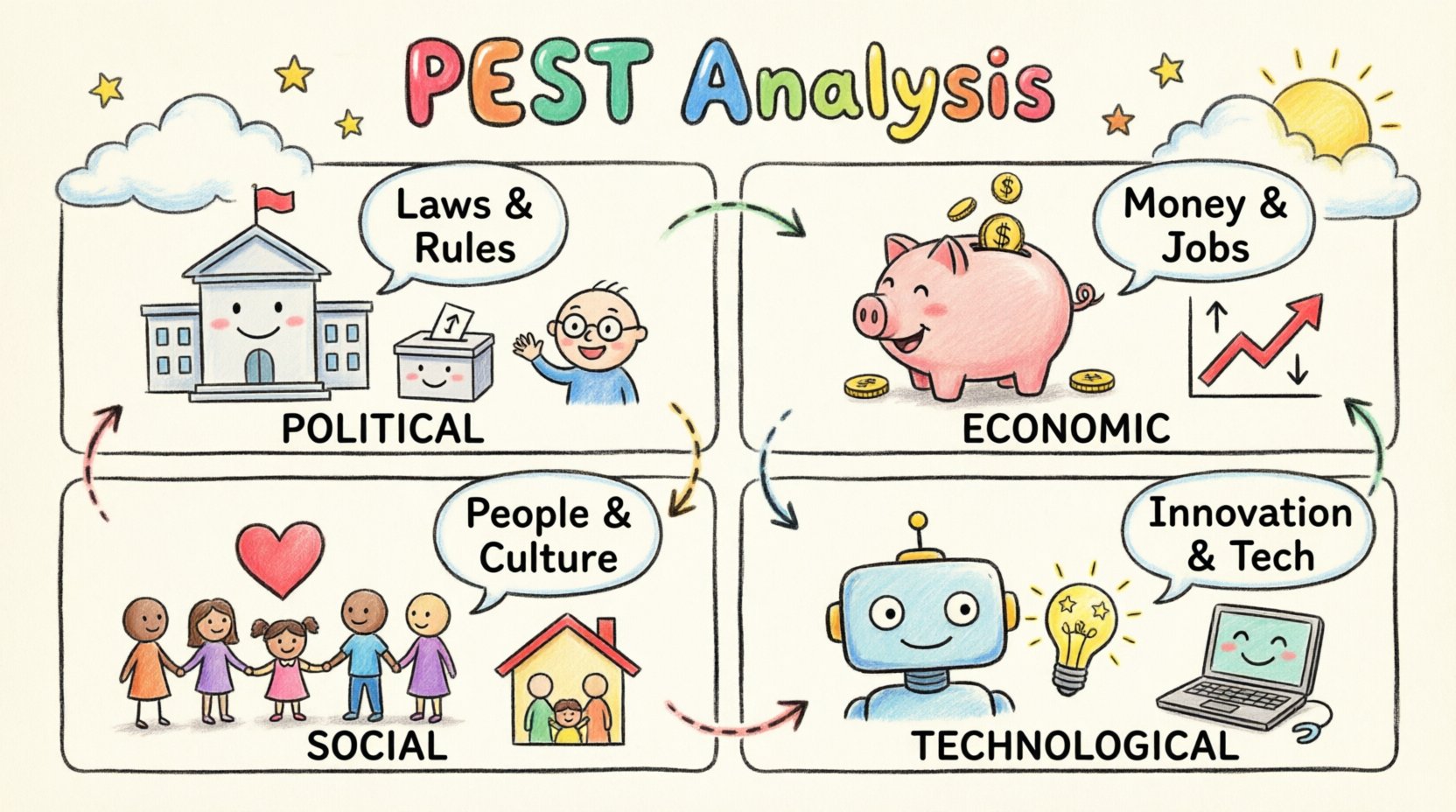
PEST analysis stands for Political, Economic, Social, and Technological. It is a strategic framework used to scan the external macro-environment of an organization. Unlike internal analysis tools that focus on strengths and weaknesses, PEST focuses on the uncontrollable forces outside the company.
Why use this framework? It provides a structured approach to gathering data. Instead of looking at random trends, you categorize them. This ensures that no critical external factor is overlooked. For example, a change in tax law (Political) might seem unrelated to a new social trend (Social), but together they could dictate your pricing strategy or market entry timing.
This analysis is often used during:
- Strategic Planning: Setting long-term goals and objectives.
- New Product Launches: Assessing market readiness and regulatory hurdles.
- Market Entry: Evaluating foreign markets for expansion.
- Risk Assessment: Identifying potential threats before they materialize.
The 4 Pillars of PEST Analysis 🏛️
Each letter in the acronym represents a distinct category of external influence. Understanding the nuances within each category is vital for accurate forecasting. Below is a high-level overview of what each component entails.
| Component | Focus Area | Key Questions to Ask |
|---|---|---|
| Political | Government intervention, laws, and stability | How do tax policies or trade restrictions affect us? |
| Economic | Financial factors and market conditions | What is the current inflation rate or GDP growth? |
| Social | Cultural, demographic, and lifestyle trends | How is consumer behavior changing regarding health or work? |
| Technological | Innovation, automation, and R&D | Is new tech making our product obsolete? |
1. Political Factors 🏛️
Political factors refer to the extent to which a government intervenes in the economy or specific industries. These are often the most immediate and impactful forces because governments have the power to enforce compliance through legislation.
Key Elements to Consider
- Tax Policy: Changes in corporate tax rates directly impact net profit margins. Higher taxes might reduce funds available for reinvestment.
- Trade Restrictions: Tariffs and quotas can make importing raw materials more expensive or exporting finished goods harder.
- Labor Laws: Regulations regarding minimum wage, working hours, and union rights affect operational costs and hiring practices.
- Environmental Regulations: Compliance costs for carbon emissions or waste disposal can be significant in manufacturing sectors.
- Political Stability: Operating in a region with frequent regime changes or civil unrest poses high risks to asset security.
Real-World Context
Consider a company planning to expand into a new country. If that country has a history of nationalizing foreign assets, the political risk is high. Conversely, if the government offers subsidies for green energy, a company in that sector gains a competitive advantage. It is not enough to know the laws; you must understand the political climate and the stability of the administration.
2. Economic Factors 💰
Economic factors determine the purchasing power of potential customers and the cost of capital. These variables are often cyclical, meaning they rise and fall over time. Understanding the economic cycle is crucial for timing your investments.
Key Elements to Consider
- Economic Growth (GDP): A growing economy usually means higher consumer spending. A recession suggests the opposite.
- Interest Rates: High interest rates increase the cost of borrowing, which can stifle expansion plans and increase debt servicing costs.
- Inflation Rates: High inflation erodes purchasing power. It also increases the cost of raw materials and labor.
- Exchange Rates: For businesses trading internationally, currency fluctuations can wipe out profit margins or make products cheaper abroad.
- Unemployment Levels: High unemployment can lower wages but also reduce overall consumer demand.
Real-World Context
If you are in the luxury goods sector, a drop in disposable income due to economic tightening will likely impact sales. However, if you are in the discount retail sector, an economic downturn might actually drive more customers to your stores. Economic analysis helps you predict demand elasticity and adjust your financial forecasting accordingly.
3. Social Factors 👥
Social factors encompass the demographic and cultural aspects of the external environment. These are often the slowest-moving factors but can have the most profound long-term impact on brand perception and product viability.
Key Elements to Consider
- Population Growth: A growing population increases the potential customer base. An aging population shifts demand toward healthcare and retirement services.
- Age Distribution: The median age of a country dictates the types of products that will sell. A younger demographic might prefer digital-first solutions.
- Lifestyle Changes: Trends such as remote work, health consciousness, or sustainability affect how people buy.
- Education Levels: Higher education levels can lead to more sophisticated demand and a larger skilled workforce.
- Attitudes Toward Work: The shift toward work-life balance impacts staffing models and benefits packages.
Real-World Context
A food manufacturer might notice a rising trend in veganism. Ignoring this social factor could lead to declining sales in traditional meat products. Conversely, capitalizing on it by launching a plant-based line can open a new revenue stream. Social analysis requires listening to cultural conversations and observing shifts in values.
4. Technological Factors 📱
Technological factors cover the impact of new innovations on the market. In the modern era, this category often moves faster than any other. It is the primary driver of disruption in almost every industry.
Key Elements to Consider
- Rate of Innovation: How fast is technology advancing? Rapid advancement can shorten product lifecycles.
- Automation: The ability to automate processes reduces labor costs and increases efficiency.
- R&D Activity: The level of research and development in your sector indicates future competition levels.
- Technology Access: Internet penetration rates determine if digital marketing or e-commerce is viable.
- Intellectual Property: Patent laws and protection of proprietary technology affect competitive advantage.
Real-World Context
The rise of artificial intelligence has forced traditional service industries to adapt. Customer service departments that relied solely on human agents are now integrating chatbots. If a company fails to adopt relevant technologies, it risks becoming obsolete. However, technology is a double-edged sword; it also opens doors for competitors to enter the market with lower barriers.
How to Execute a PEST Analysis 🛠️
Conducting a PEST analysis is a process of research, synthesis, and application. It is not a one-time task but a periodic review. Here is a step-by-step approach to executing a robust analysis.
Step 1: Define the Scope
Before gathering data, determine the objective. Are you analyzing a new product launch, a market entry, or a general strategic shift? The scope dictates which factors are relevant. A global expansion requires a different PEST analysis than a local product tweak.
Step 2: Gather Data
Collect information from reliable sources. Government reports, industry journals, economic data, and market research are essential. Avoid relying on rumors or unverified news. You need quantitative data where possible to support qualitative observations.
Step 3: Brainstorm and Categorize
Bring together a cross-functional team. Hold a workshop to list potential factors under the four headings. Encourage diverse viewpoints. An engineer might see a technological threat that a salesperson overlooks.
Step 4: Prioritize and Analyze
Not all factors are equal. Use a scoring system to rank factors based on their impact and likelihood. Focus your strategic energy on the high-impact, high-probability items. Ignore noise.
Step 5: Integrate into Strategy
The analysis is useless if it sits in a report. Translate findings into action items. If inflation is high, adjust pricing. If new regulations are coming, update compliance protocols. If technology is shifting, invest in R&D.
PEST vs. PESTLE vs. SWOT 🔍
Strategic frameworks often overlap, leading to confusion. It is helpful to understand how PEST relates to other common tools.
PEST vs. PESTLE
PESTLE adds two more dimensions: Legal and Environmental. While these are often grouped under Political (Legal) and Social/Technological (Environmental), separating them provides more granularity. Legal covers specific litigation and compliance. Environmental covers climate change and sustainability specifically. For modern sustainability goals, PESTLE is often preferred.
PEST vs. SWOT
SWOT (Strengths, Weaknesses, Opportunities, Threats) is a broader framework. PEST is essentially the external part of a SWOT analysis. PEST feeds into the Opportunities and Threats quadrants of SWOT. Strengths and Weaknesses are internal, while PEST is strictly external.
Common Pitfalls to Watch For ⚠️
Even with a solid framework, execution can go wrong. Being aware of common mistakes ensures the analysis remains accurate and useful.
- Stale Data: Using data from five years ago. Macro-environmental factors change rapidly. Ensure your data is current.
- Confirmation Bias: Only looking for data that supports your pre-existing decision. Challenge your assumptions with evidence.
- Lack of Specificity: Vague statements like “Technology is changing” are not helpful. Specify “AI is reducing manual coding time by 30%.”
- Ignoring Interconnectedness: Factors rarely exist in isolation. A technological shift often triggers a social shift. Analyze the relationships between factors.
- Static Analysis: Treating the analysis as a one-time event. The environment is dynamic. Revisit the analysis regularly.
Integrating Findings into Strategy 🚀
The ultimate value of a PEST analysis lies in its application. How do you move from data to decision?
- Scenario Planning: Use the PEST findings to create different future scenarios. Plan for the best-case, worst-case, and most-likely-case outcomes.
- Risk Mitigation: Identify the top risks from the Political and Economic sections and create contingency plans.
- Market Positioning: Use Social and Technological insights to position your brand against competitors.
- Resource Allocation: Direct resources toward areas where external conditions are favorable. If Economic factors suggest a downturn, prioritize cash flow over aggressive expansion.
Frequently Asked Questions ❓
How often should I conduct a PEST analysis?
There is no fixed rule, but an annual review is standard practice. However, if you are in a highly volatile industry (like tech or energy), you might need to review it quarterly.
Can PEST analysis predict the future?
No framework can predict the future with certainty. PEST analysis helps you anticipate possibilities and prepare for them. It reduces uncertainty rather than eliminating it.
Is PEST analysis suitable for small businesses?
Absolutely. Small businesses are often more vulnerable to external shocks than large corporations. Understanding the macro-environment helps them survive economic downturns and regulatory changes.
What is the difference between PEST and SWOT?
SWOT includes internal factors (Strengths and Weaknesses), while PEST focuses exclusively on external macro-environmental factors (Political, Economic, Social, Technological).
Final Thoughts on Strategic Scanning 🔎
External forces shape the boundaries of what is possible for any business. Ignoring them is a gamble. Using the PEST analysis framework provides a disciplined method for navigating uncertainty. By systematically examining Political, Economic, Social, and Technological factors, you gain a clearer picture of the landscape.
This clarity allows for smarter decision-making. It moves strategy from intuition to evidence. As you move forward, remember that the environment is always changing. Keep your data fresh, keep your team engaged, and remain adaptable. Strategic success belongs to those who see the horizon before the storm arrives.