


Launching a new venture involves navigating a landscape filled with variables you cannot control. While internal planning is crucial, understanding the external environment determines whether your business model survives the first year. This is where a PEST analysis becomes indispensable.
A PEST analysis allows you to identify Political, Economic, Social, and Technological factors that could impact your operations. Many entrepreneurs overlook this step, assuming their product speaks for itself. However, market entry strategies often fail because they ignore regulatory shifts or economic downturns. This guide provides a structured approach to conducting a comprehensive PEST analysis in just 120 minutes.
You do not need expensive consulting firms or proprietary software. You need a clear framework, a dedicated time block, and the right questions. By the end of this session, you will have a documented understanding of the external forces shaping your industry.
🧐 What is a PEST Analysis?
PEST stands for Political, Economic, Social, and Technological. It is a strategic framework used to evaluate the macro-environmental factors affecting an organization. Unlike a SWOT analysis, which focuses heavily on internal strengths and weaknesses, PEST looks outward.
For a new business, this outward focus is critical. You are entering a system that is already active with rules, trends, and competitors. Ignoring these elements is akin to sailing a boat without checking the weather forecast.
The Four Pillars Explained
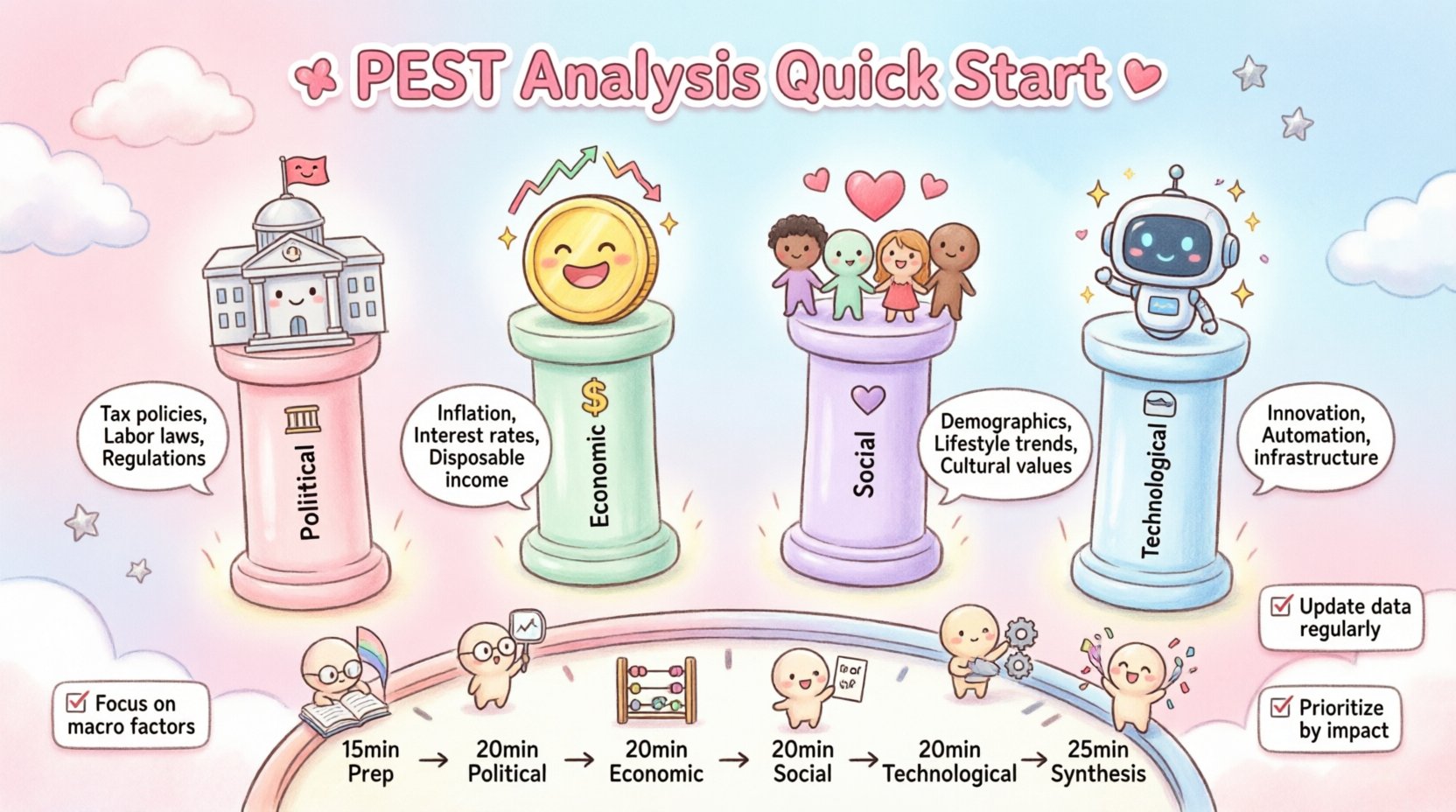
- Political: Government intervention, tax policies, trade restrictions, and labor laws.
- Economic: Growth rates, interest rates, exchange rates, and inflation.
- Social: Cultural trends, population growth, age distribution, and lifestyle changes.
- Technological: Innovation rates, automation, R&D activity, and technology incentives.
Each category represents a distinct lens through which to view your market opportunity. Understanding them helps you anticipate risks and identify opportunities before your competitors do.
⏱️ The 2-Hour Timeline Breakdown
Time management is the key to this exercise. A PEST analysis can drag on for weeks if you get lost in research. To keep it actionable, we will allocate specific time slots for each phase. This ensures you move from data gathering to strategic decision-making efficiently.
| Phase | Duration | Focus |
|---|---|---|
| Preparation & Setup | 15 Minutes | Gathering data sources and team alignment |
| Political Analysis | 20 Minutes | Regulations and government stability |
| Economic Analysis | 20 Minutes | Market affordability and inflation |
| Social Analysis | 20 Minutes | Demographics and cultural trends |
| Technological Analysis | 20 Minutes | Infrastructure and innovation |
| Synthesis & Action | 25 Minutes | Prioritizing findings and planning |
🛠️ Phase 1: Preparation (15 Minutes)
Before diving into the factors, you must set the stage. A scattered approach leads to incomplete data. Gather your resources and define the scope.
1. Define the Scope
Are you analyzing a local market or a global expansion? The scope dictates the depth of research. For a new business, focusing on the specific region where you intend to launch is usually sufficient. Narrowing the scope prevents information overload.
2. Assemble Data Sources
You need reliable information. Avoid rumors. Stick to verifiable data. You will need access to:
- Government Reports: Look for official statistics on employment, inflation, and trade.
- Industry Publications: Annual reports from trade associations.
- News Outlets: Recent articles regarding regulatory changes.
- Competitor Websites: To see how others are positioning themselves against these factors.
3. Set the Environment
Eliminate distractions. Turn off notifications. You need deep work time. If you are working with a team, ensure everyone understands the goal: to identify external risks and opportunities, not to critique the product itself.
🏛️ Phase 2: Political Factors (20 Minutes)
Political factors relate to how government intervention affects the economy and your specific industry. This is often the most volatile category for new businesses.
Key Questions to Ask
- Are there restrictions on foreign ownership in this sector?
- What are the current tax rates for small businesses?
- How stable is the current political climate?
- Are there upcoming elections that might change policy?
- What are the labor laws regarding hiring and firing?
Example Findings
If you are opening a restaurant, political factors might include health codes, zoning laws, and minimum wage legislation. If you are a tech startup, data privacy laws and intellectual property rights are critical.
Common Pitfall: Assuming laws are static. Regulations change frequently. Always note the date of your data. A policy passed last year might be repealed next month.
💰 Phase 3: Economic Factors (20 Minutes)
Economic factors determine the purchasing power of your potential customers and the cost of capital for your business. This section is about viability.
Key Questions to Ask
- What is the current inflation rate?
- Are interest rates rising or falling?
- What is the disposable income level of your target demographic?
- Is the currency stable or volatile?
- How does the unemployment rate affect talent availability?
Impact on Pricing Strategy
Economic conditions directly influence your pricing model. In a high-inflation environment, customers are price-sensitive. You may need to offer smaller package sizes or more flexible payment terms. Conversely, in a booming economy, you might have more room to invest in premium features.
Key Insight: Do not just look at national averages. Look at regional economic data. A city might have a booming tech sector while the national economy stagnates. Your local economy is what matters most.
👥 Phase 4: Social Factors (20 Minutes)
Social factors describe the cultural and demographic aspects of your market. This is where you understand your customer.
Key Questions to Ask
- What is the population growth rate?
- What is the age distribution (e.g., aging population vs. youth bulge)?
- What are the prevailing attitudes toward your product category?
- How does the lifestyle of your target market look?
- Are there cultural taboos you must avoid?
Understanding the Audience
If your product relies on technology adoption, you need to know if the population is tech-savvy. If you are selling luxury goods, you need to know if the society values status or sustainability.
Example: A shift toward remote work has changed the social demand for home office furniture and software. Ignoring this trend would result in a mismatched product offering.
📡 Phase 5: Technological Factors (20 Minutes)
Technological factors encompass the state of innovation and the rate at which technology evolves. This is often the fastest-moving category in the PEST framework.
Key Questions to Ask
- Is there a gap in the current technology landscape?
- How quickly are competitors adopting new tools?
- What is the infrastructure like (internet speed, logistics)?
- Are there new patents or R&D breakthroughs relevant to you?
- What is the cost of implementing new technology?
Disruption vs. Efficiency
Technology can disrupt your entire business model, or it can simply make your operations more efficient. You need to distinguish between the two. Is a new technology a threat that makes your product obsolete? Or is it a lever you can pull to reduce costs?
Infrastructure Check: If you plan to launch an e-commerce site, ensure the target market has reliable internet access. If not, the technology factor becomes a barrier to entry.
📝 Phase 6: Synthesis & Action (25 Minutes)
Now that you have gathered data across all four categories, it is time to make sense of it. Data without insight is noise. This phase converts your findings into a strategic plan.
1. Categorize by Impact
Not all factors are created equal. Some will have a massive impact on your bottom line, while others are negligible. Create a priority list:
- High Impact / High Urgency: Immediate action required.
- High Impact / Low Urgency: Long-term monitoring required.
- Low Impact / High Urgency: Quick fix needed.
- Low Impact / Low Urgency: Monitor occasionally.
2. Identify Risks and Opportunities
Translate each factor into a risk or an opportunity. For example, a rising interest rate (Economic) is a risk for loans. However, a new government grant for green energy (Political) is an opportunity.
3. Update Your Business Plan
Integrate these findings into your operational strategy. If the social trend is toward sustainability, ensure your supply chain reflects this. If the political climate involves stricter data laws, adjust your compliance protocols now.
⚠️ Common Pitfalls to Avoid
Even with a structured timeline, it is easy to make mistakes. Here are the most frequent errors entrepreneurs make during this process.
1. Confusing Micro with Macro
PEST is for macro-environmental factors. Do not include competitor pricing strategies here; that belongs in a competitor analysis. Keep the focus on the broad external environment.
2. Outdated Information
Data from five years ago is often useless in a fast-moving market. Ensure every statistic and news item you cite is from the last 12 months.
3. Analysis Paralysis
Do not try to find every possible factor. Focus on the ones that directly affect your business model. If you are selling digital services, physical infrastructure might be less relevant than internet penetration rates.
4. Ignoring Interdependencies
Factors often influence each other. A technological advancement (Technological) might lead to job losses (Economic), which changes consumer spending habits (Social). Look for these connections.
📚 Frequently Asked Questions
Q: Can I use a PEST analysis for an existing business?
Yes. Existing businesses use it for expansion or pivoting. However, for new businesses, it is a foundational document that should be created before launch.
Q: How often should I update this analysis?
Conduct a full review annually. However, keep an eye on specific factors. If a major election occurs or a new technology disrupts the market, update the relevant section immediately.
Q: Is PEST Analysis better than SWOT?
They serve different purposes. SWOT analyzes internal strengths and weaknesses alongside external threats and opportunities. PEST dives deeper into the external environment. Using both together provides the most complete picture.
Q: Do I need a team to do this?
You can do it alone, but a diverse team helps. One person might miss a technological trend that another person notices immediately. If you are solo, take a break and review your notes later with fresh eyes.
Q: What if I find too many risks?
This is a feature, not a bug. The goal is to know the risks before you commit capital. If the risks outweigh the opportunities, it may be a signal to pivot your business model or choose a different market.
📈 Final Thoughts
A PEST analysis is not a one-time exercise. It is a living document that reflects the reality of your operating environment. By dedicating two hours to this process, you are investing in the long-term stability of your venture.
You have now mapped the political, economic, social, and technological landscape. You know where the obstacles lie and where the open roads are. This clarity allows you to make decisions based on evidence rather than hope. As you move forward with your business plan, keep this document accessible. Review it whenever a major external change occurs.
Strategy is not about predicting the future perfectly. It is about being prepared for whatever comes. With this analysis complete, you are better equipped to navigate the uncertainty of the market.