


Strategic planning relies heavily on understanding the external environment. The PEST analysis framework is a cornerstone for this process, examining Political, Economic, Social, and Technological factors. However, many organizations apply this tool superficially. A flawed analysis leads to misguided strategies and wasted resources. This guide details seven specific errors that compromise the integrity of your environmental scan.
Conducting an external analysis is not merely a box-ticking exercise. It requires rigorous data gathering, critical thinking, and the ability to synthesize complex information into actionable intelligence. When teams rush through the PEST framework, they often miss subtle signals that could indicate major market shifts. The following sections break down the most common pitfalls and provide clear guidance on how to navigate them effectively.
1. Treating the Analysis as a Static Event 📅
One of the most pervasive errors is viewing the PEST analysis as a one-time project. Business environments are dynamic. Regulations change, consumer behaviors shift, and technological breakthroughs occur frequently. If you conduct a PEST analysis once and file it away, the data becomes obsolete quickly.
- Why it happens: Teams often associate strategic planning with annual budget cycles, leading to a “set and forget” mentality.
- The Consequence: By the time the strategy is executed, the external conditions assumed in the plan may no longer exist.
- The Fix: Establish a review cadence. Schedule quarterly reviews of the key drivers identified in the initial scan.
A living document approach ensures that the analysis remains relevant. When a new political regulation is announced, or a competitor introduces a disruptive technology, the PEST framework should be updated immediately. This keeps the strategy responsive rather than reactive.
2. Confusing Internal and External Factors 🔄
It is common for teams to blur the lines between what is happening inside the organization and what is happening outside. The PEST analysis is strictly external. Strengths, weaknesses, capabilities, and resources belong in a SWOT analysis, not a PEST framework.
- Political: Government policies, trade restrictions, tax policies (External).
- Economic: Inflation rates, exchange rates, economic growth (External).
- Social: Demographics, cultural trends, lifestyle changes (External).
- Technological: Innovation, automation, R&D activity (External).
When internal weaknesses are listed under “Political” or “Economic,” the analysis loses its diagnostic power. For example, citing “lack of skilled staff” under Technological factors is incorrect. That is an internal capability gap. The Technological factor should be “emerging AI tools that require new skills.” Keeping the boundary clear prevents confusion during the strategy formulation phase.
3. Relying on Vague Generalizations 🗣️
Specificity is the enemy of ambiguity. A common mistake is writing broad statements that apply to every industry in the world. Phrases like “the economy is growing” or “technology is advancing” offer no strategic value. Everyone knows these things are happening.
To be effective, you must quantify and qualify your findings. Instead of saying “inflation is high,” specify “inflation in the target region has risen to 4.5%, impacting consumer disposable income by 10%.” Instead of “technology is changing,” specify “adoption of cloud computing has reached 70% among SMEs in the sector.”
- Bad: “Social trends are shifting.”
- Good: “Consumer preference for sustainable packaging has increased by 25% in the last year.”
- Bad: “Political instability is a risk.”
- Good: “Upcoming elections in Region X may lead to potential tariff adjustments on imported raw materials.”
Specific data points allow you to calculate risk and opportunity accurately. Generalizations force decision-makers to rely on gut feeling rather than evidence.
4. Ignoring Geopolitical Nuance 🌍
Globalization has made local markets interconnected. A mistake frequently made by analysts is looking at their immediate market in isolation. Political decisions in one country can ripple through supply chains across the globe. Economic policies in major economies affect interest rates and currency values everywhere.
- Supply Chain Risks: Trade wars or sanctions can halt production lines overnight.
- Regulatory Divergence: Data privacy laws (like GDPR) differ by region and affect how technology is deployed.
- Cultural Sensitivity: Social norms vary significantly. A campaign successful in one culture may fail or offend in another.
Ignoring these nuances leads to a myopic view of the market. A robust analysis considers cross-border impacts. If you are planning an expansion, you must analyze the political stability of the target country, not just your home base. This depth prevents costly entry errors.
5. Failing to Connect Analysis to Action 🎯
Perhaps the most critical error is producing a report that sits on a shelf. Analysis without application is just information. The PEST analysis must feed directly into strategic decision-making. If the analysis identifies a technological shift, there must be a corresponding action plan for R&D or partnership.
Consider the following linkage:
| Factor Identified | Strategic Question | Actionable Output |
|---|---|---|
| Rising Energy Costs | How does this affect our margin? | Invest in energy-efficient machinery |
| Shift to Remote Work | How does this affect office needs? | Reduce physical footprint, invest in cloud collaboration |
| Stricter Data Laws | Are we compliant? | Audit data storage, hire compliance officer |
Without this translation step, the PEST analysis becomes a theoretical exercise. Ensure that every major finding has an owner and a deadline for addressing the implication.
6. Underestimating the Technological Factor 🖥️
While the “T” in PEST stands for Technological, it is often the most overlooked or superficially treated section. Teams tend to focus on current technology rather than emerging trends. They might note that “computers are used,” but miss the disruption caused by automation or artificial intelligence.
Technology moves faster than policy or social norms. A mistake here is looking only at the tools you use today, not the tools that will render your current business model obsolete. Disruptive innovation often comes from outside the industry. Retailers who ignored the technological shift to e-commerce lost market share to tech companies.
- Focus on Adoption Rates: How quickly is the new tech being adopted by competitors?
- Focus on Cost Reduction: Does new tech lower the barrier to entry for competitors?
- Focus on Customer Experience: How does tech change how customers interact with the brand?
Deep diving into the Technological section requires staying informed on industry journals and innovation reports. It is not enough to look at internal IT infrastructure; you must scan the broader tech landscape.
7. Neglecting Data Validation Sources 📊
The quality of your analysis depends entirely on the quality of your data. A common error is relying on anecdotal evidence or outdated reports. Using a five-year-old market study to make a decision in the current year is a strategic liability. Similarly, relying on a single source introduces bias.
To mitigate this, triangulate your data. Use government statistics, industry reports, academic research, and news outlets. Cross-reference findings to ensure consistency. If one source says demand is up and another says it is down, investigate the discrepancy rather than ignoring it.
- Primary Sources: Government census data, central bank reports, regulatory filings.
- Secondary Sources: Industry associations, reputable news outlets, market research firms.
- Validation: Check the date of publication and the methodology used by the source.
Uncertified data leads to uncertainty in strategy. If you cannot verify the claim, do not build a strategy pillar on it. Acknowledge the uncertainty in your plan and build contingency measures.
Integrating PEST into the Broader Strategy 🧩
Once the seven mistakes are avoided, the PEST analysis becomes a powerful engine for growth. It should not exist in a vacuum. It feeds into the SWOT analysis (Opportunities and Threats) and informs the vision and mission statements.
When executed correctly, this framework provides clarity on where to allocate capital. It highlights where the risks lie and where the market gaps exist. It prevents organizations from sailing into a storm without a map. The discipline of rigorous external scanning separates successful enterprises from those that stagnate.
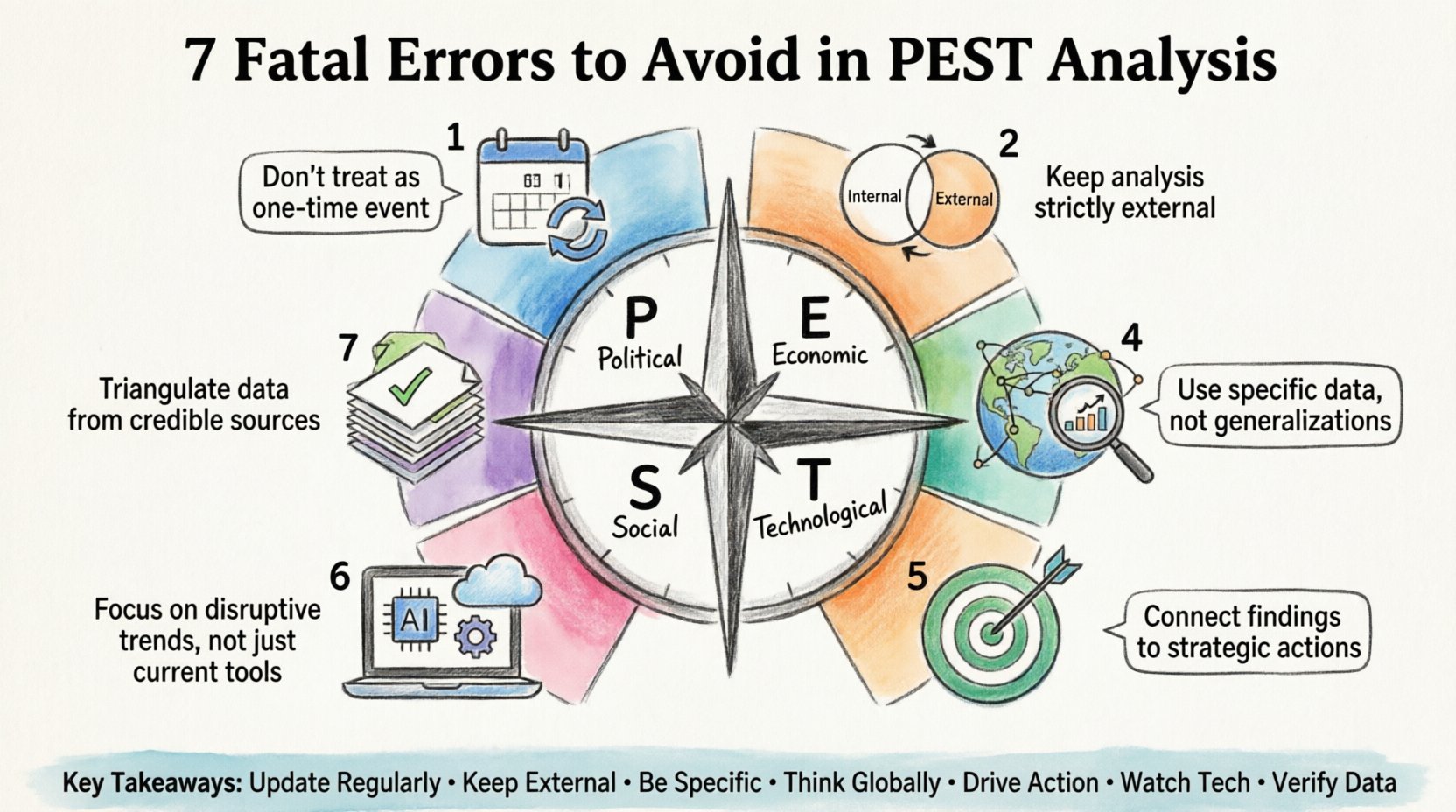
Key Takeaways for Implementation ✅
To ensure your next environmental scan is robust, keep these principles in mind:
- Update Regularly: Treat the document as living.
- Keep it External: Do not mix internal weaknesses.
- Be Specific: Use data, not generalizations.
- Think Globally: Consider geopolitical ripple effects.
- Drive Action: Link findings to strategic initiatives.
- Watch Tech: Prioritize disruptive trends over current tools.
- Verify Data: Use multiple credible sources.
By adhering to these standards, you build a foundation for strategic resilience. The external world will always change, but a well-structured analysis ensures you are prepared for the shift before it hits.