


Startups operate in an environment defined by volatility. The margin between survival and failure often comes down to the speed of decision-making. Traditional strategic frameworks, while robust, frequently demand time that early-stage ventures do not possess. A standard PEST analysis can take weeks to complete thoroughly. For a startup, that delay is a liability.
This guide introduces the Rapid PEST Analysis Method. It adapts the classic Political, Economic, Social, and Technological framework to fit the velocity of modern entrepreneurship. The goal is not perfection, but actionable clarity. You will learn how to scan the external environment without getting bogged down in data collection that yields no immediate strategic value.
🐢 Why Standard PEST Analysis Fails Startups
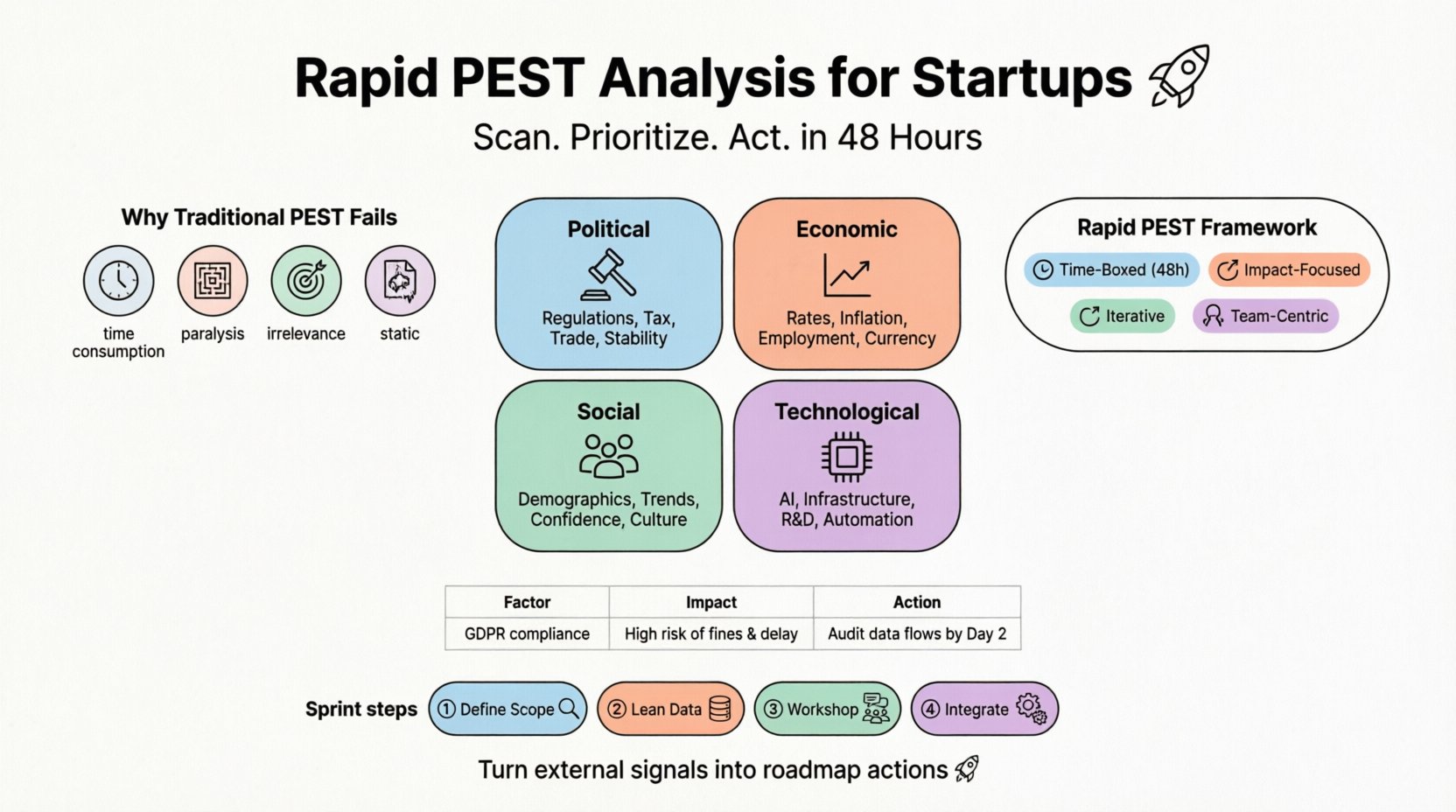
The traditional PEST analysis was designed for large enterprises with dedicated research teams. These organizations can afford months of market research. Startups, however, need to validate hypotheses and pivot within weeks. Applying a heavy framework to a light process creates friction.
Here are the primary friction points of standard analysis in a startup context:
- Time Consumption: Gathering granular data for every factor slows down product iteration.
- Paralysis by Analysis: Too much information can obscure the signal. Founders may delay launching a feature while waiting for perfect macroeconomic data.
- Irrelevance: Macro-level trends often do not impact daily operations in the short term. A startup needs to know what affects *this* customer, *this* quarter.
- Static Nature: A report created today may be obsolete next month. The market moves faster than the document creation cycle.
To survive, the framework must shift from a static report to a dynamic scanning tool. The Rapid PEST method prioritizes signal over noise.
⚡ The Rapid PEST Framework
The Rapid PEST method condenses the analysis into a sprint. It focuses on high-impact variables that can alter the business trajectory immediately. Instead of a comprehensive report, the output is a set of risks and opportunities to be integrated into the weekly roadmap.
Core Principles of the Sprint
- Time-Boxed: Limit the research phase to 48 hours maximum. Use secondary sources and existing knowledge before commissioning new research.
- Impact-Focused: Only record factors that have a High or Medium impact on the business model. Low-impact noise is discarded.
- Iterative: Treat the analysis as a living document. Update it monthly or whenever a major external event occurs.
- Team-Centric: Do not isolate this task to the CEO. Involve product, sales, and engineering leads to capture diverse perspectives.
🧩 Breaking Down the Quadrants
Each quadrant of the PEST analysis represents a specific category of external forces. In a startup context, the focus shifts from general industry trends to specific threats and enablers relevant to your product.
1. Political Factors (The Rules of the Game)
Political factors involve government intervention, legal frameworks, and trade regulations. For a startup, these are often binary: you can operate, or you cannot.
- Regulatory Changes: Are there new compliance requirements coming online? For example, data privacy laws like GDPR or CCPA can alter how you collect user data.
- Political Stability: If you are operating internationally, assess the stability of the regions you target. A sudden election cycle might delay funding or market entry.
- Taxation and Subsidies: Look for government grants, tax credits, or R&D incentives. Conversely, identify new taxes that could increase your burn rate.
- Trade Barriers: If you rely on hardware or supply chains, check for tariffs or import restrictions that could disrupt your logistics.
2. Economic Factors (The Fuel in the Tank)
Economic factors dictate the purchasing power of your customers and the cost of capital for your business. This is often the most volatile quadrant for early-stage companies.
- Interest Rates: High interest rates increase the cost of borrowing. If you rely on debt financing, this directly impacts your runway.
- Inflation: Rising inflation increases operational costs. It also reduces the disposable income of your target demographic.
- Exchange Rates: If you earn in one currency and spend in another, fluctuations can wipe out margins overnight.
- Employment Rates: A tight labor market increases the cost of hiring talent. A high unemployment rate might make hiring easier but could indicate a weaker local economy.
3. Social Factors (The Human Element)
Social factors encompass demographic shifts, cultural trends, and consumer behavior. Startups thrive by tapping into cultural moments. Understanding the social landscape helps refine the value proposition.
- Demographics: Is the population aging? Growing younger? Migration patterns can shift where your customers live.
- Lifestyle Trends: Are people shifting to remote work? Are they prioritizing health and wellness? Align your product with these lifestyle shifts.
- Consumer Confidence: How optimistic are people about the future? Low confidence often means customers delay purchasing non-essential products.
- Work Culture: The shift toward asynchronous work affects software needs. The rise of the gig economy affects B2B service models.
4. Technological Factors (The Accelerators)
Technological factors include innovation, automation, and the rate of technological change. For tech startups, this is often the primary quadrant, but it affects all industries.
- Emerging Tech: Is there a new technology (like AI) that could disrupt your model or help you build it cheaper?
- Infrastructure: Is the necessary infrastructure (5G, cloud availability) ready to support your product?
- R&D Activity: How much is being invested in your sector? High investment often signals a crowded market.
- Automation: Can automation reduce your cost base? Can it improve the user experience?
📋 The Rapid PEST Template
Structure your findings to ensure they are digestible. Do not write paragraphs. Use a table format to map factors against their impact and urgency.
| Category | Factor | Impact (High/Med/Low) | Urgency (Immediate/Short/Monthly) | Action Item |
|---|---|---|---|---|
| Political | New Data Privacy Law | High | Immediate | Review legal compliance requirements |
| Economic | Interest Rate Hike | Medium | Short | Adjust cash flow projections |
| Social | Shift to Remote Work | High | Short | Prioritize collaboration features |
| Technological | AI Integration Availability | High | Immediate | Prototype AI feature for Q3 |
This table format allows the team to scan the environment quickly. It turns abstract concepts into concrete tasks for the roadmap.
🏃♂️ Execution Steps: The Sprint
Executing a Rapid PEST analysis requires discipline. Follow this step-by-step process to ensure consistency and quality.
Step 1: Define Scope
Before collecting data, define the boundaries. Are you analyzing the global market, or just a specific region? Are you looking at a 1-year horizon or a 5-year horizon? A narrow scope yields more relevant data for immediate decisions.
Step 2: Gather Lean Data
Do not commission expensive reports. Use free resources:
- Government Publications: Census data, trade statistics, and legislative updates.
- Industry News: Trade publications and news aggregators.
- Internal Data: Sales team feedback often reveals social and economic shifts before formal reports do.
- Competitor Moves: What are competitors doing? They are often reacting to the same external factors.
Step 3: Workshop the Findings
Bring the team together for a 90-minute session. Present the raw factors. Vote on which ones matter most. Use a dot-voting system to prioritize the top 5 factors per quadrant. This ensures alignment across departments.
Step 4: Integrate into Strategy
A PEST analysis that sits in a folder is useless. Map the top factors to your OKRs (Objectives and Key Results). If a social trend indicates a shift in user behavior, update your product roadmap. If an economic factor threatens your budget, adjust your hiring plan.
🛠️ Integrating Findings into Product Strategy
The true value of the Rapid PEST method lies in its integration. How do you move from a list of factors to a shipped product?
Scenario A: Risk Mitigation
If a Political factor indicates a regulatory change is coming, you might pause a feature launch to ensure compliance. This prevents costly rework later. For example, if a new encryption standard is mandated, engineering must prioritize that upgrade immediately.
Scenario B: Opportunity Capture
If a Technological factor reveals a new API is available that reduces costs by 20%, you can redirect those savings to marketing. If a Social factor shows users are demanding mobile-first experiences, shift development resources to the mobile app.
Scenario C: Market Timing
Economic factors can dictate *when* you enter a market. If inflation is high, customers may be price-sensitive. You might choose to launch a freemium model rather than a premium one to capture market share during the downturn.
🚫 Common Pitfalls to Avoid
Even with a rapid method, mistakes happen. Avoid these common errors to maintain the integrity of the analysis.
- Ignoring Weak Signals: Sometimes, the biggest shifts start small. Do not dismiss a minor regulatory change if it affects your niche deeply.
- Confirmation Bias: Do not only look for data that supports your current plan. Actively seek out factors that threaten your assumptions.
- Overgeneralizing: “The economy is bad” is too vague. “Disposable income for premium software is down in the tech sector” is actionable.
- One-and-Done: Treating the analysis as a single event leads to obsolescence. Schedule quarterly reviews to update the data.
- Isolating the Team: If only the CEO knows the PEST analysis, the product team cannot react to it. Share the findings transparently.
📅 When to Run a Rapid PEST
You do not need to run this analysis every day. Identify specific triggers that warrant a review.
- Pre-Funding: Before approaching investors, understand the economic landscape to justify your valuation and growth assumptions.
- Market Entry: Before expanding to a new region, run a full Rapid PEST to understand local risks.
- Product Pivot: If growth stalls, the external environment might be the cause. A PEST analysis can reveal if the market has shifted against you.
- Post-Major Event: After a significant event (election, pandemic, tech breakthrough), run an analysis to assess the new normal.
🔍 Deep Dive: Case Study Application
Consider a hypothetical SaaS startup launching a project management tool for remote teams. Here is how the Rapid PEST analysis applies to their specific situation.
Political
The startup targets the EU. They identify upcoming data sovereignty laws. Action: They decide to host data locally in Frankfurt to ensure compliance, even if it increases costs.
Economic
Interest rates are rising, causing companies to cut software budgets. Action: They adjust pricing to a lower tier with fewer seats to remain accessible during budget cuts.
Social
There is a cultural shift toward “work-life balance” and anti-burnout tools. Action: They add features that track work hours and encourage breaks, differentiating from competitors.
Technological
AI tools are becoming standard for meeting transcription. Action: They integrate an AI transcription API immediately to stay competitive without building it from scratch.
This example shows how external factors translate directly into product and business decisions. The analysis is not theoretical; it drives the roadmap.
🔄 Feedback Loops and Iteration
A strategy is only as good as its ability to adapt. Establish a feedback loop to ensure your PEST analysis remains relevant.
- Monthly Review: Dedicate one hour in the monthly all-hands meeting to review the PEST document. Has anything changed?
- External Signals: Assign a team member to monitor news feeds for specific keywords related to your PEST quadrants.
- Customer Feedback: Use customer support tickets to identify social or economic pain points that your analysis missed.
- Competitor Analysis: Regularly check if competitors are pivoting based on external factors you haven’t yet identified.
This iterative approach keeps the startup agile. It prevents the organization from drifting into a strategy that no longer fits the reality of the market.
🎯 Conclusion on Agility
The business environment is not a static landscape. It is a dynamic system of forces that change constantly. For a startup, the ability to navigate these forces quickly is a competitive advantage. The Rapid PEST Analysis method provides the structure to do this without the overhead of traditional consulting.
By focusing on high-impact factors, involving the whole team, and integrating findings directly into the product roadmap, you transform external analysis into internal momentum. This approach ensures that your strategy is always aligned with reality. It allows you to move faster than competitors who are still waiting for the perfect report.
Start today. Gather your team. Define the scope. And begin the sprint. The market will not wait for you to be perfect. It will only respect you for being fast and informed.
Related posts:
 Definitive Overview: The Complete Guide to PEST Analysis for Startup Founders
 Component Breakdown: PEST Analysis Explained: A Beginner’s Guide to the 4 Key Forces
 Quick Start: How to Run a PEST Analysis in Under 2 Hours for Your New Business
 Comprehensive Walkthrough: Step-by-Step PEST Analysis for Small Business Owners