


Business environments are rarely static. Markets shift, regulations evolve, and societal expectations change overnight. For organizations aiming for longevity, relying solely on internal metrics is insufficient. A robust risk assessment strategy must look outward. This is where the PEST Analysis framework becomes indispensable. By systematically examining Political, Economic, Social, and Technological factors, leaders can identify external threats before they impact operations. This guide details how to integrate PEST analysis into your risk management protocols to secure your organization against unpredictable external forces.
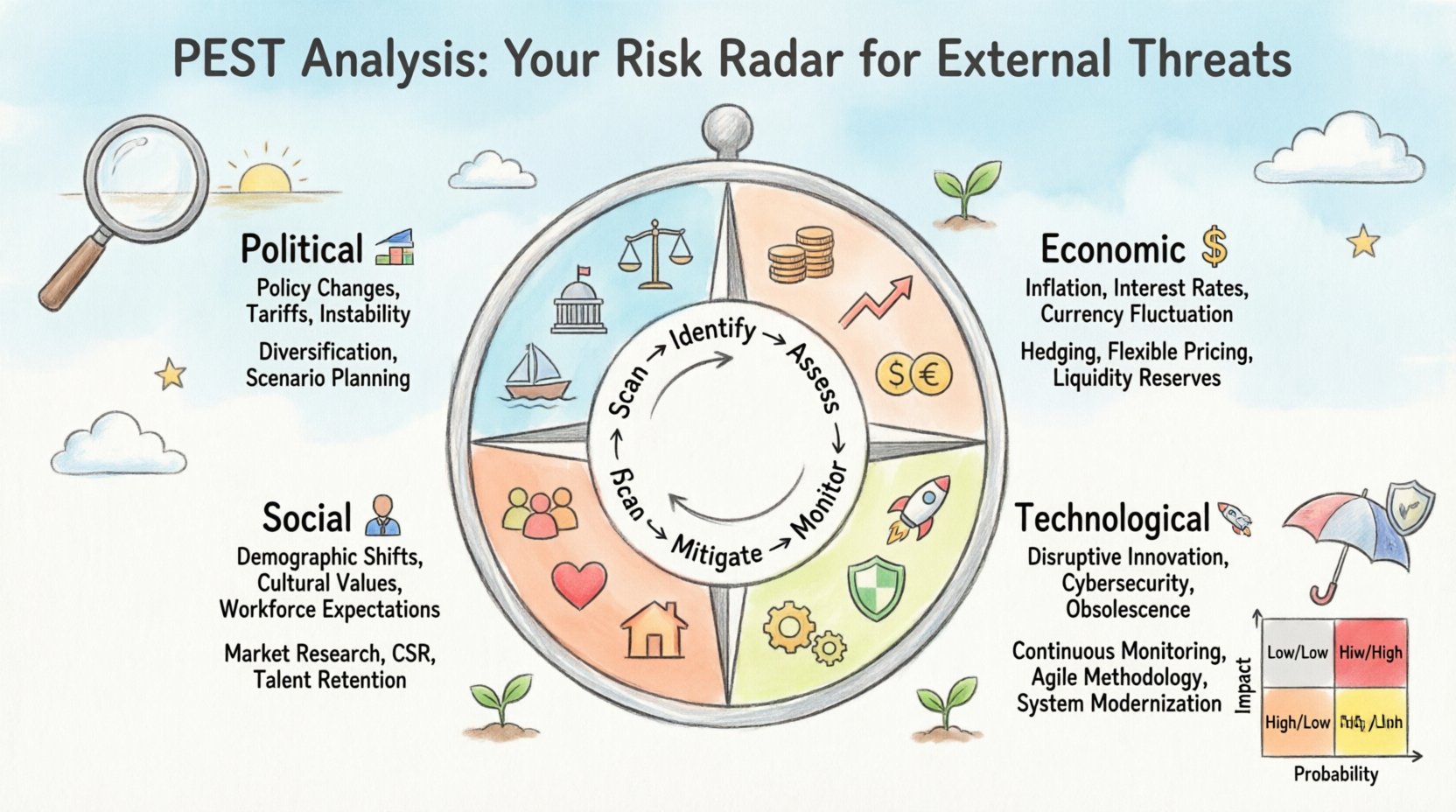
🧠 Understanding the PEST Framework in Risk Context
PEST analysis is a strategic tool used to scan the external macro-environmental factors that may influence an organization. While often used for market entry or strategic planning, its utility in risk assessment is profound. It forces a structured review of the environment, moving beyond internal biases. When applied to risk, it transforms vague worries into specific, actionable categories.
- Political: Government stability, trade policies, tax laws, and labor regulations.
- Economic: Interest rates, inflation, exchange rates, and economic growth trends.
- Social: Demographics, cultural trends, health consciousness, and lifestyle changes.
- Technological: Innovation rates, automation, R&D activity, and technology obsolescence.
Integrating these four pillars into risk assessment provides a comprehensive view of the horizon. It ensures that no major external vector is ignored. Below is a breakdown of how each category contributes to the overall risk profile.
📉 The Role of External Scanning
Internal audits reveal weaknesses within your control. External scanning reveals threats outside your control. Risk management is not just about fixing leaks; it is about anticipating the storm. PEST analysis serves as the radar system for this storm.
| Category | Key Risk Indicators | Potential Impact |
|---|---|---|
| Political | Policy changes, Trade tariffs, Political instability | Operational disruption, Compliance fines, Market access loss |
| Economic | Inflation spikes, Currency fluctuation, Recession | Margin compression, Liquidity issues, Demand shrinkage |
| Social | Demographic shifts, Consumer sentiment, Ethical trends | Brand damage, Talent acquisition failure, Sales decline |
| Technological | Disruptive tech, Cybersecurity threats, Obsolescence | Competitive disadvantage, Data breaches, Asset write-offs |
🏛️ Political Factors: Navigating Regulatory and Geopolitical Risks
Political risk stems from government actions or instability. These factors are often binary; a new regulation either exists or it does not, creating immediate compliance obligations. For global or regional businesses, political risk assessment is critical for continuity.
Key Areas of Political Risk
- Regulatory Compliance: Changes in tax codes, environmental laws, or labor standards can increase operational costs overnight.
- Trade Barriers: Tariffs, quotas, and embargoes can sever supply chains or increase the cost of goods sold.
- Political Instability: Civil unrest, regime changes, or policy volatility can threaten physical assets and personnel safety.
- Corruption and Ethics: In some jurisdictions, navigating bureaucratic corruption may be a risk factor for legal liability.
Mitigation Strategies for Political Risks
Managing political risk requires a proactive stance. Passive observation is rarely sufficient. Consider the following approaches:
- Diversification: Do not rely on a single market or supplier. Spreading operations across different political jurisdictions reduces exposure to any single policy shift.
- Scenario Planning: Develop contingency plans for various political outcomes. What happens if a tariff is implemented? What if a license is revoked?
- Stakeholder Engagement: Maintain open lines of communication with government bodies. Understanding the legislative agenda can provide early warnings of upcoming changes.
- Insurance: Political risk insurance can protect against expropriation, currency inconvertibility, and political violence.
💰 Economic Factors: Sensitivity to Market Fluctuations
Economic conditions dictate the purchasing power of customers and the cost of capital for businesses. These factors are cyclical but can be unpredictable. A robust risk assessment must account for economic volatility.
Key Economic Risk Indicators
- Inflation Rates: High inflation erodes purchasing power and increases input costs.
- Interest Rates: Rising rates increase borrowing costs, impacting capital-intensive projects.
- Currency Exchange Rates: Fluctuations can devastate margins for importers and exporters.
- Unemployment Levels: High unemployment may signal weak consumer demand but can lower labor costs.
Mitigation Strategies for Economic Risks
Economic risks are often unavoidable, but their impact can be managed through financial discipline and strategic positioning.
- Hedging: Use financial instruments to hedge against currency or commodity price fluctuations.
- Flexible Pricing Models: Implement dynamic pricing strategies that allow for adjustments based on economic conditions.
- Cost Management: Maintain lean operations to ensure survival during downturns. Focus on variable costs over fixed costs.
- Liquidity Reserves: Keep sufficient cash reserves to weather periods of economic contraction without resorting to high-interest debt.
👥 Social Factors: Adapting to Cultural and Demographic Shifts
Social forces shape consumer behavior and workforce expectations. Ignoring social trends can lead to brand irrelevance or talent shortages. These risks are often subtle but cumulative.
Key Social Risk Indicators
- Demographic Changes: Aging populations or shifts in population density affect labor supply and consumer markets.
- Cultural Values: Shifts in values regarding sustainability, diversity, and inclusion can impact brand perception.
- Health and Safety: Public health crises or changing safety expectations can disrupt operations.
- Workforce Expectations: Changes in what employees demand regarding flexibility, remote work, and ethics.
Mitigation Strategies for Social Risks
Understanding the human element is crucial for mitigating social risks. This requires empathy and data-driven insight.
- Market Research: Continuously monitor consumer sentiment and social trends through surveys and focus groups.
- Corporate Social Responsibility (CSR): Align business practices with societal expectations to build goodwill and resilience.
- Talent Retention Programs: Adapt HR policies to meet changing workforce demands, such as offering remote work options or flexible hours.
- Community Engagement: Build strong relationships with local communities to ensure social license to operate.
📡 Technological Factors: Managing Disruption and Obsolescence
Technology evolves at a pace that often outstrips business planning. Disruption can come from competitors, new entrants, or internal obsolescence. This category poses some of the most immediate existential threats.
Key Technological Risk Indicators
- Disruptive Innovation: New technologies rendering existing products or services obsolete.
- Cybersecurity Threats: Data breaches, ransomware, and system failures can halt operations.
- Infrastructure Dependency: Reliance on third-party tech providers introduces supply chain risks.
- Skills Gap: Lack of internal expertise to manage or implement new technologies.
Mitigation Strategies for Technological Risks
Technology risk management requires a balance between adoption and security.
- Continuous Monitoring: Stay informed about emerging technologies and their potential impact on your industry.
- Robust Cybersecurity: Invest in firewalls, encryption, and employee training to prevent breaches.
- Legacy System Modernization: Regularly assess and upgrade legacy systems to prevent obsolescence and security vulnerabilities.
- Agile Methodology: Adopt agile practices to allow faster adaptation to technological changes.
🔗 Integrating PEST into Risk Management Processes
Conducting a PEST analysis is a one-time exercise only if you are static. In a dynamic environment, it must be a recurring process. Integration into the broader risk management framework ensures that insights lead to action.
Step-by-Step Implementation
- Define Scope: Determine the geographic and operational scope of the analysis. Is it global, regional, or local?
- Gather Data: Collect information from reputable sources. Government reports, industry publications, and economic forecasts are valuable.
- Identify Drivers: Pinpoint specific factors within the PEST categories that are most relevant to your business.
- Assess Impact: Evaluate the likelihood and impact of each identified risk.
- Develop Responses: Create mitigation plans for high-priority risks.
- Monitor and Review: Set up a schedule to review the analysis regularly, ideally quarterly or annually.
📝 Risk Prioritization Matrix
Once risks are identified, they must be prioritized. Not all risks require immediate attention. Use a matrix to categorize risks based on severity and probability.
| Probability | Low Impact | High Impact |
|---|---|---|
| High | Monitor closely | Immediate Action Required |
| Low | Acknowledge | Plan Mitigation |
🚧 Common Pitfalls in PEST-Based Risk Assessment
While the framework is powerful, it is not foolproof. Common mistakes can undermine the effectiveness of the analysis. Awareness of these pitfalls helps maintain the integrity of the risk assessment.
- Information Overload: Collecting too much data without synthesis leads to paralysis. Focus on actionable insights.
- Confirmation Bias: Focusing only on data that supports existing beliefs. Actively seek out contrary evidence.
- Static Analysis: Treating the analysis as a snapshot rather than a continuous process. The environment changes rapidly.
- Ignoring Interconnectivity: Treating PEST categories in isolation. Political changes often trigger economic shifts.
- Lack of Stakeholder Buy-in: If leadership does not value the findings, the recommendations will not be implemented.
🔍 Monitoring and Continuous Improvement
The external environment is fluid. A risk identified today may be negligible tomorrow, or vice versa. Establishing a monitoring system is essential for long-term resilience.
- Key Risk Indicators (KRIs): Define specific metrics for each PEST category. For example, track inflation rates monthly for economic risk.
- Early Warning Systems: Subscribe to industry alerts and regulatory updates to catch changes before they become crises.
- Regular Reviews: Schedule formal reviews of the PEST analysis at least annually, or more frequently during volatile periods.
- Feedback Loops: Gather feedback from operational teams on whether the identified risks materialized as expected.
🤝 The Human Element in Risk Assessment
Technology and data are vital, but human judgment remains central. Risk assessment is not purely mechanical. It requires interpretation and strategic thinking. Leadership teams must be trained to understand the implications of PEST factors.
- Cross-Functional Teams: Involve stakeholders from finance, operations, legal, and marketing. Each brings a unique perspective on external risks.
- Training: Educate staff on how external factors influence their specific roles. A salesperson needs to understand economic risks; an IT manager needs to understand cybersecurity threats.
- Culture of Risk Awareness: Foster an organizational culture where reporting potential risks is encouraged, not punished.
📈 Measuring the Effectiveness of PEST Analysis
How do you know if your PEST-based risk assessment is working? You need metrics to evaluate the process itself.
- Response Time: Measure how quickly the organization responds to identified external threats.
- Incident Reduction: Track the frequency of risk events that could have been predicted.
- Decision Quality: Evaluate whether strategic decisions made with PEST insights performed better than those made without them.
- Stakeholder Confidence: Gauge confidence levels among investors, employees, and partners regarding the organization’s stability.
🌐 Global Considerations
For multinational organizations, PEST analysis must be conducted at multiple levels. Global trends may not apply uniformly to every region. A political shift in one country may not affect another. Tailor the analysis to local contexts.
- Localization: Adapt the PEST factors to local laws, cultures, and economic conditions.
- Cross-Border Risks: Consider risks that span borders, such as supply chain disruptions or international sanctions.
- Central vs. Local: Balance centralized risk strategies with local autonomy. Local teams often have better insight into immediate threats.
🛠️ Practical Application Tools
You do not need specialized software to conduct a PEST analysis. Simple tools are often more effective because they encourage collaboration and flexibility.
- Whiteboards: Great for brainstorming sessions with teams to map out factors visually.
- Spreadsheets: Useful for tracking data points, assigning scores, and maintaining historical records.
- Collaborative Documents: Cloud-based platforms allow multiple stakeholders to contribute in real-time.
- Interviews: One-on-one conversations with industry experts can provide deep insights that data alone cannot.
🔄 Adapting to Crisis Situations
During crises, such as pandemics or geopolitical conflicts, the standard PEST analysis may need to be accelerated. The focus shifts from long-term planning to immediate survival and adaptation.
- Rapid Scanning: Conduct a quick review of the most critical PEST factors affecting immediate operations.
- Resource Allocation: Prioritize resources to address the most pressing external threats.
- Communication: Ensure clear communication with stakeholders about how external risks are being managed.
- Flexibility: Be prepared to pivot strategies quickly as the situation evolves.
🔮 Future Trends in External Risk Management
The landscape of risk management is evolving. New methodologies are emerging to complement traditional frameworks.
- AI and Predictive Analytics: While software is not the focus, the data insights derived from advanced analytics can enhance PEST analysis.
- ESG Integration: Environmental, Social, and Governance factors are increasingly intertwined with traditional PEST factors.
- Resilience Building: The focus is shifting from pure risk avoidance to building organizational resilience against inevitable shocks.
📌 Final Considerations
Adopting PEST analysis for risk assessment is a strategic investment. It requires time, effort, and a commitment to looking outward. However, the payoff is significant. By understanding the external landscape, organizations can navigate uncertainty with confidence. They can anticipate changes, prepare responses, and maintain stability in a volatile world. The goal is not to eliminate all risk, which is impossible, but to manage it effectively. With a structured approach to Political, Economic, Social, and Technological factors, your organization can turn external threats into manageable variables. Start the analysis today, review it regularly, and ensure your risk management strategy remains as dynamic as the environment it seeks to protect.