


Making strategic choices in a volatile market requires more than intuition. It demands a structured approach to understanding the external environment. PEST Analysis provides that framework. It stands for Political, Economic, Social, and Technological factors. When applied correctly, this tool transforms uncertainty into actionable intelligence.
This guide explores how external scanning informs internal strategy. We will break down each component, provide a step-by-step execution plan, and discuss common errors to avoid. By the end, you will understand how to use this methodology to navigate complex business landscapes with confidence.
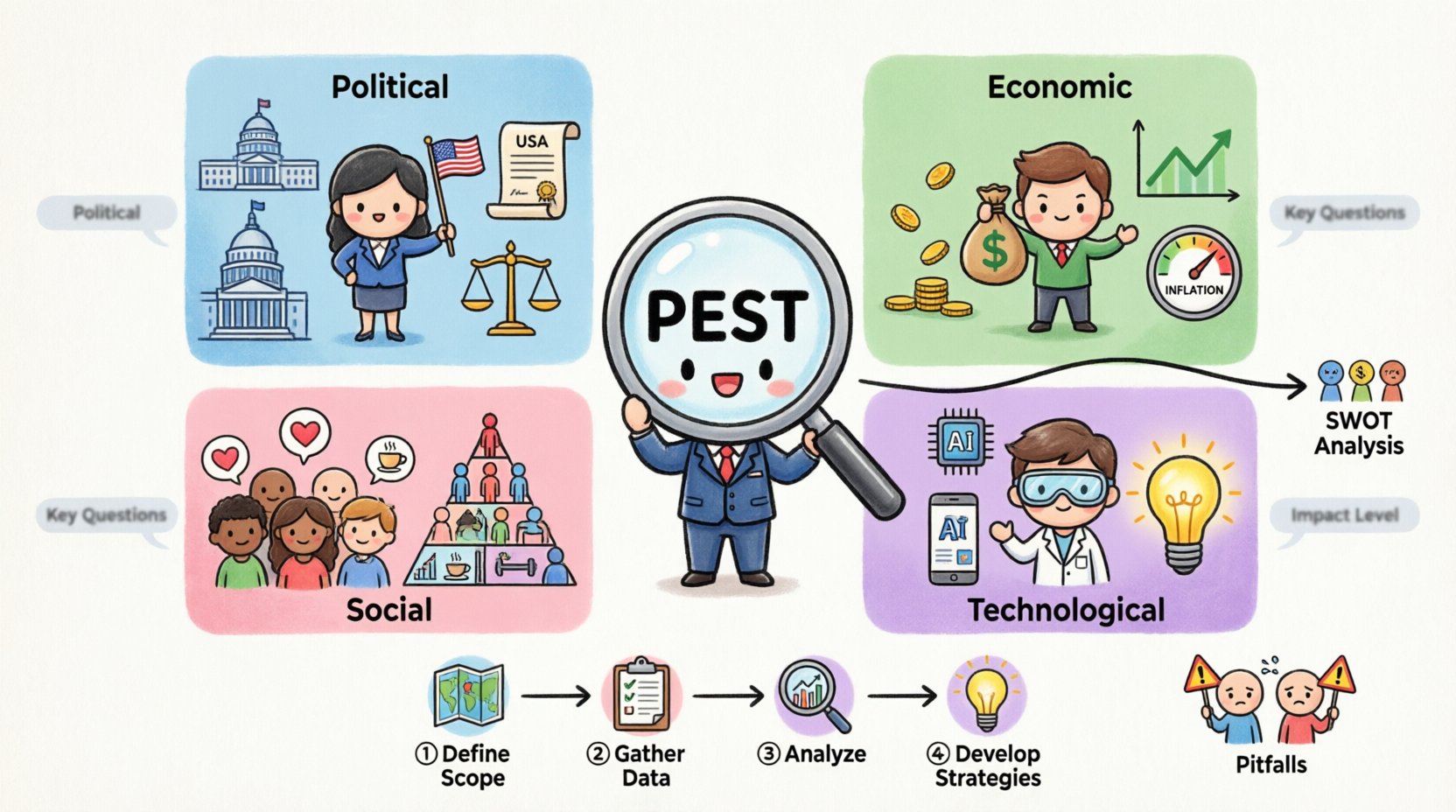
🔍 Understanding the PEST Framework
PEST analysis is a strategic tool used to identify and analyze the macro-environmental factors that affect an organization. It is not about internal strengths or weaknesses. Instead, it focuses on the forces outside the company that cannot be controlled but must be accommodated.
Many organizations skip this step, leading to strategies that fail when external conditions shift. A decision made without considering a new tax law or a technological disruption is a decision made in the dark. This framework illuminates the path.
- Political: Government policies, stability, and regulations.
- Economic: Growth rates, exchange rates, and inflation.
- Social: Demographics, cultural trends, and lifestyle changes.
- Technological: Innovation, automation, and R&D activity.
These four pillars form the backbone of external environmental scanning. They help leaders anticipate shifts before they happen, allowing for proactive rather than reactive management.
🏛️ Deep Dive: Political Factors
Political factors encompass the influence of government on the economy. This includes trade restrictions, tax laws, labor laws, and environmental regulations. Stability is also a key component here.
Key Questions to Ask
- Is the current government stable?
- Are there upcoming elections that might change policy?
- How do trade tariffs affect import costs?
- What are the compliance requirements for our industry?
Consider a company planning to expand into a new region. If that region has a history of political instability, the risk profile changes significantly. Currency controls might prevent profit repatriation. Sanctions might block supply chains. Understanding these elements is crucial for risk management.
Real-World Implications
- Regulatory Changes: New data privacy laws (like GDPR) can alter how a company collects customer information.
- Tax Incentives: Governments often offer credits for green energy adoption, affecting capital expenditure decisions.
- Trade Wars: Tariffs between nations can increase costs for manufacturers relying on global supply chains.
💰 Deep Dive: Economic Factors
Economic factors determine the purchasing power of potential customers and the cost of capital. These indicators fluctuate constantly, making them a dynamic part of the analysis.
Key Economic Indicators
- GDP Growth: Indicates the overall health of the economy.
- Inflation: Affects pricing strategies and cost structures.
- Interest Rates: Influences the cost of borrowing for expansion.
- Unemployment Rates: Impacts labor availability and wage expectations.
During an economic downturn, consumers become more price-sensitive. Luxury goods may suffer, while discount retailers thrive. Conversely, in a booming economy, credit is easier to obtain, fueling expansion.
Strategic Considerations
When analyzing economic conditions, look beyond the headlines. Consider the specific sector. A high-interest rate environment might hurt real estate but stabilize the banking sector. Understanding these nuances helps in positioning the business correctly.
- Pricing Power: Can you pass costs on to customers during inflation?
- Debt Load: Is the company leveraged enough to survive a rate hike?
- Consumer Confidence: Are people willing to spend on non-essentials?
👥 Deep Dive: Social Factors
Social factors relate to the human element of the market. This includes population growth, age distribution, career attitudes, and health consciousness. These trends change slowly but have profound impacts.
Demographic Shifts
Demographics are the foundation of market segmentation. An aging population requires different products than a youth-dominated one. Urbanization drives demand for housing and public transport. Migration patterns influence labor markets.
Cultural Trends
- Work-Life Balance: Employees increasingly demand flexibility, affecting operational models.
- Health and Wellness: Consumers prefer sustainable and organic products.
- Education Levels: Higher education correlates with different consumption habits.
- Privacy Concerns: Growing skepticism about data usage affects marketing strategies.
A company ignoring social trends risks irrelevance. For example, a brand that fails to address sustainability may lose younger demographics who prioritize ethical consumption.
📡 Deep Dive: Technological Factors
Technological factors encompass innovations that create new markets or destroy old ones. This includes automation, R&D activity, and technology incentives.
Disruptive Forces
- Automation: Reduces labor costs but requires workforce reskilling.
- Internet Connectivity: Enables remote work and global e-commerce.
- Artificial Intelligence: Optimizes decision-making and customer service.
- Mobile Technology: Changes how consumers access information.
Technology is often the fastest-moving factor in the PEST framework. A business model that relies on legacy technology can be rendered obsolete in a single quarter. Continuous monitoring of the tech landscape is essential.
Infrastructure and Access
Technology is only useful if it is accessible. Consider the infrastructure of the target market. Does the region have reliable internet? Is mobile penetration high? These factors determine the feasibility of digital strategies.
📊 Comparative Overview
Using a table can help visualize the distinctions between these factors and their potential impact.
| Factor | Key Question | Impact Level | Example |
|---|---|---|---|
| Political | Is the regulatory environment stable? | High | New environmental compliance laws |
| Economic | How does inflation affect costs? | Medium | Rising interest rates on loans |
| Social | Are consumer habits shifting? | Medium | Trend toward remote work |
| Technological | Is there a new disruptive tech? | High | Adoption of generative AI |
🚀 How to Conduct a PEST Analysis
Executing this analysis requires discipline. It is not a one-time event but a recurring process. Here is a structured approach to gathering and utilizing this data.
Step 1: Define the Scope
Before collecting data, define the boundaries. Are you analyzing a new product launch? A market entry? A long-term strategic plan? The scope determines the depth of research required.
- Geographic boundaries (Local vs. Global)
- Time horizon (Short-term vs. Long-term)
- Industry focus (Niche vs. Broad)
Step 2: Gather Data
Reliable data is the foundation of a good analysis. Use a mix of primary and secondary research.
- Government Reports: Census data, economic outlooks, and legislative updates.
- Industry Publications: Market research reports and trade journals.
- News Outlets: Current events and political commentary.
- Internal Data: Sales trends and customer feedback.
Step 3: Analyze and Prioritize
Not all factors are equally important. Some may be immediate threats, while others are long-term opportunities. Use a scoring system to prioritize.
- Impact: How much does this factor affect the business?
- Probability: How likely is this change to occur?
- Urgency: How soon must we respond?
Step 4: Develop Strategies
Translate insights into action. If a political factor suggests stricter regulations, invest in compliance now. If a social trend indicates a shift in values, adjust the brand message.
🔗 Integrating with Strategic Planning
PEST analysis does not exist in a vacuum. It feeds into broader strategic frameworks. The most common integration is with SWOT Analysis.
Connecting PEST to SWOT
PEST provides the Opportunities and Threats. Internal strengths and weaknesses are analyzed separately. By combining them, you get a complete picture.
- Opportunity: A new technology (T) that allows for cost reduction.
- Threat: A changing regulation (P) that increases compliance costs.
- Strength: Strong cash reserves to weather economic downturns (E).
- Weakness: Outdated IT infrastructure unable to handle new social demands.
This integration ensures that external realities are matched against internal capabilities.
⚠️ Common Pitfalls to Avoid
Even with a solid framework, errors can occur. Being aware of these common mistakes helps maintain the integrity of the analysis.
1. Treating It as Static
Environments change. A PEST analysis done last year may be obsolete today. Update the data regularly. Set a schedule for review, such as quarterly or biannually.
2. Ignoring Interconnections
Factors often influence each other. Economic instability can lead to political unrest. Technological advancements can drive social changes. Look for these correlations.
3. Overlooking the Micro-Environment
While PEST focuses on macro factors, do not ignore industry-specific trends. A political change might affect your industry more than the general market.
4. Data Overload
Collecting too much information can lead to paralysis. Focus on relevant data points that directly impact strategic decisions. Quality over quantity.
📈 Measuring the Impact
How do you know if the analysis was useful? Track the outcomes of decisions made based on the insights.
- Market Share: Did understanding social trends help capture new segments?
- Risk Mitigation: Did anticipating political shifts prevent fines or disruptions?
- Efficiency: Did economic analysis optimize resource allocation?
- Innovation: Did technological scanning lead to successful new product launches?
Feedback loops are essential. If a decision based on PEST analysis fails, review the data. Was the analysis flawed, or was the execution poor?
🌍 Global Considerations
For businesses operating internationally, PEST analysis becomes even more critical. Every country has a unique mix of these factors.
- Cultural Nuance: Social factors vary wildly between regions.
- Legal Systems: Political and economic structures differ by jurisdiction.
- Infrastructure: Technological readiness is not uniform globally.
A strategy that works in one market may fail in another. A localized PEST analysis for each target market is often necessary for global expansion.
🛡️ Risk Management and PEST
Risk management relies on foresight. PEST analysis provides that foresight by highlighting external risks before they materialize.
- Compliance Risk: Political changes often bring new compliance burdens.
- Financial Risk: Economic volatility affects liquidity and solvency.
- Reputational Risk: Social missteps can damage brand equity.
- Operational Risk: Technological failures can halt production.
By identifying these risks early, contingency plans can be developed. This proactive stance is far more cost-effective than crisis management.
🔮 Future Outlook
The landscape of business is shifting. Climate change is becoming a dominant political and economic factor. Data privacy is reshaping social expectations. AI is redefining technological capabilities.
Staying ahead requires constant vigilance. The tools remain the same, but the variables evolve. Leaders must remain adaptable.
- Monitor regulatory trends regarding sustainability.
- Watch for shifts in consumer behavior regarding digital privacy.
- Track investment in emerging technologies.
Success belongs to those who understand the context in which they operate. PEST analysis offers a clear lens for that understanding.
🏁 Final Thoughts
Strategic decision-making is a complex process. It requires balancing internal capabilities with external realities. PEST analysis bridges this gap.
It forces a disciplined examination of the world outside the office walls. It prevents blind spots. It highlights opportunities that might otherwise be missed. Most importantly, it grounds strategy in reality.
Use this tool regularly. Keep it updated. Integrate it into your planning cycle. When you understand the forces at play, you can navigate them with precision. This clarity is the foundation of sustainable growth.