


In an era defined by rapid change, static strategies quickly become obsolete. Organizations that rely solely on historical data often find themselves reacting to shifts rather than anticipating them. To navigate this volatility, decision-makers require a structured approach to understanding the external forces shaping their industries. This is where PEST analysis becomes an essential tool for trend spotting.
Macro trends do not appear out of nowhere. They are the result of cumulative changes in politics, economics, society, and technology. By systematically analyzing these four pillars, you can identify signals that indicate a significant shift before it becomes mainstream noise. This guide provides a comprehensive framework for leveraging PEST analysis to uncover macro trends that matter.
What is PEST Analysis? 🧩
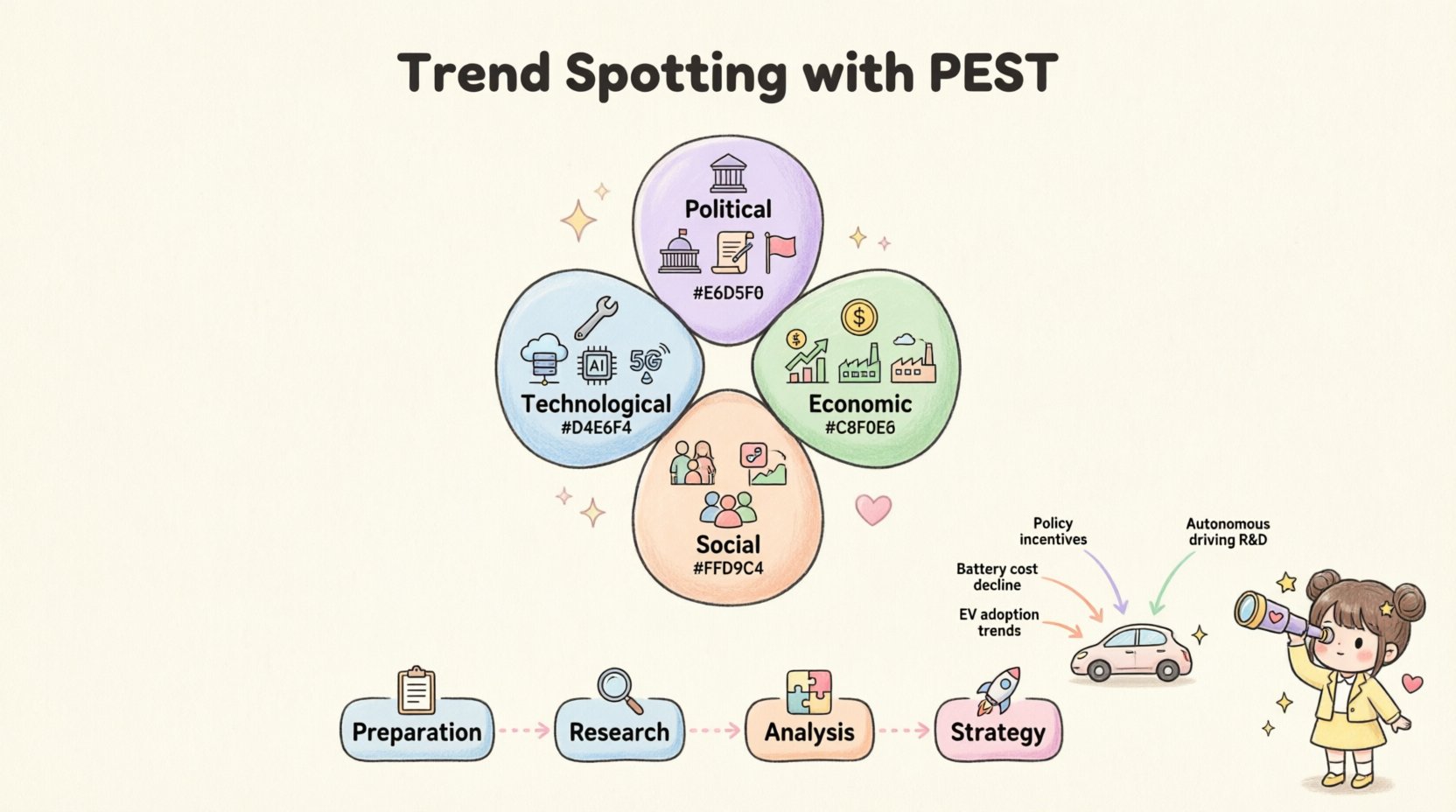
PEST is an acronym that stands for Political, Economic, Social, and Technological. It is a strategic framework used to scan the external environment of an organization. While originally designed for business strategy, its utility extends deeply into market research and trend forecasting.
Unlike internal analysis tools that focus on strengths and weaknesses, PEST looks outward. It acknowledges that an organization cannot operate in a vacuum. Every decision is influenced by the regulatory landscape, the purchasing power of consumers, shifting cultural norms, and the pace of innovation.
The Four Components Explained
- Political (P): Government intervention, tax policy, trade restrictions, and labor laws.
- Economic (E): Economic growth, interest rates, exchange rates, and inflation.
- Social (S): Demographics, cultural aspects, health consciousness, and population growth.
- Technological (T): R&D activity, automation, technology incentives, and rate of technological change.
Why PEST Matters for Trend Spotting 🎯
Trend spotting is often mistaken for hype. True trend spotting involves distinguishing between a temporary fad and a structural shift. PEST analysis provides the context necessary to make that distinction. When you see a change in one category, you can trace its impact across the others.
For example, a technological shift in renewable energy (T) is often driven by government subsidies (P) and influenced by consumer environmental awareness (S). Without the PEST framework, these connections remain fragmented. With it, you see a cohesive macro trend emerging.
Key benefits include:
- Early Warning System: Identifying regulatory changes before they impact compliance costs.
- Resource Allocation: Directing investment toward sectors with favorable economic tailwinds.
- Risk Mitigation: Understanding social backlash risks before launching new products.
- Opportunity Identification: Spotting gaps created by technological disruption.
The 4-Step Framework for PEST Trend Analysis 🔍
Conducting a PEST analysis requires discipline. It is not enough to list factors; you must evaluate their trajectory. Follow this step-by-step process to ensure your analysis yields actionable intelligence.
Phase 1: Preparation and Scoping
Before gathering data, define the boundaries of your analysis. A broad scan yields little insight. A focused scan yields clarity.
- Define the Time Horizon: Are you looking at trends for the next quarter, five years, or a decade? Macro trends take time to materialize.
- Identify the Scope: Is this analysis for a specific product line, a regional market, or the entire enterprise?
- Assemble the Team: Include diverse perspectives. A finance lead will see different economic factors than a marketing lead.
Phase 2: Data Collection and Research
This phase involves gathering raw information from credible sources. Avoid anecdotal evidence. Rely on data, reports, and official statistics.
- Political Sources: Government white papers, legislative trackers, and international trade agreements.
- Economic Sources: Central bank reports, inflation indices, and labor market statistics.
- Social Sources: Census data, cultural trend reports, and consumer behavior studies.
- Technological Sources: Patent filings, industry whitepapers, and technology adoption curves.
Phase 3: Analysis and Synthesis
Raw data is not intelligence. You must interpret what the data means for your specific context. Look for connections between the four pillars.
- Identify Drivers: What is pushing these factors forward? (e.g., population aging, digitalization).
- Assess Impact: Is the impact high or low? Is it immediate or gradual?
- Find Correlations: Does a change in tax law correlate with a shift in consumer spending habits?
Phase 4: Strategic Application
The final step is translating insights into action. This is where the trend becomes a strategy.
- Scenario Planning: Build models based on best-case and worst-case trend outcomes.
- Policy Adjustment: Update internal policies to align with new regulatory realities.
- Product Roadmap: Adjust development timelines to match technological adoption rates.
Deep Dive: Investigating Each Dimension 🧐
To spot macro trends effectively, you need to know what questions to ask within each category. Below is a detailed breakdown of the specific areas to investigate.
1. Political Factors (The Rules of the Game)
Political stability and government policy create the boundaries within which business operates. Changes here are often binary and high-impact.
- Regulatory Environment: Are regulations becoming stricter or more lenient? Watch for antitrust laws and data privacy acts.
- Tax Policy: How are corporate taxes shifting? Does this affect where you locate operations?
- Trade Barriers: Are tariffs increasing? Look for shifts in supply chain dependencies.
- Labor Laws: How are minimum wage laws and union rights evolving? This affects operational costs.
- Political Stability: Is the region stable enough for long-term investment?
2. Economic Factors (The Purchasing Power)
Economic conditions determine what people can afford and how much they are willing to spend. These factors are cyclical but can also undergo structural shifts.
- Economic Growth: Is the GDP growing or contracting? Look for recessions or booms.
- Interest Rates: High rates reduce borrowing for capital expenditure and consumer spending.
- Inflation: Rising prices erode purchasing power. How does this affect pricing strategies?
- Exchange Rates: If you import or export, currency fluctuations impact margins significantly.
- Unemployment: High unemployment reduces consumer confidence; low unemployment drives wage inflation.
3. Social Factors (The Human Element)
Social trends are often the slowest to change but the most enduring. They reflect the values and demographics of the population.
- Demographics: Is the population aging? Are birth rates falling? This dictates long-term demand.
- Cultural Attitudes: How do people view work, leisure, and community? Remote work is a prime example.
- Health Consciousness: Are consumers shifting toward organic, sustainable, or fitness-focused lifestyles?
- Education Levels: A more educated workforce changes skill requirements and consumer sophistication.
- Lifestyle Changes: Urbanization rates and the gig economy influence how people live and spend.
4. Technological Factors (The Disruptors)
Technology changes the fastest. It creates new markets and destroys old ones. Keeping up with this pillar is critical for survival.
- Innovation Rate: How quickly is new tech adopted? Is it incremental or disruptive?
- Automation: Are processes being automated? This affects labor costs and efficiency.
- Infrastructure: Is broadband or energy infrastructure improving to support new tech?
- Research & Development: Where is investment flowing? What breakthroughs are on the horizon?
- Barriers to Entry: Is technology lowering the cost to enter your market?
Connecting PEST Factors to Macro Trends 🌐
Understanding the individual pillars is only half the battle. The real value lies in connecting them. A macro trend is rarely the result of a single factor. It is the convergence of multiple pressures.
Consider the rise of electric vehicles (EVs). This was not just a technological achievement. It was driven by:
- Political: Carbon emission targets and subsidies for EV buyers.
- Economic: Rising fuel costs and the decreasing cost of battery technology.
- Social: Growing consumer concern regarding climate change.
- Technological: Breakthroughs in battery density and charging infrastructure.
When you analyze these factors simultaneously, the trend becomes undeniable. You can then plan your strategy accordingly.
Quick Reference: PEST Trend Matrix
Use this table to quickly categorize potential trends during your brainstorming sessions.
| Factor | Key Question | Example Trend |
|---|---|---|
| Political | How are government policies shifting? | Decentralization of power (e.g., crypto regulations) |
| Economic | What is the cost of doing business? | Rise of the gig economy (labor cost flexibility) |
| Social | How are people living and thinking? | Remote work adoption (lifestyle shift) |
| Technological | What new tools are available? | Generative AI integration (productivity shift) |
Common Pitfalls to Avoid ⚠️
Even with a solid framework, errors can occur. Being aware of common mistakes helps ensure the integrity of your analysis.
1. Confusing Correlation with Causation
Just because two trends happen at the same time does not mean one caused the other. Ensure you have evidence linking the PEST factor to the trend you are identifying.
2. Ignoring the Time Horizon
Short-term fluctuations should not be mistaken for macro trends. A spike in oil prices might be temporary. A shift toward renewable energy is structural. Define your timeline clearly.
3. Groupthink in Analysis
If your team agrees too quickly, you may be missing blind spots. Encourage dissent. Have someone play the role of the skeptic to challenge the prevailing assumptions.
4. Static Analysis
A PEST analysis is not a one-time document. The external environment changes continuously. Treat this as a living document that requires regular updates.
Integrating Findings into Strategy 🚀
Once you have identified the macro trends, they must inform your business decisions. Here is how to move from insight to action.
- Update Risk Registers: Add identified external risks to your formal risk management plan.
- Revise Financial Forecasts: Adjust revenue projections based on economic and social shifts.
- Refine Product Roadmaps: Ensure upcoming features align with technological capabilities and user needs.
- Train Leadership: Ensure executives understand the external landscape to make informed decisions.
- Communicate with Stakeholders: Share findings with investors and partners to align expectations.
Frequently Asked Questions ❓
How often should I conduct a PEST analysis?
For macro trends, an annual review is standard. However, in highly volatile industries, quarterly reviews may be necessary. The goal is to catch shifts before they become crises.
What is the difference between PEST and PESTLE?
PESTLE adds Legal and Environmental factors. While PEST covers the basics, PESTLE is more granular. If your industry is heavily regulated or environmentally sensitive, PESTLE is often more appropriate.
Can I use PEST for internal analysis?
No. PEST is strictly for external factors. Internal analysis should use tools like SWOT (Strengths, Weaknesses, Opportunities, Threats) or VRIO.
What if the data is unavailable?
Use proxy data. If specific economic data is missing, look at similar markets or use expert opinion. Acknowledge the uncertainty in your final report.
Is PEST analysis only for large corporations?
No. Small businesses face the same external pressures. The scale may differ, but the political, economic, social, and technological forces affect everyone.
Final Thoughts on Strategic Foresight 💭
Navigating the future requires more than intuition. It requires a disciplined approach to gathering and interpreting information about the world around you. PEST analysis offers that structure. It forces you to look beyond the immediate horizon and consider the forces that will shape the landscape in years to come.
By systematically examining Political, Economic, Social, and Technological factors, you build a robust foundation for decision-making. You stop guessing and start knowing. This clarity is the difference between reacting to the market and leading it.
Remember, the goal is not to predict the future perfectly. The goal is to be prepared for the future that arrives. With a solid PEST framework, you position your organization to adapt quickly and strategically when the trends you identified finally arrive.
Related posts:
 Definitive Overview: The Complete Guide to PEST Analysis for Startup Founders
 Component Breakdown: PEST Analysis Explained: A Beginner’s Guide to the 4 Key Forces
 Quick Start: How to Run a PEST Analysis in Under 2 Hours for Your New Business
 Comprehensive Walkthrough: Step-by-Step PEST Analysis for Small Business Owners