


In the modern business landscape, small enterprises operate in an environment defined by rapid shifts. Market dynamics change with regulatory updates, economic fluctuations, and technological advancements. To survive and thrive, leaders must look beyond their immediate operations. They need a framework that captures the external forces shaping their industry. PEST Analysis offers this clarity.
This guide explores how small businesses apply this framework to gain a strategic advantage. We will dissect each component, provide actionable examples, and outline the implementation process without relying on specific software solutions. The goal is to build a robust understanding of the external factors that influence decision-making.
Understanding the PEST Framework 🔍
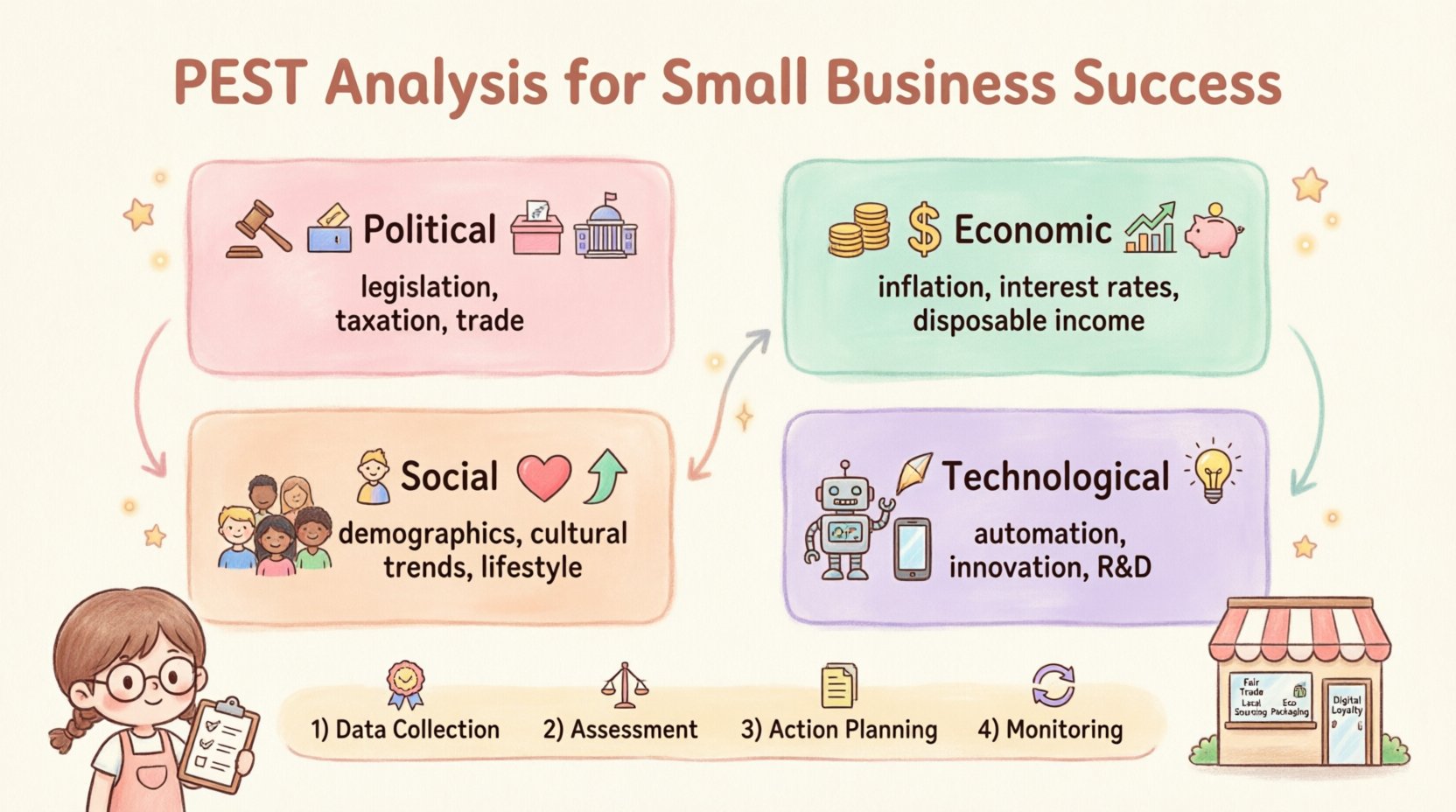
PEST stands for Political, Economic, Social, and Technological. It is a strategic tool used to scan the macro-environmental factors that affect an organization. Unlike SWOT analysis, which often focuses on internal strengths and weaknesses, PEST looks outward.
For a small business, resources are limited. You cannot compete on scale alone. Therefore, intelligence is your currency. Knowing when a tax law is changing, when consumer sentiment is shifting, or when new technology is becoming affordable allows you to pivot before competitors react.
- Political: Government intervention, stability, and regulation.
- Economic: Growth rates, exchange rates, and inflation.
- Social: Demographics, cultural trends, and lifestyle changes.
- Technological: Innovation, automation, and R&D activity.
Political Factors: Navigating Regulations and Stability 🏛️
Political factors are often the most immediate external constraints on a business. Small businesses frequently operate in niches that are heavily regulated. Ignoring these factors can lead to fines, operational shutdowns, or loss of licenses.
Key Areas of Focus
- Legislation: Labor laws, health and safety standards, and employment contracts.
- Taxation: Corporate tax rates, sales tax, and import duties.
- Trade Restrictions: Tariffs, quotas, and trade agreements.
- Political Stability: Risk of civil unrest or policy volatility.
Practical Application for Small Enterprises
Consider a local bakery. If the government introduces a sugar tax, the cost of goods sold increases. A business that monitors this trend can adjust recipes or pricing in advance. Conversely, a business that waits until the tax is enforced may face a margin squeeze.
Another example is a consulting firm offering remote services. If data sovereignty laws change regarding where client data can be stored, the firm must ensure its infrastructure complies. Failure to do so risks legal action.
Questions to Ask
- Are there upcoming elections that might change industry regulations?
- Is the local government offering grants for small business innovation?
- How might minimum wage changes affect my labor costs?
- Are there trade barriers affecting my supply chain?
Economic Factors: Sensitivity to Market Cycles 💰
Economic conditions dictate the purchasing power of your customers. Small businesses are often more vulnerable to recessions than large corporations because they have less cash reserves. Understanding the economic cycle helps in planning cash flow and inventory.
Key Areas of Focus
- Inflation Rates: Impact on input costs and pricing power.
- Interest Rates: Cost of borrowing for expansion or equipment.
- Exchange Rates: Relevance for businesses importing goods.
- Disposable Income: How much money consumers have left after necessities.
Practical Application for Small Enterprises
During periods of high inflation, customers become price-sensitive. A small retailer might shift focus from premium goods to value-oriented products. In a low-interest-rate environment, a business might secure a loan to renovate its storefront or buy new machinery.
Consider a manufacturing business that imports raw materials. If the local currency weakens, the cost of imports rises. Without a hedge or alternative supplier, profitability drops. Monitoring currency trends allows for strategic supplier diversification.
Questions to Ask
- How does inflation affect our cost of goods sold?
- What is the forecast for consumer spending in our sector?
- Are interest rates rising or falling?
- How would a recession impact our best customers?
Social Factors: Decoding Consumer Behavior 🧍
Social factors relate to the human element of the market. Demographics and cultural shifts determine what people want and how they buy. These trends often evolve slowly but have massive long-term impacts.
Key Areas of Focus
- Demographics: Age, gender, income distribution, and population growth.
- Cultural Trends: Health consciousness, sustainability, and ethical consumption.
- Lifestyle Changes: Work-from-home trends, urbanization, and leisure habits.
- Attitudes: Views on technology, privacy, and brand responsibility.
Practical Application for Small Enterprises
A fitness studio might notice a demographic shift toward an aging population. They could adapt by offering low-impact classes or mobility training. A restaurant might observe a trend toward plant-based diets and introduce a dedicated vegan menu to attract new customers.
Remote work has changed the geography of commerce. Small businesses in city centers may see reduced foot traffic, while those in residential areas might see increased demand for home services.
Questions to Ask
- How is the age profile of our customer base changing?
- Are there cultural shifts we should be aware of?
- What are the current priorities of our target audience?
- How do our customers prefer to communicate and shop?
Technological Factors: Leveraging Innovation 🚀
Technological factors cover the innovation landscape. This includes new processes, tools, and infrastructure. For small businesses, technology is often the great equalizer, allowing them to compete with larger entities through efficiency and reach.
Key Areas of Focus
- Automation: Tools that reduce manual labor.
- Internet Access: Connectivity speeds and reliability.
- Innovation: Emerging technologies relevant to the industry.
- R&D Activity: Investment in new product development by competitors.
Practical Application for Small Enterprises
Adopting automation can reduce administrative overhead. A service business might use scheduling software to manage appointments without a receptionist. A retailer might use inventory management systems to track stock levels automatically.
It is also crucial to monitor what competitors are doing. If a rival adopts a new technology that improves customer experience, you risk falling behind. However, adoption must be strategic. Buying technology for the sake of novelty can waste resources.
Questions to Ask
- What new technologies are emerging in our industry?
- How can automation improve our operational efficiency?
- Is our current infrastructure sufficient for future growth?
- How are competitors using technology to differentiate themselves?
Integrating PEST into Strategic Planning 📋
Gathering data is only the first step. The value lies in integration. How do you turn these insights into action? This requires a structured approach to planning.
Step 1: Data Collection
Gather information from public records, industry reports, and news sources. Do not rely on rumors. Use official government statistics for economic data and reputable trade publications for industry trends.
Step 2: Assessment
Evaluate the impact of each factor. Is it a threat or an opportunity? Is it high or low priority? For example, a new regulation might be a high-impact threat that requires immediate legal review.
Step 3: Action Planning
Develop specific strategies to address the findings. This might involve changing a supplier, adjusting pricing, or launching a new product line. Assign owners to each action item to ensure accountability.
Step 4: Monitoring
PEST analysis is not a one-time exercise. Set up a schedule to review the factors regularly. This ensures your strategy remains relevant as the environment changes.
Common Pitfalls to Avoid ⚠️
Even experienced leaders can misapply this framework. Common mistakes include focusing too much on the immediate present or ignoring the interconnections between factors.
- Analysis Paralysis: Gathering too much data without taking action.
- Internal Bias: Focusing only on what you want to see rather than what is happening.
- Static View: Treating the analysis as a snapshot rather than a trend.
- Isolation: Failing to connect PEST findings with internal capabilities.
Comparative Framework: PEST vs. PESTLE 📊
Some variations of this framework include Legal and Environmental factors, creating PESTLE. For small businesses, the core PEST model is often sufficient. However, environmental factors are increasingly relevant due to sustainability pressures.
| Factor | Focus Area | Small Business Relevance |
|---|---|---|
| Political | Government Policy | High |
| Economic | Market Conditions | High |
| Social | Consumer Behavior | Medium-High |
| Technological | Tools & Innovation | High |
Case Study: A Retail Scenario 🛍️
Imagine a small clothing boutique. Here is how they might apply the framework:
- Political: New import tariffs on fabric from overseas increase costs.
- Economic: Inflation reduces disposable income for luxury items.
- Social: Customers prefer sustainable and ethical fashion brands.
- Technological: Shift to online shopping and mobile payments.
Strategic Response:
- Negotiate with local suppliers to reduce tariff impact.
- Introduce a mid-range product line to attract budget-conscious shoppers.
- Source eco-friendly materials to align with social values.
- Invest in a robust e-commerce platform and social media marketing.
This approach turns external challenges into opportunities for differentiation.
Building a Resilient Strategy 🛡️
Resilience is about the ability to adapt. A business that understands its environment is better equipped to handle shocks. PEST analysis provides the radar needed to navigate turbulence.
Key Takeaways
- External factors drive internal strategy.
- Small businesses must be agile to compete with larger rivals.
- Data collection must be continuous, not sporadic.
- Action is more important than the analysis itself.
Final Considerations for Implementation ✅
Adopting this framework requires discipline. It is not enough to read a report and file it away. It must inform daily decisions and long-term planning. Start small. Pick one sector of your business and apply the PEST lens.
As you gather more experience, you will notice patterns. You will understand how political shifts ripple through economic data, and how social trends drive technological adoption. This interconnected view is where true competitive advantage is found.
Remember, the goal is not to predict the future perfectly. It is to prepare for multiple scenarios. By maintaining a clear view of the macro-environment, you position your business to seize opportunities when others are blindsided.
Use this tool consistently. Review it quarterly. Update it annually. Let the insights guide your resource allocation. This disciplined approach separates market leaders from those who simply survive.
Your business does not exist in a vacuum. It exists within a complex web of forces. Understanding that web is the first step toward mastery. Use PEST analysis to illuminate the path forward.
Related posts:
 Definitive Overview: The Complete Guide to PEST Analysis for Startup Founders
 Component Breakdown: PEST Analysis Explained: A Beginner’s Guide to the 4 Key Forces
 Quick Start: How to Run a PEST Analysis in Under 2 Hours for Your New Business
 Comprehensive Walkthrough: Step-by-Step PEST Analysis for Small Business Owners