


Strategic planning often falls into a trap of immediacy. Leaders focus on quarterly targets, annual budgets, and the next fiscal cycle. However, true organizational resilience requires looking beyond the immediate horizon. A ten-year window changes the nature of decision-making entirely. It shifts the focus from reaction to anticipation. In this context, the PEST analysis becomes an essential tool for mapping the macro-environmental forces that shape the future landscape. This guide explores how to leverage Political, Economic, Social, and Technological factors to inform a decade-long strategy.
🧭 Understanding the Time Horizon
A ten-year plan is not merely a longer version of a one-year plan. The variables that influence success change fundamentally over such a period. Short-term strategies rely on existing market conditions. Long-term strategies must account for the evolution of those conditions. Organizations that ignore this distinction often find their plans obsolete before the first milestone is reached.
When planning for a decade, several critical shifts occur:
- Capital Intensity: Investments made today often yield returns over a decade. Infrastructure, technology stacks, and workforce development require long-term commitment.
- Cultural Shifts: Generational changes in the workforce and consumer base take years to mature. Understanding demographic trends is crucial.
- Regulatory Landscapes: Laws and compliance standards evolve slowly but permanently. A policy change today could define operations ten years from now.
- Technological Obsolescence: What is cutting-edge now may be legacy hardware in five years. Anticipating the next wave of innovation is vital.
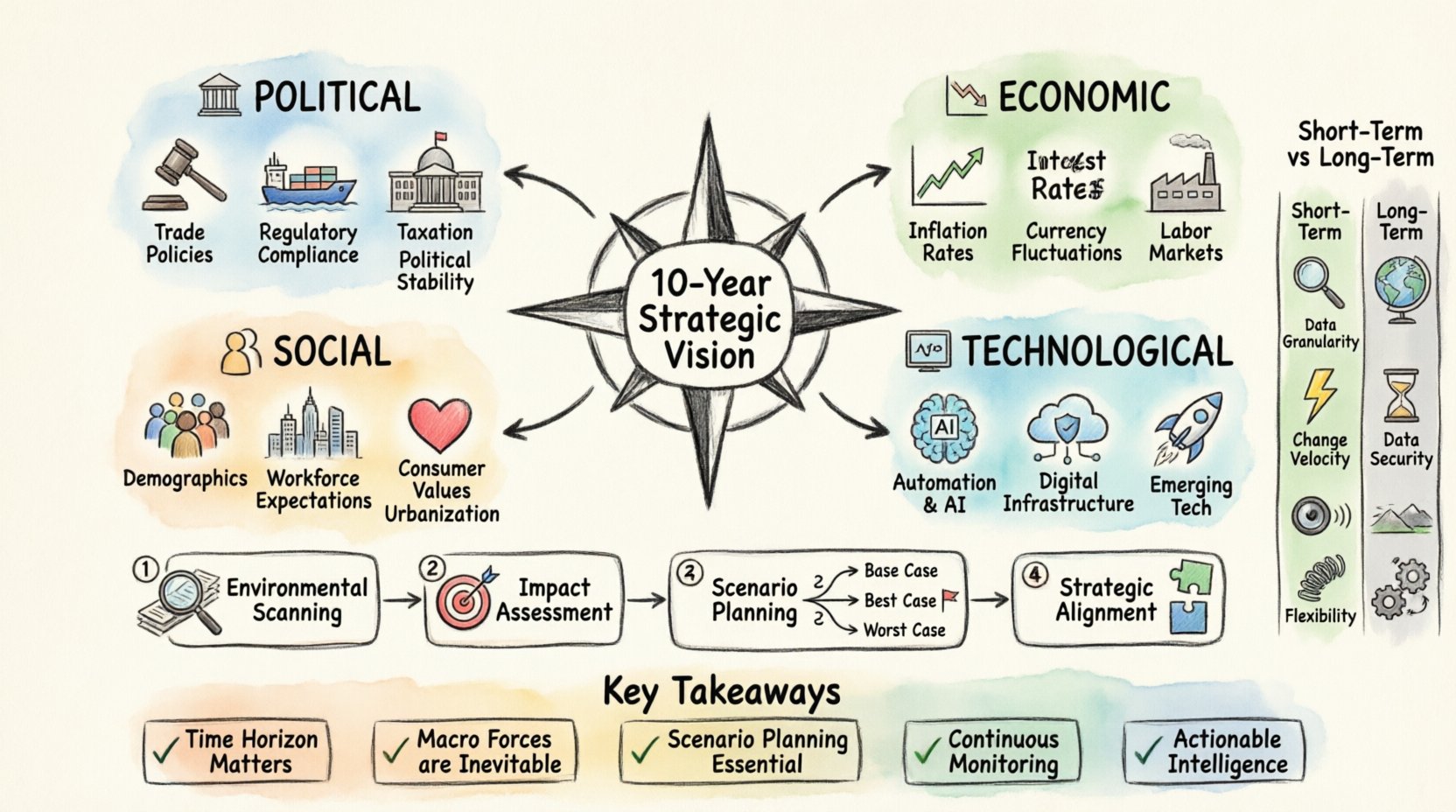
The PEST framework provides the structure needed to evaluate these macro-environmental factors systematically. It moves the conversation from internal capabilities to external realities.
🔍 Deep Dive: The PEST Framework Components
To utilize this framework effectively for a ten-year horizon, one must understand the specific dimensions of each category. General knowledge is insufficient. Specific indicators relevant to the next decade must be identified.
1. Political Factors 🏛️
Political stability and government policy dictate the rules of engagement. Over a ten-year period, political landscapes can shift due to elections, trade wars, or geopolitical tensions. This is not just about current administration policies, but the trajectory of governance.
- Trade Policies: Tariffs and free trade agreements impact supply chains. A shift towards protectionism could disrupt global sourcing strategies.
- Regulatory Compliance: Environmental regulations, data privacy laws, and labor standards are tightening globally. Future costs must factor in stricter compliance requirements.
- Taxation: Corporate tax rates and incentives for specific industries (like green energy or tech) affect long-term profitability models.
- Political Stability: Operating in regions with potential instability requires contingency planning for asset security and employee safety.
2. Economic Factors 📉
Economic conditions determine the purchasing power of customers and the cost of capital. Over a decade, economies cycle through growth, stagnation, and recession. Planning requires assumptions about these cycles.
- Inflation Rates: Long-term contracts and pricing models must account for inflation. Real value erosion can destroy margins if not hedged.
- Interest Rates: The cost of borrowing influences capital expenditure. High-interest environments favor asset-light models, while low rates favor heavy investment.
- Currency Fluctuations: For international organizations, exchange rates determine the value of revenue and costs. Hedging strategies become essential.
- Labor Markets: Unemployment rates and wage growth affect hiring costs and consumer spending power.
3. Social Factors 👥
Demographics and cultural trends are slow-moving but powerful forces. They change the way people work, live, and consume. These factors are often the hardest to predict but the most impactful over ten years.
- Demographics: Aging populations in developed nations contrast with youth bulges in developing markets. This affects labor supply and target markets.
- Workforce Expectations: The shift from traditional employment to gig work, remote collaboration, and purpose-driven careers alters organizational design.
- Consumer Values: Sustainability, ethical sourcing, and health consciousness are not fads. They are becoming baseline expectations for modern consumers.
- Urbanization: Migration patterns influence where facilities and customers are located.
4. Technological Factors 💻
Technology is the fastest-moving category. A ten-year plan must account for disruptive innovations, not just incremental improvements. The infrastructure of the future determines operational efficiency.
- Automation & AI: The integration of artificial intelligence into workflows will reshape job roles and productivity metrics.
- Digital Infrastructure: Connectivity standards (like 6G) and cloud computing capabilities will dictate speed and scalability.
- Data Security: As threats evolve, security protocols must advance. Cybersecurity is a continuous cost, not a one-time setup.
- Emerging Tech: Biotechnology, quantum computing, and renewable energy storage could open new markets or render existing ones obsolete.
🗓️ Integrating PEST into Decadal Strategy
Knowing the factors is only the first step. The value lies in integrating them into the strategic planning process. This requires a structured approach to data gathering, analysis, and application. The goal is to turn external noise into actionable intelligence.
Step 1: Environmental Scanning 📡
The process begins with collecting data. This is not a one-time event. For a ten-year plan, scanning must be continuous. Organizations should establish a system to monitor weak signals—early indicators of change that are often ignored until they become obvious.
- Identify key sources of information: government reports, academic research, industry journals, and global news.
- Assign ownership for monitoring specific PEST categories to ensure accountability.
- Use qualitative and quantitative data to build a comprehensive picture.
Step 2: Impact Assessment 🎯
Not all trends are equally important. Some factors will have a negligible effect, while others will define the success or failure of the organization. The next step is to filter the data based on relevance and impact.
- Relevance: Does this factor directly affect our core business model?
- Impact: If this factor changes, how severely does it affect operations?
- Probability: How likely is this trend to materialize within the ten-year window?
Step 3: Scenario Planning 🌐
Because the future is uncertain, organizations should not rely on a single forecast. Scenario planning allows teams to prepare for multiple possible futures based on different PEST variables. This builds organizational agility.
- Create a “Base Case” scenario based on current trends continuing linearly.
- Create a “Best Case” scenario where favorable conditions align.
- Create a “Worst Case” scenario where significant disruptions occur.
- Develop contingency plans for each scenario to ensure readiness.
Step 4: Strategic Alignment 🧩
Finally, align the internal strategy with the external reality. The goals, budgets, and resource allocation must reflect the findings from the PEST analysis. If the analysis predicts a shortage of skilled labor, the strategy must include heavy investment in training or automation.
The following table illustrates how specific PEST factors translate into strategic actions over a decade.
| PEST Category | Ten-Year Indicator | Strategic Implication |
|---|---|---|
| Political | Stricter carbon emission regulations | Invest in green supply chain and energy efficiency |
| Economic | Higher global interest rates | Reduce debt levels and prioritize cash flow management |
| Social | Increasing remote work adoption | Shift to digital-first culture and distributed infrastructure |
| Technological | Maturation of AI tools | Integrate AI into core workflows to enhance productivity |
⚖️ Comparing Short-Term vs. Long-Term Focus
It is important to distinguish how PEST analysis functions differently when applied to short-term versus long-term planning. The depth of analysis changes significantly.
| Aspect | Short-Term (1-3 Years) | Long-Term (10 Years) |
|---|---|---|
| Data Granularity | High. Specific quarterly data. | Low. Broad trend lines and projections. |
| Change Velocity | Fast. Immediate reactions. | Slow. Structural shifts. |
| Primary Focus | Market share and revenue. | Survival and relevance. |
| Flexibility | Low. Fixed budgets. | High. Adaptive roadmaps. |
Short-term analysis often treats PEST factors as constraints. Long-term analysis treats them as opportunities for transformation. For example, a rising tax rate is a cost constraint in year one, but a driver for restructuring operations in year ten.
⚠️ Common Pitfalls in Long-Term Analysis
Even with a robust framework, organizations frequently make mistakes when applying PEST analysis to long-term planning. Awareness of these pitfalls helps maintain the integrity of the strategy.
1. Linear Thinking 📉
The most common error is assuming current trends will continue in a straight line. History shows that change is often exponential or disruptive, not linear. A trend that looks stable today may collapse or explode tomorrow.
2. Recency Bias 🔍
Leaders tend to weigh recent events more heavily than historical data. A major event from five years ago may no longer be relevant. Conversely, slow-moving trends that have been ignored for a decade may suddenly become critical.
3. Internal Bias 🛡️
Organizations often see what they want to see. They may downplay threats that challenge their current business model or exaggerate opportunities that align with their ego. Objective data collection is essential to counter this.
4. Isolation of Factors 🧩
PEST factors do not exist in a vacuum. Political decisions drive economic policy, which influences social behavior, which dictates technology adoption. Analyzing them in silos misses the interconnected risks.
🔄 Maintaining the Analysis Over Time
A ten-year plan is not a document to be filed away and forgotten. It is a living framework that requires regular review. The external environment does not wait for the planning cycle to end.
- Annual Reviews: Revisit the PEST analysis once a year to update assumptions.
- Trigger Events: Establish triggers that force an immediate review. For example, a change in trade law or a breakthrough in technology.
- Feedback Loops: Ensure that operational teams report changes they see in the market back to the strategy team.
- Scenario Updates: Adjust scenarios based on new data. If the “Worst Case” becomes likely, activate the contingency plan.
By treating the analysis as a continuous process, the organization remains agile. The goal is not to predict the future with perfect accuracy, but to be prepared for various possibilities.
🌍 Real-World Application Considerations
Consider a manufacturing company planning for a decade ahead. They might analyze the following:
- Political: They anticipate stricter environmental laws. This prompts investment in renewable energy sources for factories.
- Economic: They forecast higher labor costs in their home country. This prompts a strategy to automate production or offshore to regions with favorable economic growth.
- Social: They notice a trend towards remote work. They adjust their hiring strategy to recruit globally rather than locally.
- Technological: They identify the rise of additive manufacturing (3D printing). They consider how this could reduce their supply chain complexity.
This holistic view allows the company to make capital decisions today that will pay off in ten years. It prevents the situation where a company is forced to pivot drastically because it was unprepared for a shift in the macro-environment.
🤝 The Human Element
While data drives the PEST analysis, humans drive the strategy. The analysis must be communicated effectively to stakeholders. Leaders must explain why the plan looks the way it does. Transparency builds trust and alignment.
- Involve diverse teams in the analysis process. Different perspectives identify different risks.
- Use visualizations to make complex data accessible.
- Focus on the narrative. A list of factors is dry; a story about the future is engaging.
When teams understand the external forces shaping their work, they feel more connected to the strategic vision. This engagement is critical for execution.
🔮 Final Thoughts on Future Readiness
Strategic planning is an act of discipline. It requires the courage to look at uncomfortable truths about the future. The PEST analysis offers a structured way to confront those truths. By systematically evaluating Political, Economic, Social, and Technological factors, organizations can build strategies that are robust against uncertainty.
A ten-year plan is an investment in resilience. It acknowledges that the world will change. It does not seek to control that change, but to navigate it. The organizations that succeed are not those that predict the future perfectly, but those that prepare for it thoroughly. This framework provides the foundation for that preparation.
As you move forward with your planning, remember that the analysis is a tool for clarity. Use it to strip away noise and focus on what truly matters. Maintain the discipline to revisit it regularly. And always remember that the goal is not just survival, but sustainable growth in a dynamic world.
📋 Key Takeaways
- Time Horizon Matters: Ten-year planning requires a different lens than short-term planning.
- Macro Forces are Inevitable: PEST factors shape the environment regardless of internal actions.
- Scenario Planning is Essential: Prepare for multiple futures, not just one prediction.
- Continuous Monitoring: Update the analysis regularly to stay relevant.
- Actionable Intelligence: Translate external data into internal strategic decisions.