


Struggling with consistently missed project delivery deadlines? You’re not alone. The frustration of last-minute scrambles and the financial toll of delays can be overwhelming. But what if you could quickly uncover the true root cause of this recurring problem and build a solid plan to fix it for good? The AI-Powered 5 Whys Root Cause Analysis Tool from Visual Paradigm makes this possible. This guide will walk you through a real-world example, showing how this powerful tool can turn a frustrating symptom into a clear path to lasting solutions. Let’s dive in.
Quick Summary: What You’ll Learn
-
How to use an AI-powered tool to generate a complete 5 Whys analysis in minutes.
-
The step-by-step process to define a problem, find its root cause, and build a solution.
-
How to create a professional, shareable report to align your team and stakeholders.
-
Why a structured approach beats guesswork when solving complex problems.
Imagine you’re a project manager facing a constant barrage of late deliveries. Your team is stressed, clients are unhappy, and your company is losing money. The immediate solution might be to push harder, but that’s just a band-aid. The real solution lies in understanding the root cause—the fundamental reason why deadlines are missed. That’s where the 5 Whys Root Cause Analysis Tool comes in.
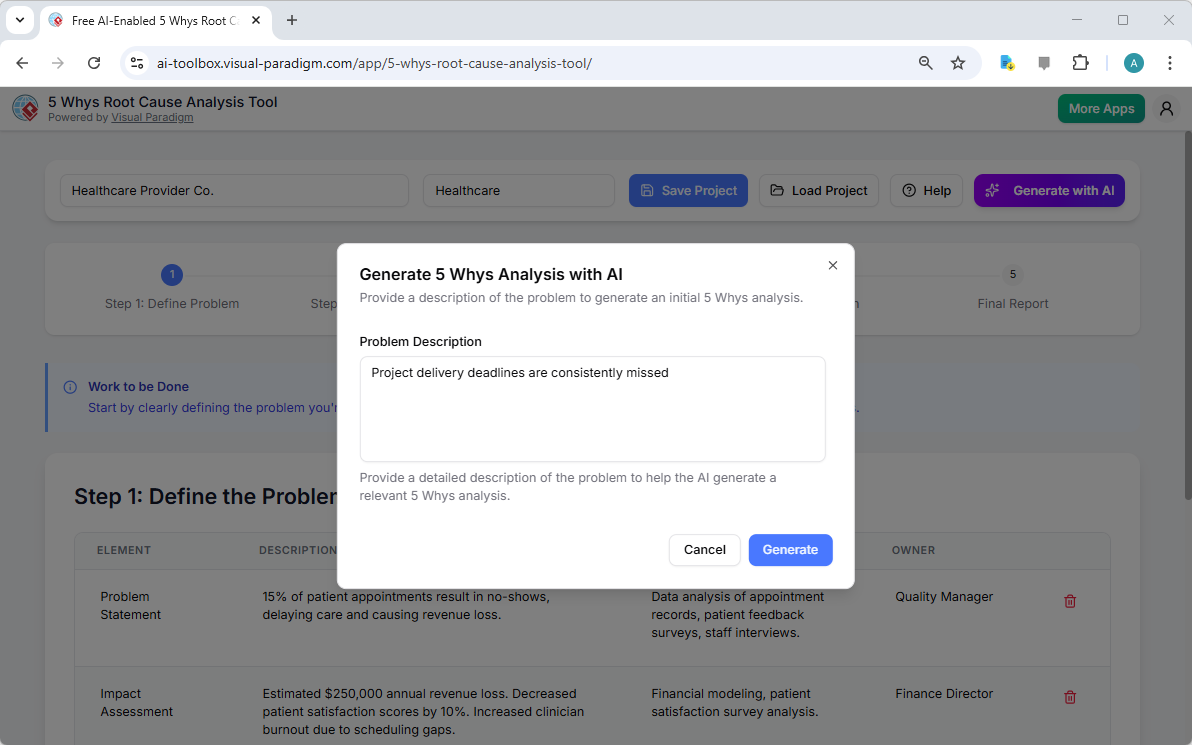
As shown in Image 1, the journey begins with a simple prompt. You start by entering a clear problem statement, like “Project delivery deadlines are consistently missed.” The tool then uses AI to generate a comprehensive analysis. This isn’t just a list of guesses; it’s a structured, logical framework designed to peel back the layers of a problem, one “Why?” at a time.
Step 1: Define the Problem and Context
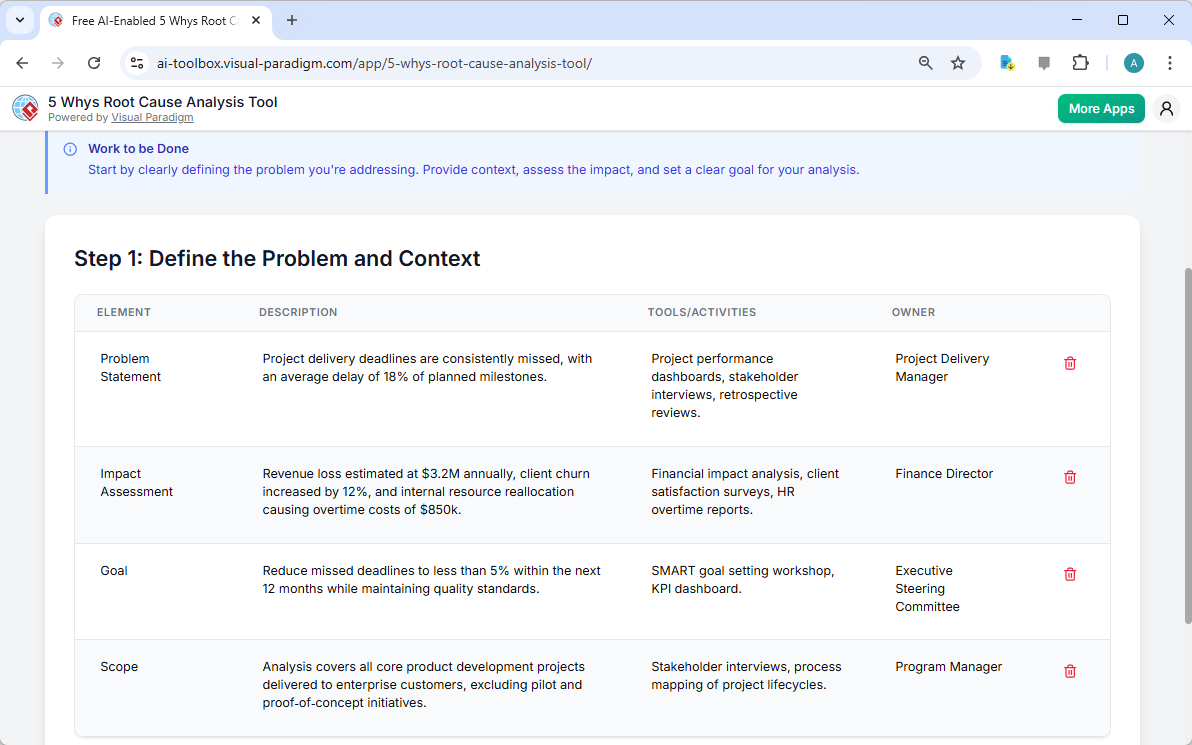
After the AI generates the initial analysis, you land on Step 1: Define the Problem and Context. This is where you set the stage. The tool provides a dynamic table with clear sections for the Problem Statement, Impact Assessment, Goal, and Scope. In the example, the AI has already populated these sections based on your initial input.
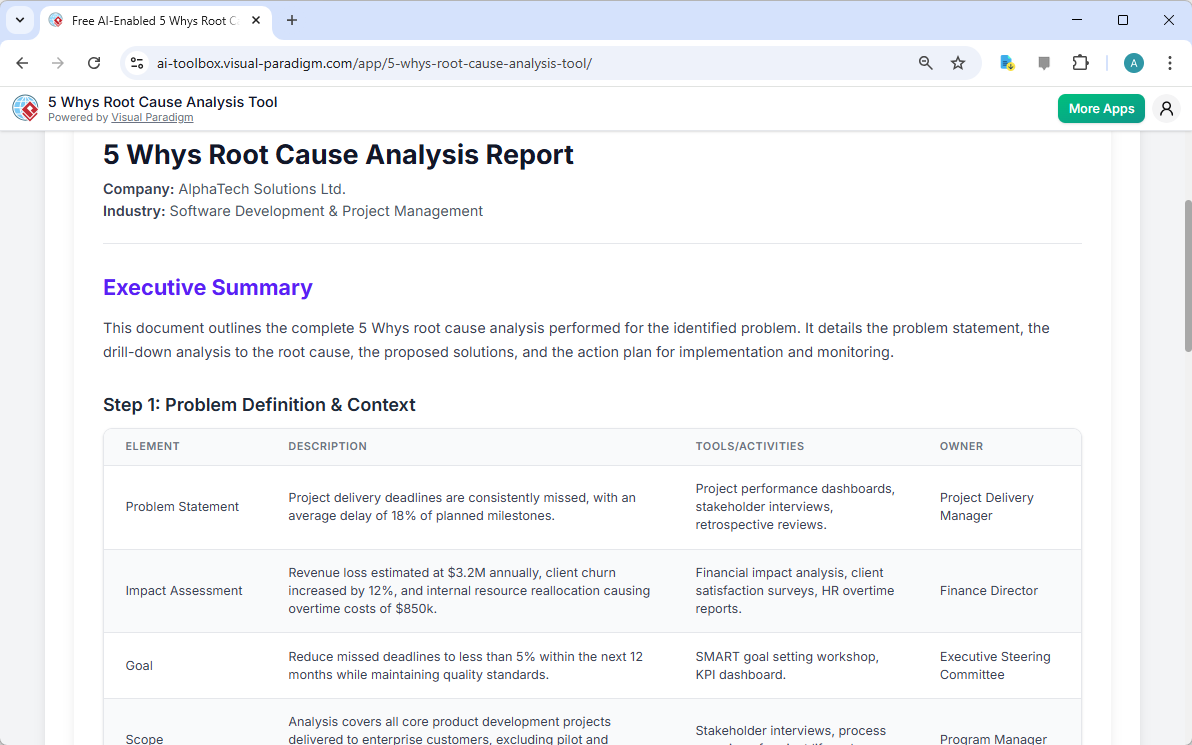
For instance, the problem statement is refined to include the specific impact: “Project delivery deadlines are consistently missed, with an average delay of 18% of planned milestones.” The impact assessment quantifies the cost: “Revenue loss estimated at $3.2M annually, client churn increased by 12%, and internal resource reallocation causing overtime costs of $850k.” This data transforms a vague complaint into a measurable business challenge.
Next, the goal is set: “Reduce missed deadlines to less than 5% within the next 12 months while maintaining quality standards.” This provides a clear target. The scope defines the boundaries: “Analysis covers all core product development projects delivered to enterprise customers, excluding pilot and proof-of-concept initiatives.” This ensures the analysis stays focused.
Step 2: Conduct the 5 Whys Analysis
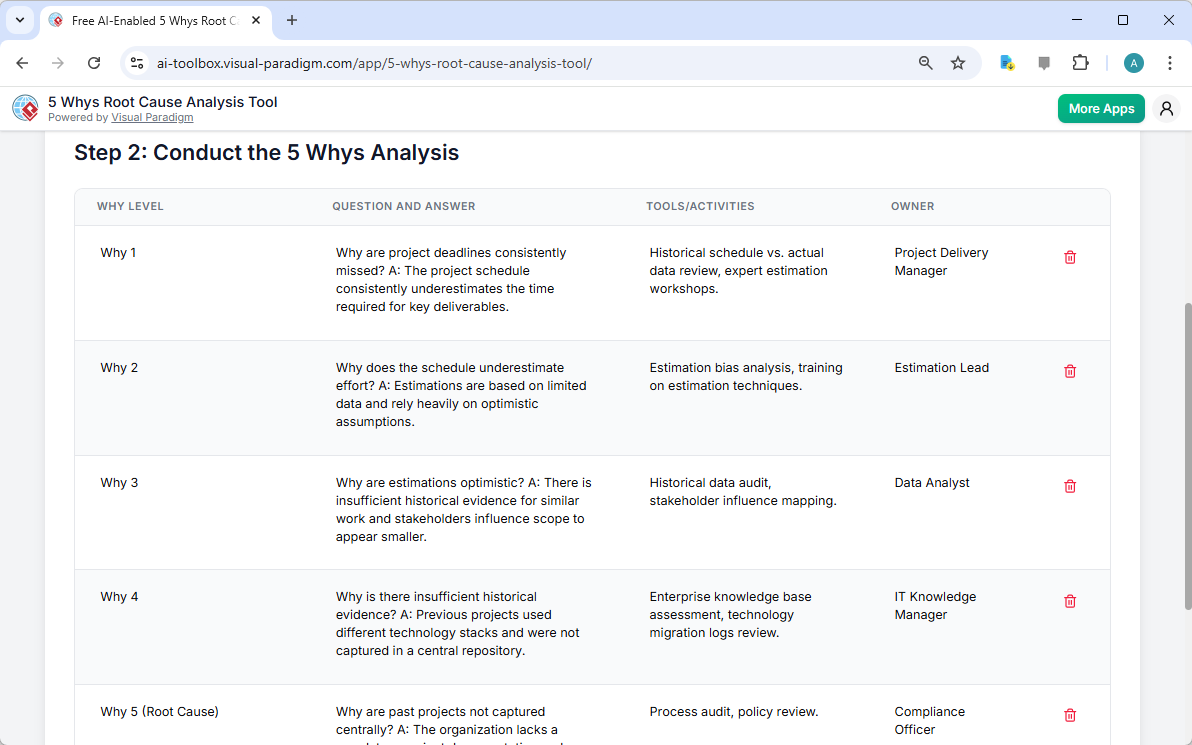
Now it’s time to dig deeper. Step 2, as seen in Image 3, is the core of the 5 Whys technique. The tool presents a table with five levels of “Why?” questions. The AI has already generated the first few levels, guiding you through the logical chain.
For example, the first “Why?” asks, “Why are project deadlines consistently missed?” The AI’s answer is: “The project schedule consistently underestimates the time required for key deliverables.” This leads to the next “Why?”: “Why does the schedule underestimate effort?” The answer: “Estimations are based on limited data and rely heavily on optimistic assumptions.” This process continues, drilling down to the fundamental issue.
By the fifth “Why?”, the analysis reveals the root cause: “Why are past projects not captured centrally?” The answer: “The organization lacks a unified, searchable repository for all project documentation, including estimates, actuals, and lessons learned.” This is the true root cause. It’s not that estimators are bad, but that they lack the historical data to make accurate predictions. This insight is the key to a lasting solution.
Step 3: Develop Solutions
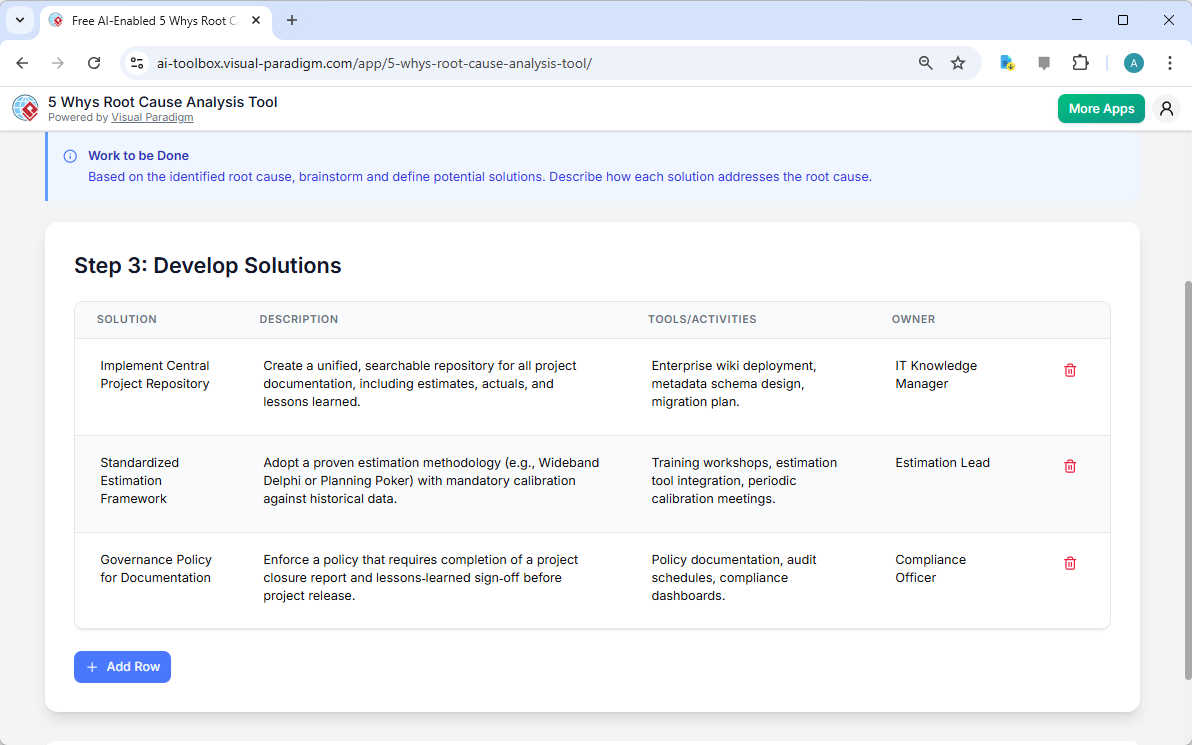
With the root cause identified, the focus shifts to solutions. Step 3, shown in Image 4, is where you brainstorm and define potential fixes. The tool provides a table to list each solution, its description, the tools or activities needed, and the owner responsible.
In our example, one proposed solution is to “Implement Central Project Repository.” The description explains it would create a unified, searchable database for all project documentation. The tools include an enterprise wiki, metadata schema design, and a migration plan, with the IT Knowledge Manager as the owner. Other solutions include adopting a standardized estimation framework and enforcing a governance policy for documentation.
This step is crucial because it ensures every solution directly addresses the root cause. It moves the analysis from theory to action, creating a clear roadmap for change.
Step 4: Implement and Monitor Actions
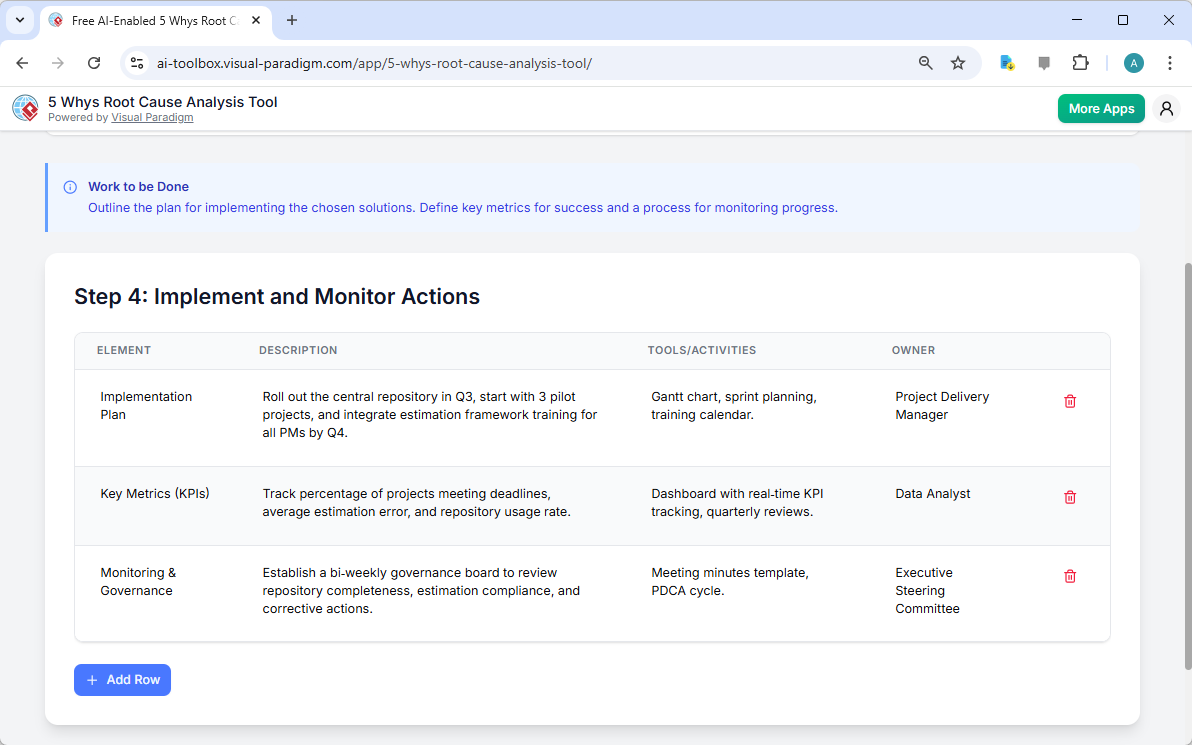
Now that solutions are defined, the next step is to create a plan for implementation and monitoring. Step 4, visible in Image 5, focuses on the “how.” It’s about setting up the processes and metrics to ensure the solutions are actually implemented and are working.
The table in this step outlines the implementation plan, key metrics (KPIs), and monitoring processes. For the central repository solution, the implementation plan might be to roll it out in Q3, starting with three pilot projects. Key metrics could include the percentage of projects meeting deadlines and the average estimation error. Monitoring could involve a bi-weekly governance board to review progress and address any issues.
This step ensures that the analysis doesn’t end with a report, but becomes a living document that drives real change.
Step 5: Final Report and Action
Finally, the tool compiles all your work into a polished, professional report. As seen in Image 6, the final report is a clean, comprehensive document that summarizes the entire analysis. It includes the executive summary, the problem definition, the 5 Whys drill-down, the proposed solutions, and the implementation plan.
This report is the final product. It’s a single source of truth that you can print, save as a PDF, or share with your team and stakeholders. It ensures everyone is on the same page and aligned on the path forward.
Using this AI-Powered 5 Whys Root Cause Analysis Tool from Visual Paradigm, you can transform a frustrating recurring problem into a clear, actionable plan. It’s a powerful way to move beyond quick fixes and address the real root causes of failure. Don’t let missed deadlines define your team’s success. Try the 5 Whys Root Cause Analysis Tool today and start building a more reliable future.
Try the AI-Powered 5 Whys Root Cause Analysis Tool now: https://ai-toolbox.visual-paradigm.com/app/5-whys-root-cause-analysis-tool/
Related Links
-
AI -Powered 5 Whys Root Cause Analysis Tool for Effective Problem…: Discover how the AI -enabled 5 Whys Root Cause Analysis Tool helps teams identify root causes , enhance collaboration, and drive lasting solutions. 5 Whys Analysis . Start with the problem statement. Ask “ Why ?” the problem is occurring and document the answer.
-
Free AI 5 Whys Tool for Root Cause Analysis – Visual Paradigm Product …: Get to the root of any problem with our free AI 5 Whys tool. A step-by-step guide to drill down from a problem to its underlying cause .
-
Visual Paradigm Guide: AI Modeling, Agile & Enterprise Architecture: Analysis Suites: Perform Root Cause Analysis , 5-Whys , Gap Analysis , and Lean Six Sigma DMAIC studies with AI guidance. Productivity: The platform even extends to content creation with article writers, infographic designers, and tools that convert text to Markdown presentations.
-
5 Whys Root Cause Analysis Tool – Visual Paradigm: The 5 Whys Root Cause Analysis Tool is a web-based application designed to guide users through a structured problem-solving process. It helps teams and individuals move beyond symptoms to uncover the true underlying cause of a problem by repeatedly asking ” Why ?”. The tool provides a clear, step-by-step framework to define a problem, conduct the ” 5 Whys ” analysis , develop effective solutions …
-
5 Whys Tool – Visual Paradigm: As the name suggested, 5 Whys takes five iterations of asking ‘Why’ to drill down from one symptom to another until you reached the root cause . Visual Paradigm features an intuitive diagram editor and a rich set of 5 Whys templates that support your problem solving and presentation needs.
-
Free Root Cause Analysis (RCA) Tool | Visual Paradigm Online: The RCA Framework Tool is a web-based application that integrates several analysis techniques into a cohesive workflow. It guides users from defining a problem and collecting data, through identifying root causes (using methods like ” 5 Whys ” or “Fishbone Diagrams”), to developing and planning robust, sustainable solutions.