


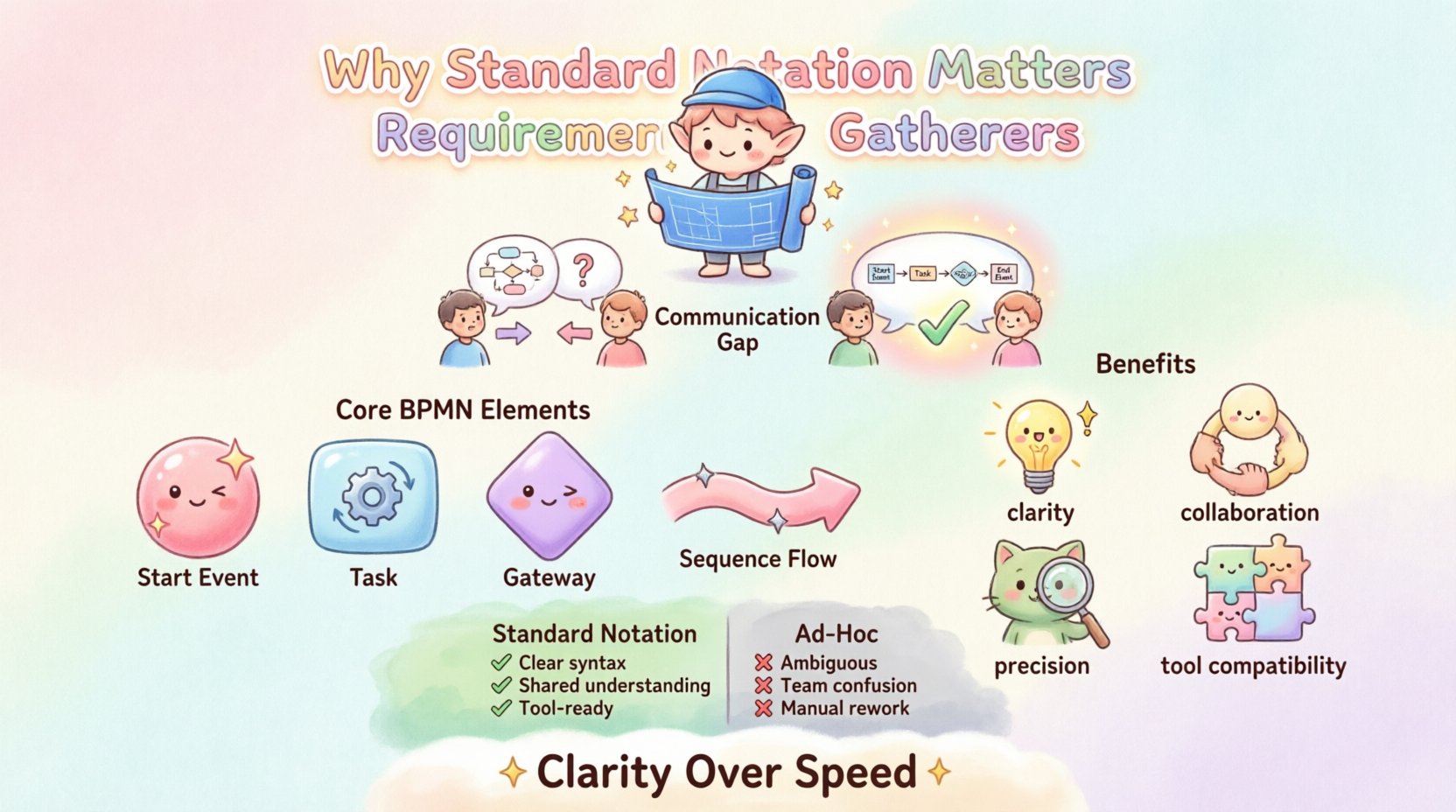
Requirement gathering is often described as the most critical phase in any business improvement initiative. It is the bridge between business needs and technical execution. However, a bridge built without a blueprint is likely to fail. In the context of Business Process Model and Notation (BPMN), this blueprint is the standard notation. For requirement gatherers, adopting a standardized visual language is not merely an aesthetic choice; it is a strategic necessity that dictates clarity, accuracy, and efficiency.
When stakeholders, analysts, and developers speak different languages, projects drift. Ambiguity creeps in. Rework accumulates. The adoption of standard notation mitigates these risks by providing a universal grammar for process logic. This article explores why standard notation is indispensable for requirement gatherers and how it transforms the way processes are defined and understood.
The Communication Gap in Business Processes 🗣️
Every organization operates on processes. Some are documented, others exist only in the minds of experienced staff. When a requirement gatherer steps in, their job is to capture, clarify, and validate these processes. Without a standard notation, the output of this effort is often a text-heavy document or a sketch that is open to interpretation.
Consider a scenario where a business analyst describes a workflow to a developer without using standard symbols:
- Scenario A (Verbal/Text): “If the user logs in, check their status. If they are active, go to the dashboard. If not, show an error. If the error happens twice, lock them out.”
- Scenario B (Standard Notation): A flow starting with a Start Event, moving through a Task, hitting an Exclusive Gateway, leading to two different paths (Success/Error), and eventually a Terminate or Loop event.
In Scenario A, the developer might miss the condition about “twice” or the specific type of error handling. In Scenario B, the logic is explicit. The gateway clearly defines the branching logic. The events clearly define the start and end points. Standard notation removes the cognitive load required to translate prose into logic.
Reducing Ambiguity Through Precision 🔍
Ambiguity is the enemy of accurate requirements. When terms are vague, assumptions are made. Assumptions lead to bugs. Bugs lead to delays. Standard notation enforces precision by restricting how elements can be connected and what they represent.
For a requirement gatherer, this precision manifests in several key areas:
- Event Definitions: Standard notation distinguishes between a Start Event, an Intermediate Event, and an End Event. A boundary event behaves differently than a signal event. This distinction ensures the trigger for a process is clearly understood.
- Gateway Logic: Gateways define how a process splits or merges. An XOR gateway implies exclusivity. An AND gateway implies parallel execution. An OR gateway implies flexibility. Using these symbols ensures the flow control logic is unambiguous.
- Sequence Flows: Arrows indicate direction. Thick lines might indicate message flows. Dotted lines might indicate associations. Each line type carries semantic meaning that text cannot easily replicate.
When requirement gatherers insist on standard notation, they force stakeholders to confront the logic of the process. It becomes harder to say “maybe” when you have to draw a specific symbol for a specific outcome.
The Cost of Ad-Hoc Diagramming 💸
Using custom shapes or non-standard icons might seem faster initially. It allows for creative expression. However, the long-term cost of this approach is significant. Custom notations require a legend. They require training. They require translation every time a new team member joins the project.
Here is a breakdown of the risks associated with non-standard notation:
- Onboarding Friction: New analysts must learn the custom lexicon before they can contribute. This slows down productivity.
- Tool Incompatibility: Most modeling tools are built to support standard notation. Custom shapes often break when imported into different environments or exported for execution.
- Documentation Drift: Over time, ad-hoc diagrams diverge from the actual system. Standard notation keeps the diagram aligned with the underlying logic because the symbols are rigid.
- Stakeholder Confusion: Business stakeholders may recognize standard symbols from training or industry exposure. Custom symbols require constant explanation.
Understanding the Core Elements of Standard Notation 🧩
To effectively use standard notation, requirement gatherers must understand the building blocks. These elements form the vocabulary of process modeling. Mastery of these components allows for the construction of complex scenarios without losing clarity.
1. Events 🏁
Events are the occurrences that trigger or result from a process. In standard notation, they are represented by circles. The line style indicates the nature of the event.
- Start Events: Thin circle. Marks the beginning of a process flow.
- Intermediate Events: Double circle or thin circle with an inner symbol. Represents an event occurring during the process.
- End Events: Thick circle. Marks the conclusion of a process flow.
2. Activities and Tasks ⚙️
Activities represent work that is performed. They are usually depicted as rounded rectangles.
- Task: A single unit of work.
- Sub-Process: A collection of tasks grouped together, allowing for abstraction and detail management.
- Call Activity: A reference to a process defined elsewhere.
3. Gateways 🚦
Gateways control the divergence and convergence of sequence flows. They are the decision points of the process.
- Exclusive Gateway (XOR): Diamond shape. Only one path is taken.
- Inclusive Gateway (OR): Diamond with a circle. Multiple paths can be taken.
- Parallel Gateway (AND): Diamond with a plus sign. All paths are taken simultaneously.
4. Objects and Connectors 🔄
The lines connecting these elements are just as important as the shapes themselves.
- Sequence Flow: Solid arrow. Indicates the order of activities.
- Message Flow: Dashed arrow. Indicates communication between different participants (Pools/Lanes).
- Association: Dotted line. Links artifacts or data to elements.
Facilitating Collaboration Across Teams 🤝
Requirement gathering is rarely a solitary activity. It involves business users, subject matter experts, IT architects, developers, and testers. Each group has a different perspective. Standard notation serves as the neutral ground where these perspectives can converge.
When a business user draws a process using standard symbols, they are communicating in a language the developer understands. When a developer draws a logic flow, the business user can verify it against their expectations. This shared visual language reduces the need for lengthy meetings to clarify intent.
Furthermore, standard notation supports the concept of semantic alignment. If a symbol means “loop” to a business analyst, it means “loop” to a developer. There is no translation layer required. This alignment accelerates the validation phase of requirements.
Data Comparison: Standard vs. Ad-Hoc Notation 📊
To illustrate the impact of notation choice, consider the following comparison of attributes between standard notation and ad-hoc diagramming practices.
| Attribute | Standard Notation | Ad-Hoc Notation |
|---|---|---|
| Interpretability | High (Industry recognized) | Low (Requires custom explanation) |
| Tool Compatibility | High (Wide support) | Low (Often proprietary) |
| Scalability | High (Handles complexity) | Low (Becomes cluttered) |
| Training Time | Low (Universal skills) | High (Organization specific) |
| Execution Potential | High (Can be automated) | Low (Manual interpretation needed) |
The data suggests that while ad-hoc notation may offer flexibility in drawing, it fails in execution and maintenance. Standard notation is designed for longevity and interoperability.
Maintaining Process Integrity Over Time 🕰️
Processes evolve. Requirements change. A system that was built for a specific set of conditions may need to adapt to new regulations or market conditions. Standard notation aids in this evolution by maintaining a clear record of the original design.
When a requirement gatherer documents a process using standard symbols, they create a versionable artifact. Changes can be tracked. Difficulties can be identified by comparing versions. If a process is documented in a custom sketch, version control becomes difficult because the visual language itself might have shifted.
Additionally, standard notation supports auditability. In regulated industries, the ability to trace a requirement back to a process step is crucial. Standard symbols provide a consistent framework for linking requirements to process logic. This traceability is often a compliance requirement.
Empowering Stakeholders with Clarity 💡
One of the primary goals of a requirement gatherer is to empower stakeholders. They want to understand the impact of the changes being proposed. Standard notation helps achieve this by simplifying complex logic.
Visual models allow stakeholders to see the “what” and the “how” simultaneously. They can spot bottlenecks, redundant loops, or missing paths more easily in a diagram than in a spreadsheet. This visual clarity leads to better decision-making.
When stakeholders see a process modeled correctly, they feel more confident in the solution. They can validate the logic against their real-world experience. If the model shows a decision point they didn’t anticipate, they can correct it immediately. This early detection of errors saves resources that would otherwise be spent on fixing the system after deployment.
The Role of the Requirement Gatherer as an Interpreter 🗣️
The requirement gatherer acts as an interpreter between business needs and technical constraints. Standard notation is their primary tool for this translation. Without it, they rely on prose, which is inherently prone to misinterpretation.
By enforcing standard notation, the requirement gatherer takes ownership of the quality of the requirements. They set the standard for the project. This authority ensures that the output of the requirements phase is robust, complete, and ready for the next stage of development.
It also encourages critical thinking. To draw a process correctly using standard notation, one must think through every branch, every exception, and every data dependency. This mental exercise often reveals gaps in the requirements that might have been overlooked in a verbal discussion.
Conclusion on Process Modeling Standards ✅
The choice of notation is a choice about quality. Standard notation provides the structure, precision, and clarity required for successful requirement gathering. It reduces ambiguity, facilitates collaboration, and ensures that processes can be maintained and evolved over time.
For requirement gatherers, adopting standard notation is not about following rules for rules’ sake. It is about respecting the complexity of the business and the intelligence of the team. It is about building a foundation that supports growth, change, and innovation. By committing to these standards, requirement gatherers ensure that their work remains a valuable asset rather than a temporary artifact.
As you move forward in your practice, prioritize clarity over speed. Prioritize standards over shortcuts. The investment in standard notation will pay dividends in every subsequent phase of the project lifecycle.