


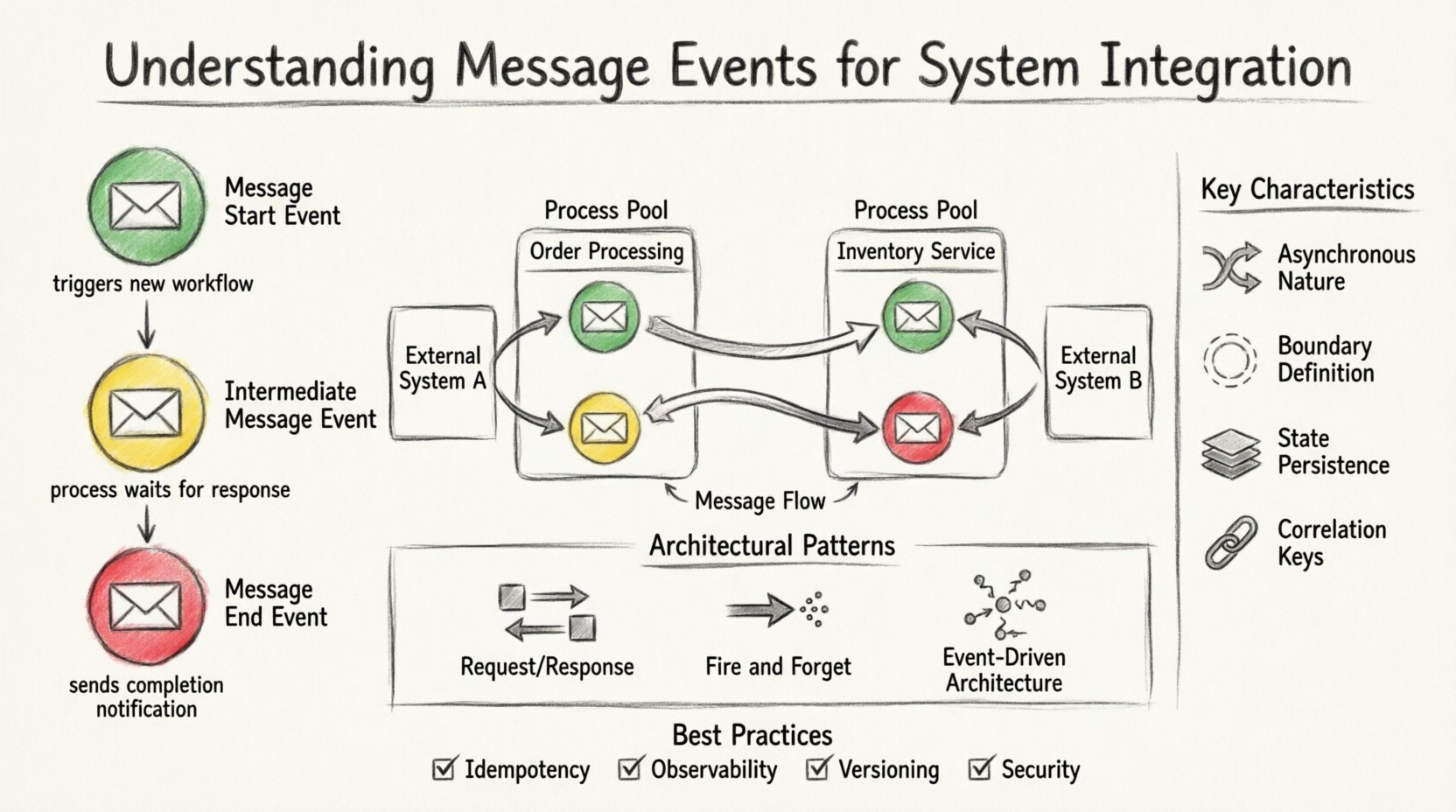
In the landscape of business process automation, communication is the lifeblood of efficiency. When we discuss Business Process Model and Notation (BPMN), one specific mechanism stands out for bridging internal logic with external systems: the message event. These events dictate how a process instance waits for, receives, or sends information across boundaries. Without a clear grasp of message events, integration efforts often become fragile, leading to broken workflows and data inconsistencies.
This guide explores the mechanics of message events, their role in system integration, and how they facilitate asynchronous communication within a process engine. We will examine the lifecycle of these events, the architectural patterns they support, and the best practices required to maintain stability.
Defining Message Events in BPMN 🔍
A message event is a specific type of event that involves the sending or receiving of a message. Unlike sequence flows, which represent the internal flow of control within a single process instance, message flows represent communication between distinct entities. These entities can be different process instances, external systems, or human participants.
The core characteristic of a message event is its ability to trigger a change in state based on external input. This is critical for integration scenarios where a process cannot proceed until a specific condition is met from an outside source. For example, an order processing workflow might pause at a message event until a payment confirmation arrives from a banking system.
Key Characteristics
- Asynchronous Nature: Message events often introduce a delay. The process does not continue until the message is received.
- Boundary Definition: They mark the boundary between the internal process and the external world.
- State Persistence: When a process waits for a message, the engine must persist the state to ensure no progress is lost if the system restarts.
- Correlation: Incoming messages must be matched to the correct process instance, usually via a correlation key.
The Three Core Categories of Message Events 📋
BPMN defines three primary types of message events based on their position and function within a process diagram. Understanding the distinction is vital for designing robust integration logic.
1. Message Start Event 🟢
A message start event initiates a new process instance. It sits at the beginning of a flow and waits for an incoming message to trigger creation. This is common in event-driven architectures where external systems initiate workflows.
- Trigger: An external system sends a payload (e.g., a “New Order” notification).
- Use Case: Webhooks, email triggers, or API callbacks that spawn a new workflow.
- Consideration: The engine must handle high concurrency if multiple messages arrive simultaneously.
2. Intermediate Message Event 🟡
This event occurs inside the process flow, between a start and an end event. It acts as a checkpoint where the process pauses and waits for a message before continuing.
- Trigger: A response to a previous action (e.g., “Credit Check Result”).
- Use Case: Waiting for user approval, database updates, or third-party API responses.
- Consideration: Timeout mechanisms are often required here to prevent indefinite waiting.
3. Message End Event 🔴
Located at the end of a process, a message end event sends a notification as the workflow completes. It signifies the successful transmission of data to an external consumer.
- Trigger: The completion of all internal logic.
- Use Case: Sending a confirmation email, updating a legacy mainframe, or notifying a monitoring dashboard.
- Consideration: Ensure the message is acknowledged before marking the instance as complete.
Message Flow vs. Sequence Flow 🚦
Confusion often arises between message flows and sequence flows. While both connect elements, they represent different layers of abstraction.
| Feature | Sequence Flow | Message Flow |
|---|---|---|
| Scope | Internal to a single process instance | External or between pools |
| Timing | Immediate execution | Asynchronous or delayed |
| Visibility | Hidden from external systems | Visible as an integration contract |
| State Change | Control flow transition | Triggered by external data |
Architectural Patterns for Integration 🔌
When designing systems around message events, specific patterns emerge to handle data exchange efficiently. These patterns dictate how the process engine interacts with other services.
Request/Response Pattern
In this scenario, the process sends a request and waits for a specific response before proceeding. This is often implemented using an Intermediate Catch Message Event.
- The engine sends a message to an external queue or API.
- The process instance enters a waiting state.
- Upon receiving the response, the correlation key matches the instance.
- Flow resumes to the next activity.
Fire and Forget Pattern
Here, the process sends a message but does not wait for a reply. This is typically modeled with a Message Send Event or a Message Start Event that triggers a side effect.
- Useful for notifications or logging.
- Reduces latency for the initiating system.
- Requires separate tracking mechanisms if confirmation is needed later.
Event-Driven Architecture (EDA)
Message events are the cornerstone of EDA. Multiple processes listen for the same event type without knowing about each other.
- Decouples services logically.
- Allows for scalability; more consumers can be added without changing producers.
- Requires careful management of message topics to avoid conflicts.
Handling Asynchronous Boundaries ⏳
Integration often introduces latency. A synchronous call might timeout, or an external system might be unavailable. Managing these asynchronous boundaries is crucial for reliability.
Correlation Keys
When multiple process instances are waiting for messages, the engine must know which message belongs to which instance. A correlation key is a data element (like an Order ID or Transaction Hash) that links the incoming message to the specific process instance waiting for it.
- Uniqueness: Must be unique per instance context.
- Storage: Must be stored persistently in the process database.
- Extraction: Must be extractable from the incoming message payload.
Timeout Handling
What happens if a message never arrives? Relying solely on an indefinite wait is risky. Boundary events can be attached to message events to define timeout behavior.
- Timer Boundary Event: Triggers an alternative flow if the message is not received within a set duration.
- Compensation: If the process is rolled back due to timeout, previous actions must be reversed.
- Alerting: Notify administrators of stalled processes.
Error Management and Compensation ⚠️
Network failures, malformed data, and service outages are inevitable. A robust integration design must account for these failures at the message event level.
Message Validation
Before a process resumes, the incoming message payload should be validated. If the schema is incorrect, the message should be rejected or routed to an error handler.
- Check required fields.
- Validate data types.
- Ensure cryptographic signatures are valid.
Dead Letter Queues
For messages that consistently fail processing, routing them to a dead letter queue preserves the data for manual inspection. This prevents the entire integration pipeline from stalling due to a single bad record.
Retries and Exponential Backoff
When sending messages via a Message End Event, transient failures should be handled automatically.
- Implement retry logic in the adapter layer.
- Use exponential backoff to reduce load on the receiving system during outages.
- Limit the number of retries to prevent infinite loops.
Performance and Scalability Considerations 🚀
High-volume message processing can strain system resources. Understanding how message events affect performance is necessary for large-scale deployments.
Database Locking
When a process waits for a message, the database row for that instance is often locked or held in a specific state. High concurrency can lead to contention.
- Optimize database indexing on correlation keys.
- Use asynchronous polling strategies where appropriate.
- Consider partitioning data by tenant or region.
Memory Footprint
Each active message event waiting for a signal consumes memory. If millions of processes are waiting simultaneously, memory management becomes critical.
- Persist waiting states to disk or external storage.
- Archive completed or expired instances promptly.
- Monitor queue depths for incoming messages.
Best Practices for Robust Workflows 🛡️
To ensure your integration patterns remain stable over time, adhere to these foundational guidelines.
- Idempotency: Design message handlers so that processing the same message multiple times does not cause duplicate side effects.
- Observability: Log all message arrivals, rejections, and timeouts. Visibility is key to troubleshooting.
- Versioning: API contracts change. Ensure message schemas support versioning to handle updates gracefully.
- Security: Encrypt sensitive data in transit. Authenticate all incoming message sources.
- Documentation: Clearly document the expected message format and correlation keys for external developers.
Summary of Integration Scenarios 📊
The table below summarizes common scenarios and the recommended message event strategy.
| Scenario | Recommended Event Type | Key Challenge |
|---|---|---|
| Order Placement | Message Start Event | Handling duplicate triggers |
| Payment Confirmation | Intermediate Catch Event | Timeout and retry logic |
| Shipping Notification | Message End Event | Ensuring delivery guarantee |
| Approval Workflow | Intermediate Catch Event | User availability and state persistence |
Final Thoughts on Workflow Reliability 🏁
Message events are more than just graphical elements in a diagram; they are the implementation of contract boundaries between systems. By treating them as first-class citizens in your architecture, you ensure that your processes can adapt to external changes without breaking.
Focus on correlation, persistence, and error handling. When these elements are solid, the integration becomes transparent to the user, allowing the business logic to flow smoothly regardless of the underlying technical complexity.