


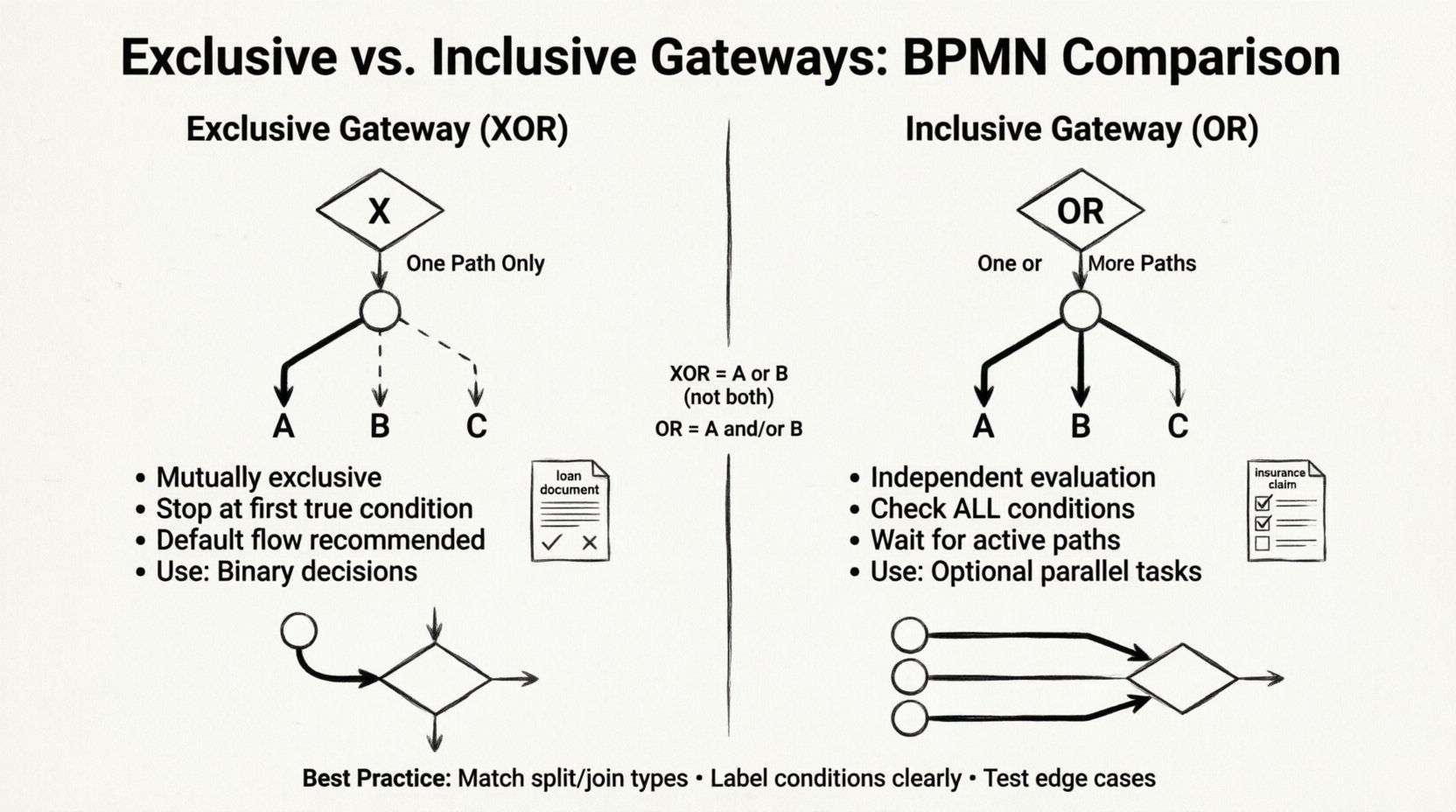
In the world of Business Process Model and Notation (BPMN), the accuracy of a process model depends heavily on how decisions are represented. Process models are not just static diagrams; they are executable specifications that define the flow of work. When a process encounters a branching point, it must determine which path to take. This is where gateways come into play. Specifically, the choice between an Exclusive Gateway and an Inclusive Gateway fundamentally changes how the process behaves under the engine.
Understanding the distinction is not merely academic. Using the wrong gateway can lead to deadlocks, processes that never complete, or tasks that are executed when they should not be. This guide provides a deep technical examination of these two gateway types, exploring their execution logic, common patterns, and the critical nuances that separate them. We will look at how tokens move through the model and how conditions are evaluated.
Understanding Control Flow in BPMN 🔄
Before diving into specific gateway types, it is essential to understand the concept of flow. A BPMN process is a sequence of events and activities connected by sequence flows. A gateway acts as a decision point that controls the divergence or convergence of these flows. It determines whether the flow should split into multiple paths or merge back into a single path.
- Divergence: The point where a single path splits into multiple possible paths.
- Convergence: The point where multiple paths merge back into a single path.
Gateways do not perform work themselves; they only control the sequence of execution. They act as the traffic lights for the process tokens. The token represents the progress of a single process instance. When a token reaches a gateway, the gateway evaluates the conditions on the outgoing sequence flows to decide where to send the token next.
The Exclusive Gateway (XOR) ⚔️
The Exclusive Gateway is perhaps the most common decision point in BPMN. It is often referred to as an XOR gateway. The symbol used is a diamond with an “X” inside it. The core logic of this gateway is strict: only one path can be taken.
Logic and Behavior
When a token arrives at an Exclusive Gateway, the engine evaluates the conditions on each outgoing sequence flow in a specific order or based on priority. The evaluation continues until a condition evaluates to true. Once a true condition is found, the token follows that path, and all other paths are ignored. Crucially, if no condition evaluates to true, the process cannot continue unless a default flow is defined.
- One of Many: Out of all available paths, exactly one must be selected.
- Mutually Exclusive: If path A is selected, paths B and C cannot be selected simultaneously.
- Default Flow: It is best practice to define a default sequence flow. This flow is taken if all other conditions are false.
Common Scenarios
The Exclusive Gateway is ideal for binary decisions or simple choices where only one outcome is possible. Consider a loan application process.
- Approval Check: Is the credit score above 700? If yes, proceed to offer. If no, proceed to decline.
- Document Verification: Has the user uploaded ID? If yes, verify. If no, request document.
In these scenarios, you cannot have both the “Offer” and the “Decline” happen at the same time for a single application instance. The decision is binary or mutually exclusive.
The Inclusive Gateway (OR) 🌐
The Inclusive Gateway offers more flexibility than the Exclusive Gateway. It is often referred to as an OR gateway. The symbol is a diamond with an “OR” inside it. This gateway allows for multiple paths to be activated simultaneously, provided their conditions are met.
Logic and Behavior
When a token arrives at an Inclusive Gateway, the engine evaluates the conditions on all outgoing sequence flows independently. Unlike the Exclusive Gateway, it does not stop after finding the first true condition. It checks all conditions.
- One or More: Any number of paths can be taken, from zero to all of them.
- Independent Evaluation: Each condition is evaluated on its own merit.
- Completion: The gateway waits for all active paths to complete before proceeding to the next step.
This behavior is critical. If you have two outgoing paths and both conditions are true, the process splits into two parallel tokens. These tokens will execute the tasks on their respective paths simultaneously.
Common Scenarios
The Inclusive Gateway is used when tasks are conditional but not mutually exclusive. Consider an insurance claim processing model.
- Damage Assessment: Is there property damage? If yes, send to adjuster.
- Medical Injury: Is there medical injury? If yes, send to medical review.
In this case, a claim can involve both property damage and medical injury. Therefore, both paths must be taken. Alternatively, the claim might involve only property damage. The Inclusive Gateway handles this variability without requiring separate models for every combination.
Side-by-Side Comparison 📊
To clarify the technical differences, we can compare the two gateway types across several dimensions. This table highlights the specific behaviors that dictate when to use which type.
| Feature | Exclusive Gateway (XOR) | Inclusive Gateway (OR) |
|---|---|---|
| Symbol | Diamond with an X | Diamond with OR |
| Paths Activated | Exactly one | One or more |
| Condition Logic | Stop at first true condition | Check all conditions |
| Default Flow | Highly recommended | Optional but useful |
| Joining Behavior | Merges when all paths converge | Waits for all active paths to complete |
| Complexity | Low to Medium | Medium to High |
| Typical Use | Binary choices, simple decisions | Optional parallel tasks, complex conditions |
Execution Mechanics ⚙️
The underlying execution mechanics differ significantly between the two gateway types. Understanding this is vital for debugging process instances.
Token Distribution
In an Exclusive Gateway, the single incoming token is split into exactly one outgoing token. The other paths remain dormant. No tokens are sent down paths where the condition is false. In an Inclusive Gateway, the incoming token can split into multiple tokens. If three conditions are true, three tokens are created and sent down three separate paths. These tokens are independent and proceed to execute their assigned tasks.
Joining Logic
When the paths merge at a joining gateway, the behavior must be consistent with the splitting behavior. For an Exclusive Gateway, a joining Exclusive Gateway waits for the single token that took the path to arrive. For an Inclusive Gateway, a joining Inclusive Gateway acts as a synchronization point. It waits for all tokens that were spawned to complete. If a token was not spawned because the condition was false, that path does not need to complete.
This distinction prevents deadlocks. If you use an Inclusive Split but an Exclusive Join, the process might hang because the Exclusive Join expects exactly one token, but multiple tokens might arrive. Conversely, using an Exclusive Split with an Inclusive Join can cause the process to wait indefinitely for tokens that will never arrive.
Common Pitfalls 🚫
Even experienced modelers can fall into traps when configuring gateways. Below are common mistakes and how to avoid them.
1. Missing Default Flows
With Exclusive Gateways, if all conditions evaluate to false and no default flow is defined, the process instance halts. This is often called a “dead path.” Always define a default flow as a safety net for unexpected data states.
2. Overlapping Conditions
In an Inclusive Gateway, ensure that conditions are not contradictory. While the gateway allows multiple paths, having conditions that logically exclude each other (e.g., “Age > 65” and “Age < 18") might lead to confusion, though the engine will simply process what is true. However, in Exclusive Gateways, overlapping conditions can cause ambiguity if the engine does not have a defined priority order.
3. Confusing Split and Join Types
Do not use an Inclusive Split with an Exclusive Join. This mismatch creates a synchronization error. The Join needs to know how many paths to expect. If you split into two paths, the Join must expect two paths (Inclusive Join).
4. Complex Conditions
Keep gateway conditions simple. Avoid embedding complex scripts or database queries directly into the gateway condition. If the logic is complex, move the decision to a Service Task or a Business Rule Task, and use the gateway only for the resulting boolean output.
Best Practices for Architects 🏗️
To maintain high-quality process models, adhere to the following guidelines.
- Label Clearly: Name your sequence flows with the condition that triggers them (e.g., “Credit Score > 700”). This makes the model self-documenting.
- Use Exclusive for Decisions: If the decision is “A or B, but not both,” use Exclusive.
- Use Inclusive for Options: If the decision is “A and/or B,” use Inclusive.
- Test Edge Cases: When modeling, simulate scenarios where no conditions are met. Ensure the default flow handles this gracefully.
- Minimize Nesting: Avoid nesting gateways too deeply. If you have a gateway inside a gateway, consider if the logic can be simplified into a single decision point.
Final Considerations 🔍
Selecting the correct gateway type is a fundamental aspect of BPMN design. It dictates the control flow, the resource allocation, and the data requirements of the process. An Exclusive Gateway enforces a strict path, ensuring that a process instance follows a single trajectory of decisions. An Inclusive Gateway allows for parallelism and optional task execution, accommodating more complex business realities.
By understanding the mechanics of token splitting, condition evaluation, and joining behavior, you can build process models that are robust and predictable. Always prioritize clarity in your modeling. A process model should be readable by both technical engineers and business stakeholders. When in doubt, review the logic against the business rules. If the rules state that multiple actions must happen simultaneously, the Inclusive Gateway is your tool. If the rules state that only one action is permitted, the Exclusive Gateway is the correct choice.
Continuous refinement of your gateway logic ensures that your automation works as intended. Regularly audit your process models to ensure that conditions remain accurate as business rules evolve. This diligence prevents the accumulation of technical debt in your process infrastructure.