


In the landscape of Business Process Model and Notation (BPMN), orchestrating the flow of work requires precision, especially when dealing with unpredictable external factors. Standard sequence flows assume immediate execution, but real-world business rarely operates on such a rigid timeline. This is where the Event-Based Gateway becomes a critical tool. It allows a process instance to wait for a specific condition or signal before proceeding. Understanding when to implement this construct and how to configure it correctly is essential for building resilient, asynchronous workflows.
Understanding the Core Concept 🧠
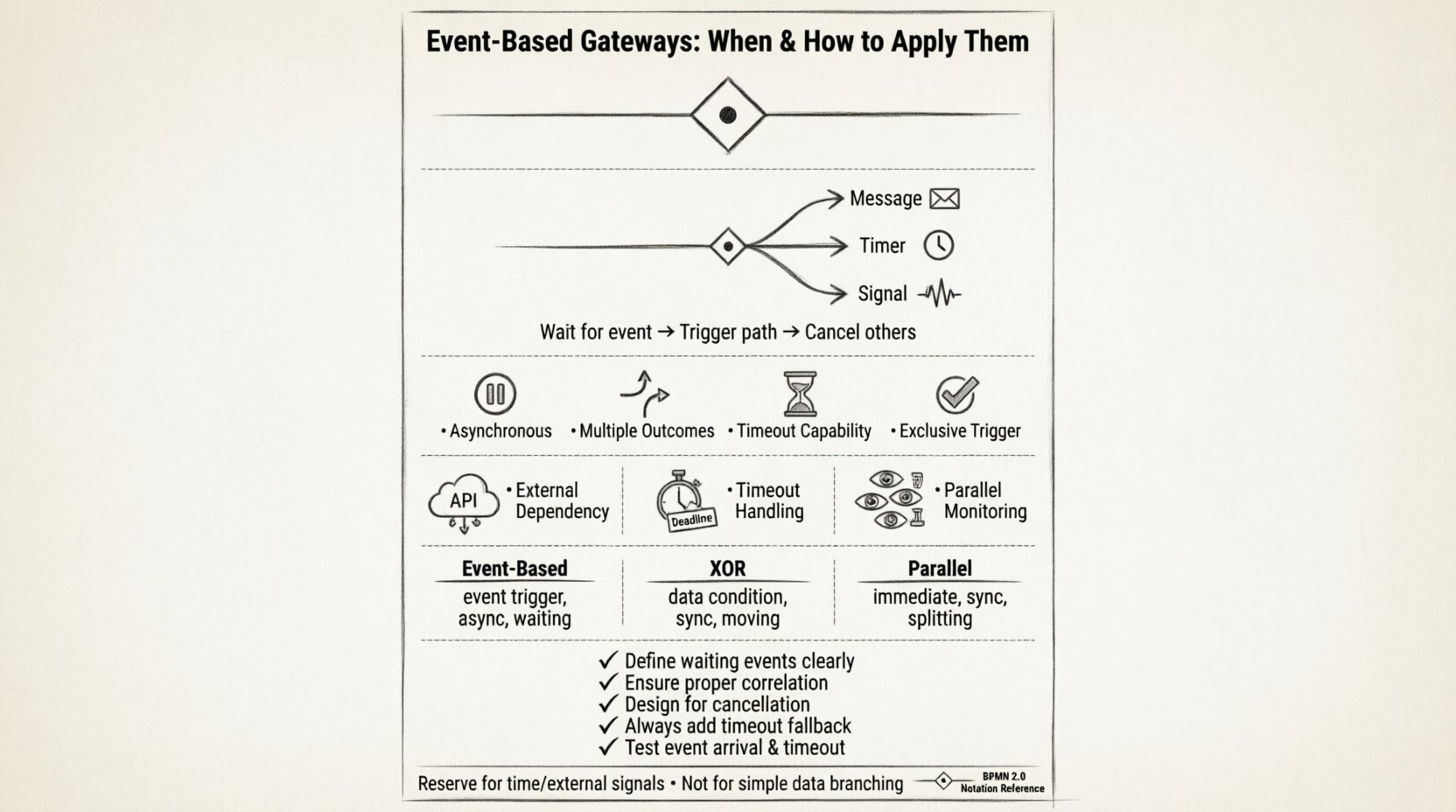
An Event-Based Gateway acts as a fork in the road where the path is determined not by a decision condition (like a XOR Gateway), but by the arrival of an event. Unlike a standard Gateway that evaluates data immediately, an Event-Based Gateway suspends the flow at that point. The engine waits for one of the connected events to occur. Once an event is triggered, the gateway terminates the waiting state and continues the process flow through the corresponding path.
This mechanism is vital for handling scenarios where the system cannot predict timing. It introduces a state of waiting without halting the entire process engine. The gateway itself does not contain logic for evaluation; it relies entirely on the event definitions attached to its outgoing sequence flows.
Key Characteristics
- Asynchronous Nature: The process instance remains active but paused at the gateway.
- Multiple Outcomes: Multiple events can be attached, but only one will trigger the flow.
- Timeout Capability: A timer event is often the default safeguard to prevent indefinite waiting.
- Exclusive Triggering: Once one event fires, all other waiting events associated with that gateway instance are canceled.
Common Application Scenarios 📅
Deciding to use an Event-Based Gateway depends on the specific requirements of the business logic. It is not a replacement for standard gateways but a specialized solution for specific temporal dependencies.
1. Handling External Dependencies ⏳
Many business processes require input from outside the system. For example, a loan approval process might need to wait for a credit check result from an external bureau. Using a standard sequence flow here would block the system. An Event-Based Gateway allows the process to pause until the external signal is received.
- Scenario: Application submitted. Process waits for Credit Check Response.
- Flow: Gateway waits. Event received? Yes -> Continue to Approval. No -> Timeout.
- Benefit: The process remains in the database, ready to resume, without consuming continuous execution threads.
2. Implementing Timeouts ⏱️
Timeouts are perhaps the most common use case. A process might need to wait for a response, but if that response does not arrive within a specific window, a fallback action must occur. This prevents processes from hanging indefinitely.
- Scenario: Order confirmation email sent. Wait for customer reply.
- Flow: Gateway waits for ‘Reply Received’ or ‘7 Days Elapsed’.
- Outcome: If 7 days pass, the ‘Timeout’ event triggers, and the order is cancelled automatically.
3. Parallel Event Monitoring 🚦
Sometimes, a process needs to monitor multiple distinct events simultaneously. This is useful in compliance or safety workflows where multiple signals must be tracked before a final state is reached.
- Scenario: Security clearance process.
- Flow: Wait for ‘Background Check Complete’ OR ‘Reference Check Complete’ OR ‘ID Verification Complete’.
- Logic: The first one to finish triggers the next step. The others are discarded.
Structuring the Logic: A Comparative View 📊
Choosing between an Event-Based Gateway and other control flow elements can be confusing. The table below outlines the distinctions to help clarify the decision-making process.
| Feature | Event-Based Gateway | XOR Gateway | Parallel Gateway |
|---|---|---|---|
| Trigger | External Event or Timer | Data Condition (Expression) | Immediate Execution |
| Timing | Asynchronous (Delayed) | Synchronous (Instant) | Synchronous (Instant) |
| Process State | Suspended (Waiting) | Active (Moving) | Active (Moving) |
| Use Case | Waiting for input/time | Branching logic | Splitting/Joining flows |
Implementation Guidelines 🔧
When designing a process model, follow these steps to ensure the Event-Based Gateway functions correctly. This approach avoids common configuration errors that lead to process bottlenecks.
1. Define the Waiting Events Clearly
Every outgoing sequence flow from the gateway must have a specific event attached. This is a requirement of the BPMN specification. You cannot have a plain sequence flow connected to an Event-Based Gateway.
- Timer Events: Use a specific duration (e.g., 2 hours) or a date-time expression.
- Message Events: Specify the message name and correlation key.
- Signal Events: Useful for broadcasting to multiple instances, though less common for single-instance waiting.
2. Ensure Proper Correlation
For message events, the engine must know which process instance to wake up. This is handled via correlation keys. If the correlation logic is missing, the event will not trigger the specific instance waiting at the gateway.
- Best Practice: Use a unique identifier from the initiating data object as the correlation key.
- Verification: Ensure the incoming message payload matches the expected key format.
3. Design for Cancellation
When one event triggers, the others must be cancelled to prevent resource leaks. Most engines handle this automatically, but the model must reflect this intent.
- Implicit Cancellation: The gateway terminates the waiting state once one path is taken.
- Explicit Cleanup: If the process continues after the gateway, ensure no lingering threads are left behind.
Performance and Scalability Considerations ⚙️
While Event-Based Gateways are powerful, they impact the performance of the process engine differently than standard flows. Understanding these impacts is crucial for high-volume environments.
Database Load
Every waiting process instance represents a record in the database that remains active. If thousands of instances are waiting for a timeout, the database must maintain these states efficiently.
- Impact: High concurrency of waiting instances can increase query load.
- Mitigation: Use appropriate database indexing on the process instance ID and event correlation keys.
Cleanup Mechanisms
Engine schedulers must scan for expired timers to wake up the correct instances. If the engine is under heavy load, this scanning might introduce latency.
- Optimization: Adjust the scheduler frequency based on the criticality of the timeout.
- Architecture: In distributed systems, ensure the event listener is distributed across nodes to avoid a single bottleneck.
Common Pitfalls and How to Avoid Them ⚠️
Even experienced architects make mistakes when implementing asynchronous flows. Reviewing these common errors can save significant debugging time.
1. The Infinite Wait
Failing to include a timeout event is a frequent oversight. If the external event never arrives, the process hangs forever.
- Solution: Always add a timer event as a fallback path, even if the probability of failure is low.
2. Incorrect Event Placement
Placing an Event-Based Gateway immediately after a task that expects immediate completion can cause race conditions.
- Solution: Ensure the preceding task has fully committed its data before the gateway begins waiting.
3. Overusing the Gateway
Do not use an Event-Based Gateway for simple data branching. If the decision depends on data that is already available, use an XOR Gateway instead.
- Solution: Reserve Event-Based Gateways for scenarios involving time or external signals.
4. Ignoring Error Handling
What happens if the waiting event fails? For example, if a message is sent but the delivery fails?
- Solution: Implement error handling paths or boundary events on the tasks preceding the gateway to catch failures before they reach the waiting state.
Advanced Patterns for Complex Workflows 🧩
For more sophisticated requirements, Event-Based Gateways can be combined with other constructs to create robust patterns.
Event Sub-Processes
Instead of placing the gateway in the main flow, an Event Sub-Process can be attached to a task. This allows the entire sub-process to wait for an event, and if triggered, interrupts the main task. This is useful for handling interruptions like ‘User Cancellation’ while a task is in progress.
- Use Case: Canceling a long-running approval task if a manager intervenes.
- Benefit: Keeps the main flow clean and encapsulates the waiting logic.
Multi-Instance Gateways
In scenarios where multiple users need to wait for a collective event, the gateway can be part of a loop. Each instance waits, and the system aggregates the results once the threshold is met.
- Use Case: Waiting for a majority vote from a committee.
- Benefit: Allows for flexible group dynamics without hard-coding the number of participants.
Final Thoughts on Process Design 🎯
Integrating Event-Based Gateways requires a shift in mindset from sequential execution to event-driven orchestration. It acknowledges that business processes exist in a world of delays, failures, and external inputs. By planning for these realities, you create systems that are not only functional but also resilient.
When designing your models, ask yourself: Does this step require data that might not exist yet? Is there a time limit for this action? If the answer is yes, an Event-Based Gateway is likely the correct choice. Avoid over-complicating the flow with unnecessary waiting states, but never ignore the possibility of delay.
Remember that the goal is clarity. A well-structured process model should be understandable by both technical developers and business stakeholders. Using the gateway correctly enhances this clarity by explicitly marking points where the system must pause and listen.
Summary Checklist ✅
- Identify Needs: Confirm if the flow requires waiting for external input or time.
- Select Gateway: Choose Event-Based over XOR or Parallel based on the trigger type.
- Define Events: Attach specific timers or messages to all outgoing paths.
- Add Fallbacks: Always include a timeout to prevent infinite waiting.
- Test Thoroughly: Verify that the process resumes correctly when events arrive and that timeouts fire as expected.
By adhering to these principles, you ensure that your process automation remains efficient, reliable, and aligned with the actual rhythms of business operations.