


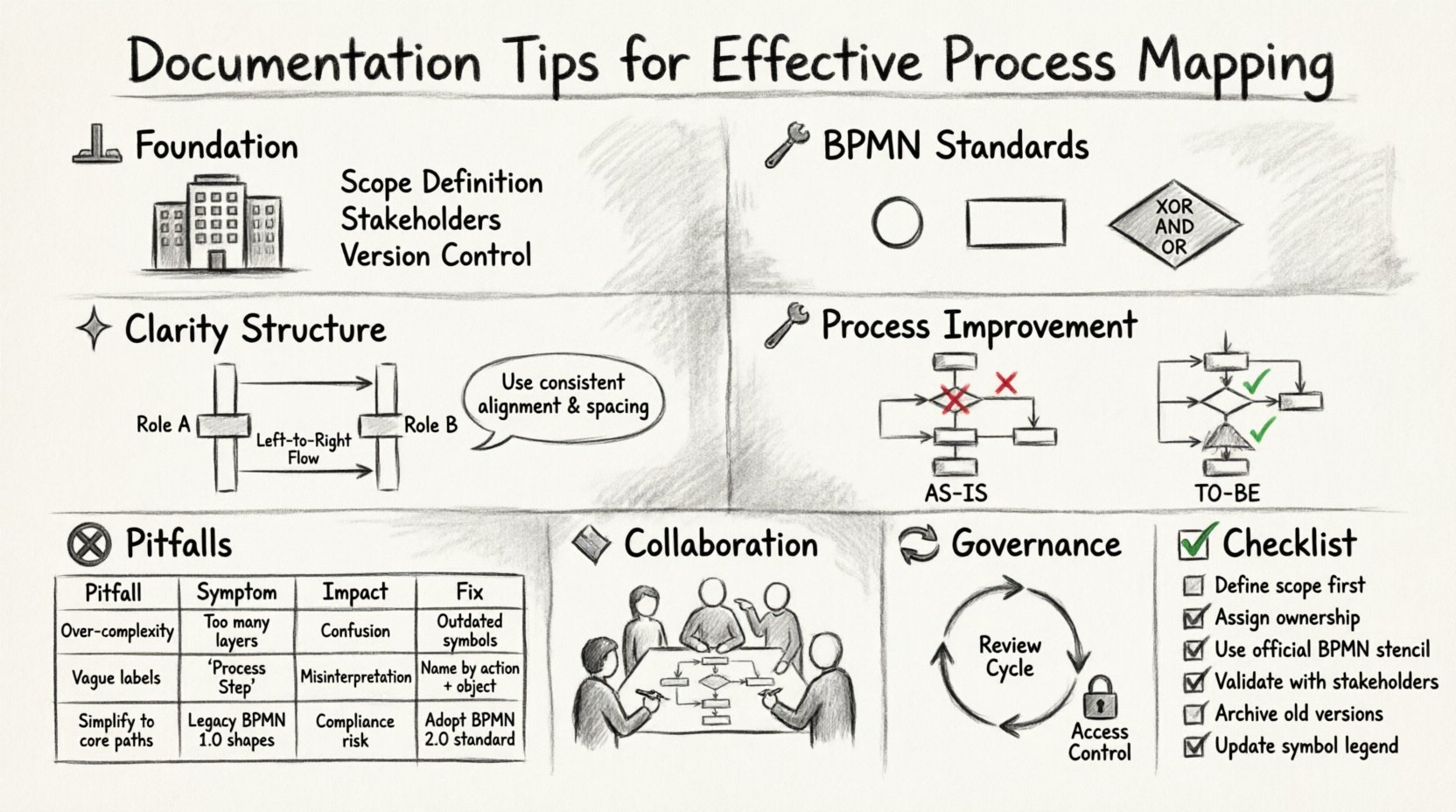
In the complex world of business operations, clarity is currency. When workflows become opaque, inefficiencies hide in plain sight. Effective process mapping is not just about drawing lines between boxes; it is about creating a reliable blueprint for how work actually happens. This guide focuses on documentation tips for effective process mapping, specifically within the context of Business Process Model and Notation (BPMN). By adhering to rigorous documentation standards, organizations can ensure that their operational logic is communicated clearly across teams, departments, and stakeholders.
Documentation serves as the single source of truth. Without it, knowledge remains trapped in the minds of individuals. With it, processes become assets that can be analyzed, improved, and automated. This article explores the mechanics of creating robust process maps that stand the test of time.
Understanding the Foundation of Process Documentation 🏗️
Before sketching a single shape, one must understand the purpose of the documentation. A process map is a visual representation of a sequence of activities. However, the quality of that representation depends entirely on the documentation surrounding it. Good documentation provides context, definitions, and rules that the visual elements alone cannot convey.
- Scope Definition: Clearly define where the process starts and where it ends. A common error is creating a map that is too broad, leading to confusion, or too narrow, missing critical dependencies.
- Stakeholder Identification: Document who owns the process, who performs the tasks, and who receives the output. This creates accountability.
- Version Control: Processes evolve. Documentation must reflect the current state. Implementing a versioning system ensures that historical changes are tracked without losing the current workflow integrity.
Adhering to BPMN Standards 🛠️
Business Process Model and Notation (BPMN) is the industry standard for process mapping. While many tools exist, the notation itself is universal. Using standard symbols ensures that anyone familiar with BPMN can read the map without needing a custom legend.
1. Event Types 🎯
Events are the triggers or results of a process. They are depicted as circles. Documentation should specify the type of event clearly:
- Start Event: The green circle indicating the beginning of the flow.
- End Event: The red circle indicating the termination of the flow.
- Intermediate Event: The thin circle between activities, representing delays, messages, or errors.
2. Activities and Tasks ⚙️
Activities represent work. In documentation, ensure that task descriptions are action-oriented. Avoid vague terms like “handle” or “do.” Instead, use specific verbs such as “verify,” “approve,” or “generate.” This reduces ambiguity for the reader.
3. Gateways and Logic 🚦
Gateways control the flow of the process. They determine how the path splits or merges. Accurate documentation of gateway logic is critical for understanding decision-making paths.
- Exclusive Gateway: Only one path is taken (XOR).
- Parallel Gateway: All paths are taken simultaneously (AND).
- Inclusive Gateway: One or more paths may be taken (OR).
When documenting these elements, explicitly state the conditions for each outgoing sequence flow. Do not rely on the reader to guess the logic.
Structuring Information for Clarity ✨
A map that is difficult to read is a map that will not be used. Structure is as important as the symbols used. Visual hierarchy guides the eye through the complexity of a workflow.
Use of Swimlanes
Swimlanes organize processes by role or system. They clarify who does what. When documenting, ensure that the lane headers are descriptive. If a task spans multiple lanes, document the handoff points explicitly. This prevents “throw it over the wall” scenarios where accountability is lost.
Annotations and Text
Not everything needs a symbol. Sometimes, a text annotation is the most efficient way to convey information. Use annotations for:
- Complex business rules that do not fit into standard shapes.
- References to external documents or policies.
- Clarifications on data requirements for specific tasks.
Consistency in Layout
Ensure that all process maps within an organization follow a consistent layout convention. Arrows should flow generally from top to bottom or left to right. Avoid crossing lines where possible, as this creates visual noise. If lines must cross, use a bridge symbol to indicate they do not connect.
The Role of Documentation in Process Improvement 📈
Process mapping is rarely a one-time activity. It is a tool for continuous improvement. The documentation generated during mapping serves as a baseline for analysis.
Identifying Bottlenecks
When reviewing a map, look for areas where work accumulates. Documentation should highlight wait times, decision delays, or rework loops. By annotating these areas with data (e.g., average time spent), the map becomes a diagnostic tool rather than just a picture.
Gap Analysis
Compare the documented “As-Is” process against the desired “To-Be” state. Documentation should clearly list the differences. This gap analysis drives the implementation of changes. It ensures that improvements are based on reality, not assumptions.
Collaboration and Review Processes 🤝
No single person knows the entire process. Effective documentation requires collaboration. The creation of a process map should involve the people who actually perform the work.
- Walkthroughs: Conduct walkthroughs with process owners and participants. Ask them to trace the path on the map. If they stumble, the documentation needs refinement.
- Feedback Loops: Establish a mechanism for users to suggest updates. Processes change due to new regulations, software updates, or market shifts.
- Approval Workflows: Document the approval chain for the map itself. Who is authorized to sign off on a change? This maintains the integrity of the documentation.
Common Pitfalls to Avoid 🚫
Even with the best intentions, errors occur. Being aware of common pitfalls helps maintain high-quality documentation.
| Pitfall | Impact | Correction Strategy |
|---|---|---|
| Over-Complexity | Readers cannot follow the flow. | Use sub-processes to simplify high-level maps. |
| Missing Endpoints | Process appears to go on forever. | Ensure every path leads to a defined end event. |
| Vague Labels | Tasks are ambiguous. | Use specific verbs and measurable outcomes. |
| Outdated Symbols | Confusion regarding notation. | Adhere strictly to BPMN 2.0 standards. |
| Ignoring Exceptions | Map fails in real-world scenarios. | Document error handling and alternative paths. |
Maintenance and Governance 🔄
Documentation is a living asset. It requires governance to remain useful. Without a maintenance strategy, maps become obsolete quickly.
Review Cycles
Establish a schedule for reviewing process maps. Quarterly or bi-annual reviews are common. During these reviews, verify that the map matches current reality. If a task has been automated, update the symbol to reflect that change. If a role has changed, update the swimlane.
Access Control
Not everyone needs to edit the maps. Define who has read-only access and who has edit permissions. This prevents accidental overwrites and maintains the stability of the documentation repository.
Integration with Knowledge Bases
Process maps should not exist in isolation. Link them to related documentation such as Standard Operating Procedures (SOPs), policy documents, and training materials. This creates a connected ecosystem of information where users can find the visual map and the detailed instructions in one place.
Checklist for Process Documentation Review ✅
Before publishing a process map, run it through this checklist to ensure quality.
- Does the map start and end clearly?
- Are all BPMN symbols used correctly?
- Is the text legible and concise?
- Are all decision points labeled with conditions?
- Are swimlanes labeled with the correct roles?
- Is the version number and date included?
- Have stakeholders reviewed the accuracy?
- Are exceptions and error paths documented?
- Is the file stored in the correct repository?
- Is there a contact person for questions?
The Human Element of Technical Documentation 👥
While BPMN is technical, the audience is human. Documentation tips must account for how people read and interpret information. Cognitive load is a factor. A map with too many details overwhelms the reader. A map with too little leaves them guessing.
Balance is key. High-level maps should focus on the flow of value. Detailed maps should focus on the specific actions and rules. By segmenting documentation based on the audience’s needs, you ensure that the information is digestible. Executives need the high-level view to understand strategy. Operators need the detailed view to execute tasks.
Furthermore, language matters. Avoid jargon that is not universally understood. If a specific term is used, define it in a glossary or within the map annotations. Consistency in terminology builds trust in the documentation.
Conclusion on Best Practices 🌟
Effective process mapping documentation is the backbone of operational excellence. It transforms abstract workflows into tangible assets that can be managed and improved. By following BPMN standards, maintaining clarity, and establishing governance, organizations can ensure their process maps remain accurate and useful.
Remember that documentation is not a destination; it is a journey. It requires ongoing attention and collaboration. When teams commit to high-quality documentation, they invest in their own efficiency and the clarity of their business operations. This investment pays dividends in reduced errors, faster training, and smoother execution.
Start with the fundamentals. Define your scope. Use the right symbols. Review with stakeholders. And maintain the maps over time. These steps create a robust foundation for any business process initiative.