


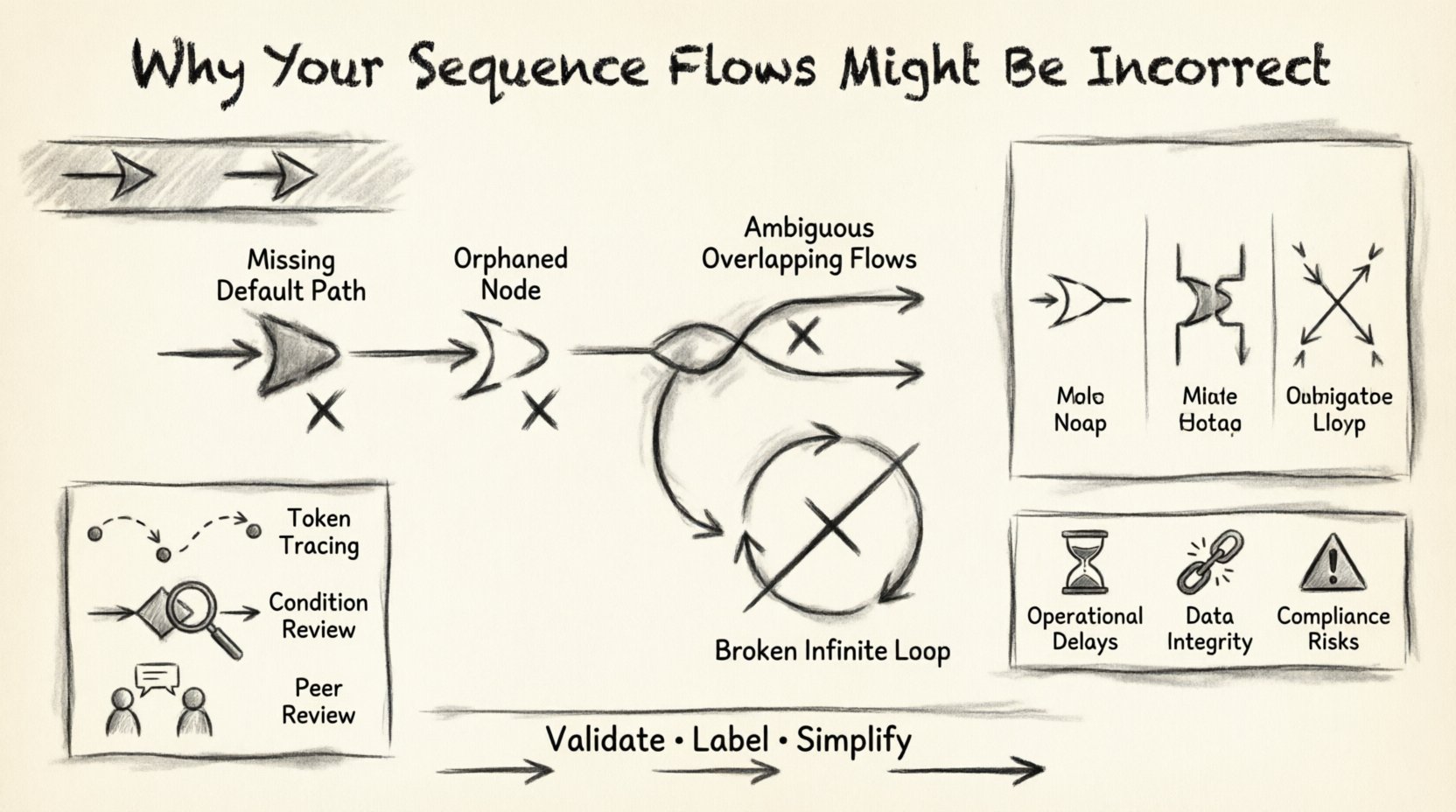
In the intricate landscape of business process modeling, the sequence flow acts as the backbone of logic. It dictates the order in which tasks occur, ensuring that information moves from one stage to the next without interruption. However, when these flows are misconfigured, the entire process model becomes unreliable. This guide explores the technical reasons behind incorrect sequence flows in BPMN and provides a framework for identifying and resolving these issues.
🔍 The Role of Sequence Flow in Process Logic
A sequence flow is a directional arrow that connects activities, gateways, and events within a diagram. It represents the control flow, determining the path a token takes through the model. Unlike data flows, which show information movement, sequence flows govern the timing and order of execution. When a modeler draws a sequence flow, they are making a definitive statement about causality.
If the sequence flow is incorrect, the simulation or execution engine may behave unpredictably. This can lead to tasks being skipped, executed out of order, or repeated indefinitely. Understanding the mechanics of how these flows interact with gateways is essential for maintaining model integrity. Every arrow drawn must serve a specific purpose in the logical progression of the business event.
🛠 Common Structural Errors
Errors in sequence flow often stem from a lack of clarity regarding the specific requirements of the process. Below are the most frequent structural mistakes encountered during modeling.
- Missing Default Paths: Exclusive gateways require a default condition if none of the specific outgoing conditions are met. Without this, the process may halt unexpectedly when a condition is false.
- Disconnected Nodes: A sequence flow must always connect two nodes. Orphaned activities or events that are not reached by any flow create dead ends in the process.
- Incorrect Gateway Connections: Connecting an inclusive gateway to an exclusive gateway without proper data handling can cause logic conflicts. The token type must match the gateway expectations.
- Overlapping Flows: Two sequence flows connecting the same two nodes without distinct conditions can create ambiguity about which path the process should take.
- Broken Cycles: Unintended loops can occur if a flow returns to a previous task without a proper exit condition, leading to infinite execution cycles.
🧩 Gateway Logic Misinterpretations
The complexity of BPMN often lies in the gateways. These elements decide how the token splits or merges. Misinterpreting their behavior is a primary cause of incorrect sequence flows.
Exclusive vs. Inclusive Gateways
An exclusive gateway routes a token down one path based on a boolean condition. An inclusive gateway allows for multiple paths to be taken simultaneously if conditions are met. Confusing these two leads to significant logical errors.
- Exclusive Gateway Pitfall: If you use an exclusive gateway to handle mutually exclusive events, ensure the conditions cover all possibilities. If condition A is false and condition B is false, the process stops.
- Inclusive Gateway Pitfall: If you use an inclusive gateway, ensure the conditions are not mutually exclusive. If both are true, both paths activate. If the process expects only one to activate, the flow is incorrect.
Parallel Gateway Synchronization
Parallel gateways split the token into multiple concurrent paths. To complete the process, these paths must synchronize at the end of the parallel block. A common error is failing to place a join gateway at the end of the parallel split.
- Orphaned Threads: If a parallel branch does not join back to the main flow, the token remains stuck in that branch.
- Missing Join: If the join gateway is placed incorrectly, subsequent tasks may execute before all parallel tasks are finished.
📊 Diagnostic Comparison Table
Use the following table to compare correct modeling practices against common errors.
| Scenario | Correct Approach | Incorrect Approach | Consequence |
|---|---|---|---|
| Exclusive Gateway | Include a default condition for all unmatched cases. | Only define conditions for known outcomes. | Process halts if a new condition arises. |
| Parallel Split | Ensure all branches eventually join. | Leave one branch without a join. | Token is stranded; task never completes. |
| Event Subprocess | Ensure the trigger event is clearly defined. | Use a sequence flow to enter the subprocess. | Subprocess triggers unexpectedly or not at all. |
| Data Object Link | Link data objects to tasks using association. | Link data objects using sequence flows. | Execution flow is confused by data dependency. |
| Message Flow | Use message flow for boundary interactions. | Use sequence flow for external communication. | Process model violates namespace boundaries. |
📉 The Impact of Incorrect Flows
When sequence flows are flawed, the impact extends beyond the diagram. It affects the operational reality of the business process.
Operational Delays
If a flow forces a task to wait for a condition that never becomes true, the process stalls. This creates bottlenecks where work accumulates. Stakeholders may not realize the delay is due to a modeling error rather than a resource issue.
Data Integrity Issues
Incorrect flows often bypass validation steps. For example, if a sequence flow skips a review task, incorrect data might proceed to the next stage. This compromises the quality of the output and can lead to compliance violations.
Audit and Compliance Risks
In regulated industries, the process model serves as evidence of control. If the model shows a flow that does not match the actual execution, audits will fail. The discrepancy between the diagram and the reality creates a significant trust gap.
🛡 Validation Strategies
To prevent sequence flow errors, adopt a rigorous validation strategy. This involves reviewing the model from multiple angles before deployment.
- Token Tracing: Simulate the process with a token. Trace the path manually to ensure it reaches the end event without getting stuck.
- Condition Review: Check every outgoing sequence flow from a gateway. Do the conditions cover all logical possibilities?
- Peer Review: Have a colleague review the diagram. Fresh eyes often spot missing connections or ambiguous flows.
- Boundary Testing: Test the process with edge cases. What happens if a condition is false? What if data is missing?
- Consistency Check: Ensure that all sequence flows follow the direction of time. Backward flows are generally indicators of errors unless modeling a specific exception.
🔄 Looping and Iteration Logic
Loops are necessary for repetitive tasks, but they are prone to error. A sequence flow that creates a loop must have a clear exit condition.
While Loops
When modeling a while loop, the condition must be evaluated before the task repeats. If the condition is placed after the task, the task executes at least once regardless of the requirement.
Do-While Logic
In scenarios where a task must run at least once, the sequence flow should return to the task only if the exit condition is not met. If the logic is inverted, the task might run indefinitely.
🔗 Handling Multiple Outcomes
Complex processes often require branching based on multiple data attributes. Using a single gateway for multiple conditions can become unmanageable.
- Decision Table: Consider using a decision table to map conditions to paths. This reduces the visual clutter of sequence flows.
- Intermediate Events: Use intermediate events to handle exceptions. Instead of a complex sequence flow branching out for every error, route errors to an exception handler.
- Subprocesses: If a branch becomes too complex, encapsulate it in a subprocess. This keeps the main sequence flow clean and focused.
📝 Ensuring Model Clarity
Clarity is the ultimate goal of any model. If a sequence flow is difficult to understand, it is likely incorrect or at least poorly designed.
- Labeling: Label every sequence flow that leaves a gateway with the condition. Do not rely on the reader to guess the logic.
- Layout: Arrange the diagram so that the primary flow moves from left to right. Avoid crossing lines where possible.
- Color Coding: While styling is optional, using colors to distinguish between normal flow and exception flow can improve readability.
🚀 Moving Forward with Accuracy
Achieving accuracy in BPMN requires discipline and attention to detail. By understanding the mechanics of sequence flows, you can build models that truly reflect the business reality. Regular audits of the process models ensure that they remain accurate as the business evolves.
Focus on the logic rather than the aesthetics. A beautiful diagram with broken flows is worse than a simple one with correct logic. Prioritize the correctness of the token movement above all else. This ensures that the process execution engine can interpret the model as intended, leading to smoother operations and better business outcomes.
Remember that modeling is an iterative process. You will likely find errors in your initial drafts. That is part of the refinement process. The goal is to reach a state where the sequence flows are robust, logical, and easy to follow. With careful validation and adherence to standards, your process models will stand as reliable tools for optimization and automation.