


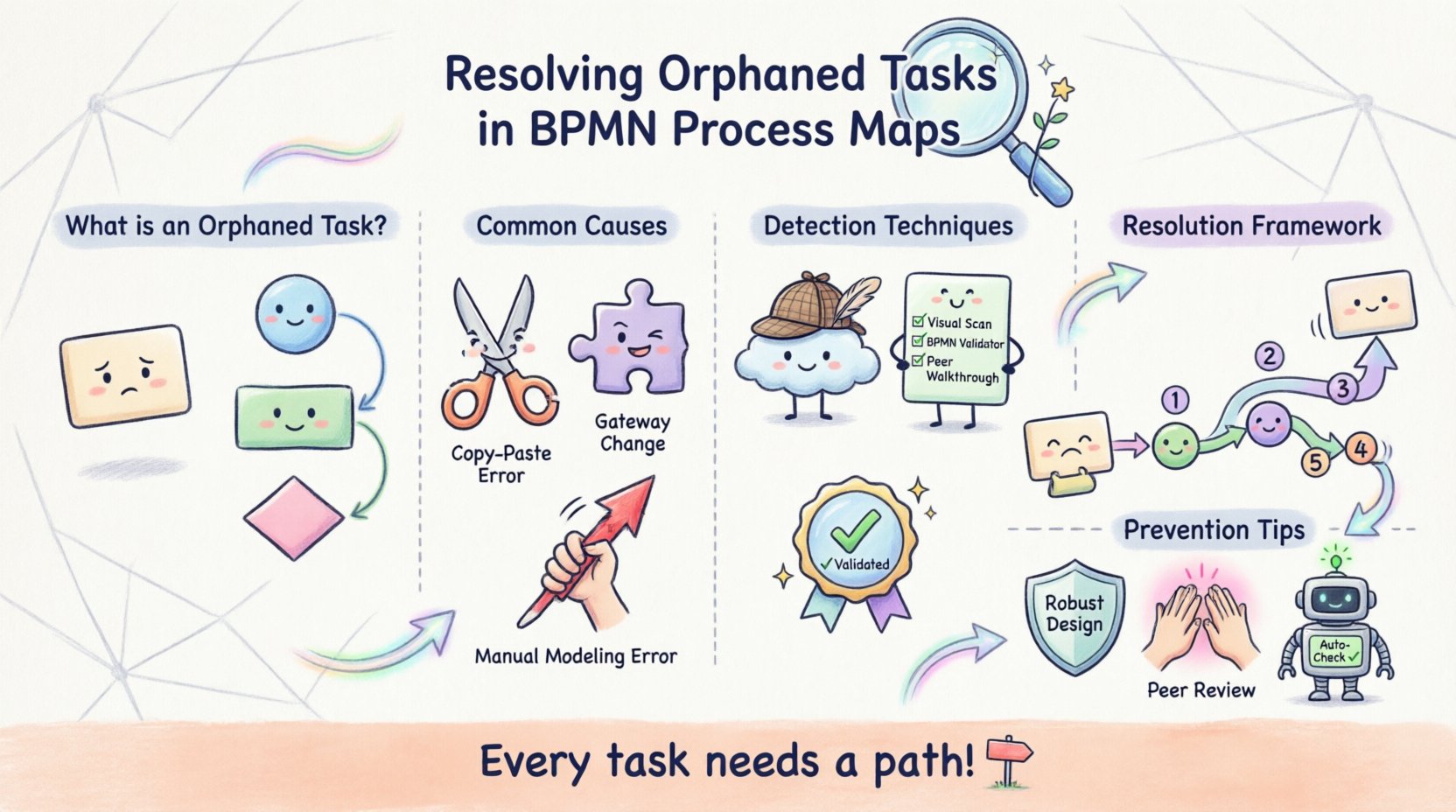
In business process modeling, integrity is paramount. When a sequence of activities is disrupted, the entire workflow risks failure. One of the most persistent structural issues in Business Process Model and Notation (BPMN) is the existence of orphaned tasks. These are elements within a diagram that lack incoming connections, creating dead ends in the logic flow. This guide details the mechanics of identifying, resolving, and preventing disconnected tasks within process maps.
🔍 What Defines an Orphaned Task in BPMN?
An orphaned task, often referred to as a disconnected element, is a node in the process map that has no incoming sequence flow or message flow. In standard modeling standards, every activity should be reachable from a start event. If a task sits in isolation or at the end of a dead path without a preceding trigger, it cannot execute. This is not merely a cosmetic issue; it represents a logical break in the control flow.
Consider the lifecycle of a work item. It begins at a start event, moves through gateways, passes through tasks, and concludes at an end event. If a task is orphaned, the engine or the human operator has no mechanism to initiate that specific step. This leads to incomplete processes where specific data or actions are skipped entirely.
- Start Event: The trigger point for the process.
- Sequence Flow: The arrow indicating the direction of movement.
- Orphaned Task: A task node with zero incoming arrows.
Orphaning can occur in various forms. It might be a single task floating in the center of the canvas. It might be a group of tasks that branch off from a gateway but are not connected to the main flow. It might even be a subprocess that is not linked to the parent process correctly.
📉 Why Connectivity Matters in Workflow Integrity
The primary function of a process map is to define order. When connectivity is broken, the definition fails. The consequences of unresolved orphaned tasks extend beyond the diagram itself.
1. Execution Failures
Automated engines rely on explicit paths. If the logic does not point to a task, the engine will not create a work item for it. In human-centric processes, operators may skip steps they do not see or cannot find, leading to procedural deviations.
2. Data Integrity Risks
Tasks often involve data transformation or storage. If a task is orphaned, the data it is supposed to process is never handled. This creates gaps in the audit trail. Critical fields may remain null, or required approvals may be missed.
3. Compliance and Audit Issues
Regulatory frameworks often require a complete record of every step in a transaction. An orphaned task indicates a missing step in the control environment. Auditors flagging disconnected nodes can result in non-compliance findings. This is particularly critical in finance, healthcare, and legal domains where process adherence is mandatory.
4. Maintenance Complexity
As processes evolve, disconnected elements become technical debt. Future modelers may attempt to connect to these tasks, inadvertently creating circular references or confusing logic. Cleaning them up early reduces long-term maintenance costs.
🔎 Common Causes of Disconnected Elements
Understanding the origin of orphaned tasks helps in preventing them. The causes usually stem from human error during the modeling phase rather than system limitations.
- Copy and Paste Errors: Duplicating a subprocess often breaks the incoming connection. The copy retains the internal logic but loses the link to the parent flow.
- Gateway Logic Changes: When modifying a decision gateway, the outgoing path might be deleted, leaving the downstream task without a parent.
- Manual Drawing: Drawing arrows without snapping to the target node results in a visual gap that looks connected but is logically broken.
- Subprocess Integration: Moving a subprocess into a new location often requires re-establishing the boundary connection. Failing to do this leaves the internal tasks orphaned relative to the new context.
- Removed Start Events: Deleting a start event without adjusting downstream flows can leave the immediate successor as an orphan.
Table: Common Causes and Indicators
| Cause | Indicator | Typical Fix |
|---|---|---|
| Deleted Gateway Path | Task has no arrow entering from the left | Reconnect from the gateway or add new flow |
| Copy-Paste Subprocess | Internal tasks visible, external link missing | Connect subprocess boundary to flow |
| Visual Drawing Error | Arrow looks connected but snaps away | Use snapping tools to verify connection |
| Isolated Task Creation | Task exists but no flow touches it | Link to previous task or start event |
🛠️ Detection Techniques for Model Audits
Before resolution, identification is required. Manual inspection is effective for small diagrams, but larger maps require systematic approaches.
1. Visual Inspection
Review the diagram from the start event outward. Trace every path. If you encounter a node with no incoming line, mark it. This is the most basic form of validation but is prone to human oversight in complex maps.
2. Logic Tracing
Follow the logic from the entry point. If a branch splits, ensure every branch connects to a valid next step. If a branch leads to a task that does not lead anywhere, that task is a dead end, which may be intentional or an orphan.
3. Validation Rules
Many modeling tools offer built-in validation. These rules check for missing flows, unconnected tasks, and invalid gateways. Running these checks before saving the model is a standard best practice.
4. Runtime Simulation
Executing a process instance can reveal orphaned tasks. If the process stops unexpectedly or skips steps, it indicates a broken flow. Runtime logs showing missing task instances can help pinpoint the location of the issue.
🔧 Step-by-Step Resolution Framework
Once an orphaned task is identified, it must be integrated back into the flow or removed if it is no longer relevant. The following framework ensures a systematic approach to fixing the model.
- Identify the Task: Locate the specific node causing the issue. Note its type (User Task, Service Task, Subprocess).
- Trace the Origin: Determine where this task logically belongs. Does it follow a specific decision point? Does it follow a data input?
- Select the Source: Identify the correct upstream element. This could be a Start Event, another Task, a Gateway, or a Message Flow.
- Establish the Connection: Draw the sequence flow. Ensure the arrowhead points correctly to the task. Verify that the connection snaps and does not overlap incorrectly.
- Validate the Logic: Ensure the new connection does not create a loop or conflict with existing gateways.
- Document the Change: Record the modification in the version history. Note why the change was made to assist future auditors.
Handling Unneeded Tasks
Sometimes, the task is orphaned because it is obsolete. If a step was removed from the business process, the task should be deleted from the map. Leaving it as an orphan creates confusion. If it must remain for historical reference, move it outside the main flow and label it clearly as inactive.
🛡️ Preventive Measures for Future Models
Resolution is reactive. Prevention is proactive. Implementing governance around modeling reduces the frequency of structural errors.
- Standard Naming Conventions: Use clear names for flows and tasks. This makes tracing easier.
- Layered Modeling: Keep high-level maps separate from detailed maps. This reduces clutter and makes disconnections easier to spot.
- Peer Reviews: Have a second modeler review the diagram before deployment. Fresh eyes catch broken flows that the creator missed.
- Template Usage: Use standardized templates that include pre-configured start and end events. This ensures every new process begins with valid connections.
- Automated Checks: Integrate validation scripts into the deployment pipeline. Prevent deployment if orphaned tasks are detected.
📈 Impact on Automation and Execution
Modern process management relies heavily on automation. Orphaned tasks disrupt this automation significantly.
Service Tasks
Service tasks often call external APIs or update databases. If a service task is orphaned, the call is never made. This means external systems remain out of sync. Data consistency is compromised across the enterprise ecosystem.
User Tasks
Human tasks rely on worklists. An orphaned human task will never appear in a user’s inbox. This leads to delays. The process appears to complete, but the specific work assigned to a person is never done.
Message Flows
Message flows connect different pools or lanes. If a message flow is orphaned, the communication between participants fails. This is critical in B2B processes where external partners expect specific triggers.
📝 Best Practices for Modelers
To maintain high-quality models, modelers should adopt specific habits.
- Connect as You Go: Do not leave tasks floating. Connect them immediately after creation.
- Use Gateways Wisely: Ensure every gateway has an incoming flow. If a gateway splits, ensure every outgoing path leads somewhere.
- Review End Points: Ensure every path eventually leads to an End Event. If a path ends in a task without an outgoing flow, it is effectively a dead end.
- Label Flows: Label sequence flows with conditions (e.g., Yes/No). This makes the logic explicit and helps identify missing paths.
- Regular Audits: Schedule periodic reviews of the process repository. Check for unused or disconnected elements.
🔗 Summary of Findings
Orphaned tasks represent a fundamental breakdown in process logic. They are not just visual errors; they are functional failures that prevent execution and compromise data integrity. Resolving them requires a methodical approach involving identification, tracing, and reconnection.
By understanding the causes, such as copy-paste errors or gateway modifications, teams can implement preventive measures. Regular audits and automated validation rules serve as safety nets. Maintaining the structural integrity of the process map ensures that the defined workflow matches the actual execution.
Ultimately, the goal is a seamless flow where every task is reachable and every step contributes to the final outcome. Addressing orphaned tasks is a necessary discipline for any organization serious about process reliability and operational excellence.