


Systems engineering just got a major upgrade. No more spending days turning stakeholder meetings into SysML requirement hierarchies. Visual Paradigm’s AI now takes your natural language description — whether it’s an autonomous vehicle safety system, a medical infusion pump, or a satellite control architecture — and delivers a clean, standards-compliant SysML Requirement Diagram in seconds.
This isn’t just faster drawing. It’s intelligent interpretation of requirements, automatic traceability relationships, proper SysML stereotypes, and a strong foundation you can build on immediately. Whether you’re deep in MBSE or just getting started, this changes how fast you can go from conversation to verifiable model.
Core Advantages at a Glance
- Text → full SysML Requirement Diagram in seconds
- Correct <>, deriveReqt, satisfy, verify relationships
- Built-in hierarchy & containment structure
- Desktop precision + conversational chatbot flexibility
- Traceability-ready for BDDs, activity diagrams, test cases
1. Desktop Power: Prompt → Professional Model
In Visual Paradigm Desktop, the workflow is beautifully simple:
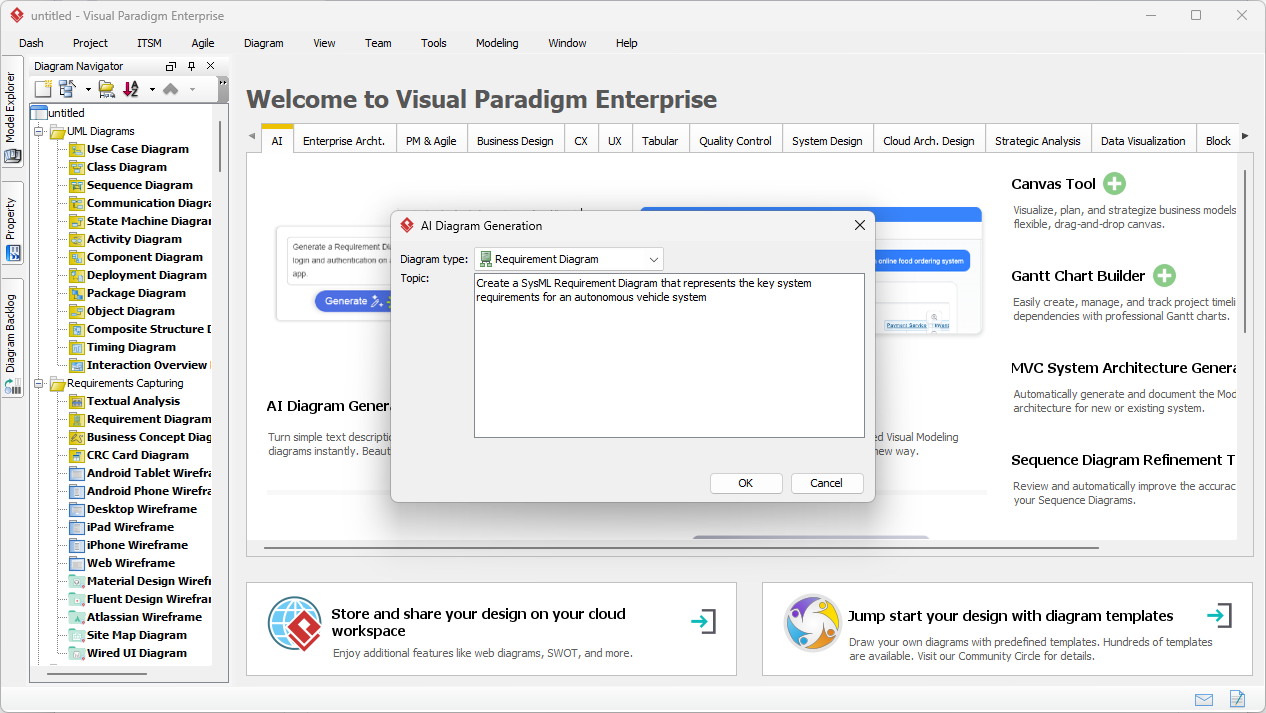
Tools → AI Diagram Generation → select “SysML Requirement Diagram” → enter your description:
“Create a SysML requirement diagram for an autonomous driving system covering obstacle detection, lane keeping, emergency braking, ISO 26262 compliance, and sensor redundancy.”
The input screen keeps it clean and focused:
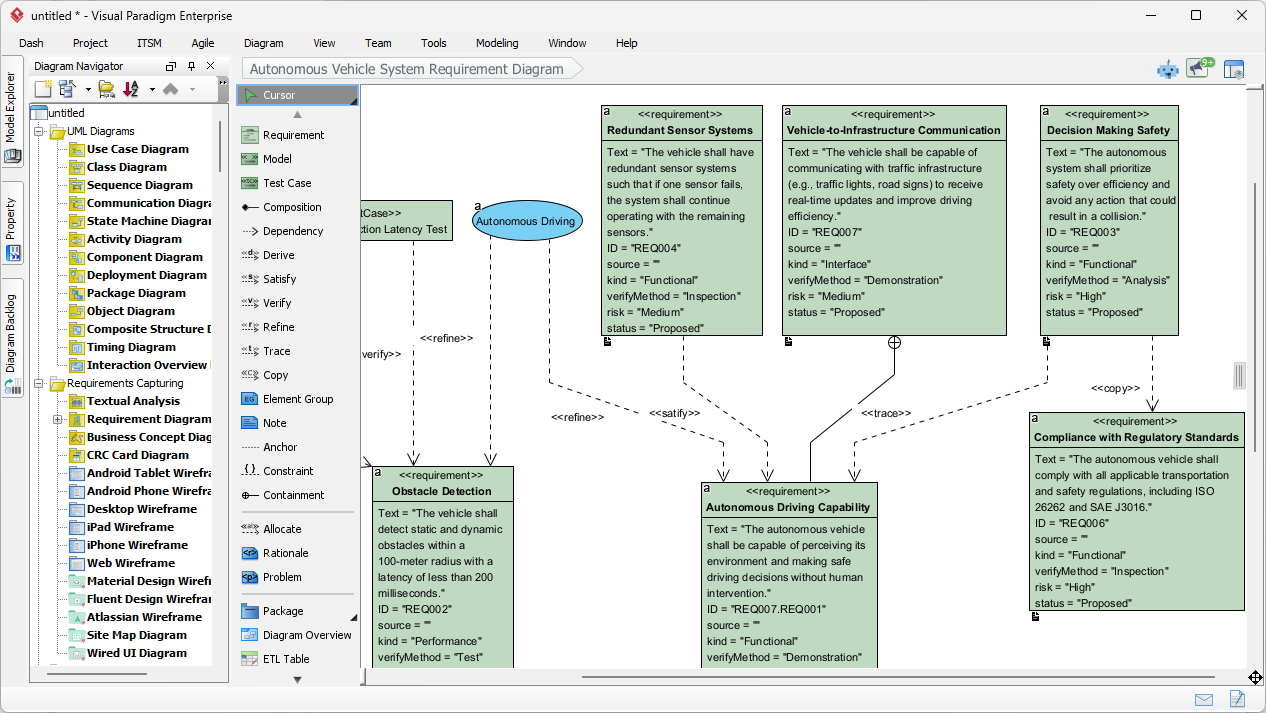
Hit OK and the AI constructs:
- Top-level requirement: Autonomous Driving Capability
- Derived sub-requirements: Obstacle Detection, Lane Keeping, Emergency Braking
- Containment and deriveReqt relationships
- satisfy links to functional blocks (inferred from context)
Here’s the generated result — fully editable, perfectly organized:
From here you can instantly:
- Link to Block Definition Diagrams
- Add verify relationships to test cases
- Generate traceability matrices & reports
- Export for compliance audits
2. Conversational Flow: Chatbot for Rapid Iteration
Need to brainstorm or prototype quickly? The Visual Paradigm AI Chatbot feels like having a SysML expert on speed dial.
Just say:
“Build a SysML requirement diagram for an e-commerce platform focusing on secure payment processing, user authentication, GDPR compliance, and fraud detection.”
The chatbot understands intent, creates <> blocks, sets up deriveReqt and verify links, and shows you the diagram immediately. Refine it live:
“Add PCI DSS compliance requirement and link it to payment gateway.”
Instant update. Here’s an example of the e-commerce security requirements diagram it produces:
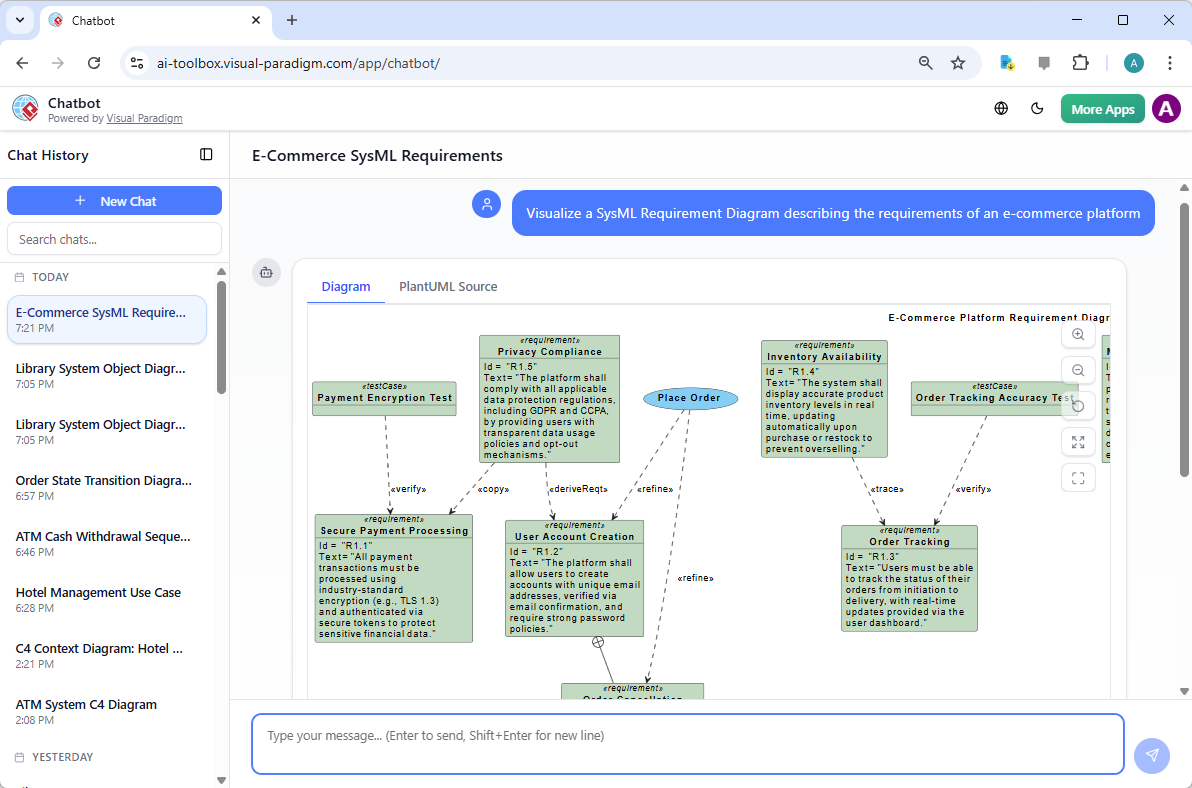
Perfect for early-stage validation, stakeholder demos, or when you’re away from your desktop.
Why This Matters in 2026
In regulated domains (automotive, aerospace, medical, defense), requirements traceability isn’t optional — it’s mandatory. Manual modeling is slow, error-prone, and hard to keep consistent.
Visual Paradigm’s AI handles the tedious structure so you can concentrate on:
- Safety-critical logic
- Risk assessment
- Verification strategy
- Stakeholder alignment
Change happens? Update the prompt or chat message → regenerate → traceability stays intact. That kind of agility is what separates leading teams in 2026.
Get Started – No More Blank Canvas
Ready to accelerate your MBSE workflow?
- Download Visual Paradigm Desktop → Full offline power + enterprise features: Download Now
- Try the AI Chatbot → Instant conversational modeling: Start Chatting
Stop wrestling with manual SysML. Start engineering smarter — today.
Related Links
The following resources explore the integration of artificial intelligence with SysML requirement diagrams to enhance systems engineering workflows. These articles detail how AI chatbots and automated generators allow teams to transform natural language into complex requirements models while maintaining standard compliance and traceability. By utilizing these AI-powered tools, developers and engineers can streamline the capture, analysis, and management of system requirements for large-scale projects.
- AI Diagram Chatbot Update: Better ArchiMate & SysML Support: This product update introduces an enhanced AI Chatbot that provides improved stability and relevance when processing complex SysML prompts.
- Mastering AI-Driven Systems Engineering: Case Study on SysML Generation: This case study demonstrates how a specialized AI chatbot significantly improves efficiency during the systems engineering phase by automating SysML diagram generation.
- AI Chatbot for Diagram and Model Generation: This interactive AI interface enables users to generate a wide variety of models and diagrams using simple natural language input.
- SysML Requirement Diagram Tool – Visual Paradigm Online: This tool provides a powerful online environment for the compliant modeling of complex system requirements within a systems engineering framework.
- Beginner’s Guide to Requirement Diagrams in SysML: This introductory guide offers a foundation for using SysML requirement diagrams to achieve effective and structured system modeling.
- How to Draw a Requirement Diagram in Visual Paradigm: This tutorial provides step-by-step instructions for creating requirement diagrams, covering notation, key elements, and best practices.
- Understanding Requirement Diagrams in UML and SysML: This resource explains the fundamental structure and purpose of requirement diagrams and their role in modern system design.
- Requirement Diagram Generator – GitHub Repository: This open-source project allows users to programmatically generate requirement diagrams that can integrate with professional modeling software.
- Using the Visual Paradigm OpenAPI for Requirement Diagrams: This technical guide explains how to use OpenAPI to programmatically manage requirement diagrams within automated system workflows.
- Visual Paradigm SysML Diagram Tool for Systems Engineering: This advanced tool supports model-based systems engineering by offering robust diagramming capabilities and full workflow integration.