


Customer experience is the sum of every interaction a person has with your brand. It is not a single transaction, but a continuous narrative. For CX managers, understanding this narrative is the foundation of strategy. Customer journey mapping provides the structure to visualize this narrative. It transforms abstract data into a tangible story. This guide defines the practice, breaks down the mechanics, and explains how to apply it effectively.
Many teams confuse a journey map with a standard flowchart. A flowchart shows logic. A journey map shows emotion, context, and human behavior. When executed correctly, it reveals friction points hidden in complex processes. It aligns internal teams around a shared customer view. This document serves as a comprehensive reference for anyone seeking to implement or refine this discipline.
What Exactly Is Customer Journey Mapping? 🤔
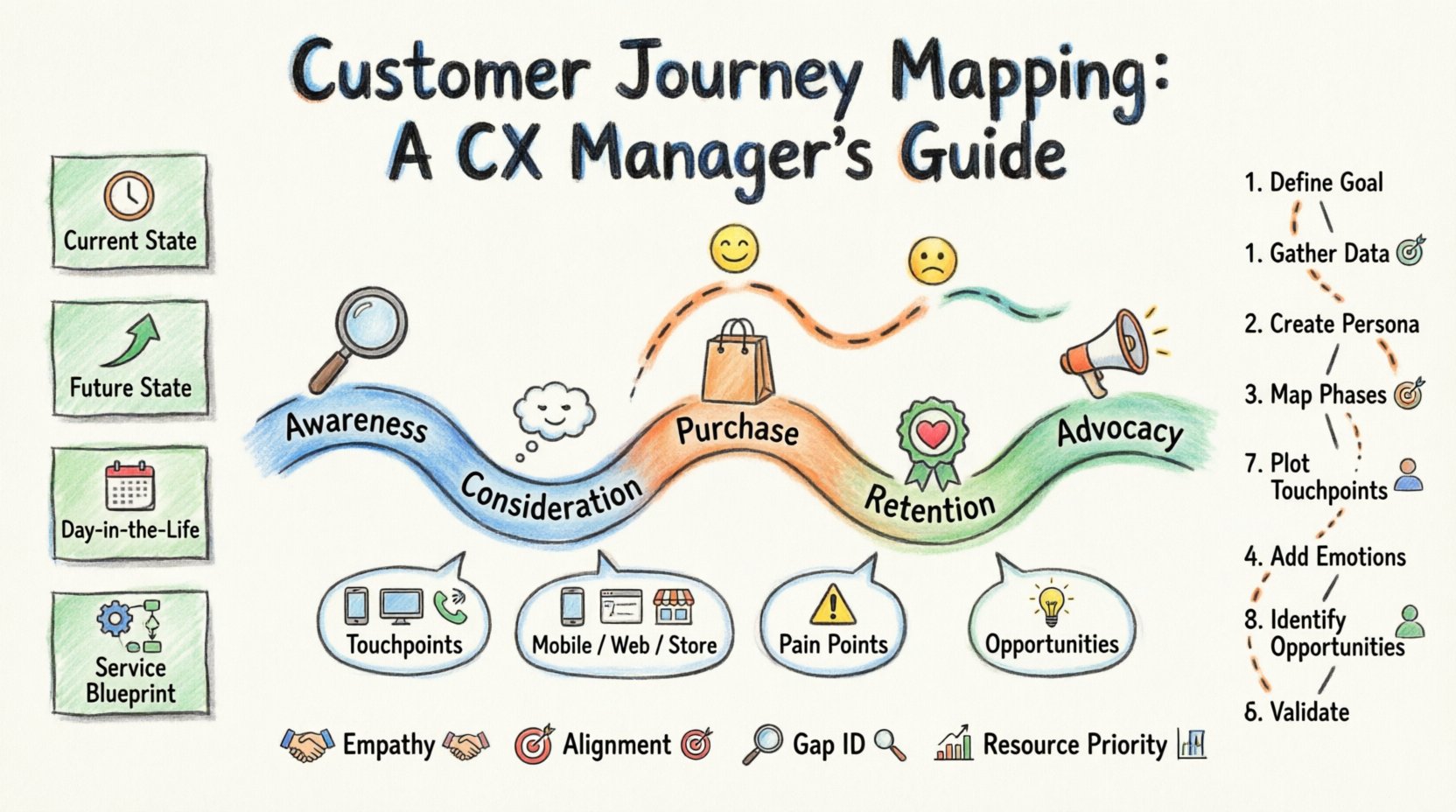
At its core, customer journey mapping is a visualization exercise. It illustrates the process a customer goes through when engaging with a company. This process spans across multiple channels and touchpoints. It covers the entire lifecycle, from initial awareness to post-purchase advocacy.
Unlike a standard process map which focuses on efficiency, a journey map focuses on the customer’s experience. It answers questions such as:
- What is the customer trying to achieve at this stage? 🎯
- What emotions are they feeling right now? 😊😠
- What barriers are preventing them from moving forward? 🚧
- Which channels are they using to interact? 📱💻
This definition extends beyond the digital interface. It includes phone calls, physical visits, and support interactions. It requires a holistic view of the organization. No single department owns the customer. Therefore, the map must reflect the cross-functional nature of modern service.
Why CX Managers Need This Tool 🛠️
The role of a CX manager is to oversee the quality of the customer experience. Without a map, efforts are often reactive. You fix problems after they occur. A journey map allows for proactive design. It shifts the focus from internal metrics to external value.
Here are the specific advantages of implementing this practice:
- Empathy Generation: It forces teams to step into the customer’s shoes. Stakeholders often forget the user’s struggle. The map makes the struggle visible.
- Alignment: Marketing, Sales, and Support often operate in silos. A shared map creates a single source of truth. Everyone sees the same end-to-end picture.
- Gap Identification: It highlights disconnections between promises and delivery. You might market one thing, but deliver another. The map exposes this inconsistency.
- Resource Allocation: It helps prioritize improvements. You can see which friction points cause the most churn.
The Anatomy of a Journey Map 🧩
A robust map contains specific layers of information. These layers work together to create a complete picture. Omitting key elements can lead to incomplete insights. Below is a breakdown of the essential components.
| Component | Description | Example |
|---|---|---|
| Persona | The specific customer type being mapped. | “Busy Parent Sarah” looking for quick delivery. |
| Phases | The major stages of the relationship. | Awareness, Consideration, Purchase, Retention. |
| Touchpoints | Specific interactions at each stage. | Email newsletter, Website checkout, Call center. |
| Channels | The medium through which the touchpoint occurs. | Mobile App, Desktop Browser, Physical Store. |
| Emotions | The feeling associated with the interaction. | Confusion, Relief, Frustration, Excitement. |
| Pain Points | Obstacles causing friction or negative emotion. | Slow loading times, Unclear pricing, Long hold times. |
| Opportunities | Areas where experience can be improved. | Add chat support, Simplify forms, Send confirmation SMS. |
Types of Journey Maps 📊
Not all maps serve the same purpose. Selecting the right type depends on your strategic goal. Understanding these distinctions ensures you gather the right data.
1. Current State (As-Is) Map
This map documents the experience exactly as it happens today. It relies on actual data and direct observation. It does not include ideal scenarios. It is essential for identifying immediate problems. You cannot fix what you do not accurately measure. This version is often the starting point for improvement initiatives.
2. Future State (To-Be) Map
This map visualizes the desired experience after improvements. It is a blueprint for change. It helps teams design new processes before implementation. It aligns stakeholders on a vision. Creating this requires a clear understanding of the target metrics. It bridges the gap between current reality and strategic goals.
3. Day-in-the-Life Map
This map looks beyond the brand relationship. It places the customer in their broader daily context. It shows how the brand fits into their life. This is useful for lifestyle brands or products used frequently. It reveals context clues that a transactional map misses.
4. Service Blueprint
This map adds a layer of internal operations. It shows the backstage processes required to support the front stage. It connects customer actions to employee actions. It highlights dependencies between departments. This is critical for operations teams managing complex services.
How to Build a Map: A Step-by-Step Process 🛤️
Creating a map is a project that requires discipline. It involves research, collaboration, and validation. Rushing this process leads to assumptions. Assumptions lead to incorrect conclusions. Follow this structured approach to ensure accuracy.
Step 1: Define the Scope and Goal
Start by asking what you want to achieve. Are you trying to reduce churn? Improve onboarding? Increase cross-sell? A map cannot cover every single interaction forever. Pick a specific journey. For example, map the “First Purchase” journey rather than the “Lifetime Value” journey. Define the start and end points clearly.
Step 2: Gather Customer Data
Data is the fuel for the map. Relying on internal opinions is insufficient. You need direct evidence from the customer. Collect data from multiple sources:
- Interviews: One-on-one conversations with real customers.
- Surveys: Quantitative feedback on specific interactions.
- Support Logs: Records of complaints and inquiries.
- Analytics: Behavioral data from digital platforms.
- Shadowing: Observing customers as they use your product.
Triangulate this data. If the analytics show high drop-off, but interviews say it was smooth, investigate further. Discrepancies often hide the real issue.
Step 3: Create the Persona
Who is walking this path? A map for a CEO differs from a map for a junior employee. Develop a persona based on the data. Include demographics, goals, motivations, and behavioral traits. This keeps the map focused. It prevents the team from designing for an average that does not exist.
Step 4: Map the Phases
Divide the journey into logical stages. Common frameworks include:
- Awareness
- Consideration
- Purchase
- Service/Usage
- Advocacy
Ensure the stages reflect the customer’s mental model, not your internal departments. A customer does not care about your “Sales Dept” vs “Billing Dept”. They care about “Buying” and “Paying”.
Step 5: Plot Touchpoints and Channels
List every interaction within each phase. Include digital and physical interactions. Note the channel used for each. A customer might see an ad on social media but buy on a desktop. They might ask support on Twitter but resolve it via email. Trace the path accurately.
Step 6: Add Emotions and Pain Points
This is the most critical step. Plot the emotional curve. Where does frustration spike? Where does satisfaction peak? Use a scale (e.g., -5 to +5) to quantify feelings. Connect specific pain points to these emotions. If a user is confused at the checkout, note that specifically. Do not just say “Checkout”. Say “Checkout: Confusion due to hidden fees”.
Step 7: Identify Opportunities
Once the problems are clear, propose solutions. Brainstorm ways to remove friction. These should be actionable. “Improve support” is vague. “Add live chat during checkout” is actionable. Link these opportunities to specific pain points on the map.
Step 8: Validate and Iterate
Take the draft back to the customers. Ask if it matches their experience. Does it resonate? If not, adjust. A journey map is not a static document. It is a living artifact. Customer behavior changes. The map must evolve with it.
Common Pitfalls to Avoid 🚫
Even experienced teams make mistakes. Being aware of these traps helps you stay on track.
- Designing for Yourself: Teams often map their internal process, not the customer experience. Avoid using internal jargon. Use customer language.
- Ignoring the Employee Journey: Customers cannot have a good experience if employees are frustrated. The internal process often blocks the external one. Consider the employee experience alongside the customer journey.
- One Map to Rule Them All: Trying to map every single customer type into one diagram creates a monster. Create specific maps for specific personas. A map for “Enterprise Clients” differs from “SMBs”.
- Lack of Stakeholder Buy-in: If marketing doesn’t trust the map, they won’t use it. Involve representatives from all departments during the creation process.
- Static Execution: Creating a map and filing it away. It must be used in meetings, strategy sessions, and design reviews. If it sits on a shelf, it is useless.
Measuring the Impact of Mapping 📈
How do you know the mapping exercise worked? You need to track specific metrics before and after implementation. These metrics validate the ROI of the effort.
- Customer Effort Score (CES): Did the friction decrease? Measure how hard it is for the customer to get things done.
- Net Promoter Score (NPS): Does satisfaction increase? Look for shifts in loyalty over time.
- Conversion Rates: Did the drop-off at specific touchpoints improve?
- Resolution Time: Did the time to resolve issues decrease?
- Churn Rate: Did retention improve for the specific segment mapped?
Regularly review these numbers. If a map is not moving the needle, revisit the map. Ensure the identified opportunities were actually implemented.
Integrating Mapping with Broader Strategy 🧠
Journey mapping does not exist in a vacuum. It must integrate with other strategic frameworks. It informs product roadmaps. It guides marketing campaigns. It shapes service design.
When product teams plan features, they should ask how it fits the journey. When marketers plan ads, they should check the persona goals. This integration ensures consistency. It prevents the disconnect where Marketing promises one thing and Product delivers another.
It also supports risk management. By understanding the journey, you can identify where a failure would be most damaging. You can build safeguards at those specific points. This proactive approach reduces the cost of failure.
The Human Element: Empathy as a Core Skill 🤝
Technical skills are useful, but empathy is the core competency. A map is just a diagram without empathy. You must understand the human behind the data point. Why are they calling support? They might not be angry; they might be scared they made a mistake.
CX managers must cultivate this mindset. It requires listening more than speaking. It requires observing more than assuming. The map is a tool to facilitate this understanding. It makes the invisible visible. It turns a nameless statistic into a person with a story.
Conclusion 📝
Customer journey mapping is a fundamental practice for any organization focused on experience. It provides clarity in a complex environment. It aligns teams around the customer. It identifies friction before it becomes a crisis.
Success requires discipline. It requires accurate data. It requires cross-functional collaboration. It requires a commitment to iteration. When done well, it transforms how a business operates. It shifts the focus from selling to serving. This shift is the essence of modern customer experience management.
Start small. Pick one critical journey. Gather the data. Build the map. Share it. Act on it. Measure the results. Then repeat. This cycle builds a culture of customer-centricity. It ensures that the customer remains at the center of every decision made within the organization.