


The landscape of customer experience is shifting beneath our feet. For years, customer journey mapping served as a static blueprint—a static diagram illustrating a linear path from awareness to purchase. Today, that approach is insufficient. The modern consumer operates in a fluid, non-linear environment where expectations are dynamic and data is instantaneous. For CX strategists, understanding these shifts is not optional; it is critical for survival and growth.
This guide explores the evolving mechanics of customer journey mapping. We examine how technology, psychology, and privacy regulations are reshaping the way organizations visualize and optimize the customer experience. The focus is on actionable insights that drive genuine engagement without relying on hype.
🔄 From Linear Paths to Dynamic Ecosystems
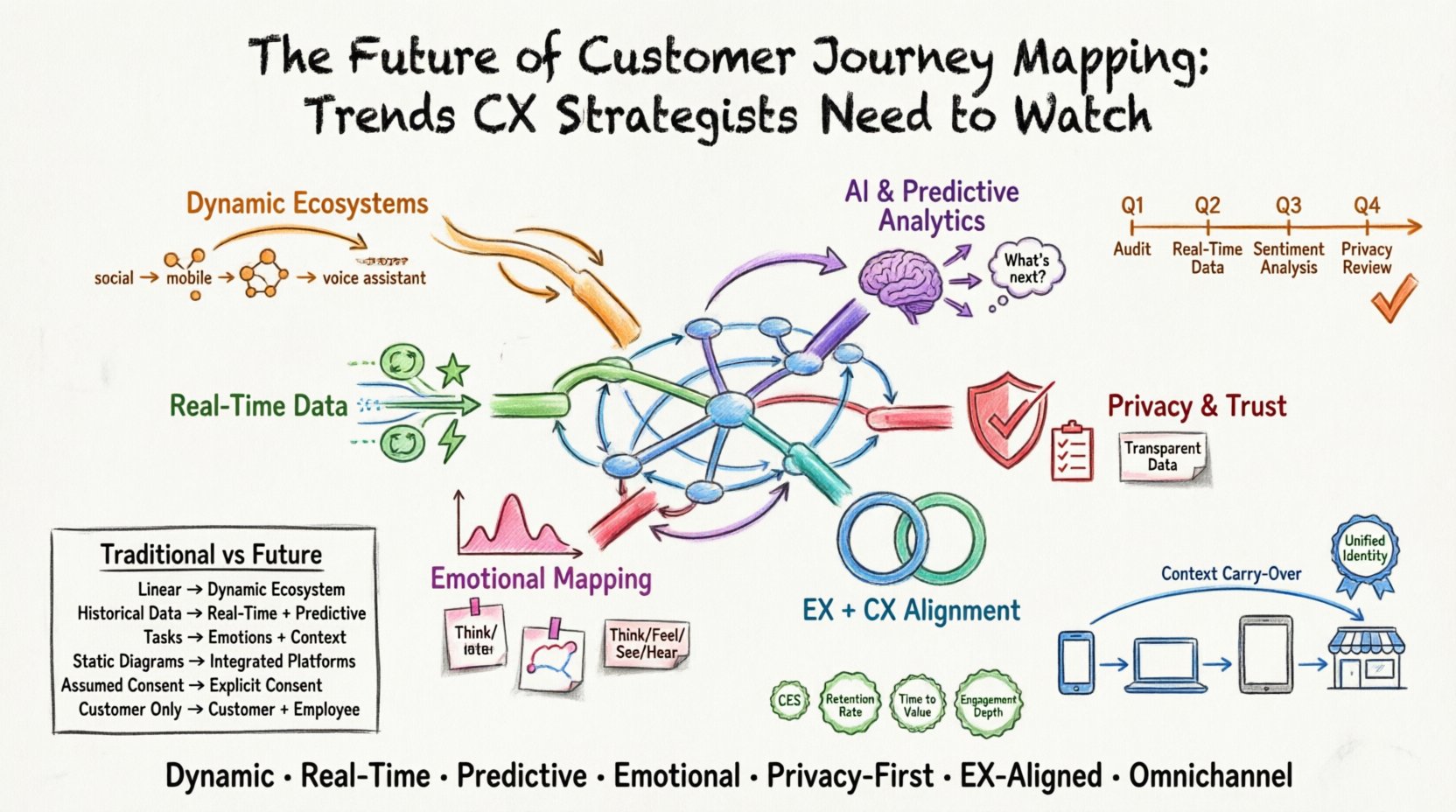
The traditional journey map depicted a straight line. Step one, step two, step three. This model assumed a predictable sequence of events. In reality, customers interact with brands through a complex web of channels. They might see an ad on social media, research on a mobile device, visit a physical store, and complete the transaction via a voice assistant.
- Fragmented Touchpoints: Customers do not follow a single thread. They jump between channels based on convenience and context.
- Contextual Relevance: The experience must adapt to the moment. A customer seeking support via chat needs different information than one browsing a catalog on a desktop.
- Non-Linear Navigation: The journey is often circular or spiral. Post-purchase support can lead to a new discovery phase, restarting the cycle.
Strategists must move away from rigid diagrams. Instead, they should view the journey as a living ecosystem. This requires a shift in mindset from mapping specific steps to mapping potential interactions and decision nodes. The goal is to anticipate where a customer might diverge and provide seamless support regardless of the path taken.
📊 Real-Time Data and Instant Adaptation
Historical data has long been the backbone of journey analysis. Companies looked at past behavior to predict future actions. However, the future demands real-time insights. Waiting for monthly reports to adjust a strategy is too slow in a digital economy.
Real-time journey mapping involves integrating live data streams into the visualization process. This allows organizations to detect friction points as they happen.
- Immediate Feedback Loops: If a customer abandons a cart, the system should trigger an intervention immediately, not a follow-up email three days later.
- Behavioral Triggers: Actions taken on the website or app can instantly update the customer profile and influence the next interaction offered.
- Dynamic Content: Content displayed to the user changes based on their current activity, location, and device.
This capability requires a robust data infrastructure. It is not merely about collecting information but about processing it quickly enough to influence the experience while it is unfolding. The speed of data processing becomes a competitive advantage.
🤖 AI and Predictive Analytics
Artificial intelligence is transforming journey mapping from a descriptive exercise into a predictive one. Instead of asking “what happened?”, AI helps answer “what will happen next?”.
Machine learning algorithms can analyze vast datasets to identify patterns that human analysts might miss. These patterns often reveal hidden friction points or opportunities for deeper engagement.
- Prediction Models: AI can forecast the likelihood of churn or the probability of a successful upsell based on current journey behavior.
- Personalization at Scale: Algorithms can tailor the journey for thousands of segments simultaneously, ensuring relevance without manual intervention.
- Natural Language Processing: Sentiment analysis on customer communications can automatically tag interactions with emotional indicators, enriching the journey map.
Implementing these technologies requires careful governance. Predictions are only as good as the data feeding them. Straying into automation without human oversight can lead to errors that damage trust.
❤️ Emotional Journey Mapping
Satisfaction metrics often fail to capture the full picture. A customer can be satisfied with a transaction but feel indifferent or frustrated by the process. The future of journey mapping involves digging deeper into the emotional landscape.
Emotional journey mapping tracks the feelings customers experience at each stage of their interaction. This adds a qualitative layer to quantitative data.
- Identifying Emotional Peaks and Valleys: Pinpointing moments of delight and moments of frustration helps prioritize improvements.
- Empathy Mapping: Integrating statements about what the customer thinks, feels, sees, and hears into the visual representation.
- Long-term Sentiment: Monitoring emotional trends over months rather than days to understand brand loyalty drivers.
Understanding emotion allows organizations to design experiences that resonate on a human level. It moves the focus from functional utility to relational value.
🔒 Privacy, Ethics, and Trust
Data privacy regulations have fundamentally changed how journey mapping is conducted. Collecting personal data for mapping purposes now requires explicit consent and strict governance.
- Consent Management: Customers must know how their data is used to build their journey profile. Transparency is key.
- Data Minimization: Organizations should only collect data necessary for the specific journey stage, avoiding overreach.
- Security Standards: Journey maps often contain sensitive information. Access controls and encryption are non-negotiable.
Trust is a currency in the modern economy. If customers feel their privacy is violated, they will disengage. Mapping the journey must include a “trust journey” that highlights how data is protected and used ethically.
📉 Employee Experience (EX) Integration
You cannot have a positive customer experience without a positive employee experience. The staff members who interact with customers are the human interface of the journey.
Mapping the employee journey alongside the customer journey reveals where internal processes support or hinder the external experience.
- Internal Friction: If an employee struggles to access customer data, the customer experience suffers.
- Empowerment: Employees need the tools and authority to resolve issues in real-time.
- Feedback Channels: Employees should have a direct line to report pain points they observe during customer interactions.
Aligning EX and CX ensures that the promise made to the customer is actually fulfilled by the team delivering the service.
⚖️ Traditional vs. Future Journey Mapping
To clarify the shift in strategy, consider the comparison below. This table highlights the differences between legacy approaches and the emerging future state.
| Feature | Traditional Approach | Future Approach |
|---|---|---|
| Structure | Linear, Step-by-Step | Dynamic, Non-Linear Ecosystem |
| Data Source | Historical, Retrospective | Real-Time, Predictive |
| Focus | Functional Tasks | Emotional & Contextual |
| Tooling | Static Diagrams | Integrated Data Platforms |
| Privacy | Assumed Consent | Explicit, Granular Consent |
| Scope | Customer Only | Customer + Employee (EX) |
🛠️ Operationalizing the Strategy
Identifying trends is only the first step. Implementing these changes requires a structured approach to updating your current mapping framework.
- Conduct a Data Audit: Assess the quality and availability of your current data sources. Determine what is real-time and what is lagging.
- Define New Metrics: Move beyond conversion rates. Adopt metrics that measure emotional engagement and time-to-resolution.
- Stakeholder Alignment: Ensure IT, marketing, and operations teams agree on the data definitions and journey goals.
- Iterative Testing: Treat the journey map as a hypothesis. Test changes in small segments before rolling out broadly.
- Continuous Training: Equip teams with the skills to interpret dynamic data and respond to real-time insights.
This process is iterative. The journey map is never finished. It evolves as the customer base evolves and as technology advances.
📈 Measuring Success Beyond NPS
Net Promoter Score (NPS) has long been the standard for measuring customer loyalty. However, it is a lagging indicator. It tells you where you stand now, not why.
Future success metrics should be leading indicators that predict future behavior.
- Customer Effort Score (CES): How easy was it for the customer to solve their problem?
- Retention Rate: How many customers return over time?
- Time to Value: How quickly does the customer realize the benefit of your product?
- Engagement Depth: How many interactions occur within a session?
Combining these metrics provides a holistic view of health. It helps strategists understand the efficiency of the journey, not just the satisfaction with the outcome.
🌐 The Omnichannel Imperative
Multichannel means being present on many platforms. Omnichannel means those platforms work together seamlessly. The future of mapping is inherently omnichannel.
A customer might start a conversation on social media and finish it via email without losing context. The journey map must reflect this continuity.
- Unified Identity: Recognizing the user across devices and channels is essential.
- Context Carry-Over: Information gathered in one channel must be available in the next.
- Consistent Voice: Brand tone and messaging should remain consistent across all touchpoints.
Failure to integrate channels creates silos that frustrate customers. The journey map acts as the blueprint for breaking down these silos.
🧭 Strategic Recommendations for the Next 12 Months
For CX leaders looking to modernize their approach, here is a practical roadmap.
- Quarter 1: Audit existing journey maps against real customer behavior data. Identify gaps between the map and reality.
- Quarter 2: Implement real-time data collection for high-value touchpoints. Begin testing predictive models.
- Quarter 3: Integrate emotional sentiment analysis into the reporting dashboard. Train teams on empathy mapping.
- Quarter 4: Review privacy policies and consent mechanisms. Align employee journey maps with customer updates.
This timeline allows for gradual adoption. It minimizes disruption while ensuring steady progress toward a future-ready strategy.
🔮 Looking Ahead
The journey mapping discipline is maturing. It is moving from a marketing exercise to a core business function. Organizations that treat the customer journey as a living entity will outperform those that treat it as a static document.
Success depends on agility. The ability to adapt the journey based on new data, new regulations, and new customer behaviors is what defines modern CX strategy. By focusing on data integrity, emotional resonance, and operational alignment, strategists can build experiences that endure.
The tools will continue to change. The technology will advance. But the fundamental goal remains the same: to understand the customer well enough to serve them better. This requires patience, discipline, and a commitment to continuous learning.
📝 Summary of Key Takeaways
- Dynamic Mapping: Abandon linear models for ecosystem-based visualizations.
- Real-Time Data: Utilize live data streams for immediate intervention.
- Predictive AI: Leverage algorithms to forecast customer needs and churn.
- Emotional Intelligence: Map feelings, not just actions.
- Privacy First: Build trust through transparent data practices.
- EX Alignment: Ensure employees have the tools to deliver the experience.
- Omnichannel Integration: Maintain context across all platforms.
By embracing these trends, CX strategists can navigate the complexities of the modern market. The future belongs to those who can listen, adapt, and deliver value consistently.