


Customer journey mapping is a strategic tool designed to visualize every interaction a person has with a brand. It is meant to clarify how users move from awareness to advocacy. However, many organizations execute this process poorly. Errors in this discipline lead to significant financial loss. Time is spent on initiatives that do not resonate with the audience. When maps are inaccurate, resources are diverted to solving the wrong problems.
This guide outlines the critical errors that drain budgets and delay results. We will examine why these mistakes occur and how they impact the bottom line. The goal is to ensure your mapping efforts yield actionable insights rather than confusion.
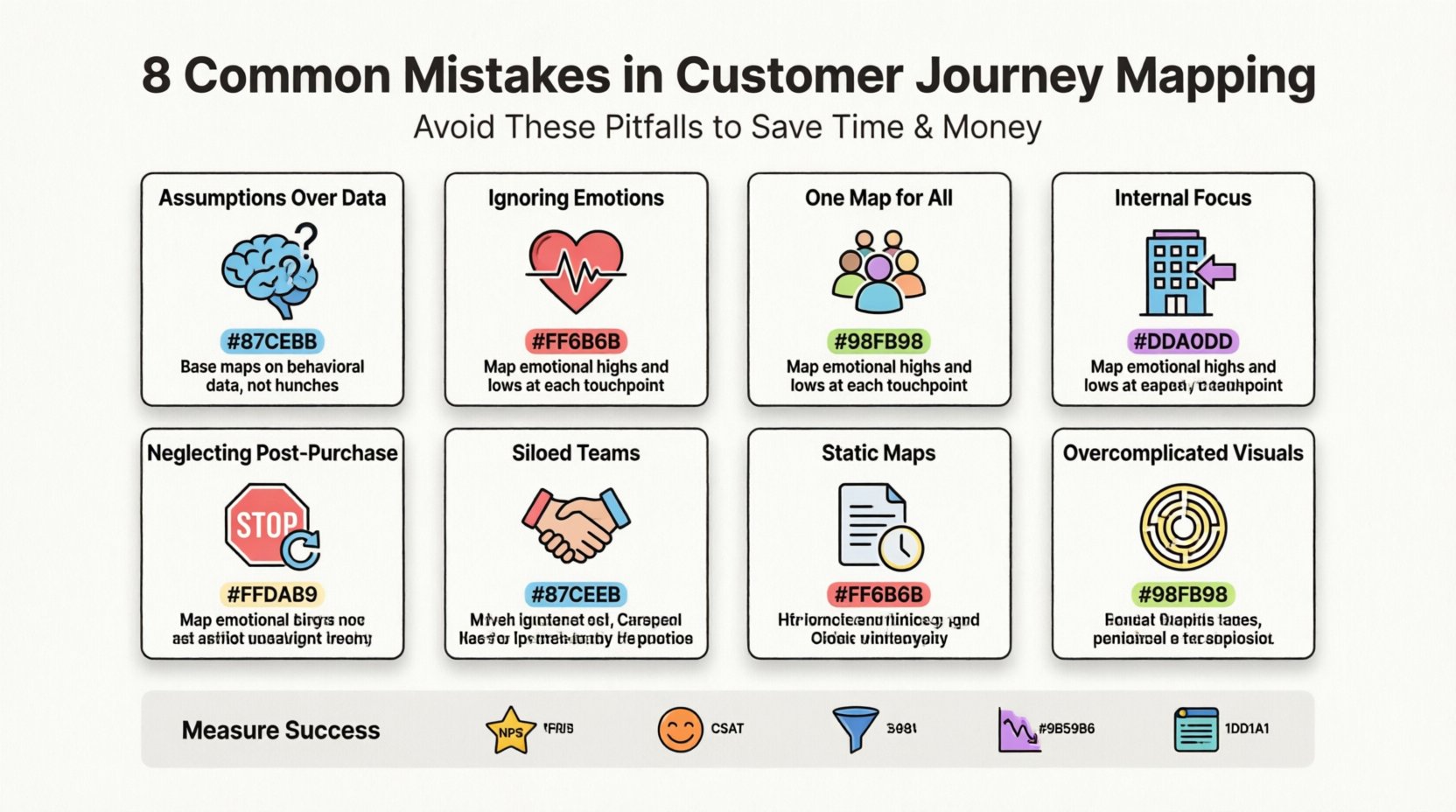
1. Relying on Assumptions Instead of Data 🧠
The most frequent error is assuming the team knows what the customer wants. Internal teams often operate in a bubble. They believe they understand the user based on intuition. This approach is dangerous. Assumptions lead to incorrect features and messaging.
When you skip data validation, you risk building solutions for problems that do not exist. The cost of this error is high. You spend money developing features that users ignore. You also waste time gathering feedback on the wrong topics.
- The Risk: Building products based on what you think is needed, not what is actually needed.
- The Cost: Development costs are sunk with no return on investment.
- The Fix: Use quantitative data (analytics) and qualitative data (interviews) to validate every step.
Without empirical evidence, your map is a hypothesis, not a strategy. Verify every touchpoint with real user behavior. Do not guess the pain points. Measure them.
2. Ignoring the Emotional Landscape ❤️
A journey map is not just a flowchart of clicks. It is a record of feelings. Many teams focus solely on the functional steps. They map the “what” without mapping the “how it feels”.
Emotions drive decisions. A customer might complete a purchase, but if they felt frustrated along the way, they will not return. Ignoring the emotional curve means missing opportunities to delight. It also means missing early warning signs of churn.
- The Risk: High friction points are overlooked because the task was completed technically.
- The Cost: Customer retention drops. Support costs rise as frustration leads to tickets.
- The Fix: Include an emotional graph alongside the process steps. Identify peaks of anxiety and valleys of joy.
Understanding the emotional state at each stage allows you to design interventions. For example, adding reassurance during a payment step can reduce anxiety. This small change can significantly improve conversion rates.
3. Creating a Single Map for Everyone 👥
One size does not fit all. A common mistake is creating one master journey map for all users. This ignores the nuance of different user segments. A new user has different needs than a power user. A business customer has different needs than an individual consumer.
If you treat every visitor the same, you confuse the message. You dilute the value proposition. Resources are wasted on generic solutions that satisfy no one completely.
- The Risk: Generic experiences that fail to convert specific segments.
- The Cost: Lower conversion rates. Higher acquisition costs as you try to cast a wider net.
- The Fix: Develop separate maps for key personas. Ensure each map reflects the unique goals and behaviors of that segment.
Segmentation is not just marketing; it is operational. Tailoring the journey to the persona ensures relevance. Relevance drives engagement. Engagement drives revenue.
4. Focusing on Internal Processes, Not Customer Needs 🏢
Organizations often map the journey from their own perspective. They map how their departments handle the process. This is called the “inside-out” view. Customers do not see your organization chart. They see a seamless or broken experience.
When you map internal handoffs, you highlight friction that the customer does not see but feels. If marketing passes a lead to sales, and sales waits three days, the customer feels abandonment. The internal process is efficient, but the customer experience is poor.
- The Risk: Optimizing efficiency for staff while creating friction for users.
- The Cost: Brand reputation damage. Loss of trust and loyalty.
- The Fix: Map the journey from the customer’s eyes. Remove internal labels. Focus on the user’s progression.
Shift the focus to the value delivered to the user. If an internal step does not add value to the user, question its necessity. Streamline the path to the goal.
5. Neglecting the Post-Purchase Phase 🛑
Many teams stop the map at the point of sale. They view the transaction as the end of the relationship. This is a critical oversight. The post-purchase phase is where loyalty is built or broken.
Acquisition is expensive. Retention is cheaper. If you ignore the onboarding, support, and renewal phases, you lose the value of the initial investment. Customers who struggle after buying will leave quickly.
- The Risk: High churn rates immediately after conversion.
- The Cost: Wasted customer acquisition spend. Lost lifetime value.
- The Fix: Extend the map to include onboarding, support interactions, and renewal. Identify friction in these stages.
A smooth post-purchase experience encourages word-of-mouth referrals. It turns a one-time buyer into a brand advocate. This organic growth is far more cost-effective than paid advertising.
6. Lack of Cross-Functional Collaboration 🤝
Journey mapping often happens in isolation. A single department might create the map without input from others. Marketing creates it without Sales. Sales creates it without Support. This leads to siloed data and conflicting strategies.
If the map is not shared, it does not become a shared reality. Teams work against each other. Support might promise what Sales does not. Marketing might drive traffic to pages that do not convert. This misalignment wastes time in meetings and money in campaigns.
- The Risk: Inconsistent messaging and service levels across touchpoints.
- The Cost: Confused customers. Internal friction and blame games.
- The Fix: Involve all stakeholders in the mapping workshop. Ensure every team sees their role in the whole picture.
Collaboration ensures a unified voice. When everyone understands the customer journey, they make decisions that support the overall experience. This alignment reduces internal waste and improves external results.
7. Treating the Map as a Static Document 📄
A journey map is not a poster to hang on a wall. It is a living document. Markets change. Technologies evolve. Customer behaviors shift. If you create a map and never update it, it becomes obsolete quickly.
An outdated map leads to bad decisions. You might launch a campaign based on a journey that no longer exists. You might optimize for a channel that is no longer relevant. Time is wasted chasing ghosts.
- The Risk: Strategic decisions based on historical data that is no longer accurate.
- The Cost: Missed market opportunities. Poor resource allocation.
- The Fix: Schedule regular reviews. Update the map quarterly or when significant market changes occur.
Keep the map current. Use real-time feedback to refine the journey. This ensures your strategy remains agile and responsive to actual conditions.
8. Overcomplicating the Visual Representation 🎨
Complexity hinders understanding. Some teams create maps with dozens of layers, colors, and interactions. The visual becomes a maze. Stakeholders cannot see the insights. They get lost in the details.
If the map is too complex, it will not be used. The goal of mapping is to communicate, not to impress. Clarity drives action. If stakeholders cannot understand the map in five minutes, it has failed.
- The Risk: Key insights are buried in visual noise.
- The Cost: Lack of adoption. Inaction on critical improvements.
- The Fix: Keep visuals simple. Focus on the critical path. Use color sparingly to highlight key issues.
Design for readability. Use icons and clear labels. Ensure the narrative is clear. A simple map that is understood is more valuable than a complex masterpiece that is ignored.
Comparison of Common Pitfalls vs. Corrective Actions 📊
| Pitfall | Impact | Corrective Action |
|---|---|---|
| Assumption-Based Mapping | Building wrong features | Validate with user data |
| Ignoring Emotions | High churn, low loyalty | Map emotional curves |
| One-Size-Fits-All | Low conversion rates | Create persona-specific maps |
| Internal Focus | Customer frustration | Map from user perspective |
| Static Document | Outdated strategy | Regular reviews and updates |
| Overcomplication | Low adoption | Simplify visuals and narrative |
How to Measure the Impact of Your Mapping Efforts 📊
Once you have corrected these mistakes, you need to know if the changes work. You must track performance indicators. Without metrics, you cannot prove the value of your journey mapping.
- Net Promoter Score (NPS): Measures overall loyalty and satisfaction.
- Customer Satisfaction (CSAT): Tracks satisfaction at specific touchpoints.
- Conversion Rates: Monitors the efficiency of the path to purchase.
- Churn Rate: Indicates retention health, especially post-purchase.
- Support Ticket Volume: Reflects friction points in the journey.
Set baselines before making changes. Track improvements over time. This data-driven approach ensures that your mapping efforts translate into tangible business results.
Final Thoughts on Continuous Improvement 🔄
Customer journey mapping is not a one-time project. It is a discipline. It requires commitment to accuracy, empathy, and agility. By avoiding the common pitfalls listed above, you protect your budget and your time. You ensure that every touchpoint adds value.
Focus on the customer, not the process. Use data to guide your assumptions. Keep the team aligned. Update the map regularly. These steps will help you build a resilient strategy that adapts to change.
Start by auditing your current maps. Identify where assumptions hide. Find where data is missing. Take the first step toward a more accurate and profitable customer experience.