


Customer journey mapping has become a standard practice for organizations aiming to improve their customer experience. However, despite its widespread adoption, significant confusion remains about what it actually is and how to execute it effectively. Many teams invest time and resources into creating maps that sit on a shelf, never influencing strategy or operations. This stagnation often stems from foundational misconceptions rather than a lack of effort.
To move forward, we must address the underlying beliefs that shape the process. By identifying and correcting these errors, teams can build a framework that drives real value. The following sections explore five persistent myths that undermine journey mapping initiatives and provide the factual perspective needed to move past them.
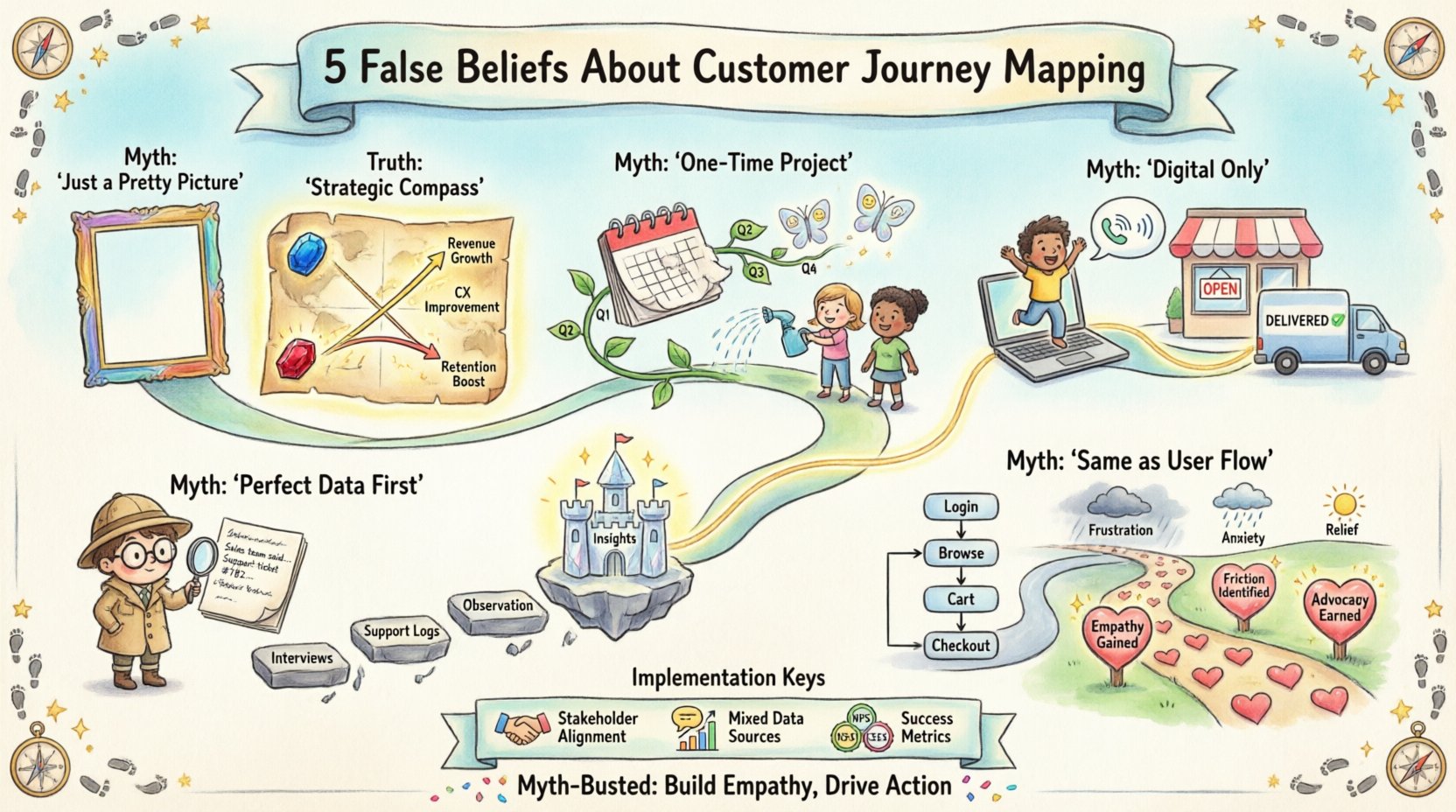
1. It Is Just a Visual Diagram 🎨
A common assumption is that customer journey mapping is primarily a design exercise. Teams often create colorful, attractive diagrams and consider the work complete once the visuals are polished. While visual communication is important, the map itself is not the end goal. It is a tool to facilitate understanding, not a decorative artifact.
When the focus shifts solely to aesthetics, the strategic depth suffers. A beautiful map that does not reflect the actual emotional and functional realities of the customer is misleading. The value lies in the data and insights captured during the creation process, not the final image.
- Strategic Alignment: The map should align with business objectives, not just design standards.
- Data Integrity: Visuals must represent verified user behavior, not assumptions.
- Actionability: Every stage of the map should point to a specific operational change or improvement.
If the output cannot be translated into a list of actionable tasks for different departments, the exercise has not been successful. The diagram serves as a shared reference point for cross-functional teams, ensuring everyone understands the customer’s perspective from start to finish.
2. It Is a One-Time Project 📅
Many organizations treat journey mapping as a project with a start date and an end date. They conduct research, build the map, and then move on to the next initiative. This approach ignores the dynamic nature of customer behavior and market conditions. What works today may not work next quarter.
Customer expectations evolve rapidly. New technologies, changing economic climates, and competitor actions all influence how users interact with a brand. A static map becomes obsolete quickly. It requires regular updates to remain relevant and useful.
| Static Approach | Living Approach |
|---|---|
| Created once a year | Updated quarterly or monthly |
| Stored in a shared drive | Integrated into workflow tools |
| Reviewed by leadership only | Accessible by all operational teams |
| Fixed based on past data | Adapted based on real-time feedback |
Maintaining a living document requires a commitment to continuous improvement. It involves monitoring key performance indicators and soliciting ongoing feedback from both customers and employees. When a new pain point emerges, the map should be the first place to look for context and root cause analysis.
3. It Only Applies to Digital Channels 📱
With the rise of e-commerce and mobile applications, there is a tendency to equate journey mapping with user experience (UX) design for websites and apps. This limits the scope of the analysis significantly. In reality, the customer journey spans multiple touchpoints, including physical interactions, call centers, and third-party integrations.
Limiting the view to digital screens creates blind spots. A customer might discover a product online, ask questions via phone support, and complete the purchase in a physical store. If the mapping only covers the website, the friction in the phone or store experience is missed.
- Omni-channel View: Ensure all channels are represented in the timeline.
- Human Interactions: Map out conversations with sales or support staff.
- Physical Touchpoints: Include packaging, delivery, and in-store environments.
A comprehensive map acknowledges the hybrid nature of modern commerce. It connects the dots between online browsing and offline fulfillment. Ignoring non-digital channels often leads to a fragmented experience where the customer feels the brand is inconsistent.
4. You Need Perfect Data Before Starting 📊
Teams often delay mapping because they do not have complete datasets. They wait for perfect analytics, comprehensive survey results, or full behavioral tracking. This perfectionism creates paralysis. Waiting for 100% data accuracy means the process never begins.
Imperfect data is better than no data. Qualitative insights from interviews and observational studies can fill the gaps left by quantitative analytics. The goal is to build a hypothesis that can be tested, not a final report that is already outdated.
Start with what is available. Use internal knowledge from support teams, sales records, and existing feedback loops. As the mapping process continues, data gaps can be identified and filled through targeted research. The act of mapping often reveals what data is missing, allowing for more focused collection efforts.
5. It Is the Same as a User Flow 🔄
It is common to confuse user flows with customer journey maps. A user flow describes the technical steps a user takes to complete a specific task, such as checking out a cart. A customer journey map describes the emotional and psychological state of the customer throughout their entire relationship with the brand.
User flows focus on functionality and conversion rates. Customer journey maps focus on sentiment, motivation, and pain points. Both are necessary, but they serve different purposes. Relying only on user flows misses the emotional context that drives loyalty and churn.
- User Flow: “Click button, enter form, submit.” (Functional)
- Journey Map: “Frustrated by long forms, anxious about security, relieved at confirmation.” (Emotional)
Integrating both perspectives provides a holistic view. The user flow ensures the system works; the journey map ensures the experience feels right. Confusing the two leads to optimization of the wrong metrics, such as speeding up a process that customers actually find stressful.
Implementation Strategy Without the Fluff 🛠️
Once the myths are cleared, the focus shifts to execution. A successful implementation relies on cross-functional collaboration and clear definition of success. It is not a task for a single department to handle in isolation.
Stakeholder Alignment
Before drawing a single line, identify who needs to be involved. Marketing, sales, support, product, and operations all play a role in the customer experience. If one department is excluded, their view of the journey will be incomplete.
- Leadership: Must approve the scope and resources.
- Frontline Staff: Provide the most accurate ground-level insights.
- Analytics Team: Validate assumptions with data.
Data Collection Methods
Diverse data sources reduce bias. Do not rely on a single source of truth. Combine quantitative metrics with qualitative stories.
- Customer Interviews: Direct conversations about motivations and barriers.
- Support Logs: Analyze recurring issues and complaints.
- Transaction Records: Understand the path to purchase.
- Observation: Watch how customers interact with products or services.
Defining Success Metrics
How do you know the mapping is working? Traditional conversion metrics are not enough. You need metrics that reflect the health of the relationship.
- Net Promoter Score (NPS): Measures loyalty and willingness to recommend.
- Customer Satisfaction (CSAT): Gauges satisfaction with specific interactions.
- Customer Effort Score (CES): Indicates how easy it is to complete tasks.
- Retention Rate: Tracks long-term engagement.
Common Pitfalls to Avoid 🚧
Even with the correct mindset, execution errors can derail the initiative. Awareness of common pitfalls helps maintain momentum.
- Creating a Single Persona: Different customer segments have different journeys. A map for a new user differs from a map for a loyal subscriber.
- Ignoring Internal Friction: Sometimes the customer is not the only one experiencing friction. Employee journey mapping can reveal internal blockers that affect the customer.
- Lack of Follow-Through: Identifying a pain point is useless if no action is taken. Assign owners to every improvement identified.
The Cost of Inaction ⚠️
Continuing to operate under these false beliefs has tangible costs. Misaligned teams waste resources on initiatives that do not address customer needs. Poor experiences lead to churn and negative word-of-mouth. The opportunity cost of inaction is often higher than the cost of correction.
By correcting these misconceptions, organizations can allocate resources more efficiently. They stop building features that nobody wants and start fixing the experiences that matter most. This shift from assumption to evidence-based strategy is the core benefit of rigorous journey mapping.
Final Thoughts on Journey Mapping 🤝
The journey mapping process is not about finding a perfect solution immediately. It is about building a shared understanding of the customer. It requires humility to admit that internal assumptions are often wrong. It requires discipline to keep the maps updated as the market changes.
When teams let go of the myths, they open the door to genuine empathy. They stop designing for themselves and start designing for the people they serve. This shift in perspective is the foundation of a sustainable customer experience strategy. The work never truly ends, but the progress becomes measurable and meaningful.
Start by auditing your current approach. Identify which of these five myths might be influencing your process. Address them one by one. The result will be a clearer view of your customer and a more effective path to serving them.