


Designing exceptional experiences requires a clear vision of both the user’s perspective and the internal mechanics that support them. Two critical frameworks dominate this landscape: Customer Journey Mapping and Service Blueprinting. While they often appear together in strategic discussions, they serve distinct purposes. Understanding the nuance between them ensures that organizations build systems that are not only user-friendly but operationally viable.
This guide explores the structural differences, application contexts, and synergistic potential of both methodologies. It is designed for Customer Experience (CX) professionals, product strategists, and operations leaders seeking to align customer needs with backend realities.
🧐 Understanding the Customer Journey Map
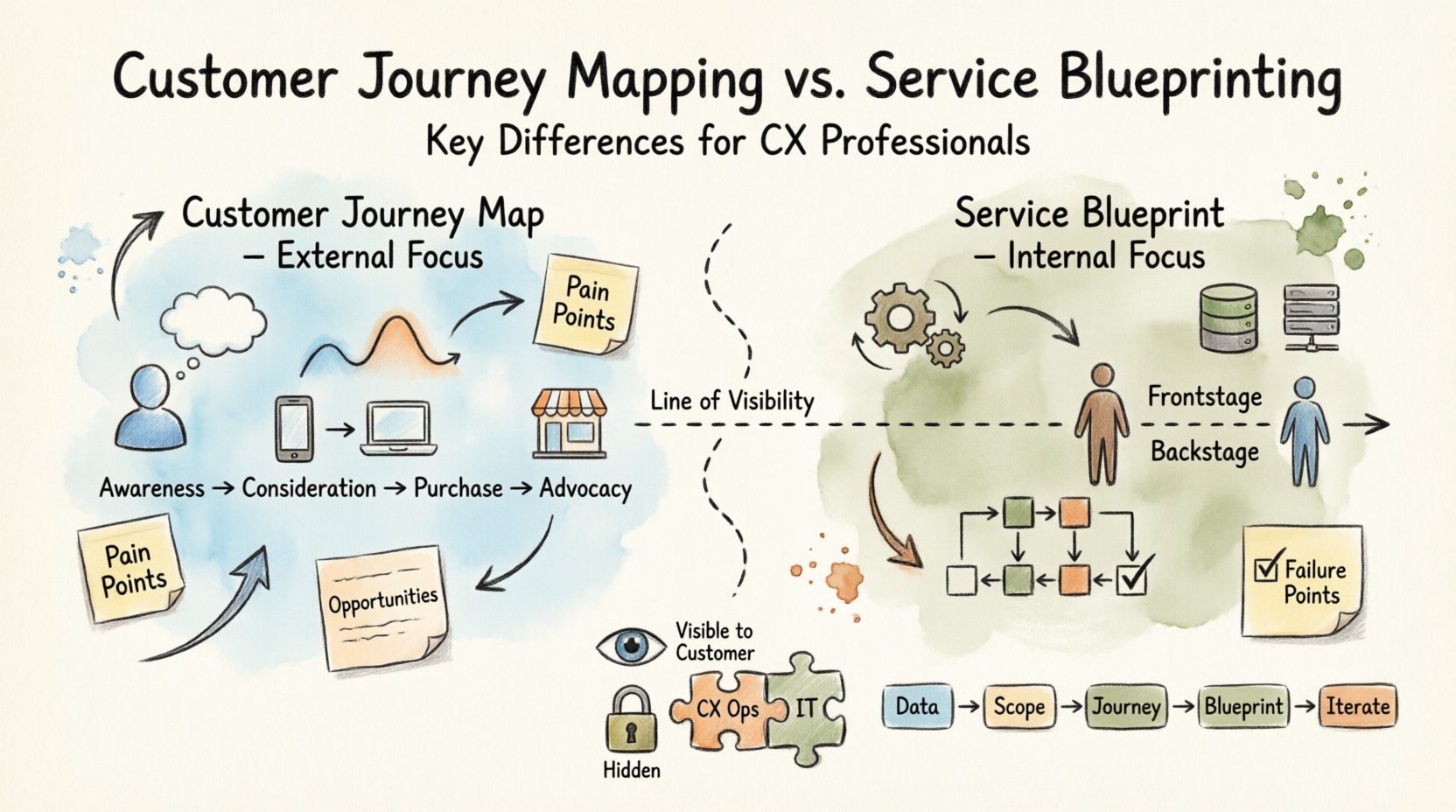
A Customer Journey Map is a visual representation of the steps a person takes to achieve a goal with your brand. It focuses on the external experience. It tracks the user from initial awareness through to post-purchase advocacy. The core purpose is empathy. It answers the question: How does the user feel at each touchpoint?
Core Components
- Personas: Specific archetypes representing your user base.
- Stages: Phases of the relationship (e.g., Awareness, Consideration, Purchase).
- Touchpoints: Channels where the user interacts with the brand (website, app, call center).
- Emotional Curve: A line graph indicating satisfaction or frustration levels.
- Opportunities: Identified gaps where experience can be improved.
Focus Areas
The journey map is primarily concerned with the what and the who. It details the actions the user performs and the feelings they experience. It does not typically explain how the company fulfills the request behind the scenes.
- Channels: Mobile, web, physical store, social media.
- Thoughts: What is the user thinking during a specific interaction?
- Pain Points: Friction that causes drop-offs or dissatisfaction.
- Emotions: Anxiety, joy, confusion, relief.
When creating a journey map, teams often use sticky notes on a large board or digital collaboration spaces to plot these elements. The output is a narrative that highlights the human element of the service.
🏗️ Understanding Service Blueprinting
A Service Blueprint is a diagram that visualizes the relationship between people, props, and processes. It focuses on the internal mechanics required to deliver the service. It answers the question: What must happen behind the scenes to make the user’s journey possible?
Core Components
- Physical Evidence: Tangible items the user sees (receipts, uniforms, app screens).
- Customer Actions: The same steps found in the journey map.
- Line of Interaction: The point where the customer interacts with the service.
- Frontstage (Onstage) Actions: Visible employee actions.
- Line of Visibility: The divider between what the customer sees and what happens internally.
- Backstage Actions: Internal processes invisible to the customer.
- Support Processes: Systems and departments that enable the service.
Focus Areas
The blueprint is primarily concerned with the how and the where (internal). It connects the customer’s visible actions to the internal workflows required to support them. It is a tool for operations and engineering teams.
- Processes: The specific steps employees take.
- Systems: Software, databases, and infrastructure.
- Dependencies: How one department relies on another.
- Failure Points: Where internal errors cause external dissatisfaction.
Blueprints are often created by operations managers, process analysts, and service designers. They serve as a technical specification for service delivery.
⚖️ Key Differences at a Glance
While both tools aim to improve service quality, their scope and audience differ significantly. The following table outlines the primary distinctions.
| Feature | Customer Journey Map | Service Blueprint |
|---|---|---|
| Primary Focus | User Experience (External) | Service Delivery (Internal) |
| Main Audience | Marketing, Design, Strategy | Operations, IT, HR, Management |
| Key Question | How does the user feel? | How do we deliver this value? |
| Visibility | Visible to the customer | Hidden from the customer |
| Timeframe | End-to-end relationship | Specific service interaction |
| Output | Empathy insights, emotional curve | Process flows, system dependencies |
🔄 Integrating Both Methodologies
Using one without the other often leads to suboptimal results. A beautiful journey map that ignores operational feasibility is a fantasy. A complex service blueprint that ignores user emotion is a machine, not a service.
The Line of Visibility
The most critical intersection between these two tools is the Line of Visibility. This horizontal line separates what the customer sees (Frontstage) from what they do not (Backstage).
- Frontstage: The interaction itself. This is where the Journey Map lives.
- Backstage: The fulfillment. This is where the Service Blueprint lives.
When aligning these, ensure that every touchpoint identified in the journey map has a corresponding operational process in the blueprint. If a customer expects a 24-hour response on social media (Journey Map), the internal ticketing system and staffing schedule (Blueprint) must reflect that capability.
Shared Ownership
Successful implementation requires cross-functional collaboration.
- CX Teams: Define the emotional goals and user paths.
- Operations Teams: Define the capacity and process limits.
- IT/Engineering: Define the system constraints and data flows.
Workshops involving all these stakeholders help bridge the gap. When a designer proposes a feature, the operations team must validate if it can be supported. When operations propose a process change, the design team must ensure it does not degrade the user experience.
📝 Implementation Steps for CX Professionals
Integrating these frameworks requires a structured approach. Avoid rushing into diagrams without data.
Step 1: Data Collection
Gather qualitative and quantitative data.
- Surveys: Net Promoter Score (NPS), Customer Satisfaction (CSAT).
- Interviews: In-depth conversations about pain points.
- Analytics: Funnel drop-offs, session duration, heatmaps.
- Support Logs: Common complaints and resolution times.
Step 2: Define the Scope
Decide which journey or service to map. Do not attempt to map the entire lifecycle of a customer in one document.
- Example: Focus on the “Onboarding Experience” or “Returns Process”.
- Reasoning: Deep dives yield better insights than broad overviews.
Step 3: Draft the Journey Map
Map the user actions and emotions first.
- Identify Stages: Break the journey into logical phases.
- Plot Touchpoints: List every channel used.
- Emotional Line: Draw the curve of satisfaction.
Step 4: Draft the Service Blueprint
Build the operational layer underneath the journey.
- Map Frontstage: Align with the Journey Map touchpoints.
- Map Backstage: List the internal steps required.
- Map Support: Identify the systems and people enabling the service.
Step 5: Validate and Iterate
Review the documents with stakeholders.
- Reality Check: Do the processes actually exist?
- Gap Analysis: Where are the mismatches between expectation and delivery?
- Update: Treat these as living documents, not static reports.
⚠️ Common Pitfalls to Avoid
Even experienced teams make mistakes when applying these frameworks. Awareness of common errors can save time and resources.
1. Over-Simplification
Creating a linear journey when reality is non-linear. Users often jump between channels or repeat steps. Avoid forcing a straight line if the behavior is cyclical.
2. Ignoring the Emotional Arc
Focusing only on the steps and missing the feelings. A process might be efficient, but if it feels cold or frustrating, the experience fails.
3. Siloed Creation
Having one team build the map and another build the blueprint without communication. This leads to the “Expectation vs. Reality” gap.
4. Outdated Information
Mapping a process that has changed six months ago. Regular reviews are necessary to keep the maps relevant.
5. Lack of Action
Creating beautiful visuals that sit on a shelf. Every insight must lead to a specific initiative or task.
📊 Measuring Impact and Success
How do you know if these frameworks are working? You need to track specific metrics that reflect both user satisfaction and operational efficiency.
Customer-Centric Metrics
- Customer Effort Score (CES): How easy was the interaction?
- Churn Rate: Did the friction points cause users to leave?
- Task Success Rate: Can users complete the goal without help?
Operational-Centric Metrics
- First Contact Resolution: Was the issue solved immediately?
- Process Cycle Time: How long does the internal step take?
- Cost per Interaction: Is the service economically viable?
🚀 Moving Forward with Strategy
The distinction between Customer Journey Mapping and Service Blueprinting is not about choosing one over the other. It is about understanding which lens to use at which stage of development. Early stages often benefit from the empathy of the Journey Map. Implementation stages require the precision of the Service Blueprint.
By mastering the interplay between the two, organizations can build experiences that are not only delightful to the user but sustainable for the business. The goal is alignment. When the customer wants a specific outcome, and the internal systems are designed to deliver it seamlessly, the brand wins.
Start with the user. Understand their emotions and actions. Then, look inward. Design the processes that support those actions. Finally, connect the two. This holistic approach ensures that the promise made to the customer is the promise kept by the organization.