


In the modern landscape of business, the customer experience is no longer a department; it is the entire organization. For a Customer Experience Manager, understanding the path a client takes from discovery to advocacy is critical. Customer Journey Mapping provides the visual framework needed to navigate this complexity. This guide explores the essential concepts, methodologies, and strategic applications required to build effective maps that drive real business value.
What Exactly is Customer Journey Mapping? 🧭
Customer Journey Mapping is the practice of creating a visual representation of every interaction a person has with your brand. It goes beyond simple touchpoints to include the emotional state, motivations, and pain points associated with each step. Unlike a linear sales funnel, a journey map acknowledges that customers do not always move in a straight line. They may loop back, skip stages, or abandon the process entirely.
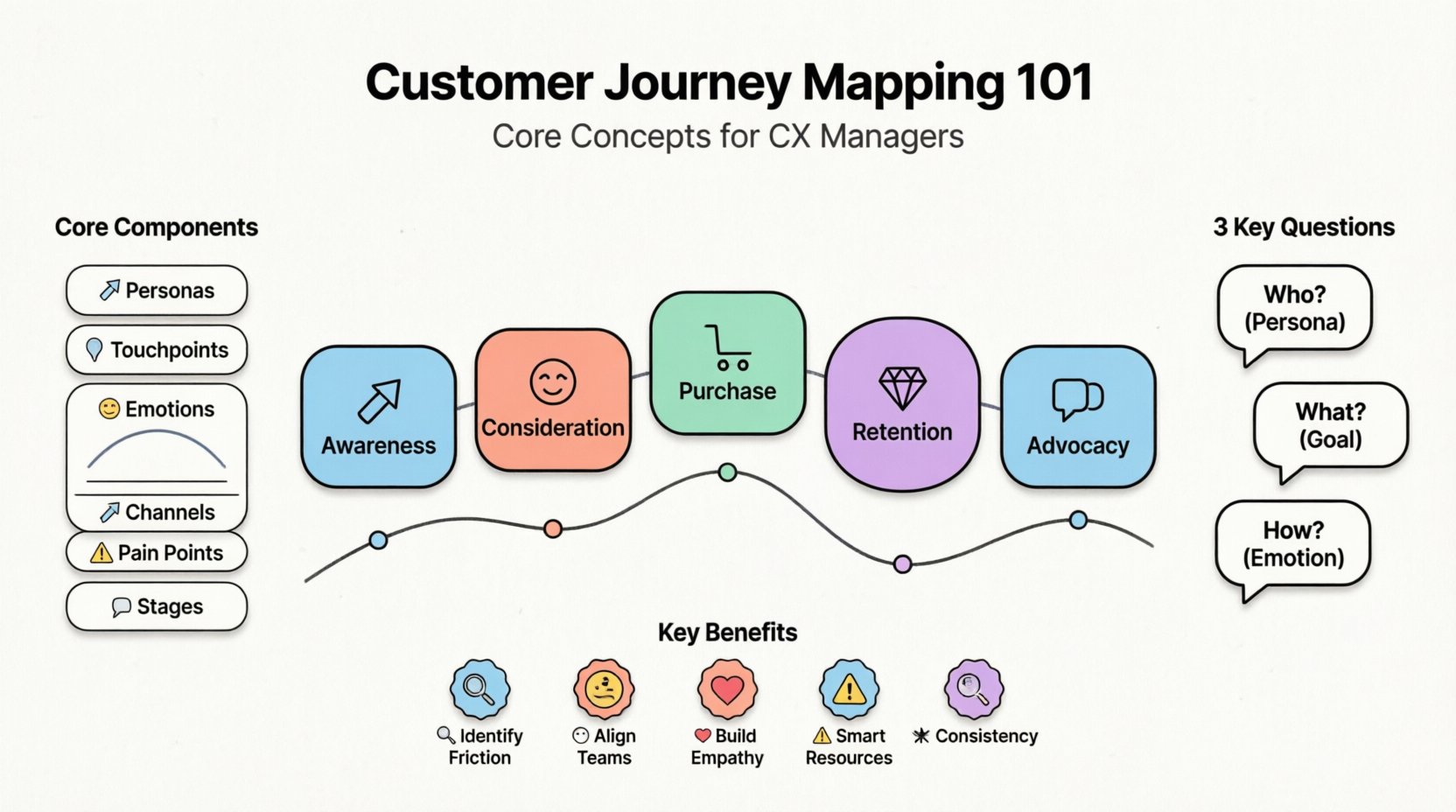
A robust map answers three fundamental questions:
Who is experiencing this journey? (Persona)
What are they trying to achieve? (Goal)
How do they feel along the way? (Emotion)
It transforms abstract data into a human story. When stakeholders see the friction points visually, empathy becomes actionable. This shared understanding aligns product, marketing, sales, and support teams around a single narrative of the customer experience.
Why CX Managers Must Prioritize This Practice 📊
Without a map, organizations often optimize silos. Marketing might drive traffic that sales cannot convert, or support might resolve tickets that product could prevent. Journey mapping reveals these gaps.
Key Benefits for the Organization
Identifying Friction: Pinpoint exactly where customers drop off or get frustrated.
Aligning Teams: Create a single source of truth for all departments.
Empathy Building: Humanize data and metrics for internal teams.
Resource Allocation: Invest in fixes that yield the highest impact on satisfaction.
Consistency: Ensure the brand promise is kept across all channels.
The Core Components of a Journey Map 🏗️
Every map must contain specific elements to be actionable. Omitting any of these can lead to an incomplete picture. Below is a breakdown of the essential building blocks.
Component | Description | Why It Matters |
|---|---|---|
Personas | Specific user archetypes based on research. | Ensures the map reflects real user needs, not assumptions. |
Stages | The high-level phases of the relationship (e.g., Awareness, Purchase). | Provides structure and chronological order to the experience. |
Touchpoints | Specific moments of interaction (website, call, email). | Identifies where the customer physically interacts with the brand. |
Emotions | The sentiment curve (happy, frustrated, confused). | Highlights emotional highs and lows that drive loyalty. |
Channels | The medium used for the touchpoint (mobile, desktop, in-person). | Clarifies the environment in which the interaction occurs. |
Pain Points | Obstacles or negative experiences encountered. | Directs focus toward areas requiring immediate improvement. |
Understanding the Stages of the Customer Journey ⏳
While industries vary, most customer journeys follow a generalized lifecycle. Understanding these stages helps in mapping specific behaviors.
1. Awareness 🚀
The customer realizes they have a problem or need. At this stage, they are researching solutions. They might see an ad, read a blog post, or hear a recommendation. The goal here is visibility and relevance. If the messaging does not resonate with their specific pain point, they will move on to a competitor.
2. Consideration 🤔
The prospect has identified a need and is evaluating options. They compare features, pricing, and reviews. This is the critical window for trust-building. Content marketing, case studies, and demos are vital here. A confusing pricing structure or lack of transparency can cause abandonment.
3. Purchase 🛒
The decision is made. The friction here is often operational. Is the checkout process smooth? Is the payment method accepted? Do the terms make sense? A complicated form or hidden fees at this exact moment can kill a deal that was close to closing.
4. Retention 💎
The transaction is complete, but the relationship has just begun. Does the product work as promised? Is onboarding clear? Support is crucial here. Customers who feel supported early on are significantly more likely to renew or repurchase.
5. Advocacy 📢
Satisfied customers become promoters. They leave reviews, refer friends, and defend the brand on social media. This stage relies entirely on the quality of the previous stages. If the experience was poor, advocacy is impossible. If it was excellent, they become a low-cost acquisition channel for you.
How to Build a Journey Map: A Step-by-Step Guide 🛠️
Creating a map is not a one-time event. It is a process that requires research, collaboration, and iteration. Follow these steps to ensure accuracy.
Step 1: Define the Goal and Scope 🎯
Start by asking what you want to achieve. Are you trying to reduce churn? Improve onboarding? Launch a new product? A map that tries to cover every possible interaction for every persona is too broad. Focus on a specific scenario, such as “First-time user onboarding” or “Resolving a billing issue”.
Step 2: Gather Qualitative and Quantitative Data 🔍
Do not rely on internal assumptions. Use data to build the map.
Quantitative: Analytics, conversion rates, support ticket volume, and survey scores.
Qualitative: Customer interviews, usability testing sessions, and support call recordings.
Combine these data points to understand both the what (numbers) and the why (feelings).
Step 3: Create the Persona Profile 👤
Who is walking this path? Define their demographics, goals, fears, and technical proficiency. A map for a tech-savvy early adopter looks very different from one for a traditional enterprise buyer. Ensure the persona is based on actual research, not a fictional stereotype.
Step 4: Map the Current State (As-Is) 🗺️
Document the journey exactly as it happens today. Include every touchpoint, channel, and system involved. Be honest about failures. If a customer has to call support to fix a website error, map that frustration. This is the foundation for improvement.
Step 5: Identify Gaps and Opportunities 💡
Analyze the current state map. Where are the delays? Where is the confusion? Where is the delight? Look for disconnects between what the customer expects and what the business provides. This is where the strategy lives.
Step 6: Design the Future State (To-Be) 🚀
Visualize how the journey should look after improvements. How can you remove the friction? How can you add value? This is the strategic target. Ensure stakeholders agree on this vision before moving to execution.
Step 7: Implement and Iterate 🔄
A map is a living document. Once changes are made, measure the results. Did the conversion rate go up? Did support tickets drop? Update the map based on new data. The customer environment changes, so your map must change with it.
Common Pitfalls to Avoid 🚫
Even experienced managers make mistakes when mapping. Being aware of these traps saves time and resources.
1. The “Me-Centric” View
Many maps focus on what the company wants to do, not what the customer wants. If your map reads like a process flowchart of your internal departments, it is not a customer journey map. It must be customer-centric.
2. Ignoring the Emotional Curve
Logic does not drive decisions; emotion does. If you only map steps without mapping feelings, you miss the primary driver of satisfaction. A smooth process that feels cold or impersonal can still lead to churn.
3. One Map to Rule Them All
A single map rarely fits everyone. Different personas have different journeys. A map for a high-volume B2B buyer differs from a low-volume B2C shopper. Create multiple maps for key segments.
4. Lack of Cross-Functional Buy-In
If only the CX team owns the map, it will fail. Marketing, Sales, Product, and Support must all validate the data. If Support disagrees with the journey described by Product, the map is inaccurate.
5. Setting It and Forgetting It
Maps become obsolete quickly. A map created two years ago likely does not reflect the current digital landscape. Schedule regular reviews to keep the map relevant.
Measuring Success: KPIs for Journey Mapping 📈
How do you know if your mapping efforts are working? You need to tie the map to key performance indicators. These metrics validate the improvements made.
1. Net Promoter Score (NPS)
Measures loyalty. A rising NPS indicates that the journey improvements are resonating with customers and turning them into advocates.
2. Customer Satisfaction (CSAT)
Tracks satisfaction at specific touchpoints. If you improve the onboarding stage, CSAT scores for that specific interaction should rise.
3. Customer Effort Score (CES)
Measures how easy it is for a customer to complete a task. Lower effort scores generally correlate with higher retention.
4. Conversion Rates
Look at the funnel. If you removed friction in the consideration stage, the conversion rate to purchase should increase.
5. Churn Rate
Reducing friction in the retention stage should lead to a lower churn rate. Monitor where customers leave and correlate it with map insights.
6. First Contact Resolution (FCR)
For support journeys, an increase in FCR indicates that the customer found the answer they needed without needing to contact you again.
Integrating Maps into Organizational Strategy 🏢
A map on a wall or in a PDF does nothing. It must be integrated into daily operations.
1. Product Development
Use the map to prioritize the roadmap. If the map shows high frustration at the payment stage, the engineering team should prioritize fixing the checkout flow before building new features.
2. Marketing Campaigns
Align messaging with the emotional state of the customer. Do not send sales emails to users in the “frustrated” part of the journey. Send educational content instead.
3. Training Programs
Use the map to train new hires. Show them the journey, the pain points, and the emotional curve. This builds empathy faster than a standard policy manual.
4. Budget Allocation
Direct resources to the stages that matter most. If the map shows that retention is the highest value stage, allocate more budget to customer success teams.
The Future of Journey Mapping 🌐
The practice is evolving alongside technology. Real-time mapping is becoming possible through advanced analytics. Instead of a static snapshot, organizations can now see the journey as it happens.
Hyper-Personalization: Maps can adapt based on user data in real-time.
AI Integration: Artificial intelligence can predict friction points before they happen.
Omnichannel Continuity: Ensuring the map connects seamlessly across mobile, web, voice, and physical stores.
As technology advances, the human element remains central. Tools can collect data, but humans must interpret the story. The CX Manager’s role is to remain the bridge between the data and the human experience.
Final Thoughts on Customer Experience Management 🤝
Customer Journey Mapping is not a magic bullet. It is a tool for clarity. It forces organizations to look at their business through the eyes of the person they serve. When done correctly, it aligns the company, reduces waste, and increases loyalty.
Start small. Pick one critical journey. Involve the right people. Listen to the data. Iterate based on feedback. Over time, these maps become the blueprint for a customer-centric culture. The goal is not just to map the journey, but to improve it continuously. Every interaction is an opportunity to build trust. Every touchpoint is a chance to deliver value.
By focusing on the core concepts outlined here, CX Managers can navigate the complexities of the modern market with confidence. The journey never truly ends, but with the right map, the destination becomes clearer.