


Enterprise Architecture demands precision. When defining how stakeholders interact with complex systems, the ArchiMate Viewpoint serves as the critical bridge between abstract concepts and concrete communication. Senior architects often face the challenge of ensuring that every view created within the modeling environment aligns with specific stakeholder needs without becoming cluttered or ambiguous.
This guide provides a structured approach to validating these definitions. It focuses on the mechanics of the standard, ensuring that your architectural artifacts remain clear, traceable, and valuable. By adhering to this checklist, you reduce the risk of misinterpretation and strengthen the governance of your architecture practice. 🏗️
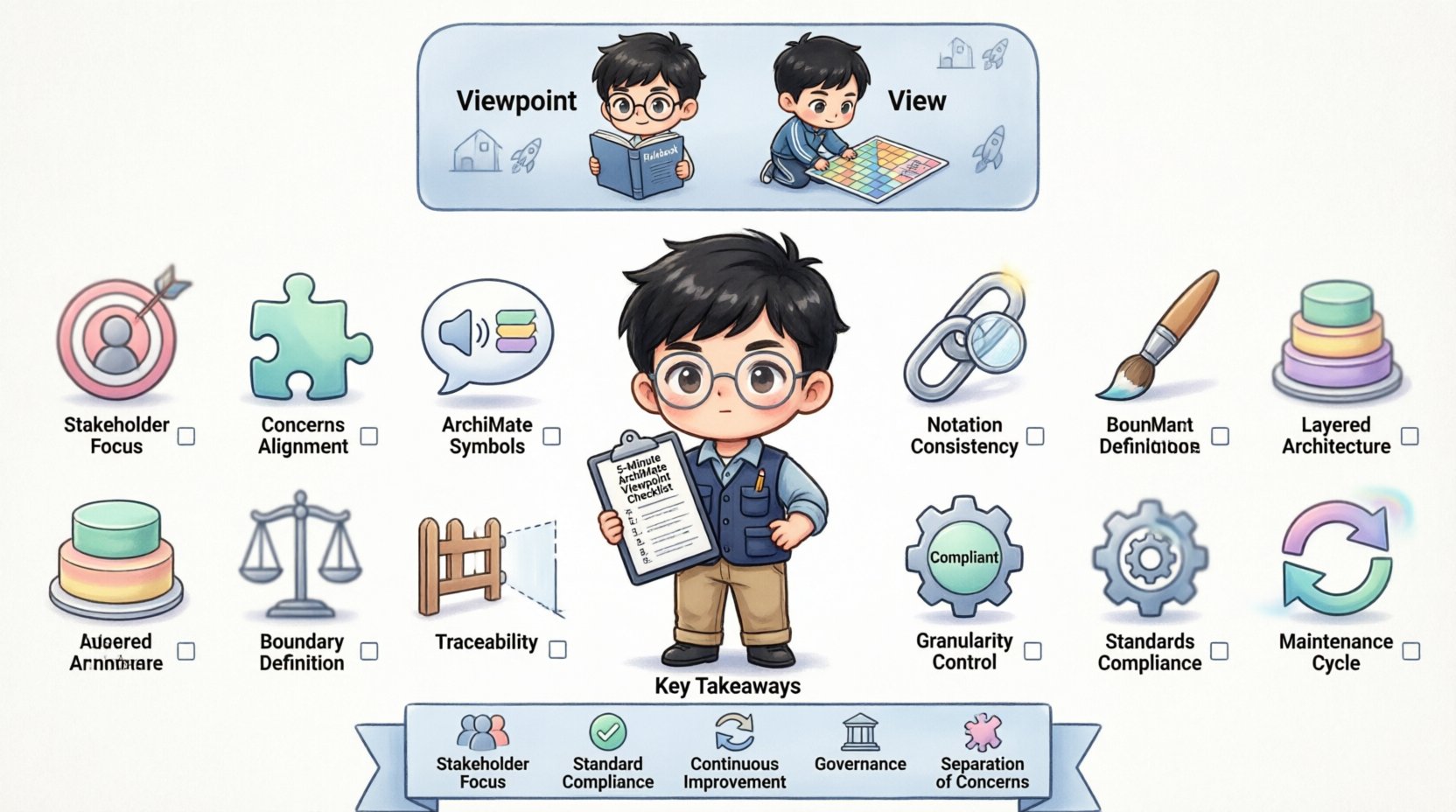
🔍 Understanding the Viewpoint vs. The View
Before diving into the validation steps, it is essential to distinguish between two frequently confused terms. A View is the specific representation of the architecture for a particular set of stakeholders. It is the actual model or diagram produced. A Viewpoint, however, is the template or specification that defines how that view is constructed. It dictates the language, the notation, the scope, and the concerns addressed.
Think of the Viewpoint as the rulebook and the View as the game played using those rules. If the rulebook is flawed, the game becomes unplayable. In enterprise architecture, a poorly defined viewpoint leads to inconsistent models, conflicting documentation, and confusion among stakeholders. 🛑
- View: The concrete output (e.g., “The Logistics Process Map for Q3”).
- Viewpoint: The abstract specification (e.g., “The Process Viewpoint for Supply Chain Managers”).
When you build an architecture, you are essentially creating a library of viewpoints. Each one targets a specific audience. The checklist below ensures that each viewpoint in your library is robust before you begin populating it with data.
✅ The Core Checklist: 10 Steps for Validation
This section breaks down the validation process into actionable items. A senior architect should be able to review a viewpoint definition in under five minutes using these criteria. Each item addresses a specific aspect of the ArchiMate specification, ensuring compliance and clarity.
1. Stakeholder Identification 🎯
Every viewpoint must explicitly state who it serves. Architecture is not created in a vacuum; it solves problems for people. If a viewpoint does not define the audience, the content within it becomes irrelevant.
- Requirement: List specific roles or groups (e.g., “Chief Risk Officer,” “Infrastructure Team Lead”).
- Check: Are these stakeholders identifiable within the organization?
- Check: Do they have a clear interest in the content?
2. Concern Mapping 🧩
A viewpoint exists to address a concern. A concern is a specific interest or issue that matters to the stakeholder. It could be cost, security, performance, or regulatory compliance.
- Requirement: Define the specific business or technical problem.
- Check: Does the viewpoint language directly speak to this problem?
- Check: Is the concern narrow enough to be answerable by the model?
3. Language Selection 🗣️
ArchiMate defines a specific language. It includes elements like Business Actor, Application Component, and Technology Node. A viewpoint must specify which subset of this language is allowed.
- Requirement: Select the permitted elements from the standard.
- Check: Are unnecessary elements excluded to prevent clutter?
- Check: Does the selected subset support the required concern?
4. Layer Definition 🏛️
Architecture is often layered. The Business Layer, Application Layer, and Technology Layer represent different levels of abstraction. A viewpoint should clarify which layers are in scope.
- Requirement: Specify active layers.
- Check: Is the scope limited to what is necessary for the stakeholder?
- Check: Are cross-layer relationships clearly defined if needed?
5. Notation Rules 📝
How should relationships be drawn? Which elements are connectors? Which are nodes? Visual consistency is key for senior architects reviewing diagrams quickly.
- Requirement: Define line styles, shapes, and colors if standard.
- Check: Are the rules documented for the modeling team?
- Check: Is the notation compatible with the chosen tooling environment?
6. Scope and Boundaries ⚖️
What is included? What is excluded? A viewpoint without boundaries invites scope creep. In modeling, scope creep leads to infinite diagrams that no one can read.
- Requirement: State the system or domain boundaries.
- Check: Is there a clear “off-limits” list?
- Check: Are external dependencies handled explicitly?
7. Traceability Mechanisms 🔗
How does this view connect to other views? Architecture is a network of interconnected models. A viewpoint should define how traceability is maintained.
- Requirement: Define linking mechanisms.
- Check: Are there requirements or strategies linked to elements?
- Check: Can a user navigate from this view to the source of the data?
8. Granularity Level 🔬
Detail is a matter of perspective. Some stakeholders need high-level overviews; others need detailed implementation specs. The viewpoint must set the expected level of detail.
- Requirement: Define the depth of decomposition.
- Check: Is the level appropriate for the stakeholder’s role?
- Check: Is there a limit on the number of elements per diagram?
9. Compliance & Standards ⚙️
Does the viewpoint adhere to the organization’s broader architecture governance? It must align with the Enterprise Architecture Framework.
- Requirement: Reference the governing framework.
- Check: Are naming conventions consistent?
- Check: Is the metadata schema compatible?
10. Maintenance & Versioning 🔄
Architecture evolves. A viewpoint definition must have a lifecycle. Who owns it? How often is it reviewed?
- Requirement: Assign ownership.
- Check: Is there a review schedule?
- Check: Is version control defined?
📊 Viewpoint Validation Matrix
For a quick reference during reviews, use this matrix to assess the health of your viewpoint definitions.
| Checklist Item | Question | Pass/Fail |
|---|---|---|
| Stakeholder ID | Is the audience clearly defined? | ☐ |
| Concern Mapping | Does it solve a specific problem? | ☐ |
| Language Selection | Is the element set appropriate? | ☐ |
| Layer Definition | Are layers scoped correctly? | ☐ |
| Notation Rules | Are visual standards set? | ☐ |
| Scope & Boundaries | Are limits defined? | ☐ |
| Traceability | Can links be established? | ☐ |
| Granularity | Is detail level suitable? | ☐ |
| Compliance | Does it fit governance? | ☐ |
| Maintenance | Is ownership clear? | ☐ |
🚧 Common Pitfalls in Viewpoint Design
Even experienced architects can stumble when defining these templates. Recognizing common errors helps avoid them. Below are the most frequent issues encountered in enterprise architecture projects.
1. The “One Size Fits All” Trap
Creating a single viewpoint for all stakeholders is inefficient. A developer needs different information than a C-level executive. If you try to satisfy everyone with one view, you will satisfy no one. The model becomes too dense to be useful. Always segment by audience need.
2. Over-Engineering the Language
Using every available element in the standard creates noise. If a stakeholder does not care about the underlying technology, do not show it. Restrict the language subset to what is necessary. Complexity kills adoption.
3. Ignoring the Context
Architecture does not exist in isolation. A viewpoint must acknowledge external dependencies. If a process relies on an external service, that relationship must be visible. Hiding context leads to implementation surprises later.
4. Lack of Traceability
Models that cannot be traced back to requirements or strategies become orphaned. They lose value over time. Ensure that every element has a reason for existing. Link it to a requirement, a goal, or a strategy.
5. Static Definitions
Viewpoints are not set in stone. As the organization changes, the viewpoints must evolve. If the tooling environment changes or the governance framework updates, the viewpoint specification must be revised. Static viewpoints become obsolete quickly.
🔄 Integrating Viewpoints into Governance
Validation is not a one-time event. It is part of an ongoing governance cycle. Senior architects play a key role in maintaining the integrity of the architecture repository.
- Review Cycles: Schedule quarterly reviews of viewpoint definitions. Check if they still align with business goals.
- Training: Ensure modelers understand the viewpoints. Training on the standard is more effective than training on specific software.
- Repository Management: Store viewpoint definitions in a central location. Make them accessible to all architects.
- Feedback Loops: Gather feedback from the stakeholders who use the views. Did the diagram answer their question? If not, adjust the viewpoint.
🛠️ Practical Application: A Scenario
Consider a scenario where a company is migrating to a cloud infrastructure. The Senior Architect needs to define a viewpoint for the Operations Team.
- Stakeholder: Operations Team Lead.
- Concern: System availability and deployment automation.
- Language: Technology Layer elements (Node, Device, System Software) and Business Layer (Process).
- Layer: Technology and Business layers.
- Notation: Standard ArchiMate connector rules.
- Scope: Production environment only.
- Traceability: Link to Infrastructure Requirements.
- Granularity: High-level deployment topology.
- Compliance: Follow Security Governance Policy.
- Maintenance: Review after each deployment cycle.
This specific viewpoint ensures the Operations Team sees exactly what they need: how systems are deployed and how they are managed, without being distracted by business logic details they do not own.
📈 Measuring Success
How do you know the viewpoints are working? Look for these indicators within your architecture practice.
- Consistency: Do diagrams look similar when made by different people?
- Clarity: Do stakeholders understand the models without a walkthrough?
- Speed: Can new models be created quickly using the defined templates?
- Reuse: Are viewpoints being reused across different projects?
If these metrics are positive, the checklist is effective. If not, revisit the definitions. The goal is efficiency and accuracy in communication.
🔐 Final Thoughts on Architecture Standards
The ArchiMate specification provides a robust framework, but its power lies in disciplined application. Senior architects act as the guardians of this discipline. By rigorously applying the checklist, you ensure that the architecture remains a valuable asset rather than a documentation burden.
Focus on the why behind every element. Every line drawn should serve a purpose. Every stakeholder should have a clear view. This approach fosters trust in the architecture function and ensures that the enterprise moves forward with clarity. 🚀
Remember, the best architecture is the one that is understood. Use these guidelines to make your models clear, concise, and compliant. Regularly audit your viewpoints. Keep them sharp. Keep them relevant. This is the path to mature enterprise architecture.
📚 Key Takeaways
- Separation of Concerns: Keep viewpoints distinct from specific views.
- Stakeholder Focus: Always start with who is reading the model.
- Standard Compliance: Adhere to the ArchiMate language rules.
- Continuous Improvement: Treat viewpoints as living documents.
- Governance: Integrate validation into your architecture review process.
Apply this checklist to your next modeling initiative. The time invested in validation saves hours of rework and confusion later. Maintain the quality of your architectural artifacts, and the organization will reap the benefits of a coherent strategy. ✅