


Enterprise Architecture is evolving. It is no longer enough to produce static diagrams that sit in a repository gathering dust. The modern landscape demands architecture that communicates, adapts, and drives decision-making across the organization. At the heart of this shift lies the strategic usage of ArchiMate Viewpoints. These constructs are the bridge between complex technical data and the specific needs of stakeholders.
When architects design models without a clear viewpoint strategy, they risk creating artifacts that are technically correct but practically useless. To ensure longevity and relevance, it is essential to understand the emerging trends shaping how these viewpoints are defined, implemented, and governed. This guide explores the practical application of ArchiMate Viewpoints in a forward-looking context, focusing on sustainability, motivation, and traceability.
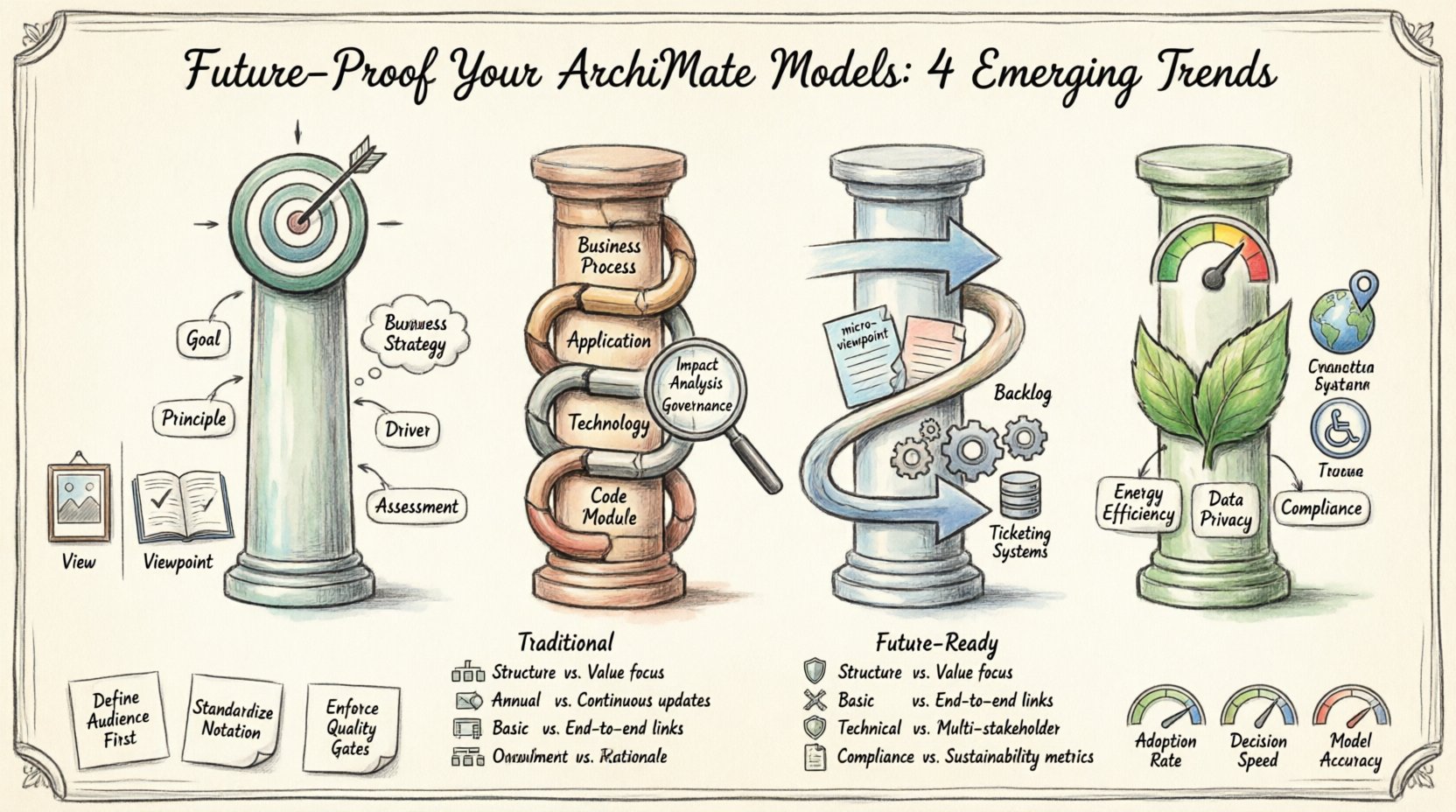
Understanding the Core: View vs. Viewpoint 🧩
Before diving into trends, clarity on terminology is vital. In the ArchiMate standard, a View is the actual representation of the architecture for a specific stakeholder. It is the picture on the wall. A Viewpoint, however, is the specification that defines the conventions, notation, and model elements used to create that View.
- View: The concrete artifact (e.g., a specific diagram showing Business to Application flow).
- Viewpoint: The rulebook or template (e.g., the definition of which layers and relationships are allowed in that specific diagram).
Future-proofing your models depends on getting the Viewpoint definition right. If the Viewpoint is too rigid, the model cannot adapt. If it is too loose, the model becomes ambiguous. The goal is to create Viewpoints that are consistent yet flexible enough to handle changing business needs.
Trend 1: Elevating the Motivation Layer 🎯
Historically, many architecture models focused heavily on the Business, Application, and Technology layers. While these structural layers describe what exists, they often fail to explain why decisions were made. The emerging trend is the robust integration of the Motivation Layer into primary Viewpoints.
Stakeholders at the executive level rarely care about infrastructure topology. They care about risk, cost, strategy, and value. By incorporating Motivation constructs into your Viewpoints, you align the architecture directly with business goals.
Key Motivations to Include:
- Goal: What are we trying to achieve? (e.g., Reduce carbon footprint).
- Principle: What rules must be followed? (e.g., Cloud First).
- Assessment: How do we measure success? (e.g., Compliance Check).
- Driver: What forces change? (e.g., New Regulation).
When designing a Viewpoint, ensure it supports the display of these Motivation elements. This adds context to every business service and application component. It transforms a static map into a narrative of value delivery.
Trend 2: Traceability and Linking 🔗
Isolated models are a relic of the past. The modern expectation is full traceability. A Viewpoint should not just show a relationship between two objects; it should enable the tracking of changes across the entire lifecycle.
This trend emphasizes the importance of relationships within the Viewpoint definition. It is not enough to link a Business Process to an Application. You must be able to trace that Application to the underlying Technology Component, and further, to the specific Code Module or Cloud Service.
Benefits of Enhanced Traceability:
- Impact Analysis: Quickly determine the ripple effect of a change.
- Governance: Prove that specific requirements are met by specific solutions.
- Discovery: Find unused components or redundant processes efficiently.
Viewpoints designed for this purpose often require a higher density of linking information. This means the modeling process must capture metadata rigorously. Automation plays a role here, ensuring that links are not lost during updates.
Trend 3: Aligning with Agile and DevOps ⚡
Traditional architecture cycles were often long and waterfall. Modern software delivery is iterative. There is a growing need for Viewpoints that support Agile and DevOps environments. These Viewpoints must be lightweight, accessible, and updated frequently.
Standard enterprise architecture diagrams are often too complex for a sprint review. The trend is towards micro-viewpoints. These are simplified representations tailored for specific teams or specific sprints.
Designing for Agile:
- Focus on Value Streams: Show how work flows through the system rather than static boxes.
- Dynamic Updates: Ensure the Viewpoint allows for rapid modification without breaking the whole model.
- Integration: Connect architectural models with backlog management and ticketing systems conceptually.
By adopting this approach, architecture becomes part of the delivery pipeline rather than a gatekeeper at the end. This ensures the models remain current and relevant to the teams building the software.
Trend 4: Sustainability and ESG Integration 🌱
Environmental, Social, and Governance (ESG) criteria are becoming mandatory for many organizations. Architecture models must now reflect these non-functional requirements. A Viewpoint that ignores energy consumption or data privacy is becoming obsolete.
This trend involves extending the standard ArchiMate layers to include Sustainability Attributes. While the standard does not have a specific “Energy Layer,” architects are embedding these concerns into the Technology and Application layers.
Examples of ESG in Viewpoints:
- Energy Efficiency: Tagging applications with estimated power consumption metrics.
- Data Sovereignty: Highlighting where data is stored to ensure compliance with regional laws.
- Accessibility: Ensuring that digital services meet accessibility standards.
Incorporating these attributes into your Viewpoint definitions ensures that sustainability is not an afterthought. It becomes a visible constraint in the architectural design process.
Comparison: Traditional vs. Future-Ready Viewpoints
| Feature | Traditional Viewpoint | Future-Ready Viewpoint |
|---|---|---|
| Focus | Structure and Layers | Value, Motivation, and Impact |
| Update Frequency | Annual or Project-based | Continuous or Sprint-based |
| Traceability | Basic Connections | End-to-End Lifecycle Links |
| Stakeholders | Technical Teams | Executives, Teams, and Regulators |
| Metrics | Compliance | Sustainability and Value Delivery |
Implementation Strategies 🛠️
How do you move from a standard setup to a future-proof one? It requires a disciplined approach to modeling. You do not need new tools; you need a new strategy.
1. Define the Audience First
Before drawing a single shape, identify who will consume this View. Is it a CIO? A Developer? A Compliance Officer? Each audience requires a different Viewpoint definition. Avoid creating a “one-size-fits-all” diagram.
2. Standardize Notation
Consistency is key to readability. Ensure that every Viewpoint uses the same color coding, symbol shapes, and layout conventions. This reduces cognitive load for anyone reading the architecture.
3. Enforce Quality Gates
Implement checks to ensure models meet the Viewpoint standards. If a Viewpoint requires a specific relationship type, the modeling process should validate that this relationship exists before the View is considered complete.
4. Document the Rationale
Why was this Viewpoint chosen? Why are these specific elements included? Documentation should accompany the Viewpoint definition itself. This ensures that if a modeler changes over time, the intent of the Viewpoint is preserved.
Common Pitfalls to Avoid ⚠️
Even with the best intentions, architects can fall into traps that reduce the utility of their models.
- Over-Complexity: Trying to fit every layer into one Viewpoint creates clutter. Keep Viewpoints focused.
- Ignoring Context: A Viewpoint that shows technology without business context is useless for strategic planning.
- Static Definitions: Viewpoints should evolve. If the business changes, the Viewpoint rules should change with it.
- Lack of Governance: Without oversight, Viewpoints become inconsistent across different projects or departments.
Governance and Quality Assurance 🛡️
Future-proofing is not just about design; it is about maintenance. Architecture Governance ensures that the Viewpoints are being used correctly and that the models remain accurate.
Key Governance Activities:
- Review Cycles: Schedule regular reviews to validate that the Viewpoints still meet stakeholder needs.
- Training: Ensure all modelers understand how to use the Viewpoints effectively.
- Version Control: Treat Viewpoint definitions as living documents that require versioning.
Governance does not mean bureaucracy. It means ensuring that the investment in modeling pays off. It ensures that the “Future-Proof” claim is backed by actual practice.
Measuring Success 📊
How do you know if your Viewpoint strategy is working? Look for these indicators of maturity:
- Adoption Rate: Are stakeholders actively using the views provided?
- Decision Speed: Is the architecture providing information fast enough to support decisions?
- Model Accuracy: Is the model reflecting the current reality of the IT landscape?
- Stakeholder Satisfaction: Do the people reviewing the architecture feel informed and confident?
If the answer to these questions is yes, your Viewpoint usage is successful. If not, it is time to revisit the definitions and the trends discussed in this guide.
The Road Ahead 🔮
The landscape of Enterprise Architecture is shifting from documentation to enablement. Viewpoints are the primary mechanism for this shift. By focusing on Motivation, Traceability, Agile alignment, and Sustainability, architects can ensure their models remain relevant.
It is not about building bigger diagrams. It is about building smarter connections. When you design Viewpoints with the future in mind, you create an architecture capability that supports the organization through change. This is the essence of true future-proofing.
Start by reviewing your current Viewpoint library. Identify which ones align with these emerging trends. Update the definitions where necessary. Train your team on the new standards. The path to a robust Enterprise Architecture is paved with intentional design choices.