


In the landscape of Enterprise Architecture (EA), communication remains the most significant hurdle. Stakeholders from business leadership to engineering teams often speak different languages. One group focuses on value streams and KPIs, while another deals with sequence diagrams and database schemas. Without a unified framework, these conversations drift apart, leading to misalignment and architectural debt. This is where structured modeling languages enter the picture.
Two dominant paradigms exist: the specialized structure of ArchiMate Viewpoints and the broader Traditional Modeling Approaches like UML or BPMN. Choosing between them is not merely a technical decision; it is a strategic choice about how an organization understands itself. This guide explores the nuances, strengths, and limitations of each approach to help architects build models that truly serve their intended audience.
🔍 Understanding ArchiMate Viewpoints 🧩
ArchiMate is more than just a diagramming language; it is an open standard for describing, analyzing, and visualizing enterprise architecture. However, the true power of ArchiMate lies in its concept of Viewpoints. A viewpoint defines the perspective from which a model is viewed. It answers the question: Who is looking at this, and why?
Think of a viewpoint as a specific lens. Just as a geologist looks at a rock with a magnifying glass while a hiker sees the mountain range, an architect uses different viewpoints to reveal different layers of truth.
- Abstraction Level: Viewpoints control the level of detail. A business executive needs a high-level motivation view, while a developer needs a detailed application interface view.
- Focus: Viewpoints isolate specific concerns. A technology viewpoint hides business processes to focus solely on infrastructure.
- Consistency: Viewpoints ensure that all diagrams within a specific context use the same notation and rules.
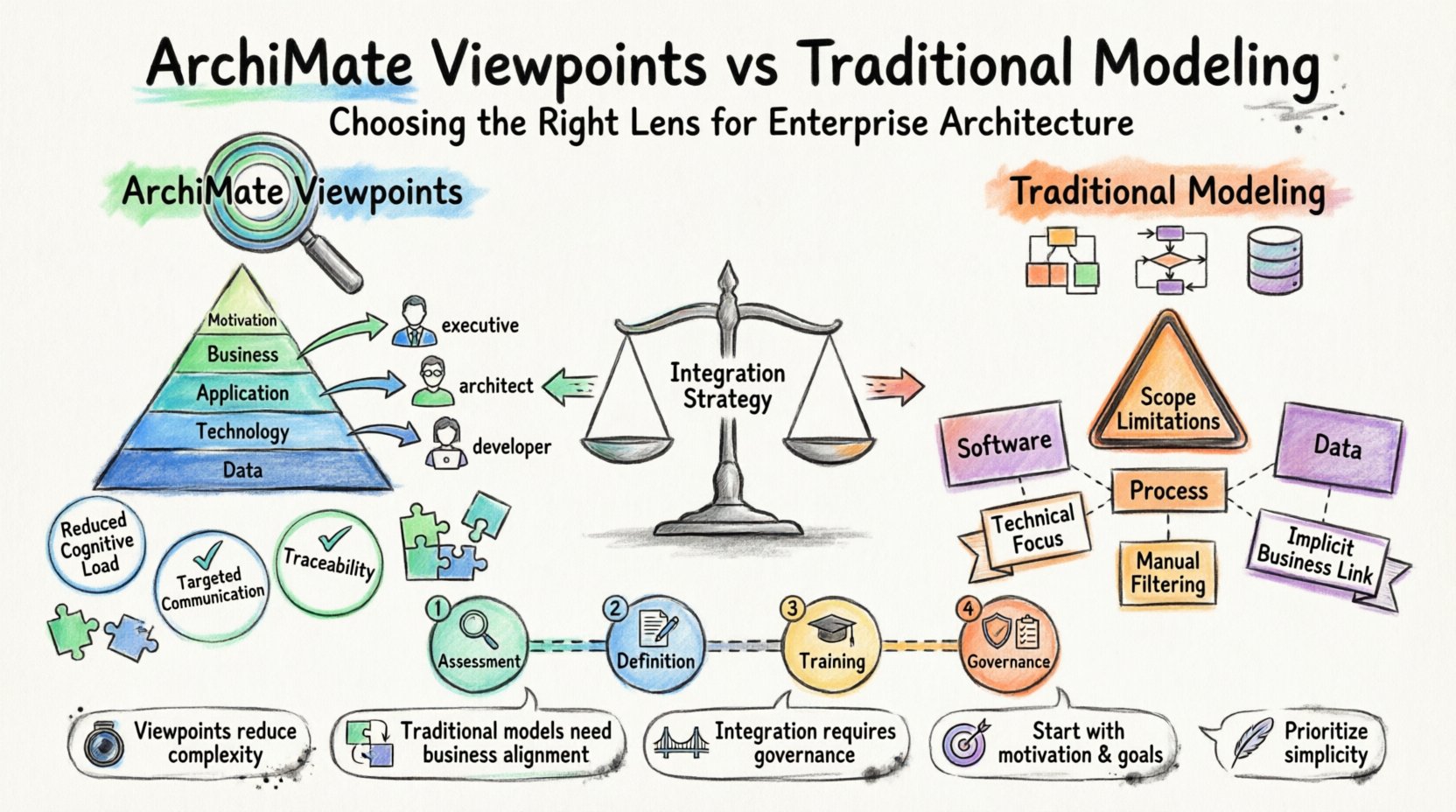
The ArchiMate standard defines specific layers: Business, Application, Technology, and Data, along with a Motivation layer. Viewpoints map concepts across these layers without forcing every diagram to be a complex matrix of every possible element.
📌 Key Benefits of Viewpoints
- Reduced Cognitive Load: Stakeholders are not overwhelmed by irrelevant data. A CFO does not need to see database table structures.
- Targeted Communication: Each diagram is crafted for a specific decision-making process.
- Traceability: Viewpoints help link business goals to technical implementation without mixing metaphors.
- Standardization: Ensures that everyone in the organization speaks the same visual language regarding architecture.
🛠️ Traditional Modeling Approaches 📐
Before the widespread adoption of enterprise architecture frameworks, organizations relied heavily on traditional modeling languages. These include the Unified Modeling Language (UML) for software systems and Business Process Model and Notation (BPMN) for workflows.
These approaches were born out of specific needs—software development and process optimization. While they are robust, applying them directly to enterprise architecture often creates friction.
📌 Common Traditional Models
- UML Class Diagrams: Excellent for defining software structure and relationships between objects. However, they rarely capture business strategy or organizational context.
- UML Sequence Diagrams: Great for showing the flow of messages between components. They are too granular for high-level business alignment.
- BPMN Flowcharts: Industry standard for processes. They excel at showing who does what, but often lack the connection to the systems that support those processes.
- Entity Relationship Diagrams (ERD): Essential for data architecture but disconnected from the applications that manipulate that data.
The challenge with these traditional approaches in an EA context is scope. A UML diagram tells you how a system works, not why the system exists or how it aligns with business value. They tend to be siloed by domain.
⚖️ Comparative Analysis: Viewpoints vs. Traditional Modeling 📊
To understand the distinction clearly, we must look at how these approaches handle specific architectural concerns. The following table breaks down the differences in structure, audience, and intent.
| Feature | ArchiMate Viewpoints | Traditional Modeling (UML/BPMN) |
|---|---|---|
| Primary Focus | Enterprise-wide alignment and cross-domain relationships | System functionality or specific process flows |
| Scope | Business, Application, Technology, and Data layers integrated | Typically isolated to one layer (e.g., only Software or only Process) |
| Audience | Diverse stakeholders (Executives, Architects, Developers) | Technical teams or Process Owners primarily |
| Abstraction | Explicit separation of concerns via viewpoints | Often requires manual filtering to manage complexity |
| Business Alignment | First-class citizen (Motivation Layer) | Secondary or implicit connection |
| Flexibility | Highly customizable to organizational needs | Rigid adherence to standard notation rules |
| Integration | Designed to connect strategy to implementation | Designed for implementation details |
The table highlights a fundamental difference in philosophy. Traditional modeling asks, How does this work? ArchiMate Viewpoints ask, Why does this work, and who benefits?
🧠 The Cognitive Load of Modeling 🧠
One of the most overlooked aspects of architecture is the human element. Architects spend hours creating models, only to find that the audience cannot understand them. This is often a result of poor viewpoint selection.
📉 The Problem of Over-Engineering
When using traditional approaches without viewpoint discipline, models often become dense. A single diagram might attempt to show the business process, the software components, the data entities, and the infrastructure servers. This violates the principle of separation of concerns.
Consequences of Over-Engineering:
- Confusion: Stakeholders cannot find the information relevant to their role.
- Rejection: If a diagram is too technical, business leaders ignore it. If too abstract, developers cannot implement it.
- Maintenance Burden: Changing one detail forces updates across a complex, monolithic diagram.
📈 The Solution: Targeted Viewpoints
By adopting ArchiMate Viewpoints, architects create a library of views. Each view is a curated subset of the total architecture.
- The Business Process View: Focuses on value streams and activities. It ignores the underlying software.
- The Application Interaction View: Focuses on how applications support business functions. It ignores the data structures.
- The Technology Deployment View: Focuses on hardware and networks. It ignores the business logic.
This approach allows the same underlying data to be visualized differently for different audiences without duplicating the data itself.
🔗 Bridging the Gap: Integration Strategies 🔗
Organizations rarely switch entirely from traditional modeling to ArchiMate. More often, they must integrate both. This presents a challenge of interoperability. How do you ensure a UML sequence diagram maps correctly to an ArchiMate application component?
📌 The Mapping Exercise
To bridge these gaps, architects must establish a mapping strategy. This involves defining relationships between elements of different languages.
- Identify Core Entities: Determine which business capabilities in ArchiMate correspond to which processes in BPMN.
- Define Interfaces: Map the interfaces of ArchiMate Application components to the ports of UML components.
- Version Control: Ensure that changes in the traditional model trigger updates in the architectural model.
This integration is not automatic. It requires governance. Without a governance framework, the two models will drift apart, creating a disconnect between the “as-is” architecture and the “implemented” reality.
🚀 Implementation Roadmap 🛤️
Adopting ArchiMate Viewpoints is a journey, not a destination. It requires a shift in mindset from documenting systems to documenting value.
📌 Phase 1: Assessment
Before starting, evaluate the current modeling landscape. What traditional diagrams are being used? Who is creating them? What decisions are being made based on them? Identify the gaps where traditional models fail to communicate enterprise-wide concerns.
📌 Phase 2: Definition
Define the standard viewpoints for your organization. Do not try to create every possible viewpoint. Start with the top three needs:
- Strategic Alignment: Linking goals to capabilities.
- Process Flow: Linking activities to applications.
- Infrastructure: Linking applications to technology.
📌 Phase 3: Training
Training is critical. Architects must understand not just the syntax of ArchiMate, but the semantics. They must understand when to use a specific viewpoint and when to avoid it. This is where authority and quiet confidence come into play—guiding teams away from the temptation to over-model.
📌 Phase 4: Governance
Establish a review process. Are the models up to date? Do they accurately reflect the current state? Viewpoints are only useful if they are trusted. If stakeholders know the models are outdated, they will ignore them.
⚠️ Common Pitfalls to Avoid ⚠️
Even with a solid plan, organizations often stumble. Here are common mistakes that undermine the value of ArchiMate Viewpoints.
- Viewpoint Fatigue: Creating too many viewpoints dilutes focus. Keep the standard set manageable.
- Ignoring the Motivation Layer: Many models start with technology. Always start with motivation (Goals, Drivers, Principles) to ensure alignment.
- Static Modeling: Architecture is dynamic. Viewpoints should reflect the ability to model change over time, not just a snapshot.
- Siloed Tools: Using different tools for different viewpoints without integration creates data fragmentation.
- Complexity Creep: Just because you can show a complex relationship does not mean you should. Simplicity is a virtue in architecture.
🌍 Future Trends in Architectural Modeling 🌐
The landscape of enterprise architecture is evolving. As organizations become more agile and digital-first, the need for flexible modeling increases.
📌 Real-Time Architecture
Traditional models were often static documents. The future lies in real-time architecture models that update as systems change. Viewpoints allow for this by providing different views of the same live data.
📌 Automation and AI
Artificial Intelligence is beginning to assist in model generation. AI can suggest relationships or identify inconsistencies. However, AI cannot define the viewpoint. The human architect must still define the lens through which the data is viewed.
📌 Cloud and Hybrid Environments
With the rise of cloud computing, the Technology layer has become more complex. Viewpoints help manage this complexity by separating concerns. A cloud migration viewpoint might look different from an on-premise security viewpoint.
💡 Conclusion on Strategic Choice 💡
Selecting between ArchiMate Viewpoints and traditional modeling is not about declaring a winner. It is about selecting the right tool for the specific architectural challenge at hand. Traditional models like UML and BPMN remain essential for technical depth and process detail. ArchiMate Viewpoints provide the necessary framework to connect those details to business strategy.
The most effective architectures often use a hybrid approach. They leverage the precision of traditional modeling for implementation and the clarity of ArchiMate Viewpoints for communication. By understanding the strengths and limitations of each, architects can build models that do more than just exist—they enable decisions.
Ultimately, the goal is not to create beautiful diagrams. The goal is to create understanding. Whether you choose a standard sequence diagram or a specialized ArchiMate viewpoint, the measure of success is whether the stakeholder understands the implication of their decision. This is the true art of comparison.
📝 Summary of Key Takeaways 📝
- Viewpoints reduce complexity: They allow stakeholders to see only what is relevant to them.
- Traditional models lack context: UML and BPMN are powerful but often lack business alignment.
- Integration is key: Bridging the gap between different modeling standards requires governance.
- Start with motivation: Always link architecture back to business goals.
- Maintainability matters: Complex models are hard to maintain; prioritize simplicity.
By adhering to these principles, organizations can navigate the complexities of modern enterprise architecture with confidence and clarity.