


Enterprise architecture is rarely about drawing a single diagram that tells the whole story. It is about constructing a coherent narrative that different stakeholders can understand and act upon. For lead architects, the challenge lies not in modeling the enterprise itself, but in curating the perspectives through which that enterprise is observed. This is where the ArchiMate Viewpoint concept becomes critical. Moving past basic diagramming requires a strategic approach to how information is structured, filtered, and presented. This guide explores the advanced techniques required to design robust viewpoints that serve governance, communication, and decision-making effectively. 🧭
Understanding the Architecture of Viewpoints 🧩
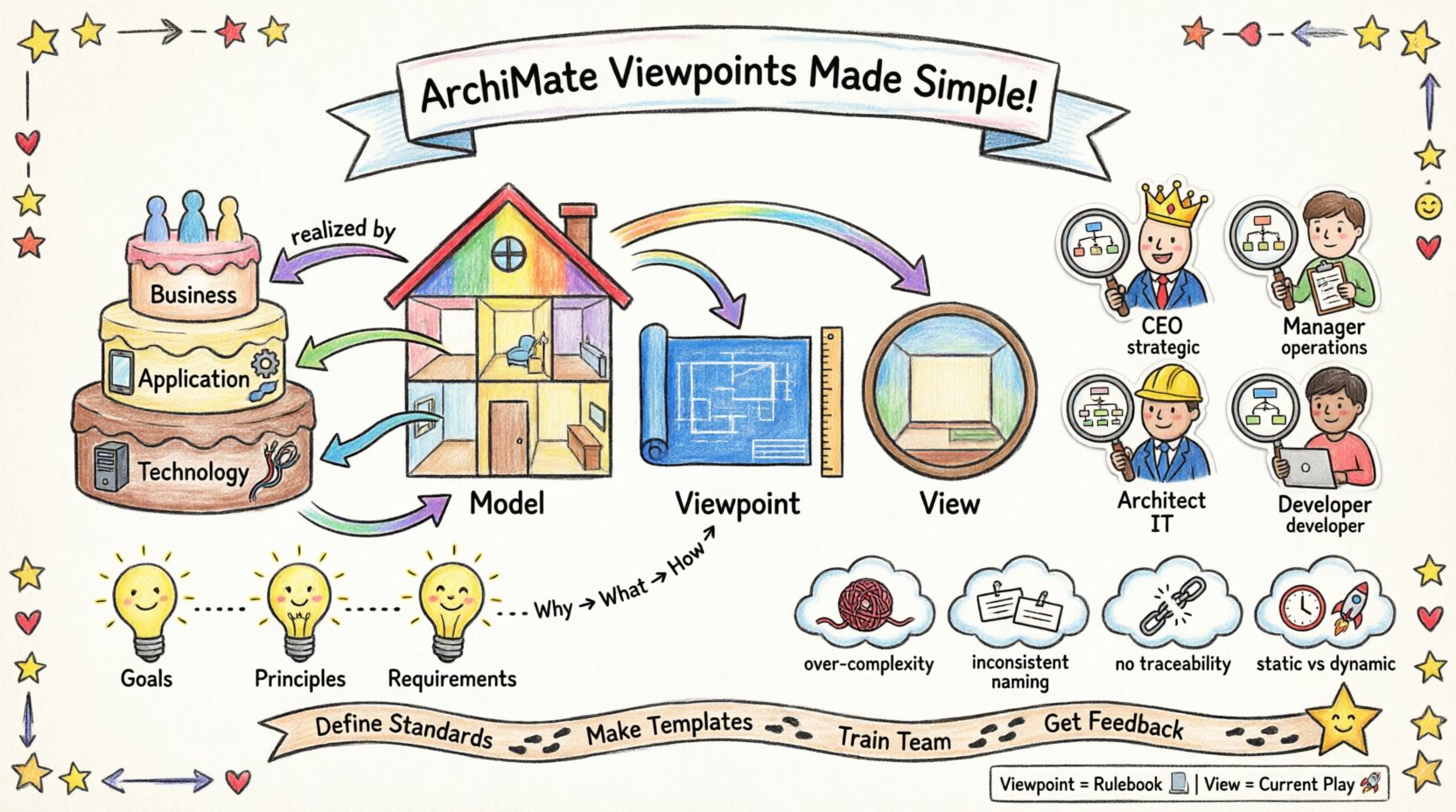
Before diving into complex modeling, one must grasp the distinction between a View, a Viewpoint, and the Model itself. This triad forms the backbone of a scalable architecture description framework.
- Model: The complete repository of all architectural elements and relationships.
- View: A representation of a specific set of related architecture elements from a specific perspective.
- Viewpoint: A specification for views. It defines the modeling language, the conventions, and the concerns to be addressed.
Advanced architects do not create views in isolation. They design viewpoints first. A viewpoint acts as a template that ensures consistency across the organization. If one team creates a business process diagram, and another creates a technical deployment diagram, they must follow a defined standard to ensure interoperability. This standard is the Viewpoint. 📐
When designing a viewpoint, consider the following:
- Language: Which layers of ArchiMate are active? (Business, Application, Technology, Data, Motivation).
- Structure: How are elements grouped? Are there specific naming conventions?
- Focus: What is the primary concern being addressed?
By defining these parameters upfront, you prevent the common issue of “diagram fatigue,” where stakeholders are overwhelmed by irrelevant details. A well-structured viewpoint filters out noise, leaving only the signal relevant to the decision at hand.
Structuring Multi-Layered Views 🏢
One of the most common mistakes in advanced modeling is treating layers in isolation. While ArchiMate separates Business, Application, and Technology, the reality of enterprise architecture is that these layers interact dynamically. Advanced viewpoint techniques require a deliberate strategy for cross-layer communication.
Consider the flow of requirements. A business capability gap (Business Layer) often requires a new application feature (Application Layer) deployed on specific infrastructure (Technology Layer). A robust viewpoint must visualize this lineage without creating a tangled web of lines.
- Horizontal Tracing: Ensure that elements in one layer can be linked to their counterparts in another layer using standard relationships like “realized by” or “serves”.
- Vertical Filtering: Decide which layers to display based on the audience. A CTO needs a different view than a Business Analyst.
- Consistency Checks: Use the viewpoint specification to enforce naming consistency across layers.
When combining layers, avoid clutter. Use grouping boxes to isolate specific domains. For example, a “Change Impact” viewpoint might show Business Capabilities and Applications, but exclude the underlying Technology infrastructure unless it is directly affected. This selective visibility is the hallmark of an experienced architect.
The Role of Concerns and Stakeholders 👥
Every viewpoint is designed to address a specific concern of a specific stakeholder. If you do not know who is looking at the diagram, you cannot design the viewpoint effectively. Advanced techniques involve mapping stakeholders to viewpoints systematically.
Start by identifying the key roles within your organization. Common roles include:
- Strategic Leadership: Concerned with vision, strategy, and value delivery.
- Operational Management: Concerned with processes, efficiency, and day-to-day operations.
- IT Architects: Concerned with integration, security, and technical feasibility.
- Developers: Concerned with implementation details and interfaces.
For each role, define the information density required. High-level stakeholders need strategic summaries, often utilizing the Motivation Layer (Goals, Drivers, Principles). Operational managers need process flows and resource allocation data. Technical teams need interface definitions and deployment structures.
Consider the following strategy for stakeholder alignment:
- Identify the Audience: Who is the primary consumer of this view?
- Define the Question: What decision are they trying to make?
- Map the Elements: Select only the elements necessary to answer that question.
- Validate: Review with the stakeholder to ensure clarity.
This iterative process ensures that your architecture description remains relevant. A viewpoint that addresses the wrong concern is technically accurate but practically useless.
Integrating Motivation and Governance 📋
Many architecture frameworks treat the Motivation Layer as an afterthought. Advanced practitioners understand that without context on “why” a change is being made, the “what” and “how” lack justification. Integrating Motivation into your viewpoint techniques adds significant value to governance processes.
The Motivation Layer includes elements such as Goals, Principles, Requirements, and Drivers. By incorporating these into your standard viewpoints, you create a direct link between architectural decisions and business objectives.
- Traceability: Link every Application Component to a Business Goal. This proves the value of the software investment.
- Principles: Display governing principles alongside the architecture elements they constrain. This reinforces compliance.
- Requirements: Show the specific requirements that triggered the architectural design. This aids in testing and validation.
When designing a governance viewpoint, ensure that the Motivation Layer is visible. A decision-making panel should not just see the proposed architecture; they should see the strategic rationale behind it. This transparency builds trust and facilitates faster approval cycles.
Common Modeling Challenges ⚠️
Even with a solid framework, pitfalls exist. Experienced architects anticipate these issues and build safeguards into their viewpoint designs.
1. Over-Complexity
The desire to be comprehensive often leads to overly complex diagrams. A single view should not contain more than 20-30 key elements. If you find yourself adding more, split the view into sub-views or use drill-down capabilities in the modeling environment.
2. Inconsistent Naming
When multiple teams contribute to the model, naming conventions drift. A “Customer” entity might be called “Client” in another part of the model. Viewpoints should enforce strict naming dictionaries. Use standardized vocabularies to ensure that everyone speaks the same language.
3. Lack of Traceability
Diagrams become stale when they are not linked to the underlying data. Ensure that every element in a view is a reference to a core model element. This allows for automated consistency checks and reporting.
4. Static vs. Dynamic
Architecture is not static. A viewpoint that only shows the “as-is” state is insufficient. Advanced techniques involve creating “to-be” views that highlight the target state. Clearly label the time horizon of each view to avoid confusion between current operations and future plans.
Implementation Strategy 🔄
Rolling out advanced viewpoint techniques requires a structured approach. It is not a task that can be done overnight. It requires planning, training, and iteration.
- Define Standards: Document the viewpoint specifications clearly. Include examples of valid and invalid diagrams.
- Template Creation: Create reusable templates for common viewpoints. This reduces the time architects spend setting up diagrams.
- Training: Conduct workshops to teach the team how to use the viewpoints effectively. Focus on the “why” behind the design choices.
- Feedback Loop: Regularly review the viewpoints with stakeholders. Ask them if the information is clear and actionable.
By following these steps, you build a culture where architecture is a tool for communication rather than a burden of documentation.
Comparison: Viewpoint vs. View 📊
To clarify the distinction further, consider the following comparison table.
| Aspect | Viewpoint | View |
|---|---|---|
| Definition | The specification or template for creating a view. | The actual representation created using a viewpoint. |
| Stability | Remains constant over time. | Changes as the enterprise changes. |
| Purpose | Ensures consistency and standardization. | Communicates specific information to stakeholders. |
| Example | The “Strategic Roadmap” template. | The 2024 Strategic Roadmap diagram. |
Understanding this distinction is vital. You do not update the Viewpoint every time a project changes. You update the View. The Viewpoint remains the rulebook; the View is the current play.
Maintaining and Evolving the Framework 🛠️
Architecture frameworks are living entities. As the organization evolves, so must the viewpoints. Regular reviews are necessary to ensure that the viewpoints still serve their intended purpose.
- Quarterly Reviews: Check if any viewpoints are no longer being used.
- Stakeholder Surveys: Ask if the current views provide the necessary insights.
- Technology Updates: Ensure that the modeling language supports new types of elements if the enterprise adopts new technologies.
Evolution should be gradual. Introducing a new viewpoint should be accompanied by a pilot phase. Test it with a specific group before rolling it out to the entire organization. This minimizes disruption and allows for adjustments based on real-world usage.
Final Thoughts on Architectural Excellence 💡
Advanced ArchiMate Viewpoint techniques are not about complexity for the sake of complexity. They are about clarity, precision, and alignment. When executed well, they transform architecture from a static documentation exercise into a dynamic strategic asset. The goal is to enable better decision-making across the enterprise.
By focusing on the separation of concerns, the integration of motivation, and the systematic management of stakeholder views, lead architects can drive significant value. The techniques outlined here provide a foundation for building a resilient architecture practice. Remember, the best diagram is the one that is understood by the person holding it.
Continue to refine your approach. Seek feedback. Iterate on your designs. The path to excellence in enterprise architecture is continuous improvement. 🚀