


In the complex landscape of Enterprise Architecture, clarity is often the scarcest resource. Senior architects face the constant challenge of translating vast amounts of technical detail into actionable business intelligence. This is where the ArchiMate Viewpoint becomes indispensable. A viewpoint is not merely a visual filter; it is a strategic instrument designed to address the specific concerns of defined stakeholders. Without a disciplined approach to viewpoint design, architecture models risk becoming overwhelming monoliths that fail to communicate effectively.
This guide provides a comprehensive examination of ArchiMate Viewpoints. We will explore the theoretical foundations, the practical application of layered modeling, and the governance strategies required to maintain consistency across an enterprise. Whether you are aligning with ISO 42010 or managing a specific architecture repository, understanding how to structure views is critical for successful delivery.
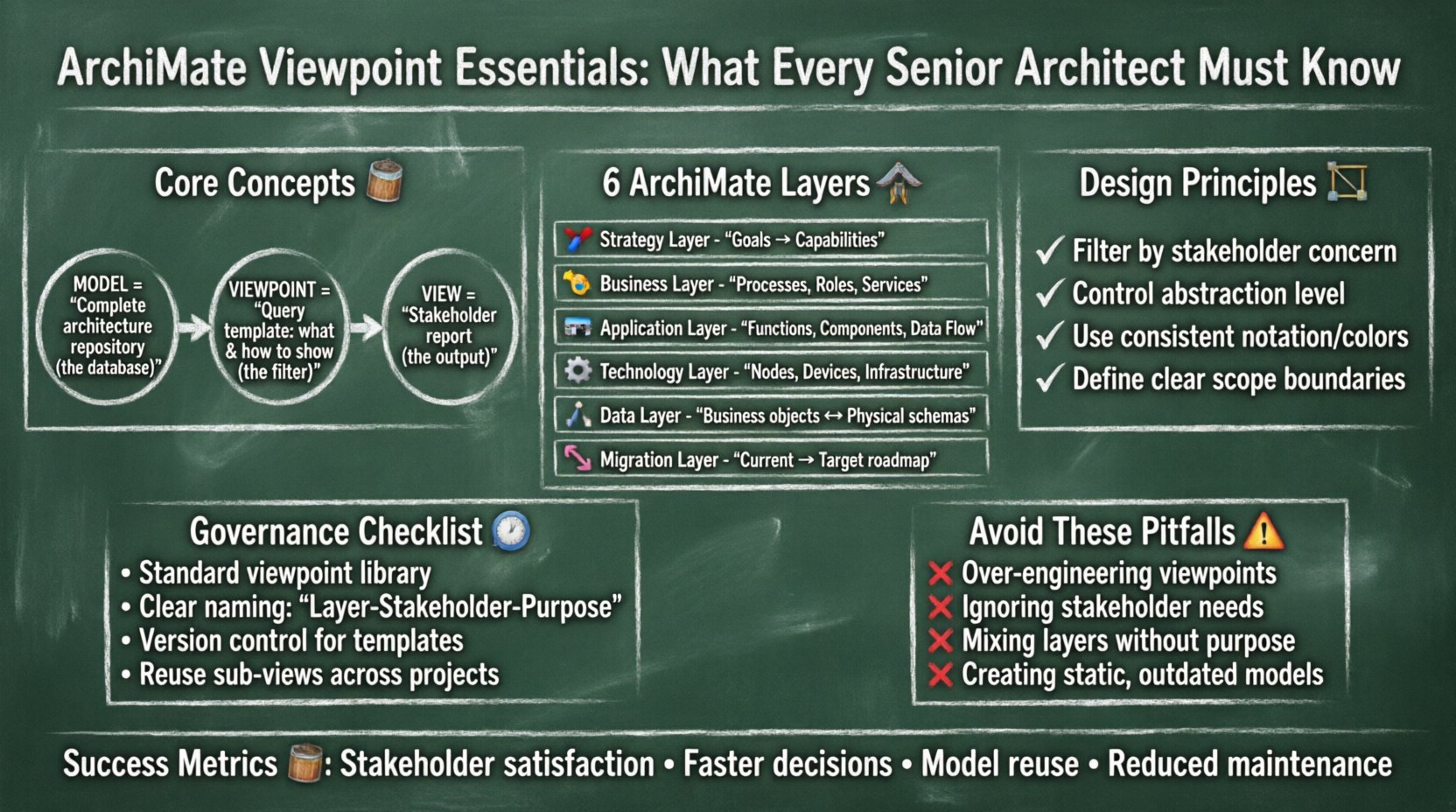
Understanding the Viewpoint Concept 🔍
Before diving into the mechanics, it is essential to distinguish between the core artifacts of the modeling environment. Many professionals confuse the Viewpoint, the View, and the Model. While they are interconnected, their functions differ significantly.
- Model: The comprehensive repository of all architecture information. It contains the entire set of elements and relationships defined within the architecture language.
- Viewpoint: A specification that defines the conventions, notations, and models relevant to a particular set of concerns. It dictates what information is visible and how it is presented.
- View: The actual representation of the model as seen through the lens of a specific viewpoint. It is the output generated for the stakeholder.
Think of the Model as the database, the Viewpoint as the query logic, and the View as the report generated for the user. A senior architect must ensure that the query logic (Viewpoint) is optimized for the specific user (Stakeholder) to prevent information overload.
The Relationship Between View, Model, and Viewpoint 🧩
Establishing the correct relationship between these three concepts is the foundation of a maintainable architecture practice. When a viewpoint is defined, it restricts the scope of the view. This restriction is not a limitation but a feature. It allows stakeholders to focus on what matters to them without being distracted by irrelevant technical details.
| Concept | Definition | Purpose |
|---|---|---|
| Model | The complete set of architecture elements | Single source of truth |
| Viewpoint | The template for viewing the model | Filter and structure information |
| View | The instance of the model displayed | Communication and analysis |
By adhering to this structure, you ensure that changes to the Model do not break the Views. The Viewpoint acts as the contract between the architect and the stakeholder.
ArchiMate Layers and Viewpoint Strategy 🏗️
The ArchiMate specification organizes architecture concepts into layers. A senior architect must understand how to construct viewpoints that traverse these layers effectively. Each layer represents a different level of abstraction and concern.
1. Business Layer
This layer focuses on the organizational structure, business processes, and roles. A Business Viewpoint might be designed for a process owner. It filters out application and technology details, focusing strictly on actors, roles, and business services. The goal is to clarify accountability and workflow efficiency.
2. Application Layer
Here, the concern shifts to software capabilities and interactions. An Application Viewpoint is critical for development teams. It highlights application functions, components, and data objects. It answers questions about system integration, data flow between applications, and functional dependencies.
3. Technology Layer
This layer deals with the infrastructure. A Technology Viewpoint is essential for infrastructure managers. It focuses on nodes, devices, and communication paths. It abstracts away the business logic to show how the hardware supports the software.
4. Data Layer
Data is often treated as a cross-cutting concern. A Data Viewpoint maps business objects to physical data structures. This is vital for data governance, ensuring that business definitions align with technical storage schemas.
5. Implementation & Migration Layer
Often overlooked, this layer manages the transition from the current state to the target state. A Migration Viewpoint is crucial for project managers. It outlines the projects, initiatives, and gaps that need to be addressed to achieve the target architecture. It provides the roadmap for execution.
6. Strategy Layer
This layer connects the architecture to the business strategy. A Strategy Viewpoint aligns business goals and drivers with the architectural capabilities. It ensures that every technical decision can be traced back to a strategic objective.
Designing Viewpoints for Clarity 📐
Creating a viewpoint is an exercise in information design. The objective is to reduce cognitive load while preserving necessary context. Here are the core principles for designing effective viewpoints.
- Filter by Concern: Identify the primary concern of the stakeholder. If they are concerned with security, the viewpoint should highlight security controls and access points, not general process flows.
- Control Abstraction: Determine the level of detail required. A high-level view aggregates components, while a detailed view breaks them down. Do not mix these levels in a single view without clear demarcation.
- Consistent Notation: Ensure that the symbols and colors used in the view align with the organization’s standard. Consistency reduces the learning curve for stakeholders reviewing multiple diagrams.
- Contextual Boundaries: Define the scope of the view clearly. Does it cover the entire enterprise or a specific domain? Labeling the scope prevents misinterpretation of the model’s coverage.
When designing these viewpoints, avoid the temptation to include every possible relationship. A diagram with too many lines becomes a “spaghetti diagram” that conveys no information. Use lines that indicate flow, dependency, or interaction, and remove static relationships that do not add value to the current discussion.
Governance and Consistency Standards 🛡️
As an organization grows, the number of models and viewpoints expands. Without governance, this leads to fragmentation. Different teams may create their own interpretations of the same concepts, resulting in conflicting models. A senior architect must establish a governance framework for viewpoints.
Standardization
Define a standard set of viewpoints that should be used across the enterprise. Instead of allowing every project to invent its own view structure, provide a library of approved viewpoints. This library should include:
- Standard Business Process Views
- Standard Application Integration Views
- Standard Infrastructure Views
Naming Conventions
Viewpoints must be named consistently. A naming convention that includes the stakeholder group, the layer, and the purpose helps in locating the correct view. For example, “BizProcess-Executive” is clearer than “View1”.
Version Control
Just like the models themselves, viewpoints should be versioned. When a standard changes, the old viewpoint should be archived, and a new one should be published. This ensures traceability and prevents stakeholders from using outdated templates.
Reuse and Composition
Complex views can be composed of simpler views. A senior architect should encourage the reuse of sub-views. If a specific application view is used in five different reports, define it once and reference it. This reduces redundancy and maintenance effort.
Common Pitfalls and How to Avoid Them ⚠️
Even experienced architects fall into traps when designing viewpoints. Recognizing these pitfalls early can save significant time and effort.
- Pitfall: Over-Engineering the Viewpoint
Creating a viewpoint that is too complex defeats the purpose. If the viewpoint requires extensive configuration to generate a simple report, it is too heavy. Keep the definition as simple as possible. - Pitfall: Ignoring the Stakeholder
Designing a view that looks good technically but makes no sense to the business user. Always validate the viewpoint with the intended audience before finalizing it. - Pitfall: Mixing Layers Without Purpose
Combining Business, Application, and Technology layers in a single view without a clear reason. While cross-layer views are possible, they should be used sparingly. Prefer separate views for each layer to maintain clarity. - Pitfall: Static Models
Creating a viewpoint that is never updated. An architecture model that does not evolve becomes a historical artifact rather than a planning tool. Ensure the viewpoint supports the ongoing lifecycle of the architecture.
Integrating Viewpoints into the Architecture Process ⚙️
Viewpoints are not standalone documents; they are integral parts of the architecture workflow. They must be integrated into the decision-making process.
Decision Support
Use viewpoints to support architectural decisions. When a decision needs to be made about a new technology, generate a Technology Viewpoint that shows the impact on existing nodes. This provides the evidence needed for a rational decision.
Communication
Viewpoints are the primary medium for communication between the architecture team and other departments. Ensure that the output of the viewpoint is in a format that the audience can consume. This might mean exporting to PDF, generating a web report, or presenting directly in the modeling tool.
Documentation
Every viewpoint should have accompanying documentation. This text explains the scope, the assumptions, and the limitations of the view. It ensures that the diagram is interpreted correctly and prevents ambiguity.
Metrics for Success 📊
How do you know if your viewpoint strategy is working? You can measure effectiveness through several metrics.
- Stakeholder Satisfaction: Do the stakeholders feel that the views address their concerns?
- Model Maintenance Time: Does the viewpoint structure reduce the time needed to update models?
- Decision Velocity: Are architectural decisions being made faster due to clearer information?
- Reuse Rate: How often are viewpoints reused across different projects?
Final Considerations 📝
The ArchiMate Viewpoint is a powerful mechanism for managing complexity. It transforms a dense model into a navigable landscape for different stakeholders. By focusing on the concerns of the user rather than the completeness of the data, you create architecture that is usable and valuable.
Senior architects play a pivotal role in defining these structures. Your responsibility extends beyond drawing diagrams to defining the standards that govern how information is presented. This requires a balance of technical precision and communication strategy. As you refine your approach to viewpoint design, you will find that the architecture becomes more agile, more understandable, and more aligned with business goals.
Remember that the goal is not to create the most detailed model possible, but to create the most effective communication tool possible. Continuously evaluate your viewpoints against the needs of your stakeholders. Adapt them as the organization evolves. This iterative process ensures that your architecture practice remains relevant and impactful.
By implementing these principles, you establish a robust framework for enterprise architecture. The viewpoints become the bridge between strategy and execution, ensuring that the vision of the organization is accurately reflected in its technical reality.