


Unified Modeling Language (UML) serves as the blueprint for software architecture. Within the suite of diagrams available, the class diagram stands as the cornerstone for defining the static structure of a system. It maps out classes, attributes, operations, and the crucial relationships that bind them together. Among these relationships, two concepts often cause confusion for developers and architects: aggregation and composition. Both represent forms of association, yet they carry distinct semantic weights regarding ownership and lifecycle management.
Choosing the correct relationship model is not merely a syntactic preference; it dictates how objects interact, how memory is managed, and how the system handles failures or deletions. Misinterpreting these relationships can lead to fragile codebases where object lifecycles are improperly managed, resulting in dangling references or resource leaks. This guide dissects the nuances of aggregation and composition, providing a clear framework for applying them in your designs.
🔗 The Foundation: Understanding Association
Before distinguishing between aggregation and composition, one must understand the baseline concept: association. In UML, an association is a relationship between two or more classes that describes how they interact. It is the most general form of relationship.
Consider a simple scenario: a Student class and a Course class. A student enrolls in a course. This is an association. The visual representation is a solid line connecting the two classes. Often, associations have names (like “enrolls in”) and multiplicities (e.g., one-to-many).
Association defines how classes talk to each other. Aggregation and composition refine this to define how they exist together. They are specializations of association that imply a “part-whole” relationship. However, the intensity of that relationship varies significantly.
🔵 Aggregation: The Weak Whole
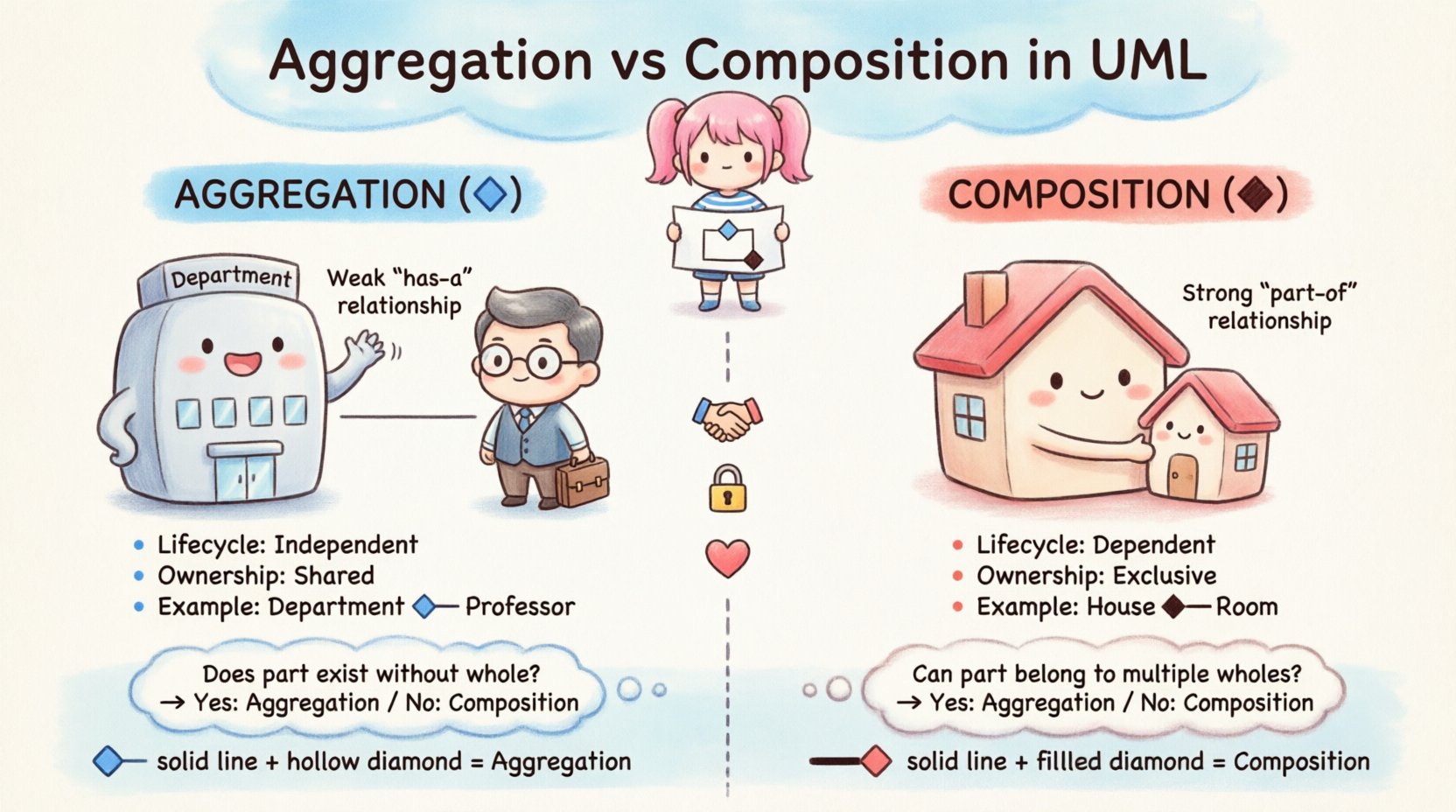
Aggregation represents a relationship where one class is a part of another, but the part can exist independently of the whole. It is often described as a “has-a” relationship that is weak. The key characteristic is the independence of the child object’s lifecycle.
Visual Representation
In UML class diagrams, aggregation is depicted by a solid line connecting the classes with a hollow diamond shape at the end of the “whole” class. The diamond points toward the containing class.
- Symbol: Solid line with a hollow diamond (◊).
- Direction: The diamond sits on the container side.
Lifecycle Independence
The defining feature of aggregation is lifecycle independence. If the “whole” object is destroyed, the “part” objects continue to exist. They are shared resources.
Consider a Department and a Professor.
- The Department has many Professors.
- However, a Professor does not cease to exist if the Department is disbanded or dissolved.
- The Professor might move to another department or leave the university entirely.
Here, the Department aggregates the Professors. The Professors are not owned exclusively by the Department. They are independent entities that happen to be associated with it.
Implementation Logic
In object-oriented programming, this often translates to dependency injection or passing references rather than creating new instances within the container constructor. The container holds a reference to the external object.
- Constructor: The container does not create the parts.
- Setter: The parts are usually assigned via a setter method.
- Destruction: When the container is deleted, the reference is removed, but the garbage collector does not delete the parts.
🔴 Composition: The Strong Whole
Composition is a stronger form of association. It represents a “part-of” relationship where the part cannot exist without the whole. It is an exclusive ownership model. If the whole is destroyed, the parts are destroyed with it.
Visual Representation
Composition is visually similar to aggregation but with a filled diamond. This filled shape signifies the strength of the bond.
- Symbol: Solid line with a filled diamond (◆).
- Direction: The diamond sits on the container side.
Lifecycle Dependency
The lifecycle of the part is strictly tied to the lifecycle of the whole. The part is created and destroyed with the whole.
Consider a House and a Room.
- A Room is a part of a House.
- If the House is demolished, the Rooms cease to exist as functional units.
- A Room cannot exist independently of the structure that defines its boundaries.
Another classic example is a Car and an Engine. While an engine can be removed for repair, in the context of the car’s logical structure, the engine is a component integral to the car’s existence. If the car is scrapped, the engine is scrapped (or recycled as part of that process). In strict composition, the engine is not a shared resource with other cars in the same logical scope.
Implementation Logic
Implementation-wise, composition implies the container is responsible for the creation and destruction of the parts.
- Constructor: The container creates the instances of the parts.
- Scope: The parts are often private members of the container class.
- Destruction: When the container is destroyed, the parts are explicitly destroyed or garbage collected as a direct consequence.
📊 Side-by-Side Comparison
To clarify the distinctions, we can examine the attributes of both relationships in a structured format.
| Feature | Aggregation | Composition |
|---|---|---|
| Relationship Type | Weak “has-a” | Strong “part-of” |
| Visual Symbol | Hollow Diamond (◊) | Filled Diamond (◆) |
| Lifecycle | Independent | Dependent |
| Ownership | Shared | Exclusive |
| Creation | External | Internal |
| Destruction | Independent | Automatic with Whole |
| Example | Department – Professor | House – Room |
🧠 Lifecycle Management and Memory
Understanding the lifecycle implications is critical for robust software design. In systems with limited resources or manual memory management, the distinction between aggregation and composition determines who is responsible for cleaning up.
Aggregation and Shared References
In aggregation, the container holds a reference. Multiple containers might hold references to the same child object. This is common in scenarios involving shared services or global registries.
- Scenario: A
Userobject and aProfileobject. - Behavior: A
Userhas aProfile. AnotherSystemModulemight also hold a reference to that sameProfile. - Implication: If the
Useris deleted, theProfilemust remain accessible to theSystemModule.
If this relationship were modeled as composition, deleting the User would delete the Profile, potentially breaking the SystemModule‘s functionality.
Composition and Exclusive Ownership
Composition ensures encapsulation of resources. The whole is the sole manager of the parts. This reduces coupling between unrelated parts of the system.
- Scenario: A
Documentand itsPages. - Behavior: A
Pagebelongs to oneDocument. - Implication: If the
Documentis closed, thePagedata is discarded. No other object should be holding a reference to that specificPageinstance.
This model prevents data integrity issues where a part is modified by a parent that no longer “owns” it. It enforces a clear boundary of responsibility.
🛠️ Real-World Design Scenarios
Applying these concepts requires context. Here are specific scenarios where the choice matters.
1. The Library System
Imagine a system managing a library.
- Books and Library (Aggregation): A book can exist without a library. It can be sold, lost, or moved to another library. The library aggregates books from its collection.
- Books and Members (Association): A member borrows a book. This is a transient association, not a structural relationship.
2. The Financial Account
Consider a banking application.
- Account and Transactions (Composition): A transaction record is meaningless without the account it belongs to. If the account is closed, the transaction history is archived or destroyed as a unit. The transaction is a part of the account’s state.
- Account and Customer (Aggregation): A customer can have multiple accounts. If one account is closed, the customer still exists. The customer aggregates accounts.
3. The User Interface
In graphical user interfaces, widget structures often rely on composition.
- Window and Buttons (Composition): A button inside a window is part of that window’s layout. If the window closes, the button’s state is irrelevant.
- Window and Toolbar (Aggregation): A toolbar might be shared across multiple windows. If one window closes, the toolbar remains available for other windows.
⚠️ Common Pitfalls and Misconceptions
Even experienced designers stumble when mapping real-world concepts to UML relationships. Here are common errors to avoid.
1. Confusing Composition with Inheritance
It is tempting to use inheritance (is-a relationship) when composition (part-of relationship) is more appropriate. Inheritance implies a semantic identity. Composition implies a structural dependency.
- Wrong:
CarextendsEngine. - Right:
CarcontainsEngine(Composition).
Inheritance creates an is-a relationship. A Car is not an Engine. It has an Engine. Confusing these leads to deep inheritance hierarchies that are hard to maintain.
2. Overusing Composition
Strict composition is powerful but can create rigidity. If you compose everything, you lose flexibility. For example, composing a Logger into every class means you cannot easily swap the logging mechanism without rebuilding the object tree. Sometimes aggregation is better for pluggable components.
3. Ignoring Multiplicity
The diamond shape does not tell you how many parts exist. You must specify multiplicities (e.g., 0..1, 1..*, 0..*). A composition can have zero parts, or many parts. The relationship strength remains the same, but the cardinality defines the structure.
4. Assuming Implementation Equals Diagram
A common mistake is assuming the UML diagram must match the exact code implementation line-for-line. UML is a model, not a spec. You might implement aggregation using a pointer in C++ or a reference in Java. The diagram conveys the semantic intent, which might differ slightly from the low-level memory management.
🔍 Advanced Considerations
Beyond basic definitions, there are architectural implications for how these relationships affect system evolution.
Dependency Injection and Aggregation
Aggregation pairs naturally with Dependency Injection (DI). Since the child exists independently, it can be injected into the container at runtime. This supports testing and modularity. You can swap out the injected dependency without affecting the container’s lifecycle.
Immutable Objects and Composition
Composition is often used in immutable data structures. If a structure is composed of parts, and the whole is immutable, the parts are typically immutable as well. This ensures that once the “whole” is created, the internal state cannot change, reinforcing the composition contract.
Recursive Structures
Both aggregation and composition can be recursive. A Folder can contain Files and other Folders. This creates a tree structure.
- Aggregation Recursion: A folder can be moved to another parent (shared existence).
- Composition Recursion: A folder is part of a directory tree. If the root is deleted, everything is deleted.
Choosing the right recursive model affects how you handle deletion operations. Composition simplifies deletion logic (delete root = delete all). Aggregation requires traversal to ensure references are cleaned up without deleting shared nodes.
🎯 Guidelines for Selection
When you find yourself drawing a class diagram and debating between these two options, ask these specific questions.
- Does the part exist without the whole?
- Yes ➔ Use Aggregation.
- No ➔ Use Composition.
- Can the part belong to multiple wholes?
- Yes ➔ Use Aggregation.
- No ➔ Use Composition.
- Who is responsible for the part’s creation?
- External ➔ Use Aggregation.
- Internal (Container) ➔ Use Composition.
- What happens if the whole is deleted?
- Part survives ➔ Use Aggregation.
- Part dies ➔ Use Composition.
These questions force a concrete decision based on business logic rather than abstract design patterns.
📝 Summary of Best Practices
Clarity in modeling prevents ambiguity in implementation. Here are the core takeaways for maintaining high-quality class diagrams.
- Use Aggregation for Shared Resources: When objects are independent and can be reused.
- Use Composition for Exclusive Parts: When the part’s existence is meaningless without the whole.
- Be Consistent: Once you decide on a pattern, apply it consistently across the system. Don’t mix aggregation and composition for similar relationships unless there is a distinct semantic reason.
- Document the Intent: If the lifecycle is complex, add notes to the diagram. UML is a communication tool.
- Review Regularly: As requirements change, relationships might shift. A composition might need to become an aggregation if the business rules change to allow shared parts.
Mastering these distinctions allows you to build systems that are resilient, maintainable, and logically sound. The difference between a hollow diamond and a filled one is small visually, but it represents a fundamental difference in how your software manages the flow of data and control. By paying attention to these details, you ensure that your architecture reflects the true nature of the problem domain.