


Visual Paradigm‘s AI-Powered Hoshin Kanri Policy Deployment Tool enables business leaders to rapidly create a comprehensive strategic plan for their organization. This powerful application guides users through a structured 5-step process, from defining high-level strategic goals to generating a final, professional report. The tool leverages AI to generate a complete Hoshin Kanri plan based on a brief business description, significantly accelerating the strategic planning process. For a manufacturer of precision automotive components, this tool provides a clear, disciplined framework to align the entire organization around breakthrough objectives, ensuring focus on what truly matters. The final output is a professional document that consolidates strategic goals, cascaded objectives, action plans, and monitoring processes into a single, shareable report.
Key Takeaways
-
Use the AI-Powered Hoshin Kanri Policy Deployment Tool to generate a comprehensive strategic plan in minutes.
-
Follow a structured 5-step workflow to define strategic goals, cascade objectives, develop action plans, monitor progress, and generate a final report.
-
Input your business context to ensure AI-generated suggestions are relevant and accurate.
-
Save your plan locally as a .json file to maintain complete control and privacy over your strategic data.
-
Generate a professional, printable report to communicate your strategy effectively to leadership and teams.
How the AI-Powered Hoshin Kanri Tool Works
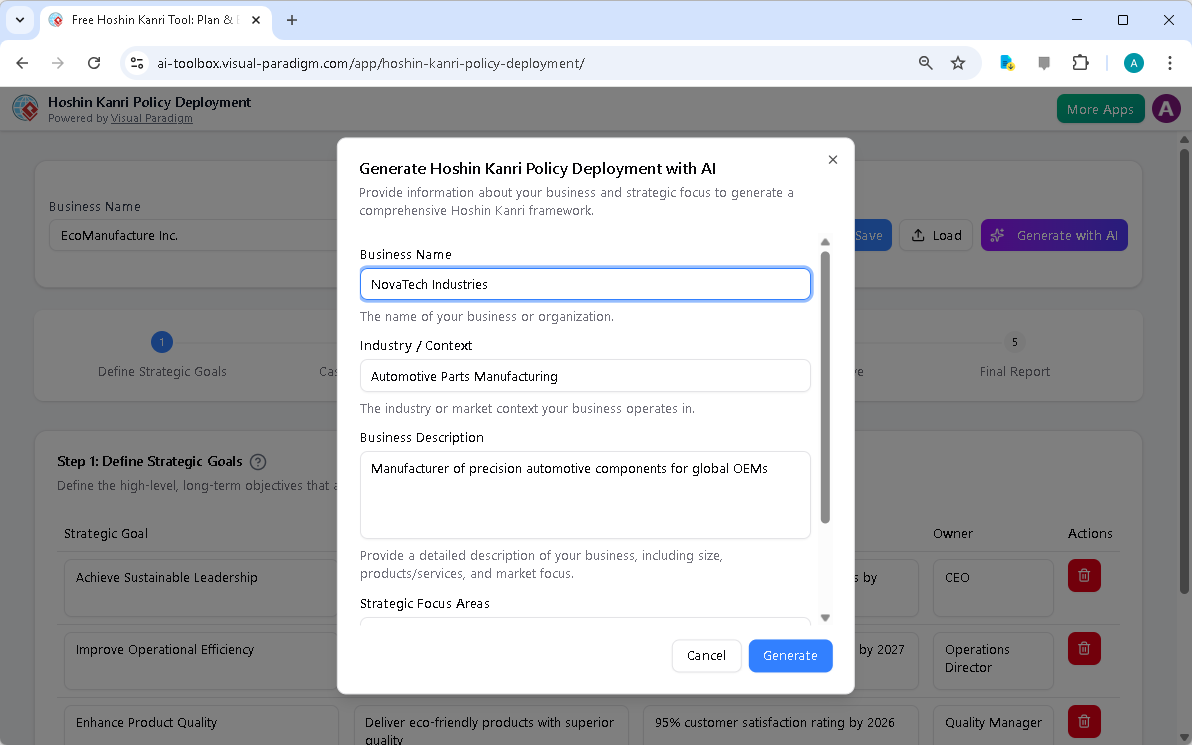
Visual Paradigm’s AI-Powered Hoshin Kanri Policy Deployment Tool streamlines the complex process of strategic planning into a simple, guided experience. The workflow is designed to be intuitive, guiding users through five distinct steps to create a robust policy deployment framework. The process begins with the AI generation screen, where users provide essential context about their business. Image 1 shows this initial step, where the user inputs the business name, industry, and a description of their operations. In this example, the business is NovaTech Industries, an automotive parts manufacturer. This information serves as the foundation for the AI to generate relevant and context-specific strategic goals and objectives.
Step 1: Define Strategic Goals
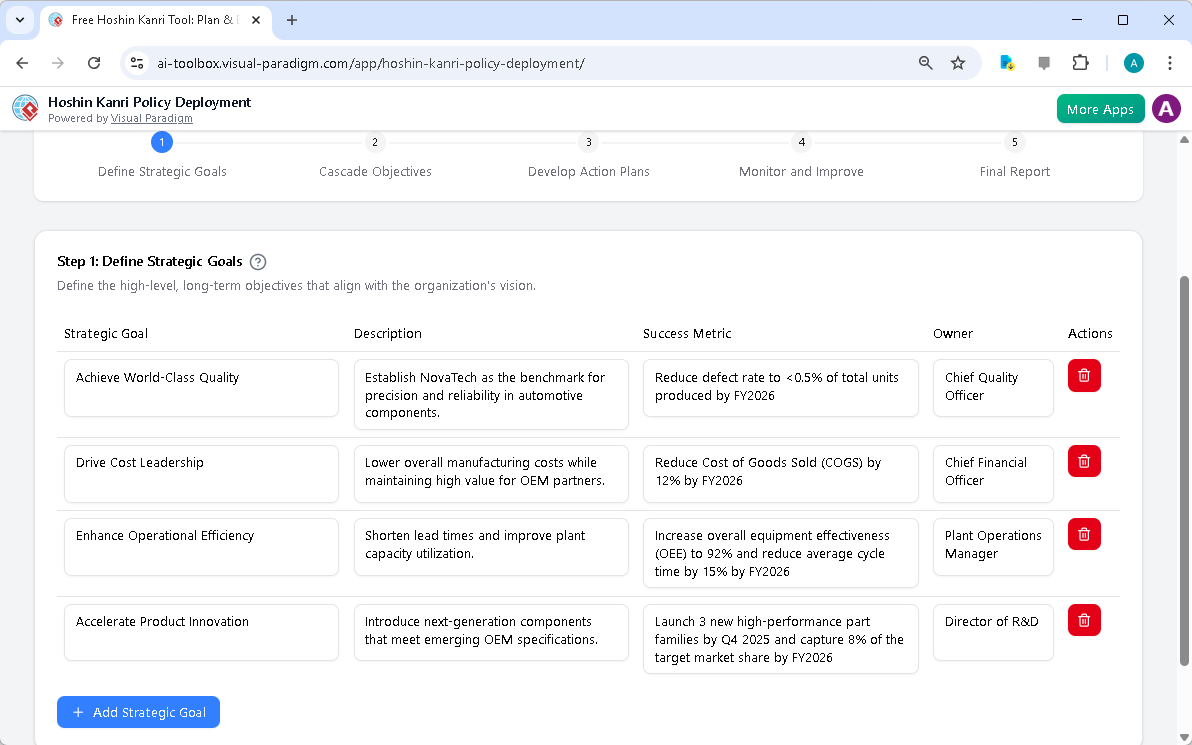
After providing the initial business context, the AI generates a first draft of the strategic goals. Image 2 displays the output of this AI generation, showing a table with high-level, long-term objectives. The tool presents goals such as “Achieve World-Class Quality,” “Drive Cost Leadership,” “Enhance Operational Efficiency,” and “Accelerate Product Innovation.” Each goal includes a description, a success metric, and an owner, providing a clear and actionable starting point. This initial output allows business leaders to quickly assess the AI’s suggestions and begin the refinement process, ensuring the goals are aligned with the organization’s vision.
Step 2: Cascade Objectives
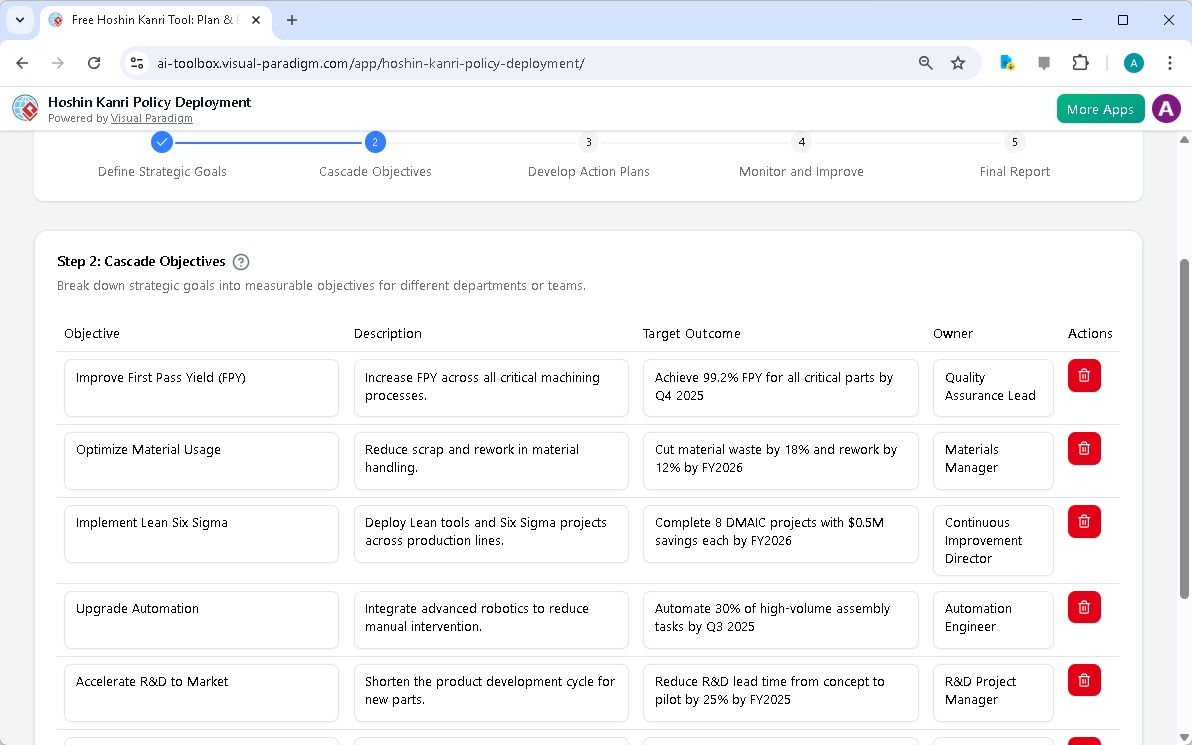
Once the strategic goals are defined, the process moves to cascading these goals into department-specific objectives. Image 3 illustrates this step, where the high-level goals are broken down into measurable objectives for different teams. For example, the strategic goal of “Achieve World-Class Quality” is cascaded into objectives like “Improve First Pass Yield (FPY)” and “Optimize Material Usage.” Each cascaded objective includes a description, a target outcome, and an owner, ensuring that every team understands their role in achieving the organization’s vision. This cascading process is crucial for fostering organizational alignment and ensuring that all levels of the company are working towards the same critical objectives.
Step 3: Develop Action Plans
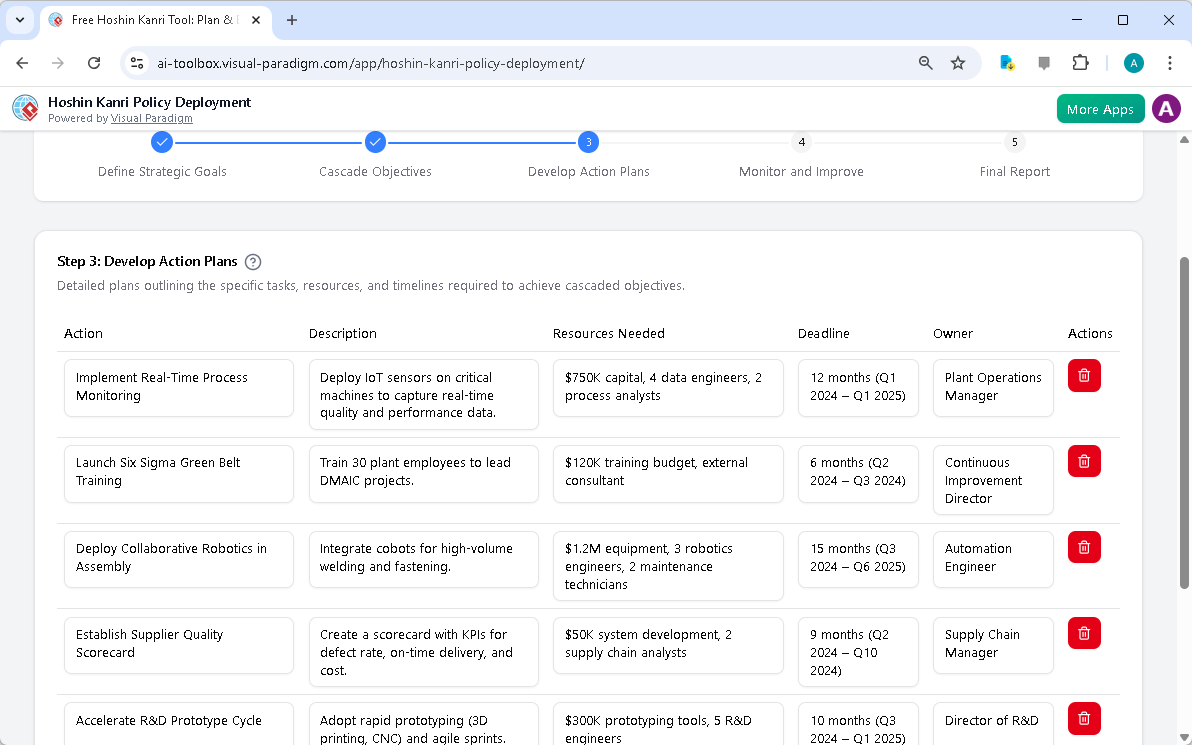
With the cascaded objectives in place, the next step is to develop detailed action plans. Image 4 shows the “Develop Action Plans” section, where specific tasks, resources, and timelines are defined for each objective. For instance, the objective “Improve First Pass Yield” is supported by the action “Implement Real-Time Process Monitoring,” which requires specific resources and has a defined deadline. This level of detail ensures that the strategy is not just a set of goals but a concrete plan with clear ownership and accountability. The dynamic table format allows for easy editing and refinement, making it simple to update and adjust the plan as needed.
Step 4: Monitor and Improve
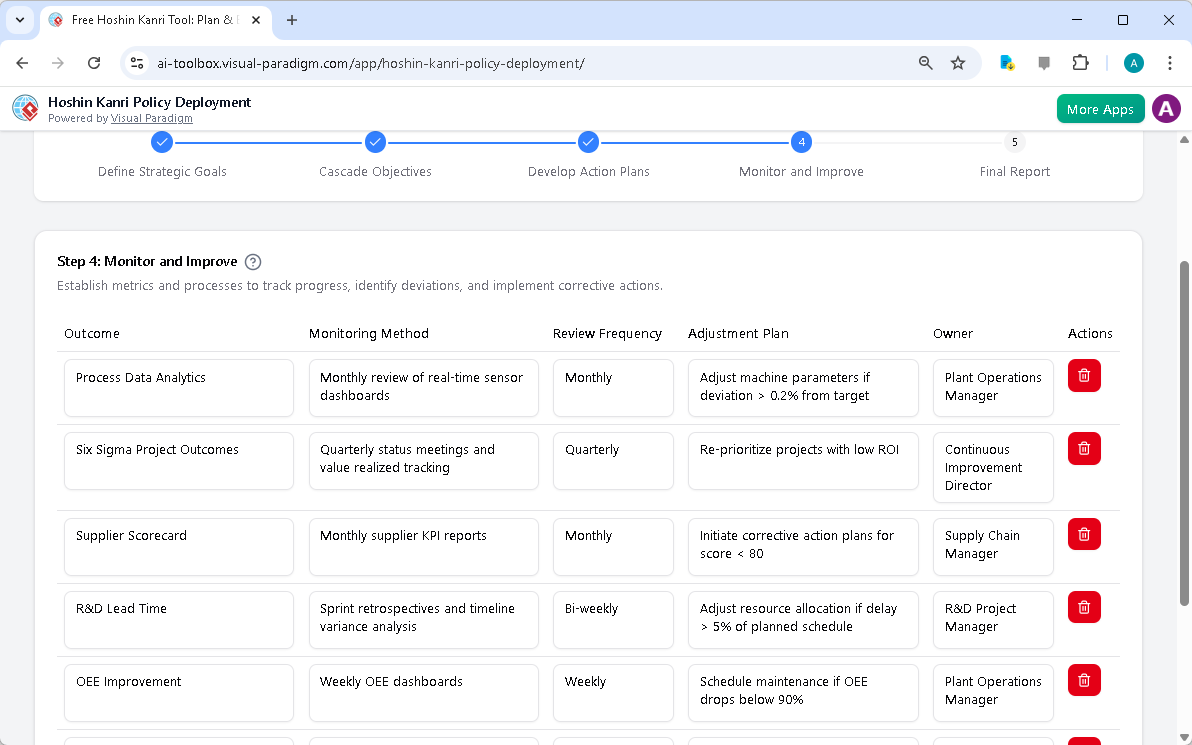
Strategic planning is an ongoing process, and the final step is to establish a monitoring and improvement framework. Image 5 displays the “Monitor and Improve” section, where metrics and processes are defined to track progress. For each objective, a monitoring method, review frequency, and adjustment plan are specified. This ensures that the organization can regularly review its performance, identify deviations from the plan, and implement corrective actions. This systematic monitoring process is essential for maintaining accountability and driving continuous improvement, ensuring that the organization stays on track to achieve its strategic goals.
Step 5: Final Report
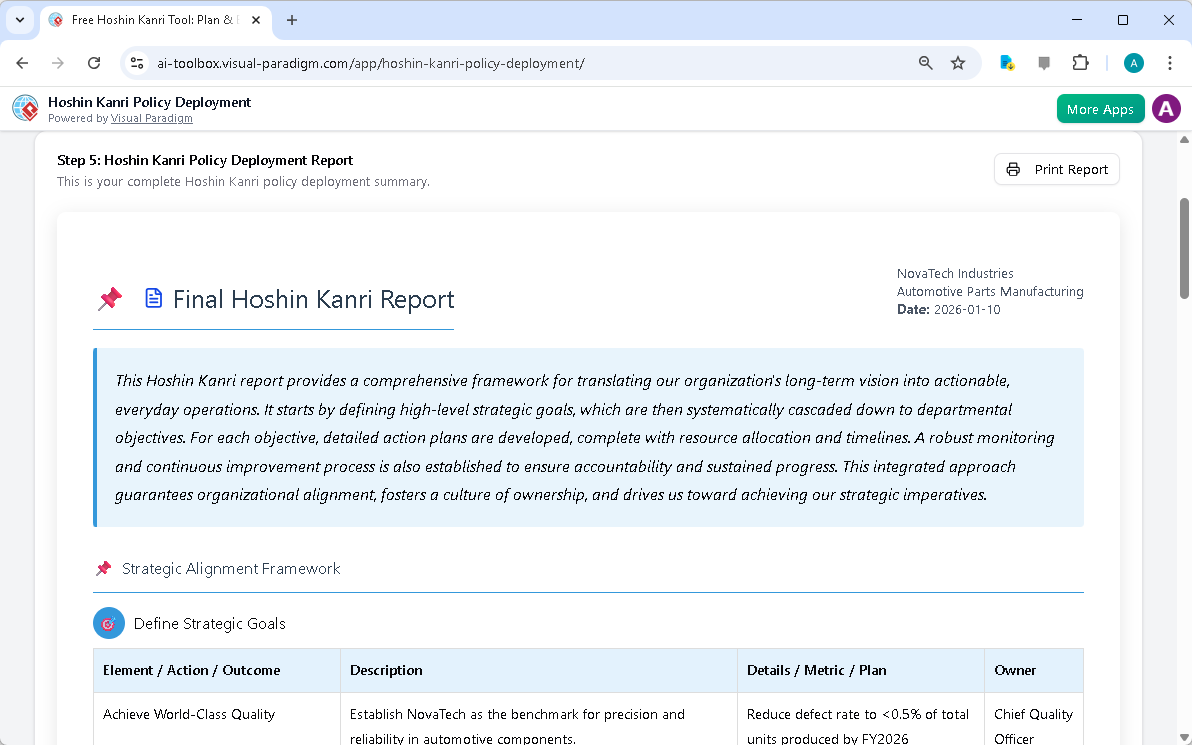
The final step is to generate a comprehensive report that summarizes the entire Hoshin Kanri plan. Image 6 shows the “Final Report” screen, which consolidates all the information from the previous steps into a single, professional document. The report includes a summary of the strategic alignment framework, detailed tables of strategic goals, cascaded objectives, action plans, and monitoring processes. This final report is a powerful tool for communicating the organization’s strategic direction to leadership and teams, ensuring everyone is aligned and committed to the same goals. Users can print the report or save it as a PDF for easy sharing and documentation.
Benefits of Using the Hoshin Kanri Policy Deployment Tool
The AI-Powered Hoshin Kanri Policy Deployment Tool offers several key benefits for organizations looking to improve their strategic planning. First, it significantly accelerates the planning process by using AI to generate a comprehensive first draft in minutes. This allows business leaders to focus on refining and validating the plan rather than starting from scratch. Second, the structured 5-step workflow ensures a disciplined and thorough approach to policy deployment, guiding users through each critical phase of the Hoshin Kanri methodology. Third, the tool promotes organizational alignment by enabling the cascading of strategic goals from the top level down to individual teams, ensuring that everyone understands and contributes to the organization’s vision. Finally, the ability to save the plan locally as a .json file ensures that sensitive business strategies remain private and under the organization’s control.
For a manufacturer like NovaTech Industries, this tool provides a clear and actionable framework to achieve breakthrough results in quality, cost, and innovation. By following the guided process and leveraging the AI-powered capabilities, organizations can transform their strategic vision into a detailed, executable plan that drives sustained success.
Try the AI-Powered Hoshin Kanri Policy Deployment Tool now and create your strategic roadmap in minutes. Start Your Free Trial
Related Links
While the specific term “Hoshin Kanri” does not appear explicitly in the provided sources, the following articles detail strategic alignment, policy deployment, and strategic planning frameworks that comprise the core methodologies of Hoshin Kanri. These tools enable organizations to link high-level vision to daily execution and ensure all departments move toward the same strategic goals.
-
Strategy Map Tool – Visualize Your Organization’s Strategic Goals: This tool allows for the creation of visual strategy maps that align business objectives directly with key performance indicators (KPIs) and specific initiatives.
-
Vision and Strategy Tool – Align Your Organization’s Purpose and Goals: A dedicated feature for creating strategic roadmaps and vision statements that foster organizational alignment across all teams.
-
Business Motivation Model (BMM) Tool for Strategic Planning: This solution enables strategic alignment by connecting business drivers and goals to the initiatives required to achieve them.
-
What is the Business Motivation Model? A Guide to Strategic Alignment: An introductory guide explaining how the BMM framework helps organizations align strategy and goals to improve execution effectiveness.
-
AI-Powered Balanced Scorecard Software for Strategic Planning: Learn how to leverage AI-driven insights to build balanced scorecards that monitor the performance metrics essential for executing a strategic vision.
-
Strategic Planning with PESTLE & Porter’s Five Forces Analysis: A guide to evaluating the external business environment, a critical step in the “Hoshin” phase of setting long-term direction.
-
Gap Analysis App – Prioritized Strategic Action Plans: This AI-powered app identifies strategic improvement opportunities and delivers prioritized initiatives and resource allocation plans.
-
Vision and Strategy Template – Pre-Designed Framework for Planning: Access pre-built templates designed to help teams quickly establish mission goals and strategic initiatives.
-
AI-Powered Scenario Analysis for Strategic Business Planning: This resource explains how to use AI to model future outcomes and evaluate risks during the strategic planning process.
-
Unlock Your Business Potential with BMM Modeling: A strategic guide demonstrating how aligning vision, goals, and execution leads to measurable business outcomes.