

Enterprise architecture frequently encounters a critical bottleneck: communication. While technical teams build complex systems, business leaders require clarity on value and risk. When these groups operate with different mental models, projects stall, budgets inflate, and strategic goals drift. The solution lies not in more meetings, but in better visual language. ArchiMate Viewpoints provide a structured mechanism to translate enterprise complexity into digestible information for specific audiences.
This guide explores how leveraging these structured perspectives accelerates alignment. By focusing on the right view for the right person, organizations reduce ambiguity and make faster decisions. We examine the mechanics of viewpoint selection, the mapping of stakeholders to specific models, and the governance required to keep these assets valuable over time.
🤔 The Communication Challenge in Modern Organizations
In large-scale transformations, the disconnect between strategy and execution is often visible. Executives focus on business capabilities and market positioning. Architects focus on application interfaces and technology standards. Developers focus on code and deployment pipelines. Without a bridge, each group creates artifacts that satisfy their own needs but fail to inform others.
Common symptoms of this misalignment include:
- Scope Creep: Features are added because the business need is clear, but the technical impact is unknown.
- Redundant Solutions: Different departments build similar tools because they lack visibility into existing assets.
- Slow Decision Making: Approvals stall because stakeholders cannot agree on the current state or the target state.
- High Rework Costs: Systems are built incorrectly because requirements were interpreted differently.
ArchiMate addresses this by defining a language that is formal, consistent, and extensible. However, the full language is often too dense for non-technical stakeholders. This is where the concept of a Viewpoint becomes essential. A viewpoint acts as a filter, selecting specific parts of the enterprise architecture model relevant to a particular set of concerns.
🔍 Defining ArchiMate Viewpoints
A viewpoint is a specification for a stakeholder. It defines the purpose of the view, the language used, and the specific elements selected from the broader architecture model. It is not just a diagram; it is a contract on what is being shown and what is being omitted.
Key characteristics of a robust viewpoint include:
- Stakeholder Identification: Clearly defined who will consume this information.
- Concerns Addressed: Specific questions the view answers (e.g., “Where is the risk?”).
- Format and Notation: The visual style and level of abstraction.
- Level of Detail: High-level for executives, detailed for implementation teams.
By standardizing these elements, architecture teams ensure consistency. A business process view created today looks the same as one created next year, allowing for longitudinal analysis without confusion.
📊 Mapping Viewpoints to Stakeholder Groups
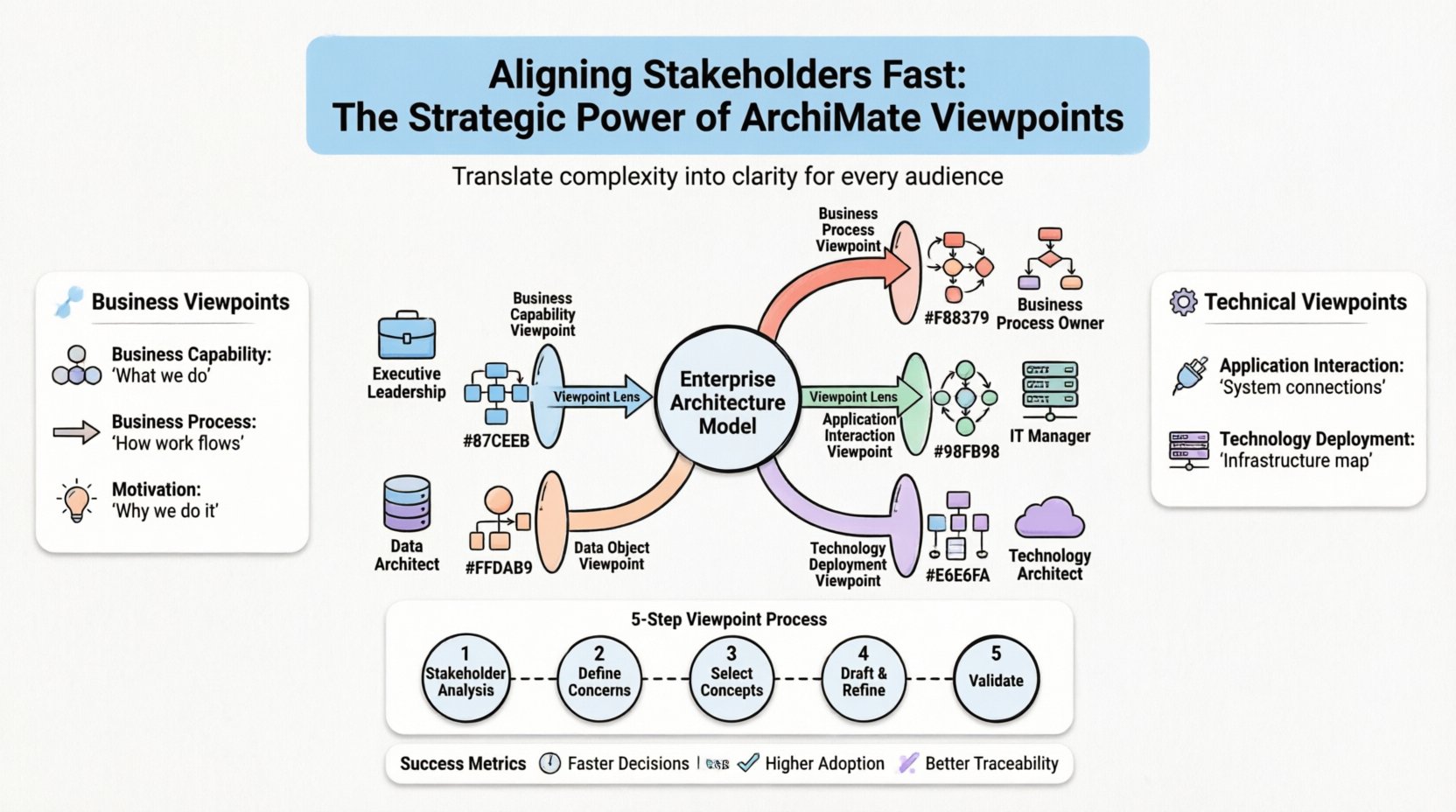
Selecting the correct viewpoint is the first step in alignment. Different roles require different levels of abstraction and focus. The following table outlines common stakeholder groups and the ArchiMate viewpoints that best serve their needs.
| Stakeholder Group | Primary Concern | Recommended Viewpoint | Key Focus Elements |
|---|---|---|---|
| Executive Leadership | Strategic fit, ROI, Risk | Business Capability & Motivation | Capabilities, Value Streams, Drivers |
| Business Process Owners | Efficiency, Handoffs, Bottlenecks | Business Process | Processes, Flow Objects, Roles |
| IT Managers | Application dependencies, Integration | Application Interaction | Applications, Interfaces, Data Objects |
| Technology Architects | Infrastructure, Security, Performance | Technology Deployment | Nodes, Devices, Systems Software |
| Data Architects | Data flow, Integrity, Governance | Data Object | Entities, Attributes, Relationships |
This matrix helps prevent information overload. Showing a technology deployment diagram to a C-suite executive often results in disengagement. Conversely, showing a high-level capability map to an implementation team provides insufficient detail for their daily work.
🧩 Key Viewpoints for Business Alignment
To align stakeholders effectively, specific viewpoints must be prioritized based on the organization’s current maturity and strategic goals. The following sections detail the most impactful viewpoints for driving alignment.
🏢 Business Capability Viewpoint
This viewpoint maps what the organization can do, independent of how it is done. It is crucial for strategic planning. By visualizing capabilities as building blocks, leaders can identify gaps between current state and desired state.
- Why it works: It abstracts away specific processes and applications, focusing on value delivery.
- Use Case: Deciding which business units to merge or which capabilities to outsource.
- Key Elements: Business Capability, Business Function, Business Role.
🚀 Business Process Viewpoint
Once capabilities are identified, the flow of work must be understood. This viewpoint depicts the sequence of activities, interactions, and organizational units involved in a process.
- Why it works: It highlights inefficiencies, bottlenecks, and handoff points between departments.
- Use Case: Process optimization projects or digital transformation initiatives.
- Key Elements: Business Process, Business Actor, Business Service.
💡 Motivation Viewpoint
Understanding the “why” is as important as the “what.” This viewpoint connects business goals, principles, and requirements to the capabilities and processes that support them.
- Why it works: It provides traceability. Stakeholders can see how a specific process contributes to a strategic driver.
- Use Case: Justifying investment in a new system by linking it to a regulatory requirement.
- Key Elements: Goal, Principle, Requirement, Driver.
🛠️ Key Viewpoints for Technical Alignment
While business alignment drives strategy, technical alignment ensures execution. IT stakeholders need views that show connectivity and constraints.
🔄 Application Interaction Viewpoint
Applications do not exist in isolation. This view shows how software systems exchange information. It is vital for integration planning and legacy modernization.
- Why it works: It exposes dependencies that might cause outages or data silos.
- Use Case: Planning a migration from monolithic architecture to microservices.
- Key Elements: Application Component, Application Service, Interface.
🖥️ Technology Deployment Viewpoint
Software must run on hardware. This viewpoint maps the physical or virtual infrastructure required to support the applications.
- Why it works: It clarifies resource allocation and infrastructure costs.
- Use Case: Cloud migration planning or disaster recovery site design.
- Key Elements: Node, Device, System Software, Infrastructure Function.
⚙️ The Process of Developing Viewpoints
Creating a viewpoint is a deliberate process. It requires analysis, design, and validation. Skipping steps often leads to artifacts that are ignored by the intended audience.
Step 1: Stakeholder Analysis
Before drawing anything, identify who needs to be aligned. Group them by their interests and authority. Understand their existing knowledge base. A technical team does not need basic definitions, whereas a board member needs high-level context.
Step 2: Define Concerns and Requirements
What questions must this view answer? For example, “Does this change affect compliance?” or “How long will this take to implement?” Define the scope of the model to ensure it stays focused.
Step 3: Select ArchiMate Concepts
Choose the specific elements from the ArchiMate language that represent the concerns. Avoid using every available element. Simplicity increases comprehension. If a Business Role is not necessary for the story, do not include it.
Step 4: Draft and Refine
Create the initial model. Review it against the requirements. Is the flow logical? Are the relationships clear? Use consistent naming conventions. Ambiguity in labels defeats the purpose of the viewpoint.
Step 5: Validation with Stakeholders
Present the draft to the target audience. Ask for feedback. Did it answer their questions? Was it too complex? This step is critical for buy-in. If stakeholders do not understand the model, it is not a valid viewpoint.
🛡️ Governance and Maintenance
Architecture models become obsolete quickly if not maintained. A viewpoint that is outdated creates more confusion than no view at all. Governance ensures the artifacts remain accurate and relevant.
Effective governance practices include:
- Change Management: Any change to the core architecture must trigger a review of relevant viewpoints. If a process changes, the process view must update.
- Version Control: Maintain history of views. Stakeholders need to know what the architecture looked like before a specific decision was made.
- Access Control: Ensure sensitive data is not visible to unauthorized groups. Some viewpoints may reveal security risks that require restricted access.
- Review Cycles: Schedule periodic reviews of the viewpoint catalog. Are there new stakeholder groups? Are old viewpoints still useful?
Integrating these reviews into existing project gates ensures architecture remains a living document rather than a static archive.
📈 Measuring the Impact of Viewpoint Alignment
How do you know if the investment in ArchiMate Viewpoints is paying off? Quantifiable metrics help demonstrate value to the organization.
Consider tracking the following indicators:
- Decision Latency: Time taken to approve architectural changes. Reduced time suggests better clarity.
- Stakeholder Satisfaction: Survey feedback on the clarity and usefulness of architecture artifacts.
- Project Rework: Number of changes required post-implementation due to misunderstanding.
- Adoption Rate: How often are the views referenced in meetings and documentation?
- Traceability: Percentage of business goals linked to technical implementations.
These metrics provide evidence that the architecture function is supporting business outcomes. They shift the perception of architecture from a cost center to a strategic asset.
🚀 Real-World Scenarios for Implementation
To illustrate the practical application of these concepts, consider two common organizational scenarios.
Scenario A: Digital Transformation
A traditional retailer wants to launch an e-commerce platform. The challenge is aligning the legacy physical store operations with the new digital requirements.
- Viewpoint Used: Business Capability & Application Interaction.
- Outcome: Leadership sees where capabilities are duplicated. IT sees where data must flow between online and offline systems. The roadmap is clear.
Scenario B: Merger and Acquisition
Two companies merge and need to integrate their IT landscapes. The teams speak different languages and use different standards.
- Viewpoint Used: Technology Deployment & Motivation.
- Outcome: The combined architecture shows where systems can be retired. Strategic drivers highlight which technologies align with the new combined culture. Conflicts are identified early.
🔗 Integrating Viewpoints into Governance
Architecture does not exist in a vacuum. It must be woven into the fabric of organizational governance. This ensures that architectural decisions influence project delivery and procurement.
Key integration points include:
- Project Charter Approval: Require the relevant business capability view to be attached to project charters.
- Architecture Review Boards: Use the application interaction view to assess technical debt and integration risks during reviews.
- Procurement: Use the technology deployment view to ensure new vendors fit the existing infrastructure standards.
- Risk Management: Link the motivation viewpoint to risk registers to show which goals are threatened by technical gaps.
By embedding these viewpoints into standard processes, architecture becomes part of the daily workflow rather than a separate, optional activity.
🏁 Final Considerations
Aligning stakeholders is not a one-time event. It is an ongoing discipline that requires commitment from leadership and participation from the architecture team. ArchiMate Viewpoints offer a proven framework to facilitate this alignment. They provide the structure needed to translate complex reality into actionable insight.
Success depends on selecting the right lens for the right audience. It requires patience to build the models, discipline to maintain them, and humility to accept feedback. When done correctly, the result is an organization that moves faster, makes fewer mistakes, and stays focused on its strategic goals.
Start by identifying one high-friction area where communication breaks down. Select a viewpoint that addresses that specific concern. Build the model. Share it. Refine it. Repeat. Over time, these practices compound, creating a culture of clarity and shared understanding.