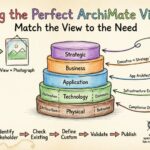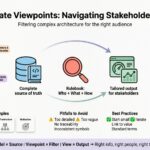


Enterprise architecture often fails not because of bad strategy, but because of bad communication. When stakeholders look at the same model, they see different things. This disconnect creates friction, slows decision-making, and wastes resources. The ArchiMate standard addresses this through a specific mechanism: the Viewpoint.
For enterprise leaders, understanding how to define and utilize Viewpoints is not an academic exercise. It is a critical governance function. It determines who sees what, why they see it, and how decisions are validated. This guide provides a deep dive into the mechanics of ArchiMate Viewpoints, stripping away the jargon to reveal the operational value.
🧩 The Core Distinction: Viewpoint vs. View
Confusion often arises between two related but distinct concepts: the Viewpoint and the View. To navigate the architecture effectively, you must distinguish between the template and the artifact.
Understanding the Definitions
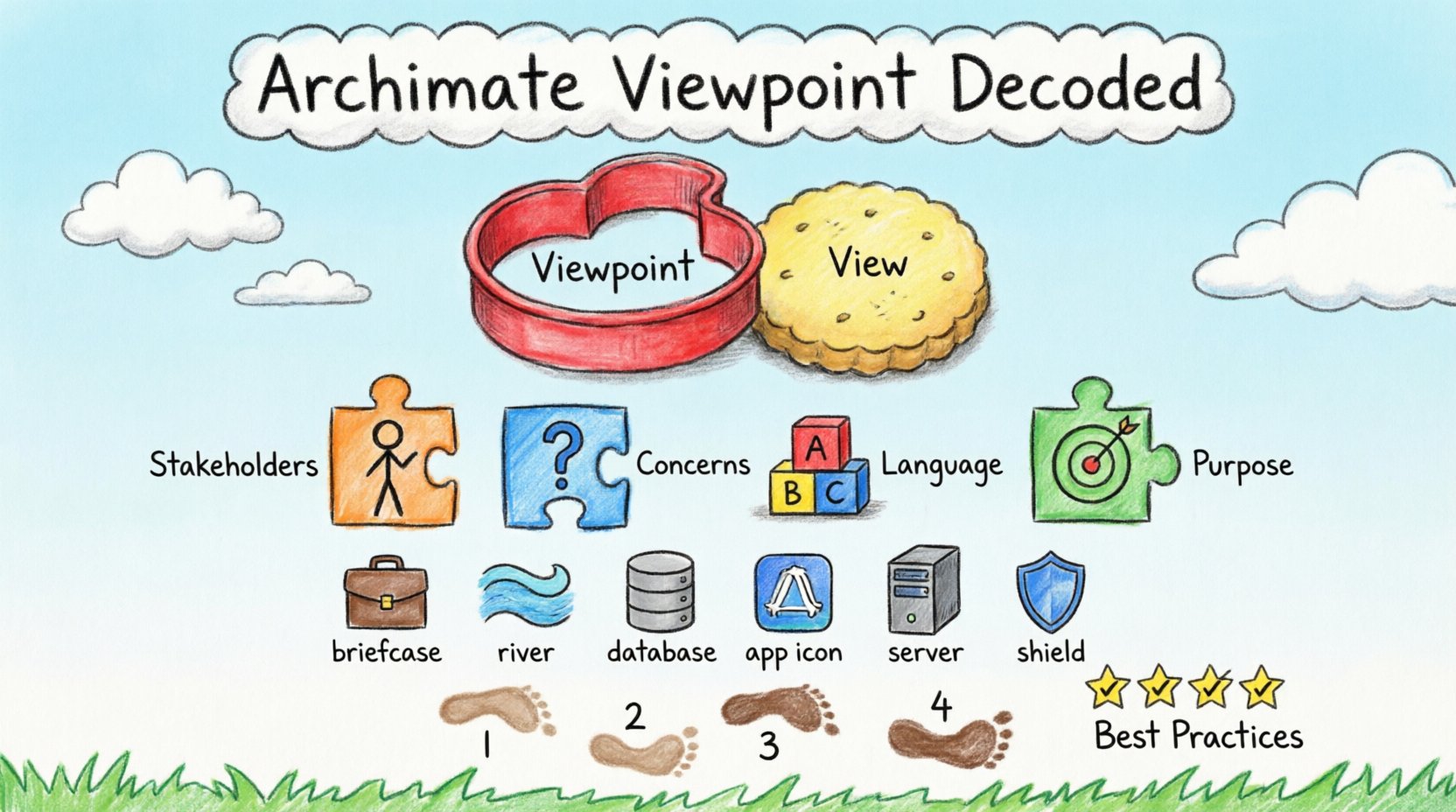
- Viewpoint: A specification of the conventions for constructing and using a view. It defines the lens through which the architecture is observed. It answers: Who is this for? What questions does it answer? Which parts of the model are relevant?
- View: The actual representation of a set of related concerns. It is the artifact produced using a Viewpoint. It answers: What does the current state look like for this specific stakeholder?
Think of the Viewpoint as the rules of a game and the View as the actual play. You cannot have a consistent View without a defined Viewpoint.
Comparison Table: Viewpoint vs. View
| Feature | Viewpoint | View |
|---|---|---|
| Nature | Template / Specification | Instance / Artifact |
| Duration | Long-term (Standard) | Short-term (Snapshot) |
| Reusability | High (Used across multiple projects) | Low (Specific to a project or time) |
| Focus | Stakeholder Concerns | Current State / Future State |
| Example | “Security Officer Perspective” | “2024 Infrastructure Security Map” |
🧠 Anatomy of a Robust Viewpoint
A well-defined Viewpoint is not just a request for a diagram. It is a structured definition that ensures consistency. When creating or reviewing a Viewpoint, four critical components must be present.
1. Stakeholders
Identify the specific roles that will consume this View. Avoid generic terms like “management.” Be precise.
- Business Executives: Need high-level capability maps.
- IT Architects: Need interface and data flow details.
- Security Officers: Need compliance and access control matrices.
- Developers: Need API and component specifications.
2. Concerns
What questions is this Viewpoint designed to answer? A Viewpoint that tries to answer everything usually answers nothing effectively.
- Feasibility: Can we build this?
- Viability: Should we build this?
- Stability: Will this survive change?
- Compliance: Does this meet regulatory standards?
3. Language and Notation
The Viewpoint must specify the modeling language used. In the context of ArchiMate, this usually involves selecting specific layers (Business, Application, Technology) and ensuring the syntax is consistent across the organization.
4. Purpose
Why does this View exist? Is it for decision approval? For execution planning? For compliance reporting? The purpose drives the level of detail required.
📊 Standard Viewpoint Types in Enterprise Architecture
While custom Viewpoints are necessary, starting with standard types ensures alignment with industry practices. The following table outlines the primary categories and their typical concerns.
| Viewpoint Category | Primary Layer Focus | Typical Stakeholders | Key Concerns Addressed |
|---|---|---|---|
| Business Capability | Business | CXO, Strategy Leads | Market responsiveness, Skill gaps, Process efficiency |
| Value Stream | Business | Process Owners | Customer journey, Bottlenecks, Handoffs |
| Data Model | Business / Information | Data Stewards, Analysts | Data quality, Ownership, Flow between systems |
| Application Portfolio | Application | CTO, App Owners | Redundancy, Licensing costs, Integration points |
| Infrastructure | Technology / Physical | Infrastructure Leads | Network topology, Hardware specs, Redundancy |
| Security | Technology / Application | CISO, Compliance | Authentication, Encryption, Access policies |
🛠️ Designing a Viewpoint: A Step-by-Step Approach
Creating a Viewpoint is a deliberate process. It requires gathering requirements and translating them into modeling constraints. Follow this structured approach to ensure adoption.
Step 1: Identify the Audience
Start by interviewing the stakeholders who will use the architecture outputs. Do not assume you know their needs. Ask them:
- What decisions do you need to make based on this information?
- What information is missing from current reports?
- What terminology is familiar to you, and what is confusing?
Step 2: Map Concerns to Layers
Archimate structures architecture into layers. A Viewpoint must filter this data. Determine which layers are necessary for the specific concern.
- Full Stack: Required for transformation projects.
- Business Only: Required for capability planning.
- Technology Only: Required for infrastructure migration.
Step 3: Define the Scope
Scope limits the complexity. A Viewpoint for a global organization might need to filter by region or business unit. A Viewpoint for a single project might focus only on the application layer. Clear scope prevents information overload.
Step 4: Establish the Syntax
Define the visual rules. How should connections be drawn? Which colors indicate status? Which icons represent specific asset types? Consistency in visual language is crucial for rapid comprehension.
🔗 Integration with TOGAF Architecture Development Method
Many enterprise architecture frameworks operate alongside ArchiMate. The TOGAF Architecture Development Method (ADM) provides a cycle where Viewpoints play a pivotal role in the requirements management and solution architecture phases.
The Role of Viewpoints in ADM Phases
- Phase A (Architecture Vision): Initial Viewpoints are defined to capture the high-level scope and stakeholder concerns.
- Phase B (Business Architecture): Business Viewpoints are used to document the current and target state of business processes and capabilities.
- Phase C (Information Systems): Data and Application Viewpoints map the information flows and system landscape.
- Phase D (Technology Architecture): Technology Viewpoints detail the hardware, network, and software environment.
- Phase E (Opportunities and Solutions): Migration Viewpoints help plan the transition from current to target state.
Aligning Viewpoints with the ADM cycle ensures that architecture is not a static document but a living process that supports project lifecycles.
⚖️ Governance and Maintenance of Viewpoints
Once Viewpoints are created, they require governance. A Viewpoint that is not maintained becomes outdated, leading to confusion and loss of trust in the architecture practice.
Establishing a Viewpoint Registry
Maintain a central register of all active Viewpoints. This registry should include:
- Owner: The individual responsible for updates.
- Status: Active, Deprecated, or Draft.
- Last Review Date: When was the definition last validated?
- Access Control: Who is authorized to create Views using this Viewpoint?
Review Cycles
Viewpoints should not be static. Schedule regular reviews.
- Quarterly: Check for minor syntax updates or new stakeholder requests.
- Annually: Review the relevance of the Viewpoint. Is it still solving the right problems? Has the organization changed?
Handling Deprecation
When a Viewpoint is no longer needed, do not delete it immediately. Archive it. Mark it as deprecated. This preserves historical context for legacy data while preventing new Views from being created using outdated standards.
🚫 Common Pitfalls and Anti-Patterns
Even with the best intentions, organizations often stumble when implementing Viewpoint strategies. Recognizing these patterns early can save significant effort.
1. The “One-Size-Fits-All” Viewpoint
Creating a single Viewpoint for all stakeholders is a common error. A developer needs different information than a CFO. If you force everyone to use the same complex model, neither group gets what they need.
2. Over-Engineering the Model
Attempting to model every single relationship in the enterprise results in a diagram that is too large to read. Viewpoints must filter. If a relationship does not serve the specific concern of the Viewpoint, it should be excluded from that View.
3. Ignoring the Motivation Layer
Many Viewpoints focus strictly on Business, Application, and Technology layers. However, the Motivation Layer (Stakeholders, Requirements, Goals, Principles) is critical for understanding why changes are happening. Excluding this layer makes it difficult to trace decisions back to business drivers.
4. Lack of Training
Creating a Viewpoint is only half the battle. Stakeholders must understand how to interpret the resulting Views. If the notation is not standardized or understood, the View is useless. Training sessions are a necessary investment.
📈 Measuring the Value of Viewpoints
How do you know if your Viewpoint strategy is working? Rely on qualitative and quantitative metrics to assess effectiveness.
Qualitative Indicators
- Clarity: Do stakeholders understand the architecture without needing extensive explanation?
- Alignment: Are technical decisions clearly linked to business goals?
- Speed: Does the architecture team spend less time re-explaining the same concepts in meetings?
Quantitative Indicators
- Adoption Rate: How many projects are using the standardized Viewpoints?
- Request Volume: Are there fewer ad-hoc requests for custom diagrams?
- Decision Latency: Has the time to approve architecture designs decreased?
🔮 Future Considerations and Evolution
As enterprise environments shift towards cloud-native architectures and AI-driven operations, Viewpoints must evolve. The traditional static diagrams are becoming less relevant.
- Dynamic Views: Moving towards real-time dashboards that reflect the current state of the infrastructure rather than static snapshots.
- Automated Compliance: Using Viewpoints to define rules that can be automatically checked against the architecture model.
- Integration with DevOps: Embedding architecture metadata directly into the pipeline so Viewpoints reflect the deployed state.
Leadership must remain agile. The Viewpoints defined today may not fit the operational model of tomorrow. Continuous improvement is the only sustainable path.
📝 Summary of Best Practices
To ensure success in your enterprise architecture program, adhere to these core principles when working with Viewpoints.
- Start with the Stakeholder: Never define a Viewpoint without knowing who will read it.
- Focus on Concerns: Ensure every element in the View answers a specific question.
- Maintain Consistency: Use standard notation and colors across all Viewpoints.
- Document Thoroughly: Keep the Viewpoint definition accessible and up to date.
- Review Regularly: Treat Viewpoints as living documents, not static artifacts.
By implementing a structured approach to Viewpoints, enterprise leaders can transform architecture from a theoretical exercise into a practical tool for decision-making. The clarity gained reduces risk, aligns technology with business strategy, and fosters a culture of transparency across the organization.