

In modern enterprise environments, the disconnect between business strategy and technical execution is a persistent challenge. Departments often operate with distinct objectives, terminology, and priorities. Business leaders focus on value streams, market positioning, and customer experience. Meanwhile, IT teams prioritize infrastructure stability, code quality, and system integration. Without a unified framework to translate these perspectives, organizations struggle to align their long-term goals with day-to-day operations.
This misalignment creates silos. Decisions made in the boardroom may be technically unfeasible, while IT projects may fail to deliver actual business value. To resolve this, enterprise architecture frameworks provide a common language. ArchiMate is a leading standard in this field. However, simply having a model is not enough. The key to effective communication lies in the use of Viewpoints. These specialized views allow stakeholders to see the information relevant to them without being overwhelmed by the complexity of the entire enterprise model.
🧩 Understanding the Silo Problem
Before exploring the solution, it is necessary to understand the root cause of the disconnect. Silos form when information is not shared effectively or when it is presented in a format that is inaccessible to certain groups.
- Language Barriers: Business stakeholders speak in terms of processes, roles, and services. IT stakeholders speak in terms of components, interfaces, and protocols. When these languages do not map to each other, misunderstandings occur.
- Information Overload: A complete enterprise model contains thousands of elements. Showing a CEO the full technical stack is counterproductive. It obscures the high-level strategy.
- Lack of Context: A technology diagram often lacks the business justification. Why is this server here? How does it support this customer journey? Without context, technical decisions appear arbitrary.
These issues lead to friction. Projects face delays because requirements are misinterpreted. Resources are wasted on systems that do not support core business functions. The organization loses agility and responsiveness to market changes.
🔍 What Are ArchiMate Viewpoints?
ArchiMate defines a viewpoint as a specification for the presentation of an architecture description from the perspective of a specific set of stakeholders. It answers three fundamental questions:
- Who: Who is the audience?
- What: What information do they need to make decisions?
- How: How should this information be structured and visualized?
A viewpoint filters the underlying architecture model. It selects specific elements and relationships relevant to the stakeholder group. It also defines the notation style, layout, and level of detail. This ensures that the architecture description remains manageable and focused.
Key Characteristics of a Viewpoint
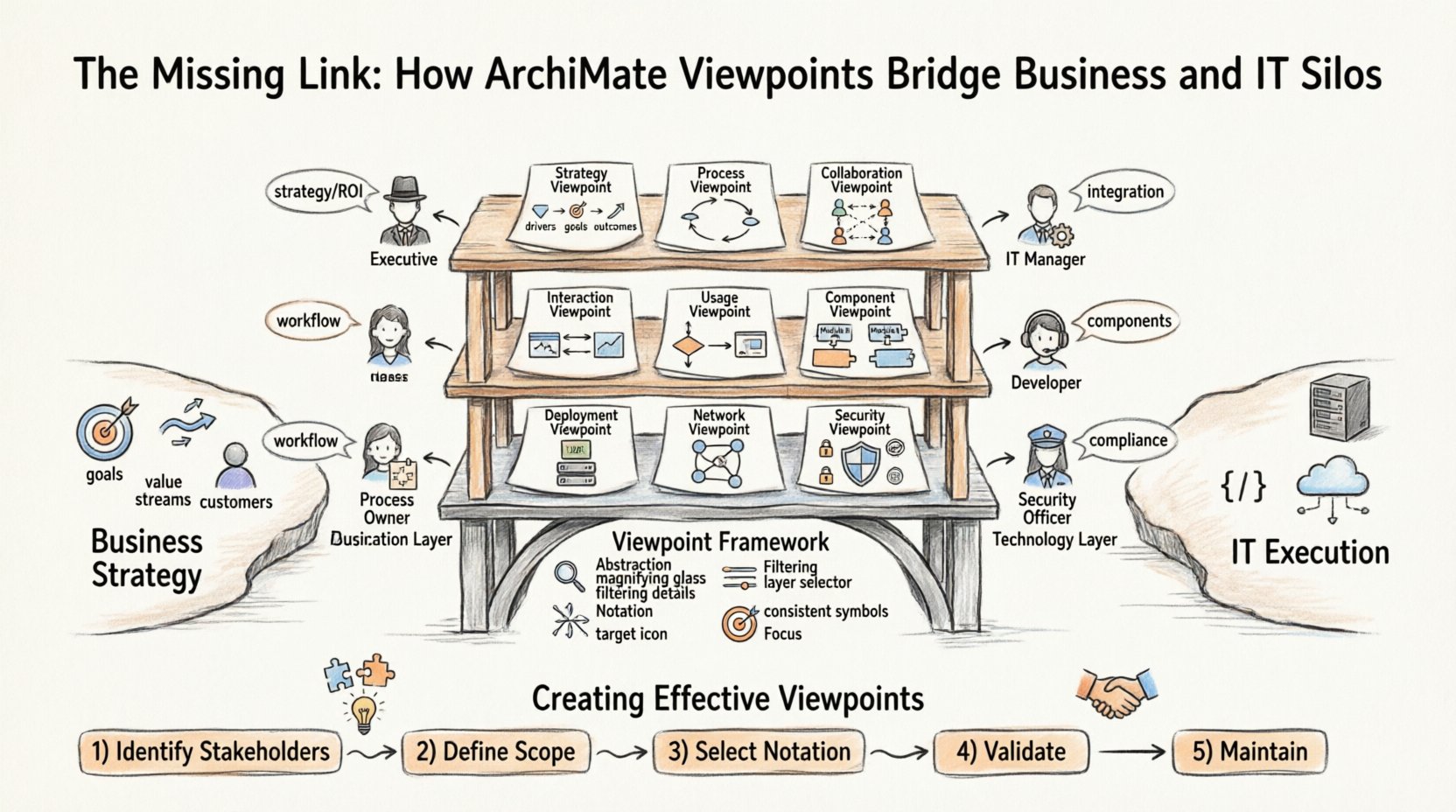
- Abstraction: Hiding unnecessary detail to focus on the relevant scope.
- Filtering: Selecting specific layers or domains (Business, Application, Technology).
- Notation: Choosing the appropriate symbols and layout for clarity.
- Focus: Addressing a specific concern, such as security, performance, or cost.
📊 Mapping Stakeholders to Viewpoints
Not every stakeholder needs the same information. A robust architecture practice identifies the key roles within the organization and maps them to appropriate viewpoints. This ensures that the right people see the right data at the right time.
| Stakeholder Group | Primary Concern | Recommended Viewpoint Focus |
|---|---|---|
| Executive Leadership | Strategic alignment, ROI, Risk | Business Strategy, Capability Mapping |
| Process Owners | Efficiency, Workflow, Handoffs | Business Process, Collaboration |
| IT Managers | System Integration, Data Flow | Application Interaction, Data Flow |
| Developers | Interfaces, Components, Deployment | Application Component, Technology Node |
| Security Officers | Access Control, Compliance | Security, Risk, Compliance |
🏢 Business Layer Viewpoints
The business layer represents the core activities of the organization. It describes the structure and behavior of the enterprise without reference to the systems that support it. Business stakeholders are the primary audience for these views.
1. Strategy Viewpoint
This view connects high-level goals to actionable initiatives. It maps strategic drivers to specific capabilities and business outcomes.
- Elements: Drivers, Goals, Principles, Outcomes.
- Relationships: Realization, Influence, Assignment.
- Benefit: Ensures that every project traces back to a strategic objective.
2. Process Viewpoint
Process owners need to understand how work flows through the organization. This view highlights roles, interactions, and business processes.
- Elements: Business Processes, Business Roles, Business Interactions.
- Relationships: Flow, Trigger, Assignment.
- Benefit: Identifies bottlenecks and opportunities for automation.
3. Collaboration Viewpoint
This view focuses on how different actors within the business interact. It is crucial for understanding organizational boundaries and partnerships.
- Elements: Business Actors, Business Roles.
- Relationships: Communication, Collaboration, Aggregation.
- Benefit: Clarifies responsibilities and handoff points between departments.
💻 Application Layer Viewpoints
The application layer bridges the gap between business needs and technical implementation. It describes the software systems that support business processes.
1. Application Interaction Viewpoint
This view shows how applications communicate with each other. It is essential for integration planning.
- Elements: Application Functions, Application Components, Application Interfaces.
- Relationships: Communication, Access.
- Benefit: Visualizes data flow and dependency between systems.
2. Application Usage Viewpoint
This view maps business processes to the applications that support them. It answers the question: “Which system runs this process?”
- Elements: Business Processes, Application Services, Application Functions.
- Relationships: Realization, Usage.
- Benefit: Identifies redundant systems and gaps in coverage.
3. Application Component Viewpoint
For technical teams, this view details the internal structure of applications.
- Elements: Application Components, Interfaces, Data Objects.
- Relationships: Realization, Dependency.
- Benefit: Supports development planning and refactoring efforts.
🖥️ Technology Layer Viewpoints
The technology layer describes the infrastructure required to run applications. This is the domain of infrastructure teams and architects.
1. Technology Deployment Viewpoint
This view maps software components to physical hardware. It is critical for capacity planning and deployment strategies.
- Elements: Application Components, System Software, Technology Nodes, Devices.
- Relationships: Deployment, Realization.
- Benefit: Ensures infrastructure can support the workload.
2. Technology Network Viewpoint
This view focuses on the connectivity between technology nodes. It is vital for network architecture and security.
- Elements: Communication Networks, Nodes, Devices.
- Relationships: Communication, Access.
- Benefit: Highlights network bottlenecks and single points of failure.
3. Technology Security Viewpoint
Security officers require a specific view to assess risk and compliance.
- Elements: Security Mechanisms, Nodes, Functions.
- Relationships: Access, Aggregation.
- Benefit: Verifies that security controls are in place across the infrastructure.
🔄 Integrating the Layers
While individual layers have their own viewpoints, the true power of ArchiMate lies in the integration between them. A Business Process might be realized by an Application Function, which is deployed on a Technology Node. Linking these layers provides a complete picture of the enterprise.
Integration Viewpoints combine elements from multiple layers to address cross-cutting concerns.
- Value Stream Viewpoint: Connects business goals to the technical realization of value.
- Change Management Viewpoint: Shows the impact of a change across all layers.
- Portfolio Viewpoint: Aggregates projects and initiatives across the enterprise.
Without integration, the model remains fragmented. Stakeholders see their piece of the puzzle but not the whole picture. Integration viewpoints facilitate holistic decision-making.
🛠️ Creating Effective Viewpoints
Creating a viewpoint is not a one-time task. It requires ongoing maintenance and adaptation as the organization evolves. Here is a recommended process for developing and managing viewpoints.
Step 1: Identify Stakeholders
Start by listing all groups that interact with the architecture. Interview them to understand their information needs. What decisions do they make? What data do they require to make those decisions?
Step 2: Define the Scope
Decide which layers and domains are relevant. If the audience is business-focused, limit the view to the Business and Application layers. If the audience is technical, include the Technology layer.
Step 3: Select Notation
Choose the standard ArchiMate notation or adapt it for clarity. Ensure consistency in symbols and colors. A confusing diagram is worse than no diagram.
Step 4: Validate with Stakeholders
Present the draft viewpoint to the stakeholders. Ask if it answers their questions. If they find missing information, adjust the filter or layout. Validation ensures adoption.
Step 5: Maintain and Update
As the enterprise changes, the viewpoints must change. Establish a governance process to review and update the architecture descriptions regularly.
⚠️ Common Pitfalls to Avoid
Even with a solid framework, mistakes can undermine the effectiveness of the architecture practice. Be aware of these common issues.
- Over-Modeling: Creating too many viewpoints can confuse stakeholders. Focus on quality over quantity.
- Inconsistency: Using different symbols for the same element across different views creates confusion. Enforce a style guide.
- Lack of Context: Providing a diagram without explaining what it represents. Always include a legend or description.
- Static Views: Treating the model as a one-time deliverable. Architecture is dynamic and must evolve with the business.
- Ignoring the Human Element: Focusing only on technical correctness. A diagram must be understandable by humans, not just machines.
📈 Measuring Success
How do you know if the viewpoints are working? Look for these indicators of success within the organization.
- Reduced Miscommunication: Fewer emails and meetings dedicated to clarifying requirements.
- Faster Decision Making: Stakeholders can access the information they need without waiting for summaries.
- Better Alignment: Projects are more likely to meet business objectives because the connection is visible.
- Increased Transparency: The organization has a clear view of its capabilities and investments.
🚀 Future Trends in Architecture Description
The field of enterprise architecture continues to evolve. As organizations become more digital, the need for clear communication grows.
- Dynamic Visualization: Moving from static diagrams to interactive dashboards that allow users to drill down into details.
- Automated Generation: Using tools to generate viewpoints directly from live system data.
- Enhanced Collaboration: Cloud-based platforms that allow multiple stakeholders to view and comment on the architecture simultaneously.
- AI Integration: Using artificial intelligence to suggest connections or identify inconsistencies in the model.
These trends suggest that the role of the architect will shift from creating diagrams to curating information. The viewpoint remains the critical mechanism for delivering that curated information to the right audience.
🔗 Bridging the Gap
The silos between business and IT are not inevitable. They are the result of poor communication and a lack of shared context. ArchiMate Viewpoints provide the structure needed to build that shared context.
By filtering complexity and focusing on stakeholder concerns, viewpoints transform raw data into actionable intelligence. They allow business leaders to see the technical implications of their strategy. They allow IT teams to see the business value of their work.
Investing in a robust viewpoint strategy is an investment in organizational clarity. It reduces friction, improves efficiency, and ensures that technology serves the business, not the other way around. The missing link is not a tool or a technology. It is a shared understanding, facilitated by a structured approach to architecture description.
Start by mapping your stakeholders. Define your viewpoints. Validate your models. And watch as the disconnect between business and IT begins to close. The path to alignment is paved with clear, purposeful communication.