

Enterprise architecture often struggles not because of poor modeling, but because of poor translation. A complex model containing every detail of an organization’s structure, processes, and systems can become noise to the very people it is meant to serve. When a technical diagram ends up on the desk of a C-suite executive, the value of that information diminishes rapidly. The gap between the architecture and the business strategy is often where projects fail, budgets stall, and alignment dissolves.
This is where the concept of ArchiMate Viewpoints becomes critical. It is not merely a modeling technique; it is a communication strategy. By filtering the vastness of the enterprise model through specific lenses, teams can ensure that stakeholders see only what is relevant to their decision-making. This guide explores why adopting a diverse range of viewpoints is essential for modern architecture teams and how to implement them effectively.
🔍 Understanding the Architecture Communication Gap
In many organizations, the architecture repository is treated as a single source of truth. While this sounds efficient, it creates a bottleneck. The repository contains technical specifics, business rules, strategic goals, and technology infrastructure all mixed together. When a stakeholder requests information, the architecture team often provides a snapshot that is too dense or too abstract.
Consider the following scenarios:
- The CFO needs to understand the cost implications of migrating to a new cloud environment but is not interested in the specific API endpoints or server configurations.
- The Lead Developer needs to know the data flow between applications to debug an integration issue but does not care about the high-level strategic drivers.
- The Product Owner requires clarity on which business capabilities are supported by which software components to prioritize the backlog.
Without distinct viewpoints, the architecture team must manually curate information for every request, leading to inconsistency and delays. Viewpoints standardize this curation. They define what elements are shown, how they are represented, and for whom they are intended. This structured approach reduces ambiguity and ensures that the right people get the right information.
🧩 What Is an ArchiMate Viewpoint?
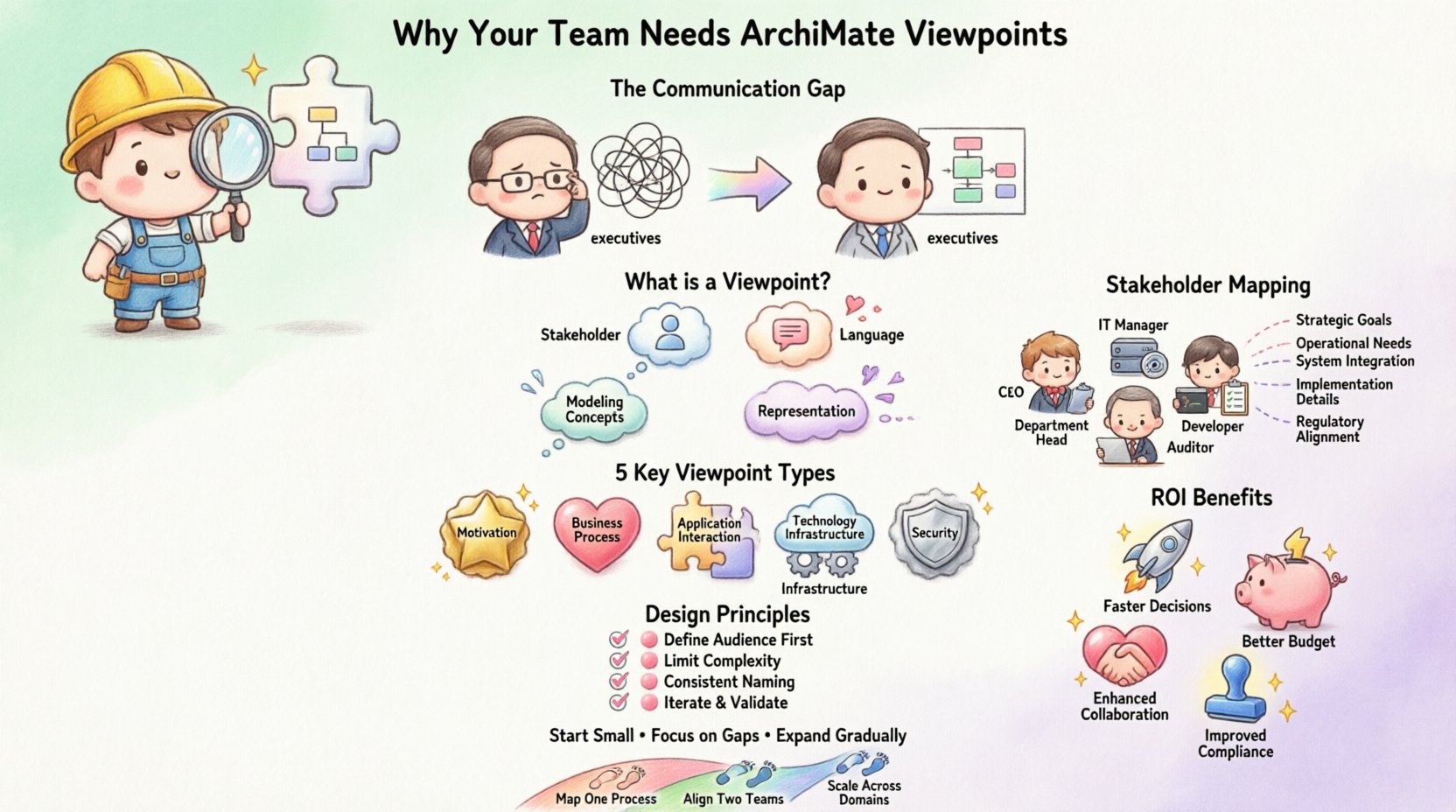
At its core, a viewpoint is a specification for a specific type of architecture description. It defines the perspective from which the model is viewed. In the ArchiMate standard, a viewpoint dictates the scope of the view. It answers the question: What does this stakeholder need to see to do their job?
A viewpoint is defined by:
- Stakeholder: Who is consuming this view? (e.g., Business Manager, Architect, Developer)
- Language: Which part of the ArchiMate language is used? (e.g., Business Layer, Application Layer, Technology Layer)
- Modeling Concepts: Which specific elements and relationships are included?
- Representation: How is the information visually or textually presented?
By separating the viewpoint from the model, you maintain a single source of truth in the repository while generating multiple, tailored outputs. This separation is vital for scalability. If you change the underlying data, all viewpoints automatically reflect the change, but the presentation remains consistent for each stakeholder group.
📉 The Cost of Generic Models
When teams rely on a single, monolithic model without applying viewpoint logic, several issues arise. These issues often lead to architectural drift and stakeholder disengagement.
1. Cognitive Overload
Presenting a full-stack architecture diagram to a business leader overwhelms their cognitive load. They cannot distinguish between a strategic business goal and a temporary technical debt item. This leads to confusion and loss of trust in the architecture team.
2. Decision Paralysis
When too much information is available, decision-making slows down. If a stakeholder cannot find the specific data point they need within a wall of diagrams, they may default to assumptions or rely on outdated information.
3. Inconsistent Messaging
Without standardized viewpoints, different architects might create different diagrams for the same stakeholder group. One diagram might focus on processes, while another focuses on systems. This inconsistency creates friction during reviews and governance meetings.
4. Maintenance Burden
Maintaining multiple manual diagrams that are not linked to a single source of truth is unsustainable. As the enterprise changes, these manual copies become stale. Viewpoints automate the generation of these views from the central model.
👥 Aligning Viewpoints with Stakeholders
Effective architecture communication requires mapping viewpoints directly to stakeholder roles. Here is a breakdown of common stakeholder groups and the types of viewpoints they typically require.
| Stakeholder Role | Primary Concern | Recommended Viewpoint Focus |
|---|---|---|
| C-Suite Executives | Strategy, Risk, Investment | Strategic, Motivation, Business Process |
| Department Heads | Process Efficiency, Capabilities | Business Service, Business Function, Application |
| IT Managers | Integration, Infrastructure, Cost | Technology, Application Interaction, Infrastructure |
| Developers & Engineers | APIs, Data Flow, Dependencies | System Software, Data Object, Interface |
| Compliance & Audit | Security, Governance, Controls | Security, Governance, Role-Based Access |
Notice that the C-Suite focuses on why (Motivation) and what (Strategy), while Developers focus on how (Interfaces and Systems). A single diagram cannot effectively serve both. By creating specific viewpoints for these groups, you ensure that the architecture speaks their language.
🛠️ Key Viewpoint Types and Their Uses
Implementing a robust architecture practice involves defining a catalog of viewpoints. Below are the most impactful types to consider for your team.
1. The Motivation Viewpoint
This viewpoint connects business strategy to implementation. It visualizes drivers, goals, and assessments. It is essential for understanding why a change is happening. For example, it can show how a regulatory change (Driver) impacts a business goal (Goal) and necessitates a new capability (Capability).
2. The Business Process Viewpoint
Focuses on the flow of activities and the roles involved. It is crucial for process improvement and identifying bottlenecks. It maps out who does what and how information flows between departments without getting bogged down in technical system details.
3. The Application Interaction Viewpoint
This is vital for integration teams. It shows how applications exchange data and services. It highlights interfaces and data objects between systems. This helps in identifying redundant interfaces or breaking changes in the software landscape.
4. The Technology Infrastructure Viewpoint
Focuses on the hardware, network, and deployment environment. It is used for capacity planning and infrastructure upgrades. It maps nodes and devices, showing how the physical environment supports the logical applications.
5. The Security Viewpoint
Security is not an afterthought. This viewpoint highlights security mechanisms, authentication points, and data protection controls. It ensures that security requirements are visible throughout the architecture, not just in a separate document.
📝 Designing Effective Viewpoints
Creating a viewpoint is not just about selecting a template. It requires deliberate design to ensure it meets the communication needs of the audience. Follow these principles when defining new viewpoints.
- Define the Audience First: Never start with the model. Start with the person reading the diagram. What is their title? What decisions do they make daily? What information do they need to make those decisions?
- Limit Complexity: A good viewpoint hides complexity. If a stakeholder only cares about the application layer, do not show the technology layer. Filtering is more important than completeness.
- Consistent Naming: Ensure that business terms used in the viewpoint match the terms used in the business glossary. If the business calls it “Customer Onboarding,” the diagram should not say “User Registration Process” unless there is a clear mapping.
- Iterate and Validate: Show a draft viewpoint to a representative stakeholder. Ask them: Can you find the information you need within 30 seconds? If the answer is no, refine the viewpoint.
🔄 Maintaining Consistency Across Viewpoints
One of the biggest risks in adopting viewpoints is creating silos where different views tell different stories. To maintain integrity, the architecture team must enforce strict governance.
1. Single Source of Truth All viewpoints must reference the same underlying model elements. If a business capability is renamed in the model, it must automatically update across all viewpoints. This prevents the scenario where the CFO sees “Capability A” and the Developer sees “Capability B” for the same thing.
2. Version Control Viewpoints should be versioned. When the model changes significantly, old viewpoints might become misleading. Track when a viewpoint was last reviewed and updated. This ensures that stakeholders are always looking at current data.
3. Access Control Not all viewpoints are suitable for all audiences. Some data might be sensitive. Implement access controls that restrict which viewpoints are available to which user groups. This protects intellectual property and sensitive architectural decisions.
🚧 Common Pitfalls to Avoid
Even with the best intentions, teams often stumble when implementing viewpoint strategies. Be aware of these common traps.
- Over-Engineering: Creating too many viewpoints for minor differences. If two roles need the same information, do not create two viewpoints. One well-designed viewpoint can serve both.
- Ignoring the Business Layer: Focusing heavily on technology and application layers while neglecting the business layer. Architecture must start with business needs. If the business layer is weak, the technology will fail to support the organization.
- Lack of Training: Stakeholders often do not know how to read architecture diagrams. Training is required to help them understand the symbols, relationships, and notation used in the viewpoints.
- Static Reporting: Treating viewpoints as static PDF reports. They should be dynamic. If the tool allows, provide interactive views where stakeholders can drill down into details as needed.
💡 The ROI of Clear Viewpoints
Investing time in defining and maintaining viewpoints yields tangible returns. It is not just about better diagrams; it is about better outcomes.
Reduced Project Delays
When stakeholders understand the architecture, they make faster decisions. They do not need to schedule meetings to ask basic questions about dependencies or impacts. This accelerates the delivery pipeline.
Better Budget Allocation
With clear views of the technology landscape, finance teams can identify redundant systems more easily. They can see which applications are underutilized and which are critical. This leads to more efficient spending.
Improved Compliance
When security and governance viewpoints are standardized, audits become smoother. You can demonstrate exactly where controls are implemented and how data flows without manually compiling evidence for every request.
Enhanced Collaboration
When everyone speaks the same architectural language, collaboration improves. Business and IT can discuss initiatives without translation errors. The shared vocabulary bridges the traditional divide between departments.
🌟 Moving Forward with Your Architecture Strategy
The adoption of ArchiMate Viewpoints is a shift in mindset. It moves the architecture function from a documentation exercise to a communication service. It acknowledges that different people need different maps to navigate the same territory.
To begin this transformation, audit your current artifacts. Ask yourself: Who is looking at these diagrams? Do they understand them? Are they making decisions based on this data? If the answers are uncertain, start by identifying the top three stakeholder groups and designing specific viewpoints for them. Measure the impact on decision-making speed and clarity.
Architecture is not about building the perfect model. It is about enabling the organization to execute its strategy. Viewpoints are the bridge that makes that execution possible. By investing in the clarity of these views, you invest in the alignment of the entire enterprise.
Start small, focus on the most critical communication gaps, and expand your viewpoint catalog as the maturity of your practice grows. The conversation is the most important part of the architecture lifecycle. Ensure it is clear, consistent, and actionable.