

Enterprise Architecture (EA) serves as the strategic blueprint for complex organizations. It provides structure, clarity, and direction when navigating digital transformation. However, the sheer complexity of modern business landscapes often leads to models that are difficult to interpret or maintain. At the heart of this complexity lies the concept of the Viewpoint. While ArchiMate provides a standardized language for describing architecture, the way these viewpoints are constructed and utilized determines the success or failure of the entire modeling effort.
Many architects focus heavily on the syntax and the modeling tools themselves, neglecting the foundational principles of what a Viewpoint actually achieves. A poorly designed viewpoint can lead to confusion, misalignment, and significant rework. This guide explores the critical areas where architects frequently stumble when defining ArchiMate viewpoints. By understanding these pitfalls, you can build more robust, maintainable, and valuable architecture models.
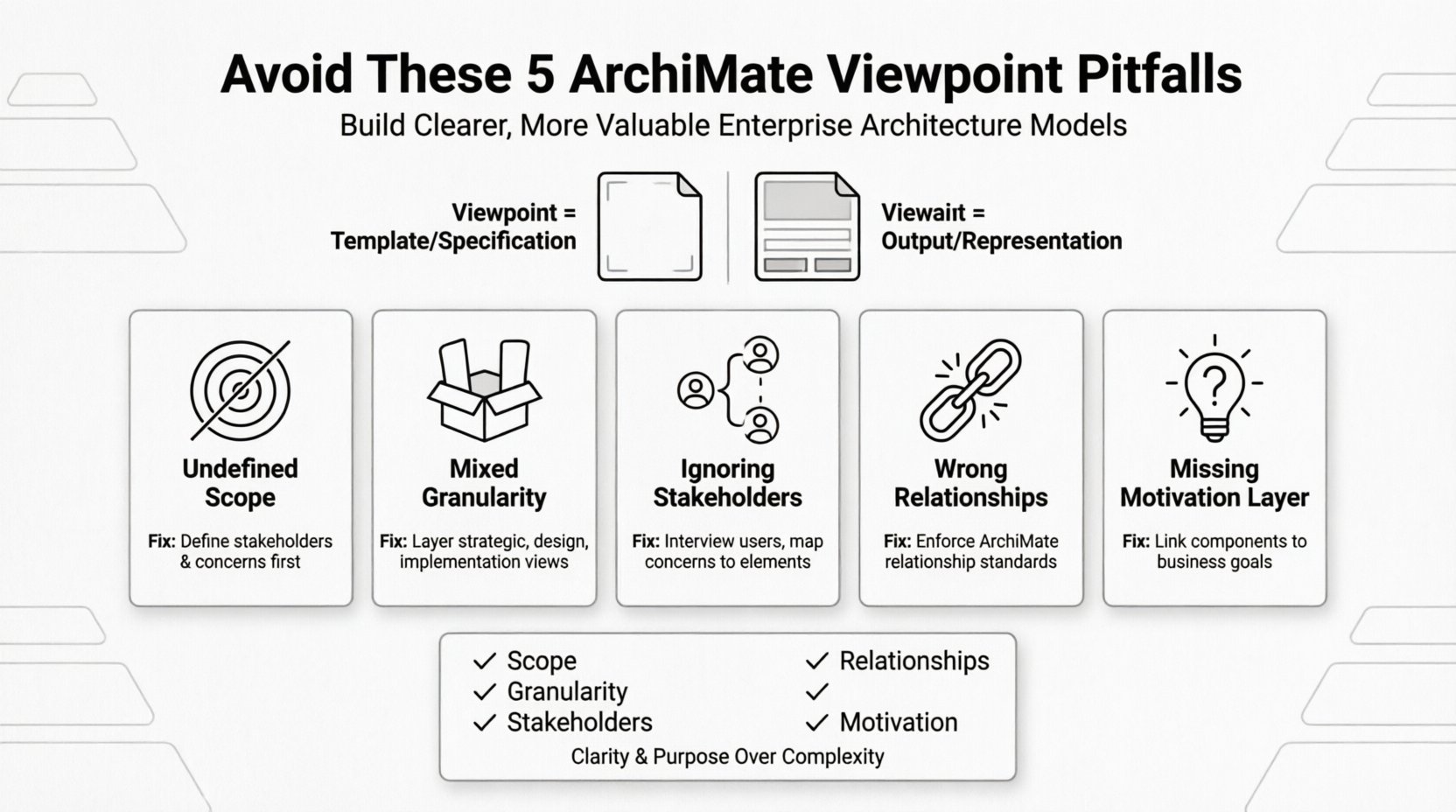
🧠 Understanding the Core: View vs. Viewpoint
Before diving into the mistakes, it is essential to clarify the distinction between a View and a Viewpoint. This distinction is often blurred in practice, leading to structural issues in the architecture repository.
- Viewpoint: This is a specification. It defines the conventions, notations, and perspectives used to create a view. It answers the question: “How do we represent architecture for this specific audience?” It includes rules about which ArchiMate elements are allowed, the level of detail required, and the specific focus area.
- View: This is the actual representation. It is the concrete output created using a viewpoint. It answers the question: “What does this architecture look like for this specific stakeholder?”
When architects conflate these two concepts, they end up with ad-hoc diagrams that lack consistency. A Viewpoint acts as the template; the View is the filled-in document. Confusing the template with the output creates maintenance nightmares.
⚠️ Pitfall 1: Undefined Purpose and Scope
One of the most common errors is creating a viewpoint without a clearly defined purpose. Architects often begin modeling without asking who will use the diagram or what decision it supports. This leads to “boil the ocean” approaches where every possible element is included.
Why This Happens
- Lack of stakeholder engagement at the design phase.
- Fear of missing critical information, leading to over-inclusion.
- Unclear governance standards for the architecture repository.
The Consequences
When a viewpoint lacks scope, the resulting views become cluttered. Stakeholders cannot find the information they need amidst the noise. This reduces trust in the architecture capability. If a diagram contains too much information, it conveys too little. It fails to highlight the specific risks, opportunities, or changes relevant to the audience.
The Fix
Define the Stakeholders and their Concerns before defining the Viewpoint. Every viewpoint should answer a specific set of questions. For example, a Security Viewpoint should focus on data flows and access controls, not on the physical server hardware unless it directly impacts security posture. Use a checklist to validate scope:
- Who is the primary audience?
- What specific decision does this view support?
- What information is strictly out of scope for this view?
- Which ArchiMate layers (Business, Application, Technology) are relevant?
⚠️ Pitfall 2: Overloading a Single Viewpoint
Architects sometimes try to solve multiple problems with a single Viewpoint. They might attempt to combine a high-level strategy view with a detailed implementation view. This violates the principle of separation of concerns.
The Problem with Mixed Granularity
Strategic leaders need to see the big picture: business capabilities, value streams, and organizational structure. They do not need to see specific API interfaces or database schemas. Conversely, developers need the details. Combining these into one Viewpoint creates a model that satisfies neither group.
The Consequences
- Models become unreadable for senior management.
- Technical teams feel the model is too abstract to be useful.
- Version control becomes difficult as changes for one audience break the view for another.
The Fix
Adopt a layered approach. Create distinct Viewpoints for different levels of abstraction. For instance:
- Strategic Viewpoint: Focus on Motivation, Business, and Strategy layers.
- Design Viewpoint: Focus on Application and Business layers.
- Implementation Viewpoint: Focus on Technology and Physical layers.
This ensures that each View is tailored to the cognitive load of its intended audience. It also simplifies maintenance. If a technology change occurs, the Strategic Viewpoint remains untouched.
⚠️ Pitfall 3: Ignoring Stakeholder Needs
Architecture is a communication tool. If the communication fails, the architecture fails. A common mistake is designing Viewpoints based on what the architecture team wants to show, rather than what the business needs to see.
Alignment Gaps
Stakeholders often have specific concerns that are not immediately obvious. A CFO cares about cost and ROI. A CTO cares about scalability and technical debt. A Compliance Officer cares about regulatory data flows. If the Viewpoint does not explicitly address these concerns, the model will be ignored.
The Consequences
- Low adoption rates of the architecture models.
- Architects spending time on diagrams that no one reviews.
- Decisions made outside the architectural framework because the framework was not trusted.
The Fix
Conduct stakeholder interviews during the Viewpoint design phase. Map specific ArchiMate elements to stakeholder concerns. For example, if a stakeholder is concerned with cost, ensure the Viewpoint allows for the inclusion of Cost Drivers or Investment Attributes. Do not assume everyone understands the standard notation. Provide legends and context where necessary.
⚠️ Pitfall 4: Inconsistent Layering and Relationships
ArchiMate defines specific relationships between layers (e.g., Serve, Access, Realize, Trigger). A frequent error occurs when these relationships are misused within a Viewpoint to force connections that do not exist or to simplify complexity in a way that creates false dependencies.
Relationship Misuse
Using a Realization relationship where an Access relationship is appropriate can distort the understanding of the system. For example, a Business Process does not “Realize” a Software Application. It uses or supports it. Mislabeling relationships creates confusion during impact analysis.
The Consequences
- Incorrect impact analysis during change management.
- Confusion regarding the flow of data and control.
- Technical debt in the model that requires significant cleanup later.
The Fix
Enforce strict modeling standards. Create a modeling guide that explicitly defines valid relationships for each Viewpoint. Use automated validation rules if the tool supports them. Review models against the ArchiMate reference model regularly. Ensure that the flow of information and control is logical and consistent with the business reality.
⚠️ Pitfall 5: Neglecting the Motivation Layer
The Motivation Layer (Goals, Principles, Requirements, Assessments) is often the first casualty in modeling efforts. Architects frequently skip it, focusing only on the structural layers (Business, Application, Technology, Data). This creates a disconnect between what is being built and why.
The Cost of Missing Motivation
Without the Motivation Layer, stakeholders cannot trace the lineage of an architectural decision. They see a new application, but they do not see which business goal drove its creation. This makes it difficult to justify investments or retire obsolete components.
The Consequences
- Loss of context for future architects.
- Inability to measure the value delivered by the architecture.
- Difficulty in aligning new projects with strategic objectives.
The Fix
Integrate the Motivation Layer into every major Viewpoint. Even if the view is technical, link the technical components to the Business Goals they support. Use the Driven By relationship to connect Requirements to Architecture Elements. This ensures that the architecture remains purpose-driven rather than just a static diagram of components.
🛡️ Strategic Best Practices Checklist
To ensure you avoid the pitfalls discussed above, use the following checklist when designing or reviewing an ArchiMate Viewpoint. This table summarizes the key areas of focus.
| Area of Focus | Common Mistake | Impact | Recommended Action |
|---|---|---|---|
| Scope | Too broad or undefined | Cluttered models, confusion | Define clear boundaries and allowed elements |
| Granularity | Mixing strategy and detail | Models unusable for target audience | Create separate Viewpoints for different levels |
| Stakeholders | Designed for architects, not users | Low adoption and trust | Interview stakeholders to map concerns to elements |
| Relationships | Incorrect or forced links | Flawed impact analysis | Enforce strict relationship standards and validation |
| Motivation | Excluded from views | Loss of strategic context | Link elements to Goals and Requirements explicitly |
🔍 Maintaining Viewpoint Integrity Over Time
Creating a Viewpoint is not a one-time task. Architecture evolves. Business goals shift. Technology stacks change. If the Viewpoint remains static while the model evolves, the Viewpoint becomes obsolete.
Versioning and Governance
Establish a governance process for Viewpoints. When a new ArchiMate element or relationship is introduced in the standard, review the Viewpoints to see if they need updating. Conversely, if a relationship is deprecated, ensure it is removed from the Viewpoint specifications.
The Review Cycle
Set regular intervals for reviewing the architecture models and their underlying Viewpoints. A quarterly review is often sufficient. Ask the following questions:
- Are the current Viewpoints still relevant to the organization?
- Are there new stakeholder groups that require new perspectives?
- Is the model accuracy still high, or has it drifted?
- Do the views still support the decision-making processes?
🤝 Collaboration and Review Processes
Architecture modeling is rarely a solitary activity. It requires collaboration between business analysts, technical architects, and domain experts. Excluding these groups from the Viewpoint design process often leads to the pitfalls mentioned earlier.
Peer Reviews
Implement a peer review process for Viewpoints. Before a Viewpoint is published, have it reviewed by another architect who understands the domain. They can spot scope creep, inconsistent terminology, or missing elements. This reduces the risk of deploying a flawed standard across the organization.
Feedback Loops
Create channels for feedback from the end-users of the views. If a stakeholder says, “I cannot find the cost information I need,” update the Viewpoint to include cost attributes. This iterative improvement keeps the architecture relevant and valuable.
📝 Final Considerations
The power of ArchiMate lies not just in its syntax, but in how effectively it communicates complex realities. Viewpoints are the mechanism that translates technical complexity into business value. By avoiding the common pitfalls of scope creep, stakeholder misalignment, and inconsistent modeling, you ensure that your architecture repository remains a trusted asset.
Success in Enterprise Architecture is not about creating the most detailed model possible. It is about creating the right information for the right people at the right time. Treat Viewpoints as living specifications that require care, governance, and continuous improvement. When you prioritize clarity and purpose over complexity, your architecture models become strategic assets rather than administrative burdens.
Take the time to define your Viewpoints rigorously. Invest in understanding your stakeholders. Validate your relationships. These steps may slow down the initial modeling phase, but they save significant time and effort in the long run. A well-structured architecture framework supports agility, not hinders it.