


In the modern business landscape, the customer experience is often the only true differentiator left. Yet, too many organizations struggle with a fractured reality. A customer might receive a glowing email from marketing, only to be handed off to a support team that has no context, and then face a billing department that operates on completely different priorities. This disconnect is the hallmark of organizational silos. 🏗️
Breaking down these walls requires more than just a mandate from leadership. It requires a shared artifact that everyone can point to, understand, and improve. That artifact is the customer journey map. When used correctly, this tool does not just visualize a customer’s path; it visualizes the internal friction points that prevent your organization from moving as one. This guide explores how to leverage customer journey mapping to align your whole team, ensuring every department contributes to a seamless experience. 🤝
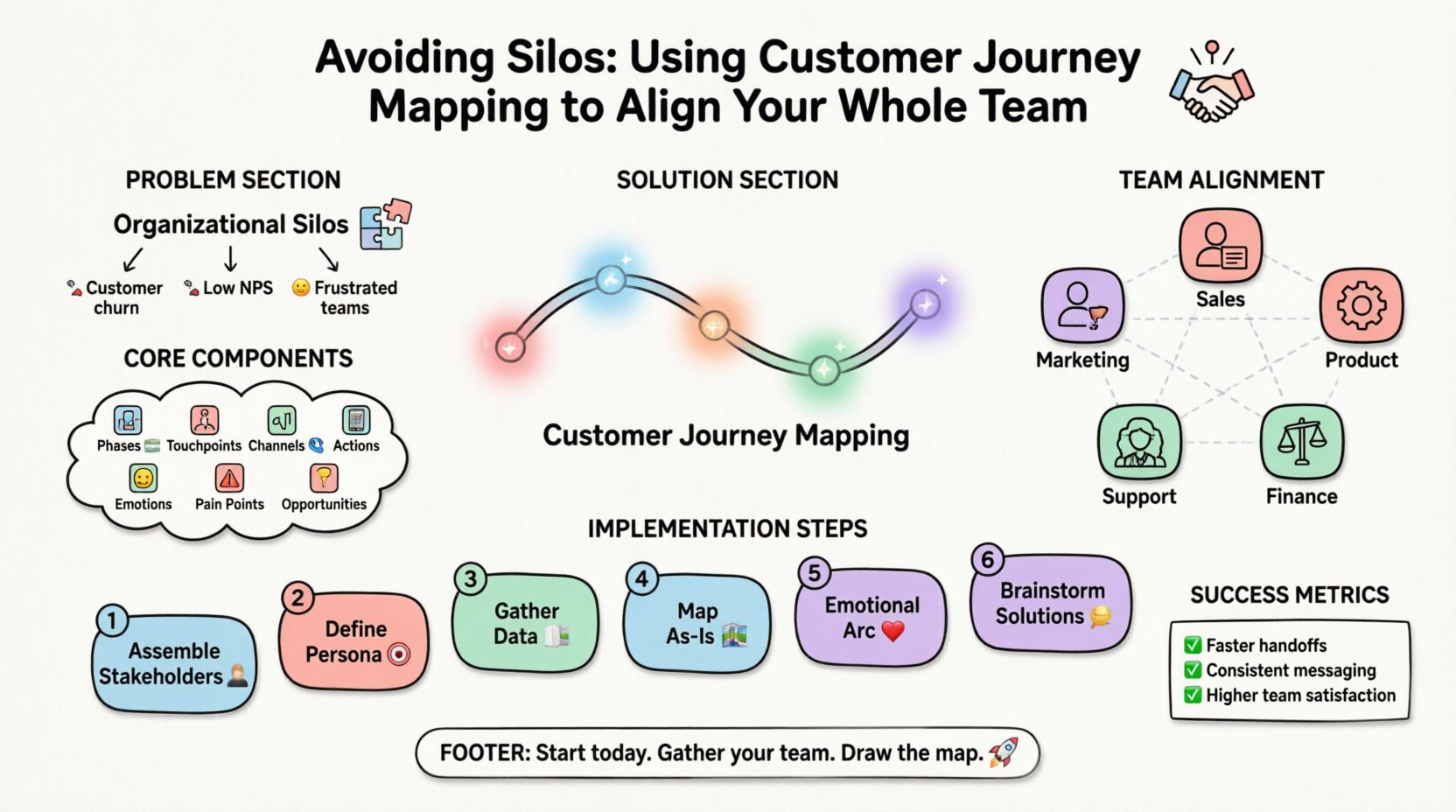
📉 The Silent Killer of CX: Organizational Silos
Silos are not just physical barriers or separate departments. They are cultural and informational barriers. When teams operate in isolation, they optimize for their own metrics, often at the expense of the broader customer experience. This creates a fragmented reality for the user.
Why Silos Form
Understanding the root cause is the first step to dismantling them. Common drivers include:
- Compartmentalized KPIs: Marketing is measured on leads, sales on closing, and support on resolution time. These goals do not always align.
- Communication Gaps: Information rarely flows laterally. The insights gathered by support staff rarely make it to product development teams.
- Tool Fragmentation: When teams use different software stacks, data becomes trapped. The customer’s history in the CRM is invisible to the product team’s analytics dashboard.
- Leadership Structure: Hierarchical structures often reinforce vertical reporting lines rather than horizontal collaboration.
The Impact on the Customer
When silos exist, the customer feels the pain. They have to repeat themselves. They receive inconsistent messaging. They face delays caused by internal handoffs. This leads to:
- Increased customer churn 📉
- Lower Net Promoter Scores (NPS) 📉
- Higher cost of acquisition due to poor retention 📉
- Frustrated employees who feel powerless to fix systemic issues 😫
🗺️ What is Customer Journey Mapping?
Customer journey mapping is the process of creating a visual representation of every interaction a user has with your organization. It goes beyond a simple checklist of touchpoints. It captures the emotional state of the user, the channels they use, and the underlying motivations behind their actions.
Core Components of a Map
To be effective, a journey map must include specific layers of data:
- Phases: The overarching stages (e.g., Awareness, Consideration, Purchase, Retention).
- Touchpoints: Specific interactions (e.g., landing page, sales call, onboarding email).
- Channels: Where the interaction happens (e.g., web, mobile app, phone, in-person).
- User Actions: What the customer is actually doing at that moment.
- Thoughts & Emotions: What the customer is thinking and feeling (e.g., confusion, excitement, anxiety).
- Pain Points: Where the process breaks down or creates friction.
- Opportunities: Areas where improvement can be made.
🔗 Why CJM Breaks Down Silos
A customer journey map serves as a single source of truth. It forces cross-functional collaboration because a single journey rarely fits within one department’s scope. To map a journey accurately, you need input from everyone.
Connecting the Departments
Here is how different teams contribute to the alignment:
- Marketing: Provides insights on how customers are found and what expectations are set initially. They ensure the promise matches the product.
- Sales: Understands the decision-making process and the specific objections raised during negotiation. They bridge the gap between interest and commitment.
- Product: Knows the technical capabilities and limitations. They ensure the solution actually solves the problem identified in the journey.
- Support: Holds the most critical data. They know where customers get stuck after the sale. They reveal the reality of the post-purchase experience.
- Finance/Legal: Ensure compliance and understand cost structures that might impact the customer experience (e.g., billing cycles, contract terms).
The Shared Narrative
When these teams sit in the same room to build the map, a shared narrative emerges. Marketing stops blaming Sales for low conversion. Sales stops blaming Product for bugs. Support stops blaming Marketing for setting false expectations. They see the chain of events connecting their actions to the final outcome. This shared narrative is the foundation of alignment. 🧩
🛠️ Steps to Implement Collaborative CJM
Implementing a journey mapping initiative that actually aligns teams requires a structured approach. It cannot be a one-off workshop. It must be a living process.
1. Assemble the Right Stakeholders
Do not limit this to the CX team. You need representatives from every department that touches the customer. Ensure you have decision-makers who can commit resources to changes identified later.
2. Define the Persona
Map the journey for a specific persona. A “New User” journey is vastly different from a “Churned Customer” reactivation journey. Focus on the primary persona first to avoid scope creep.
3. Gather Qualitative and Quantitative Data
Do not rely on assumptions. Use a mix of data sources:
- Customer Interviews: Direct feedback on feelings and motivations.
- Analytics: Funnel drop-off rates, session duration, bounce rates.
- Support Tickets: Common complaints and recurring issues.
- Sales Call Logs: Objections and questions asked repeatedly.
4. Map the Current State (As-Is)
Document the journey exactly as it happens now, not as you wish it happened. Highlight the friction points. Be honest. This is often the most uncomfortable part of the process because it exposes internal failures.
5. Identify the Emotional Arc
Plot the emotional journey. Where is the customer confident? Where are they anxious? A dip in confidence often signals a process failure that needs immediate attention. This humanizes the data for the team.
6. Brainstorm Solutions Together
Once the map is drawn, move to the “To-Be” state. Ask the group: “How do we fix this friction point?” This ensures that the solution has buy-in from the people who will implement it.
📊 Roles and Responsibilities in the Mapping Process
To ensure clarity during the alignment process, define who is responsible for what. The following matrix outlines typical responsibilities during a collaborative mapping initiative.
| Role | Responsibility | Contribution to Alignment |
|---|---|---|
| Project Lead | Facilitate workshops and maintain the map | Ensures all voices are heard and deadlines are met |
| Customer Researcher | Conduct interviews and gather feedback | Provides objective data to back up team opinions |
| Department Reps | Share internal process knowledge | Ensures technical and operational realities are reflected |
| Data Analyst | Analyze behavioral data and metrics | Quantifies the impact of friction points |
| Executive Sponsor | Remove roadblocks and approve resources | Signals organizational priority and commitment |
| UX/UI Designer | Visualize the touchpoints and interface | Makes the journey map readable and actionable |
⚠️ Common Pitfalls and How to Avoid Them
Even with the best intentions, journey mapping initiatives can fail to drive alignment. Be aware of these common traps.
1. Treating the Map as a One-Off Project
A journey map is not a poster you put on the wall and forget. It must be updated regularly as the product and market evolve. Schedule quarterly reviews to ensure the map remains accurate. 🔄
2. Ignoring the “Back of House”
Customer journeys are not just about what the customer sees. They are about what happens behind the scenes. If the internal approval process takes three weeks, the customer experiences that delay. Map the internal processes that impact the external experience.
3. Focusing Only on the Happy Path
Most teams map the ideal scenario where everything goes right. You must map the error states. What happens when the payment fails? What happens when the user cancels? These are often where the biggest alignment opportunities exist.
4. Lack of Executive Buy-In
Without leadership support, changes identified in the map often stall. If a fix requires budget or cross-departmental time, leadership must champion the initiative to overcome inertia.
5. Overcomplicating the Map
A map with 50 steps is useless. Keep it focused on the critical path. If the map is too complex, teams will disengage. Simplicity drives action.
📏 Measuring Success Beyond Revenue
How do you know if the alignment is working? While revenue is a lagging indicator, there are leading indicators that show internal alignment improving.
- Internal Satisfaction Scores: Survey employees on how well they understand the customer journey and how well other departments support their work.
- Reduction in Handoff Time: Measure the time it takes for a lead to move from marketing to sales, or a ticket to move from support to engineering.
- Consistency in Messaging: Audit communications across channels to ensure the brand voice remains consistent.
- First Contact Resolution: If support can solve issues faster, it indicates better information sharing.
- Employee Retention: Teams that understand the bigger picture often feel more engaged and less frustrated.
🔮 Sustaining the Momentum
Alignment is not a destination; it is a continuous practice. To keep the momentum going after the initial mapping session:
- Make the Map Visible: Display the map in physical meeting rooms and keep a digital version accessible to all staff.
- Use It in Onboarding: Train new hires on the customer journey so they understand how their role impacts the whole.
- Link to OKRs: Tie team objectives to journey milestones. If Marketing’s goal is “Reduce Friction in Onboarding,” they are aligned with the map’s goals.
- Celebrate Wins: When a friction point is fixed and customer feedback improves, share that story with the whole organization.
🚀 Moving Forward with a Unified Vision
The path to a seamless customer experience is paved with internal cooperation. By using customer journey mapping as a collaborative tool, you transform it from a marketing exercise into a strategic asset. It forces the organization to look at itself through the customer’s eyes, revealing where the walls are too high and the doors are too narrow.
When your team stops thinking in terms of “my department” and starts thinking in terms of “the customer journey,” the silos begin to crumble. The result is a more agile organization, happier employees, and customers who feel valued at every turn. This is not about perfecting a process; it is about building a culture where the customer is the central focus of every decision. 🌟
Start today. Gather your team. Draw the map. And begin the work of alignment. The journey is long, but the destination is worth the effort.