


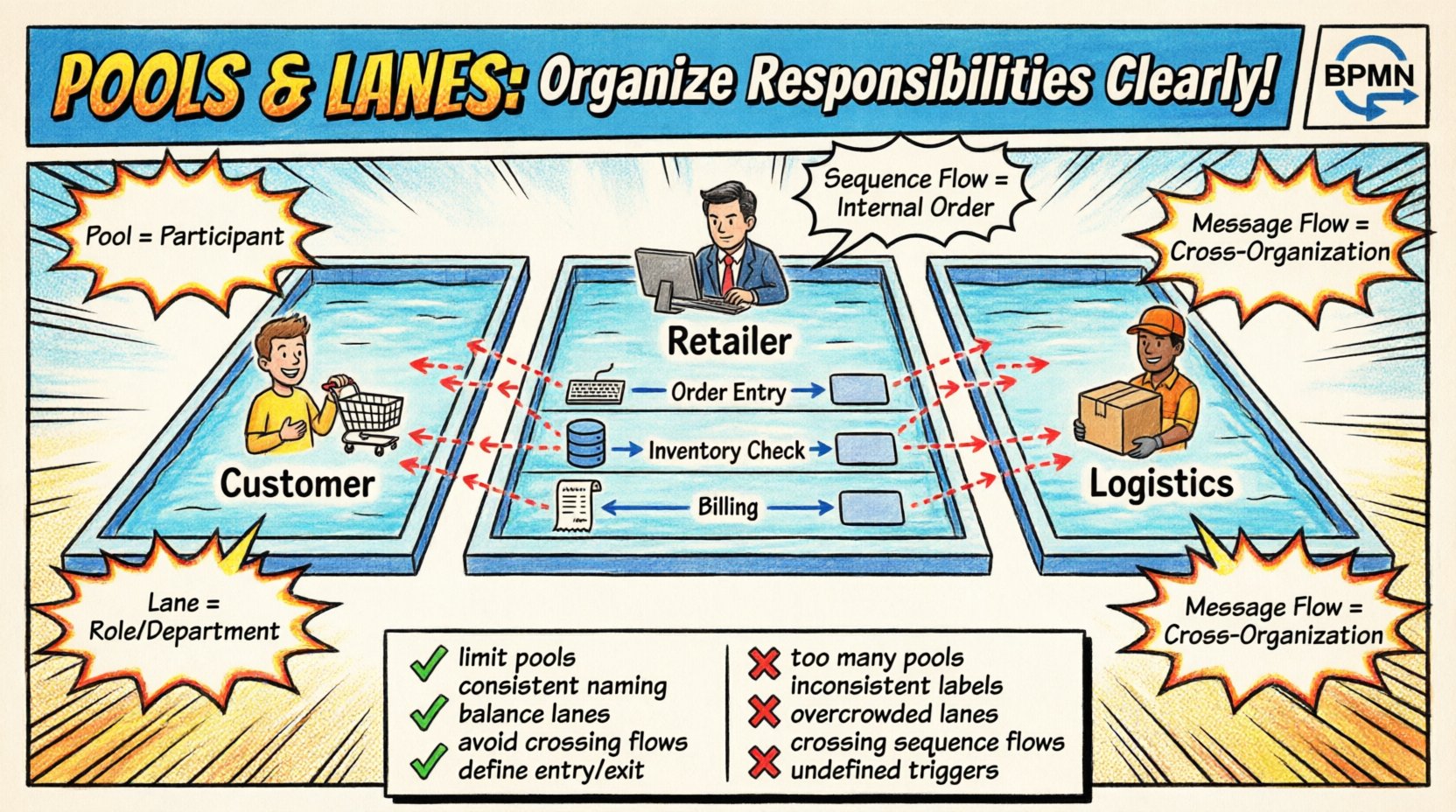
In the landscape of business process modeling, clarity is not merely an aesthetic preference; it is a functional necessity. When stakeholders attempt to visualize how work moves through an organization, ambiguity can lead to bottlenecks, duplicated efforts, and communication breakdowns. The Business Process Model and Notation (BPMN) standard offers a robust framework for depicting these workflows. Among its most critical structural elements are pools and lanes. These components serve as the backbone for defining who does what, ensuring that every step in a process is assigned to the correct actor.
This guide explores the mechanics, semantics, and best practices surrounding pools and lanes. By understanding how to structure these elements effectively, modelers can create diagrams that are not only visually comprehensible but also operationally accurate. We will examine the theoretical underpinnings, practical applications, and common pitfalls to avoid when organizing responsibilities.
🏊 Defining the Pool
A pool represents a participant in a business process. In the context of a BPMN diagram, a pool is the container that holds the private flow of activities belonging to a specific entity. It defines the boundaries of that entity’s involvement in the interaction.
What Constitutes a Participant?
The concept of a participant is flexible. It can represent various levels of an organization or system, depending on the scope of the model:
- Organizational Units: A specific department, such as “Finance” or “Human Resources.”
- External Entities: A customer, a supplier, or a regulatory body.
- Systems: An automated application, a database, or a legacy mainframe.
- Individuals: In some contexts, a specific role or person, though this is often better handled within lanes.
Visually, a pool is depicted as a large rectangle. When multiple pools exist on a single diagram, they represent a collaboration. The interaction between these pools is the primary focus of the model.
Types of Pools
There are two distinct ways pools are utilized in process modeling:
- Collaboration Pools: These are used when modeling interactions between multiple participants. For example, a process showing the exchange of information between a “Customer” pool and a “Bank” pool.
- Private Process Pools: These contain the internal logic of a single participant. The internal activities are hidden from the outside world, focusing solely on the internal workflow of that specific entity.
Understanding the distinction is vital. A private pool focuses on internal efficiency, while a collaboration pool focuses on interface and handoffs.
🚣 Defining the Lane
If a pool represents the organization, the lanes within it represent the sub-groups or roles responsible for executing specific tasks. Lanes are horizontal or vertical subdivisions within a pool. They allow for a granular breakdown of responsibilities.
Roles vs. Departments
Lanes provide a mechanism to separate activities based on who performs them. This separation is crucial for identifying handoffs. A handoff occurs when a task passes from one lane to another, often indicating a change in ownership or a potential delay.
Common uses for lanes include:
- Functional Roles: “Manager,” “Analyst,” “Customer Service Agent.”
- Departmental Units: “Sales,” “Logistics,” “Quality Assurance.”
- System Components: “Frontend,” “Backend,” “Database.”
Nested Lanes
BPMN allows for lanes within lanes. This is useful for deep organizational hierarchies. For instance, a main pool might represent “IT Department,” with a lane for “Development,” and a sub-lane within that for “Backend Team.” While powerful, excessive nesting can make diagrams difficult to read. It is often better to split the main pool into multiple pools if the hierarchy becomes too deep.
🔄 Interaction Mechanics
The relationship between pools and lanes dictates how flows are drawn. The type of flow used depends on whether the activity remains within the same participant or crosses boundaries.
Sequence Flows
Sequence flows represent the order of activities. They are solid lines with arrows. Crucially, sequence flows are generally contained within a single pool. If a sequence flow crosses a pool boundary, it implies a synchronization that is not technically standard without a boundary event or message flow.
- Within a Lane: Indicates a direct handoff between tasks performed by the same role.
- Between Lanes (Same Pool): Indicates a task transfer between different roles within the same organization. This is a common source of delay and should be minimized where possible.
Message Flows
Message flows are dashed lines with open arrowheads. They represent the exchange of information between participants. These flows connect pools, not lanes.
- Crossing Pool Boundaries: A message flow must always connect a pool to another pool. It cannot connect a lane to a lane in a different pool directly, though it effectively connects the participants those lanes belong to.
- Communication Artifacts: These flows often represent emails, API calls, or physical documents moving between entities.
📋 Best Practices for Structure
To ensure a model remains maintainable and understandable, adhere to the following guidelines regarding pools and lanes.
1. Limit the Number of Pools
While collaboration diagrams can involve many participants, a single diagram with too many pools becomes visually cluttered. If a process involves more than five distinct participants, consider splitting the model into multiple diagrams or focusing on specific interactions.
2. Consistent Naming Conventions
Lane names should be consistent across the model. If you use “Sales Team” in one diagram, do not use “Sales Dept” in another. Consistency aids in navigation and reduces cognitive load for the reader.
3. Balance Lane Width
Visually, lanes should be relatively balanced. If one lane contains a significant amount of activity while another is empty, it suggests an imbalance in responsibility or a missing process step. Adjust the process or the lane structure to reflect reality.
4. Avoid Crossing Sequence Flows
Sequence flows should not cross lane boundaries. If a task in Lane A must pass control to Lane B, the flow should go from the task in Lane A to an intermediate event or a gateway, and then resume in Lane B. This visual cue highlights the handoff point clearly.
5. Define Clear Entry and Exit Points
Every lane should have a clear start point where work enters it and an end point where work leaves it. If a lane has no start event, it implies the work begins externally. If it has no end event, the process may be incomplete.
🛑 Common Modeling Errors
Even experienced modelers can fall into traps when organizing responsibilities. The table below outlines frequent mistakes and their implications.
| Error | Consequence | Correction |
|---|---|---|
| Ignoring Boundary Events | Missing error handling or timeouts. | Use boundary events to show exceptions within a specific lane. |
| Cross-Pool Sequence Flows | Implies direct control transfer between organizations. | Replace with Message Flows to represent communication. |
| Too Many Lanes | Diagram becomes unreadable and complex. | Group related roles or split the diagram into sub-processes. |
| Missing Start Events | Unclear how the process initiates. | Ensure every pool has a defined start event. |
| Unlabeled Lanes | Ambiguity regarding who performs tasks. | Always assign a descriptive name to every lane. |
🧩 Managing Complexity in Large Models
As processes grow, the number of pools and lanes can expand rapidly. This complexity can obscure the actual flow of work. Here are strategies to manage large-scale diagrams.
Sub-Processes
When a lane contains a complex sequence of tasks, encapsulate that logic within a collapsed sub-process. This keeps the main diagram clean. The internal details can be viewed on a separate page or tab, maintaining the high-level view of responsibilities.
Swimlane Management
In large swimlane diagrams, it is common for lanes to span multiple pages. Ensure that the lane headers are repeated or clearly marked to maintain context as the reader scrolls or navigates pages. A lane representing “Finance” on page one should not be confused with a different “Finance” lane on page two.
Focus on Handoffs
In complex models, the most critical points are the handoffs between lanes. Highlight these areas. They are where delays typically occur and where accountability can become blurred. Ensure that every transition between lanes is explicitly defined by a flow or an event.
📦 Case Study: Order Processing Flow
To illustrate these concepts, consider an “Order to Cash” scenario involving multiple participants.
- Pool 1: Customer
- Lane: Buyer
- Pool 2: Retailer
- Lane: Order Entry
- Lane: Inventory Check
- Lane: Billing
- Pool 3: Logistics
- Lane: Warehouse
In this model:
- The Buyer submits an order (Message Flow to Retailer).
- The Order Entry lane receives it and validates data (Sequence Flow).
- Control moves to the Inventory Check lane (Sequence Flow across lanes).
- If stock is available, Billing is triggered.
- A confirmation is sent to the Warehouse in the Logistics pool (Message Flow).
- The Warehouse ships the goods (Sequence Flow).
- A shipping notification is sent back to the Buyer (Message Flow).
This structure clearly delineates that the Retailer manages the internal logic, while the Customer and Logistics interact externally. Each lane within the Retailer pool owns a specific phase of the transaction.
🔍 Semantic Precision in BPMN
The power of BPMN lies in its semantic precision. Pools and lanes are not just visual aids; they carry specific meaning regarding state and control.
Control vs. Information
Distinguish between control flow and information flow. Sequence flows within lanes often represent control (who does the next step). Message flows between pools represent information (what is shared). Confusing these two leads to incorrect process logic.
State Management
A lane can hold state. For example, an “Approval” lane might hold a task until a decision is made. The pool holds the overall process state. Understanding where state resides helps in debugging process instances. If a process stalls, check the lane where the task is currently waiting.
📈 Conclusion
Effective process modeling relies heavily on the correct use of pools and lanes. These structures provide the necessary scaffolding to assign ownership, define boundaries, and illustrate interactions. By adhering to best practices and avoiding common pitfalls, modelers can create diagrams that serve as reliable blueprints for business operations.
Remember that the goal is clarity. If a stakeholder looks at the diagram and cannot identify who is responsible for a task, the model has failed. Regular reviews of the structure, ensuring lanes are balanced and pools are necessary, will maintain the integrity of the process model over time.