


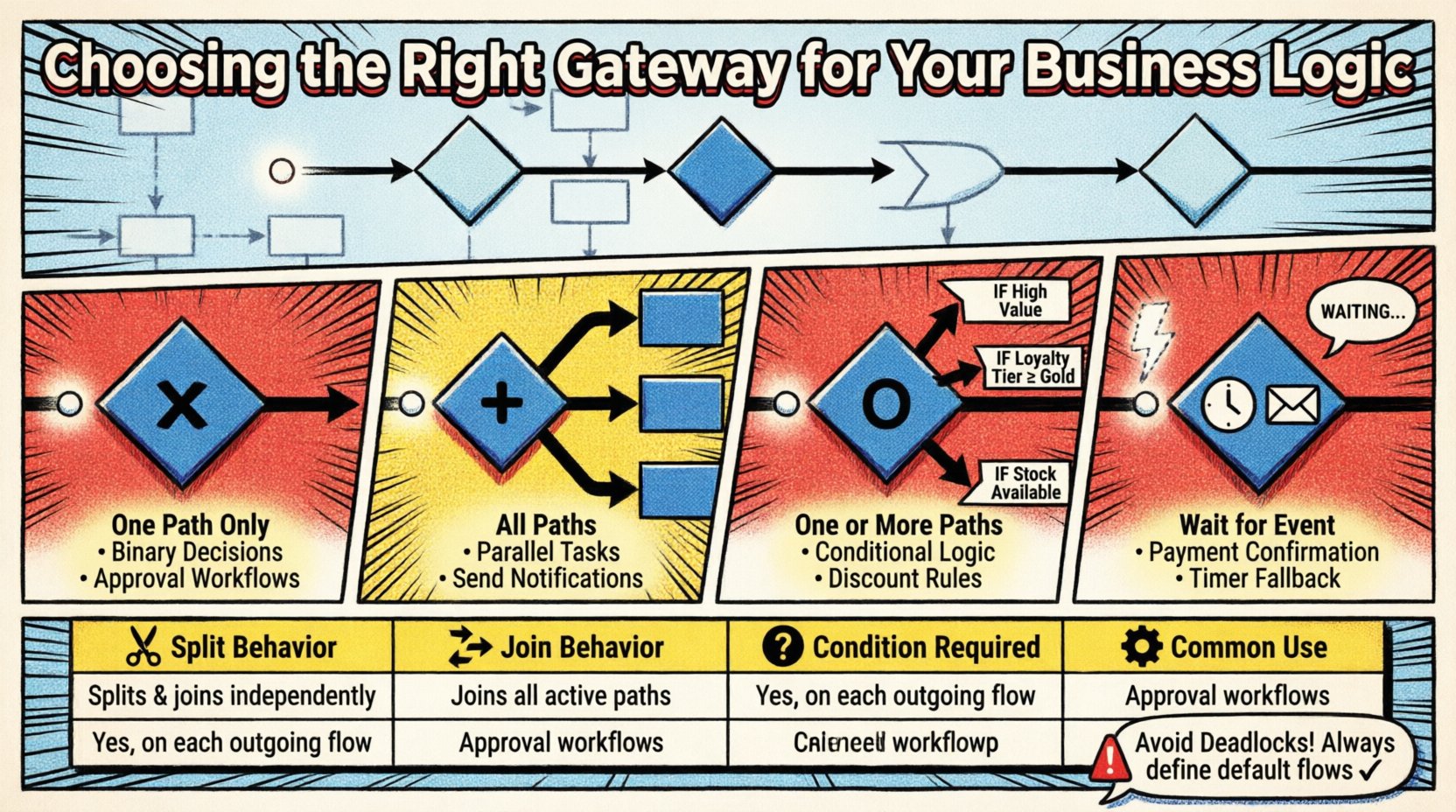
In the landscape of business process modeling, precision is not merely a preference; it is a requirement. When designing workflows, the path a process takes determines the efficiency, compliance, and success of the operation. At the heart of these decisions lie gateways. These symbols act as the traffic controllers of your process engine, dictating where tokens flow, when they merge, and how conditions are evaluated.
Choosing the wrong gateway can lead to deadlocks, lost tokens, or unintended execution paths. This guide provides a deep dive into selecting the appropriate gateway structure for your specific business logic requirements. We will explore the mechanics of BPMN gateways, analyze their behavioral differences, and establish best practices for robust process design.
Understanding Gateway Semantics 🧠
Before implementing logic, one must understand the underlying mechanics of the modeling language. Gateways are not just visual elements; they represent specific logical operations performed by the process engine. They determine the synchronization and branching of the process flow.
- Input Flow: The incoming sequence flow carrying a token.
- Output Flow: The outgoing sequence flows that receive tokens based on evaluation.
- Condition Evaluation: The logic applied to determine which paths are active.
- Token Synchronization: How multiple tokens are handled when paths converge.
A token represents the progress of a single instance of the process. Gateways manipulate these tokens to reflect the state of the business transaction. Misinterpreting a gateway’s behavior can result in a process that halts unexpectedly or executes steps in the wrong order.
Core Gateway Types Explained ⚙️
There are several distinct types of gateways, each serving a unique purpose in process orchestration. Understanding the specific behavior of each type is essential for accurate modeling.
1. Exclusive Gateway (XOR) 🚫
The Exclusive Gateway is the most common decision point. It allows the process to choose exactly one path out of many available options. The logic here is mutually exclusive; if one condition is true, the others must be false.
- Behavior: Evaluates conditions in order. The first condition that evaluates to true activates the corresponding outgoing flow.
- Default Flow: If no explicit condition is met, the process follows the default path.
- Use Case: Approval workflows where a request is either approved, rejected, or requires more information.
Example Scenario: A loan application is received. The gateway evaluates the credit score. If the score is above 700, it goes to Fast Track. If below 700, it goes to Manual Review. Only one path is taken.
2. Parallel Gateway (AND) ➕
The Parallel Gateway is a synchronization point. It splits one incoming flow into multiple outgoing flows that execute simultaneously. It does not evaluate conditions; it simply creates copies of the token.
- Behavior: All outgoing flows are activated. The incoming flow is consumed.
- Convergence: At a parallel join, the process waits until tokens arrive from all incoming paths before proceeding.
- Use Case: Sending notifications. You might need to email the customer, update the inventory, and notify the warehouse simultaneously.
Example Scenario: An order is placed. The system must update the database, send an SMS confirmation, and generate a PDF invoice. All three actions happen at once without waiting for one another.
3. Inclusive Gateway (OR) ⚡
The Inclusive Gateway offers more flexibility than the Exclusive Gateway. It allows for one or more paths to be taken based on multiple conditions. Unlike the Exclusive Gateway, multiple conditions can be true simultaneously.
- Behavior: Evaluates all conditions. Any path with a true condition is activated.
- Convergence: The gateway waits for tokens from all active paths before merging.
- Use Case: Discount calculations where a customer might qualify for both a seasonal sale and a loyalty bonus.
Example Scenario: A shipping method is selected. If the package is heavy, it goes to Freight. If it is fragile, it goes to Express Handling. If both are true, both paths execute.
4. Event-Based Gateway 📅
This gateway waits for an external event to occur. It is useful when the timing of the next step is unpredictable. It effectively suspends the process flow until a specific trigger happens.
- Behavior: Waits for a timer, message, signal, or error. Only the path associated with the received event is activated.
- Timeout: Often used with a timer to prevent the process from waiting indefinitely.
- Use Case: Waiting for a payment confirmation or a user response to a query.
Example Scenario: A reservation is made. The process waits for a payment event. If payment arrives within 24 hours, it proceeds to Confirm Booking. If the timer expires, it proceeds to Cancellation.
5. Complex Gateway 🔀
The Complex Gateway is designed for situations where the conditions for branching are not simple boolean expressions. It allows for advanced logic combinations, such as requiring multiple conditions to be true or false in specific configurations.
- Behavior: Supports complex boolean expressions (e.g.,
(A AND B) OR C). - Convergence: Waits for tokens from all paths where the condition evaluated to true.
- Use Case: Advanced eligibility checks involving multiple data attributes.
Gateway Comparison Matrix 📊
To assist in the selection process, review the following comparison of gateway behaviors regarding token flow and synchronization.
| Gateway Type | Split Behavior | Join Behavior | Condition Required? | Common Use |
|---|---|---|---|---|
| Exclusive (XOR) | One path only | Wait for one token | Yes (Optional default) | Binary decisions |
| Parallel (AND) | All paths | Wait for all tokens | No | Parallel tasks |
| Inclusive (OR) | One or more paths | Wait for all active paths | Yes | Conditional inclusion |
| Event-Based | One path (event) | Wait for one token | No (Event driven) | External triggers |
Designing Robust Logic Flows 🛡️
Once the gateway type is selected, the implementation requires careful attention to data flow and error handling. A well-structured process anticipates failure points and ensures that resources are released correctly.
1. Avoiding Deadlocks
A deadlock occurs when a process waits for a token that can never arrive. This is common with Parallel Gateways if one path fails or loops indefinitely.
- Check Convergence: Ensure every split has a corresponding merge.
- Verify Conditions: Ensure at least one path is always active in an Inclusive Gateway.
- Timeouts: Implement timer events to break infinite waits in Event-Based Gateways.
2. Managing Orphan Tokens
An orphan token is a process instance that gets stuck in a branch that is no longer reachable. This often happens when conditions change dynamically during runtime.
- State Management: Ensure data used for gateway conditions is up-to-date.
- Logging: Track which path was taken for audit purposes.
- Validation: Run simulation tests before deploying to production.
3. Synchronization Points
When tasks run in parallel, they may take different amounts of time. The Parallel Join gateway will hold the flow until the slowest task completes.
- Performance Impact: Long-running parallel tasks delay the entire process.
- Optimization: Consider if tasks truly need to be synchronized. Can they run independently?
- Timeouts: Set limits on how long a parallel task can run before triggering an alert.
Common Pitfalls to Avoid ⚠️
Even experienced modelers can introduce errors through subtle misunderstandings of gateway logic. Review these common mistakes to ensure stability.
- Overusing Exclusive Gateways: Do not use an Exclusive Gateway when logic requires multiple paths. This forces a binary choice where none exists.
- Missing Default Flows: In Exclusive Gateways, always define a default path. If conditions fail unexpectedly, the process will stall.
- Incorrect Join Logic: Using an Exclusive Join after a Parallel Split causes a deadlock because the join expects one token, but the split sent two.
- Complex Conditions: Keep condition expressions simple. Complex boolean logic is harder to debug and maintain.
- Ignoring Asynchronous Events: Event-Based Gateways require the system to listen for external signals. Ensure the infrastructure supports this.
Validation and Testing Strategies 🧪
Before a process goes live, it must undergo rigorous testing. This ensures that the gateway logic behaves as expected under various data scenarios.
1. Path Coverage
Test every possible path through the gateway. If a gateway has three outgoing flows, ensure all three are triggered during testing.
- Positive Testing: Verify the process flows correctly when conditions are met.
- Negative Testing: Verify the process flows to the default path when conditions are not met.
- Boundary Testing: Test with data at the edge of condition ranges (e.g., exactly 700 vs 701).
2. Concurrency Testing
For Parallel Gateways, simulate multiple instances running simultaneously to check for resource contention or race conditions.
- Load Testing: Ensure the engine handles the synchronization overhead.
- Deadlock Detection: Monitor for processes that hang indefinitely.
3. Audit Trail Review
Review the execution logs to confirm which gateways were triggered and why. This is crucial for debugging future issues.
- Traceability: Ensure the log records the variable values that determined the path.
- Consistency: Verify that the same input always yields the same output path.
Performance Impact 📉
While gateways are lightweight, the logic attached to them can impact system performance. Complex evaluations or frequent synchronization can increase latency.
- Evaluation Cost: Complex scripts used in Inclusive Gateways take more processing time than simple variable checks.
- Token Management: Parallel Gateways create more tokens, which increases memory usage during execution.
- Event Polling: Event-Based Gateways may require polling mechanisms if the system does not support native event pushing.
Optimization strategies include caching evaluation results and minimizing the scope of parallel execution. Keep the process flow as linear as possible, introducing branching only when business rules demand it.
Integration with Business Rules
Gateways are the physical representation of business rules. They must align with the organization’s policies and regulations.
- Clarity: The logic should be understandable by business stakeholders, not just developers.
- Maintainability: Use external rule engines for complex conditions to keep the process model clean.
- Flexibility: Design gateways that allow rules to change without modifying the core process structure.
Final Considerations for Implementation
Selecting the correct gateway is a foundational step in building reliable automation. It defines the intelligence of the process. By understanding the specific behaviors of Exclusive, Parallel, Inclusive, and Event-Based gateways, you can construct workflows that are resilient and efficient.
Always prioritize clarity over complexity. A simple Exclusive Gateway is often better than a convoluted Complex Gateway. Test thoroughly, monitor closely, and iterate based on real-world execution data. This approach ensures your business logic remains accurate and your processes continue to drive value without interruption.
Remember that a process model is a living document. As business needs evolve, the gateways within the model may need adjustment. Regular reviews of process performance and gateway logic will keep your automation aligned with current operational goals.