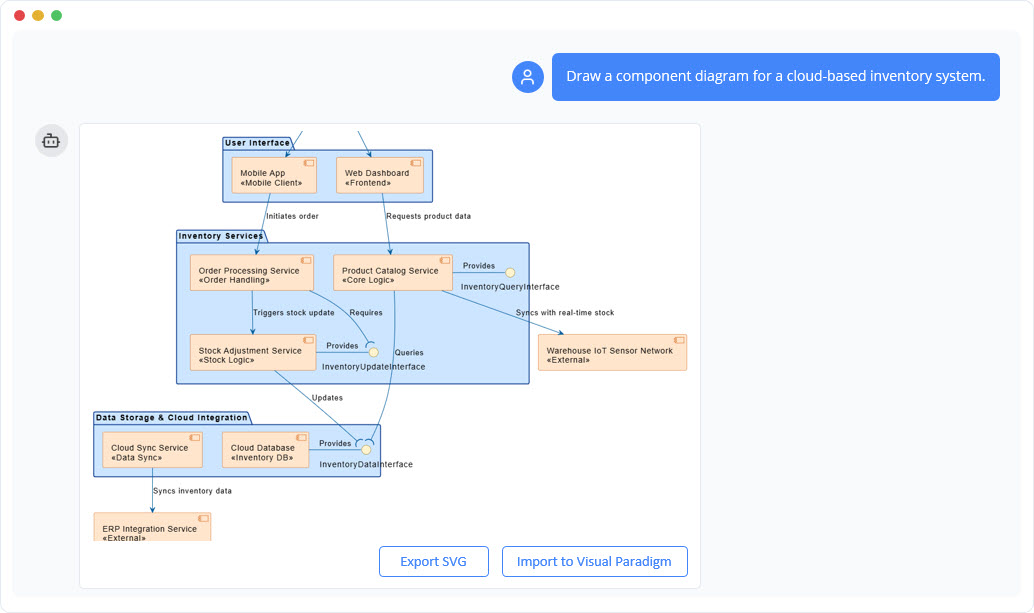


Visual Paradigm is a leading visual modeling platform that has significantly enhanced systems engineering workflows through its integration of artificial intelligence (AI). With robust AI-powered support for SysML (Systems Modeling Language), Visual Paradigm enables engineers, architects, and system designers to generate, refine, and manage complex system models using natural language prompts. This guide provides a complete overview of the platform’s AI capabilities in SysML, key features of the AI chatbot, integration benefits, and best practices—supported by authoritative sources.
Overview of AI in Visual Paradigm for SysML
Visual Paradigm leverages advanced AI to automate and accelerate systems modeling tasks, transforming how professionals conceptualize, design, and document complex systems. By interpreting natural language inputs, the AI generates accurate, standards-compliant SysML diagrams, reducing manual effort and minimizing modeling errors.
The AI-powered ecosystem supports multiple modeling languages, including SysML, UML, and ArchiMate, making it a unified platform for enterprise architecture, software engineering, and systems design. This all-in-one approach streamlines collaboration across disciplines and ensures consistency across model artifacts.
⚠️ Note: While AI greatly enhances productivity, it may occasionally produce inaccuracies. Always validate AI-generated content before finalizing models or using them in critical development or compliance processes.
Key AI Capabilities for SysML Modeling
1. AI Diagram Generator for SysML
The AI Diagram Generator allows users to describe a system’s architecture—such as components, data flows, and interactions—in plain English. The AI then automatically creates a compliant SysML diagram.
-
Use Case: “Design a modular electric vehicle powertrain with battery, motor, and inverter subsystems.”
-
Output: A structured SysML block diagram with appropriate elements and relationships.
-
Benefit: Rapid prototyping of system architecture without deep modeling expertise.
🔗 SysML Diagram Tool: Visual Paradigm’s comprehensive SysML toolset with AI assistance for diagram creation and management.
2. Internal Block Diagram (IBD) Generation
Internal Block Diagrams (IBDs) are essential for detailing the internal structure of a system block, including its parts, ports, and connectors.
-
AI Functionality:
-
Parses technical descriptions like “The drone’s flight controller has a GPS port, a telemetry port, and a motor interface.”
-
Automatically generates IBDs with correctly placed parts, ports, and connectors.
-
-
Interactive Refinement: Users can refine the IBD by prompting the AI to add or remove components (e.g., “Add a thermal sensor to the motor module”).
🔗 Enhanced AI Diagram Generator – ArchiMate & SysML Update: Details on recent enhancements to IBD generation and AI accuracy.
3. Block Definition Diagram (BDD) Support
Block Definition Diagrams (BDDs) define the static structure of a system by modeling blocks, their attributes, and relationships.
-
AI Capabilities:
-
Generate BDDs from natural language descriptions such as:
-
“Model a smart TV system with a display block, processor block, and Wi-Fi module.”
-
“Create a BDD for an F1 car’s engine control unit with sensors, actuators, and a central ECU.”
-
-
Support for iterative editing: Add new modules, functions, or constraints via prompt.
-
-
Benefits:
-
Accelerates early-stage system design.
-
Enables rapid iteration during requirements gathering and conceptual design.
-
🔗 AI-Powered SysML Requirement Diagram Tool: Explores how BDDs and requirements are linked through AI.
4. Requirements Diagram Generation
Requirements traceability is critical in systems engineering. Visual Paradigm’s AI automates the creation and maintenance of Requirements Diagrams in SysML.
-
Features:
-
Converts textual requirements into structured requirement blocks.
-
Automatically links requirements to system elements (e.g., blocks, interfaces).
-
Supports updates: “Link requirement R-005 to the thermal protection subsystem.”
-
-
Traceability: AI helps maintain bidirectional traceability between requirements and design elements, turning models into living documents.
🔗 SysML Requirement Diagram – A Guide to AI-Powered Requirements Engineering: In-depth guide on using AI for requirement modeling and traceability.
5. Iterative Refinement of Diagrams
One of the most powerful aspects of Visual Paradigm’s AI is its ability to evolve diagrams through conversation.
-
How It Works:
-
After initial generation, users can prompt the AI to:
-
Add new elements: “Add a backup power supply to the smart TV system.”
-
Modify existing ones: “Change the data rate of the telemetry port to 10 Mbps.”
-
Remove or restructure components: “Remove the audio amplifier block.”
-
-
-
Use Case: Refining a BDD for a medical device after stakeholder feedback, with real-time AI-driven updates.
6. Seamless Integration with Visual Paradigm Desktop
AI-generated diagrams are not isolated outputs—they are fully integrated into the Visual Paradigm Modeling Desktop environment.
-
Benefits:
-
Export and import diagrams directly into the desktop application.
-
Perform advanced engineering: detailed documentation, code generation, simulation, and model validation.
-
Collaborate with teams using version control and shared repositories.
-
-
Workflow Example:
-
Use AI chatbot to generate a BDD for a satellite system.
-
Import into desktop for detailed IBD creation.
-
Generate C++ or Python code from the model.
-
Export documentation for compliance (e.g., DO-178C, ISO 26262).
-
🔗 Mastering UML Visual Modeling in the Visual Paradigm AI Ecosystem – Module 6: Infrastructure and Deployment Modeling: Demonstrates integration with infrastructure and deployment modeling.
Key Features of the Visual Paradigm AI Chatbot
✅ Contextual Understanding
-
The AI is trained to interpret long, complex, or technical descriptions (e.g., engineering specifications, technical reports).
-
Handles ambiguous inputs by asking clarifying questions or making reasonable assumptions.
✅ Standards Compliance
-
All generated diagrams follow official SysML standards (OMG SysML v1.7).
-
Ensures interoperability with other tools and compliance with industry regulations.
✅ Automated Traceability
-
Automatically establishes and maintains traceability links between:
-
Requirements and system blocks
-
Blocks and their internal parts
-
Diagrams and documentation
-
-
Enables audit trails and supports certification processes.
Supported Diagram Types Beyond SysML
While SysML is a core focus, Visual Paradigm’s AI extends support to other modeling languages:
-
UML (Unified Modeling Language): Use cases, class diagrams, sequence diagrams, state machines.
-
ArchiMate: Enterprise architecture modeling (business, application, technology layers).
-
Component Architecture: Visualize software and hardware components and their interactions.
🔗 AI-Powered SysML Requirement Diagram Tool: Highlights the platform’s versatility across modeling domains.
Best Practices for Using AI in SysML Modeling
-
Start with Clear Prompts: Use precise, descriptive language (e.g., “Create a BDD for a solar-powered IoT weather station with a battery, sensor array, and LoRa transmitter”).
-
Validate AI Output: Always review diagrams for correctness, completeness, and compliance.
-
Use Iterative Refinement: Build models incrementally—generate, review, prompt changes, repeat.
-
Leverage Integration: Move AI-generated models into the desktop environment for deeper analysis and documentation.
-
Document Assumptions: Note any AI-made assumptions (e.g., default data types, port types) for traceability.
Getting Started with Visual Paradigm AI
-
Access the AI Chatbot: Visit Visual Paradigm Chat to start generating diagrams.
-
Try Tutorials: Watch video guides on YouTube:
Reference List (Markdown Format)
- SysML Diagram Tool: Comprehensive SysML toolset with AI-powered diagram generation and management.
- AI-Powered SysML Requirement Diagram Tool: Article detailing AI’s role in creating and maintaining SysML requirement diagrams.
- AI Chatbot: Overview of Visual Paradigm’s AI chatbot and its modeling capabilities.
- Mastering UML Visual Modeling in the Visual Paradigm AI Ecosystem – Module 6: Infrastructure and Deployment Modeling: Guide on using AI for component and deployment modeling.
- Enhanced AI Diagram Generator – ArchiMate & SysML Update: Release notes highlighting improvements in AI-generated SysML and ArchiMate diagrams.
- Visual Paradigm Chat: Interactive AI chat interface for generating and editing SysML diagrams.
- AI-Powered SysML Diagram Generation (YouTube): Tutorial video demonstrating AI-driven SysML diagram creation.
- Building Component Architecture with AI (YouTube): Practical demonstration of AI in component modeling.
- Creating SysML Requirements with AI (YouTube): Step-by-step guide to AI-assisted requirement modeling.
- SysML Requirement Diagram – A Guide to AI-Powered Requirements Engineering: Detailed guide on using AI for requirement traceability and documentation.
Conclusion
Visual Paradigm’s AI-powered SysML capabilities represent a paradigm shift in systems engineering. By enabling natural language-driven diagram generation, iterative refinement, and seamless integration with professional modeling tools, the platform empowers engineers to focus more on innovation and less on repetitive modeling tasks.
With strong standards compliance, automated traceability, and support across UML, SysML, and ArchiMate, Visual Paradigm stands as a leading all-in-one AI modeling ecosystem for modern system design.
🛠️ Pro Tip: Combine AI generation with human expertise to create accurate, maintainable, and compliant system models—because AI is a collaborator, not a replacement.