Running a small business involves navigating a landscape that changes faster than ever before. Market trends shift, regulations update, and technology evolves at a pace that can overwhelm even the most experienced entrepreneurs. To maintain stability and seize opportunities, owners need a structured approach to understanding their external environment. This is where the PEST analysis becomes an essential tool.
This guide provides a deep dive into the Political, Economic, Social, and Technological factors that influence your business. By following this walkthrough, you will gain a clear picture of the forces acting upon your organization. The goal is not just to identify these factors, but to translate them into actionable business intelligence.
🧩 What is a PEST Analysis?
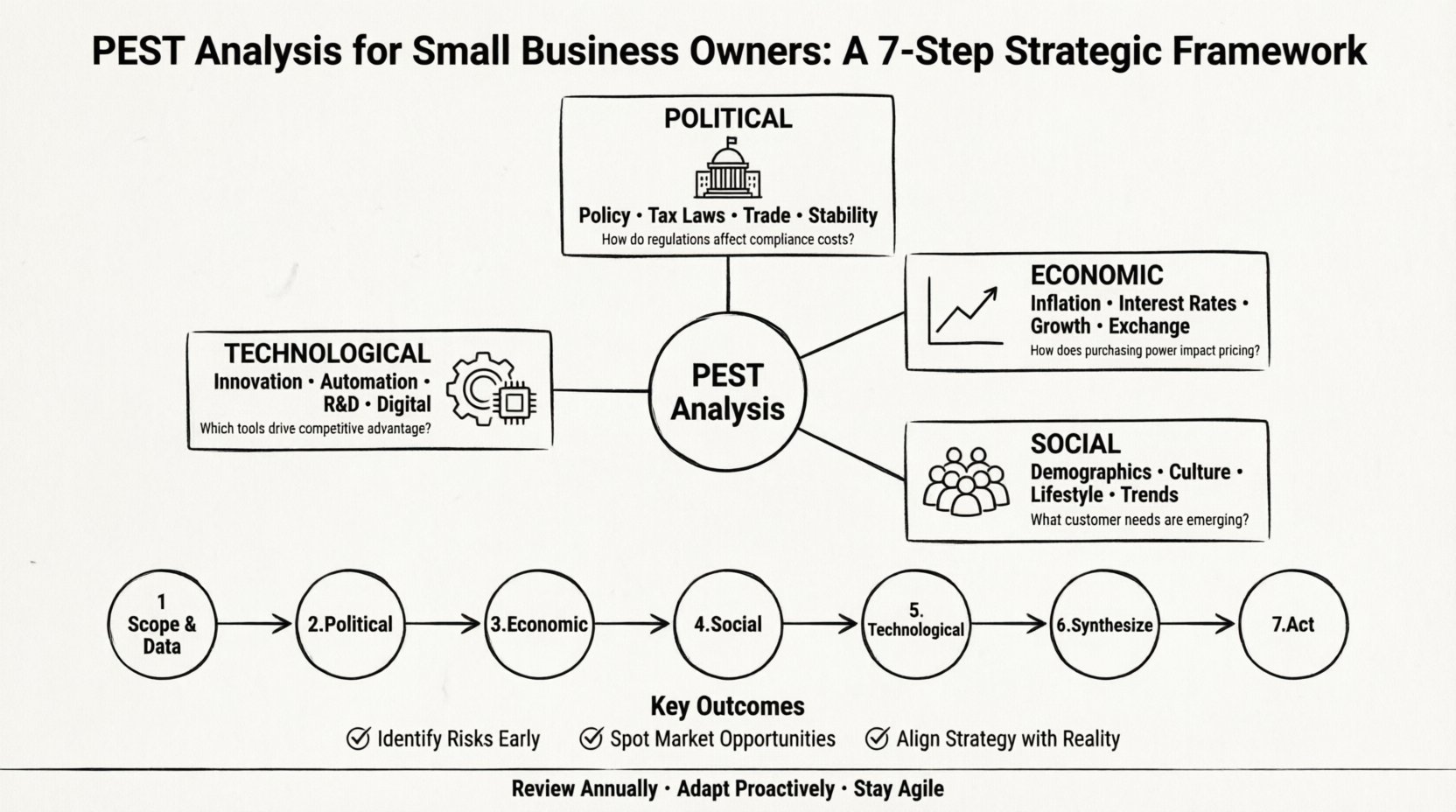
A PEST analysis is a strategic framework used to scan the external macro-environmental factors affecting an organization. The acronym stands for:
- Political
- Economic
- Social
- Technological
Unlike internal audits that focus on resources and capabilities, this method looks outward. It helps small business owners anticipate changes before they happen. For example, a new tax law might alter your pricing strategy, or a shift in consumer behavior might demand a new product line.
Understanding these external drivers allows you to:
- Identify potential risks before they become crises.
- Spot emerging market opportunities.
- Align your long-term strategy with current realities.
- Improve decision-making based on data rather than intuition.
📋 The Four Pillars of PEST Explained
Each component of the framework represents a distinct category of influence. Below is a detailed breakdown of what each pillar encompasses.
| Factor | Key Focus Areas | Why It Matters |
|---|---|---|
| Political | Government policy, tax laws, trade restrictions, stability | Determines legal compliance costs and market access. |
| Economic | Inflation, interest rates, exchange rates, economic growth | Impacts purchasing power and operational costs. |
| Social | Demographics, culture, lifestyle trends, population growth | Reveals customer needs and labor availability. |
| Technological | Innovation, automation, R&D, digital infrastructure | Drives efficiency and creates new competitive advantages. |
📝 Step 1: Preparation and Data Gathering
Before analyzing specific factors, you must set the stage. A poorly prepared analysis leads to vague conclusions. This step involves defining the scope and collecting reliable information.
Define the Scope
Is this analysis for the entire company or a specific product launch? Is it for the domestic market or an international expansion? Defining the boundaries ensures your research remains focused.
- Timeframe: Are you looking at the next 12 months or the next 5 years?
- Geography: Which regions are relevant to your supply chain or customer base?
- Industry: Focus on trends specific to your sector.
Gather Information
You do not need expensive software to gather data. Publicly available information is often sufficient. Focus on primary and secondary sources.
- Government Reports: Look for census data, labor statistics, and economic forecasts.
- Industry Publications: Trade journals often highlight emerging trends.
- News Outlets: Monitor local and national news for regulatory changes.
- Competitor Activity: Observe how competitors are reacting to the same environment.
🏛️ Step 2: Analyzing Political Factors
Political factors refer to the extent to which a government intervenes in the economy. For a small business, these factors often dictate the rules of the game.
Key Questions to Ask
- Is the political environment stable, or is there potential for unrest?
- Are there new regulations regarding health and safety that apply to your operations?
- How might tax policies change in the upcoming fiscal year?
- Are there trade tariffs that affect your cost of goods sold?
Impact on Strategy
Consider a retail business. If the government introduces stricter zoning laws, your expansion plans might stall. If tax incentives are introduced for green energy, you might invest in solar panels to reduce long-term costs. Political analysis helps you navigate compliance and leverage incentives.
- Compliance: Ensure you meet all legal requirements to avoid fines.
- Lobbying: Join industry groups to have a voice in policy formation.
- Contingency: Plan for scenarios where political shifts disrupt supply chains.
💰 Step 3: Analyzing Economic Factors
Economic factors directly affect the purchasing power of your customers and the cost of your inputs. These are often the most volatile elements of the analysis.
Key Questions to Ask
- What is the current inflation rate, and is it rising?
- How do interest rates affect your borrowing costs?
- Is the disposable income of your target demographic increasing or decreasing?
- Are there exchange rate fluctuations if you import materials?
Impact on Strategy
During high inflation, customers become more price-sensitive. You might need to adjust your pricing strategy or introduce lower-cost product tiers. Conversely, in a booming economy, you might invest in marketing to capture market share.
- Pricing: Adjust prices to reflect cost increases without losing volume.
- Inventory: Stock up on materials if prices are expected to rise.
- Financing: Lock in fixed-rate loans if interest rates are predicted to climb.
👥 Step 4: Analyzing Social Factors
Social factors involve the demographic and cultural aspects of your environment. Understanding your audience is crucial for product-market fit.
Key Questions to Ask
- How is the population age distribution changing in your area?
- Are there shifting attitudes toward sustainability or ethical consumption?
- How has remote work changed the demand for commercial space?
- What are the current lifestyle trends affecting your industry?
Impact on Strategy
Demographics dictate demand. An aging population might increase demand for healthcare services, while a younger population might drive tech adoption. Cultural shifts can also impact branding and marketing messages.
- Marketing: Tailor messages to reflect current social values.
- HR: Adapt recruitment strategies to attract diverse talent.
- Product: Develop features that align with new lifestyle habits.
📱 Step 5: Analyzing Technological Factors
Technological factors encompass the innovation and advancements that affect your business. Ignoring technology can lead to obsolescence.
Key Questions to Ask
- Is automation reducing the need for manual labor in your sector?
- Are there new software tools that could improve your workflow?
- How is data security evolving, and what does this mean for your customers?
- What are the barriers to entry created by new technology?
Impact on Strategy
Technology can be a disruptor or a defender. Adopting new tools early can give you a competitive edge. However, rapid tech changes also require continuous investment in training and infrastructure.
- Efficiency: Implement systems to automate repetitive tasks.
- Security: Invest in cybersecurity to protect customer data.
- Adoption: Train staff on new tools to ensure smooth integration.
🧠 Step 6: Synthesizing and Interpreting Findings
Collecting data is only half the work. You must interpret what the data means for your specific situation. This step bridges the gap between observation and action.
Identify Patterns
Look for connections between the factors. For instance, a technological advancement (Technology) might lead to a shift in consumer habits (Social). Recognizing these interdependencies provides a holistic view.
- Cross-Reference: Check if a political change influences economic stability.
- Correlation: See if social trends align with technological adoption rates.
- Contradictions: Note where factors seem to work against each other.
SWOT Integration
The PEST analysis feeds directly into a SWOT analysis. External factors from PEST become Opportunities and Threats in SWOT. Internal strengths and weaknesses are then matched against these external realities.
- Opportunities: External factors you can leverage.
- Threats: External factors that could harm your business.
✅ Step 7: Developing Actionable Strategies
The ultimate goal is to create a plan that mitigates risks and capitalizes on opportunities. This is where the analysis translates into operational reality.
Prioritize Actions
- High Impact: Focus on factors that will significantly alter your bottom line.
- High Probability: Prioritize trends that are likely to occur.
- Urgency: Address immediate threats before long-term opportunities.
Assign Responsibility
Who in your team is best suited to handle these changes? Assign ownership to ensure accountability.
- Operations: Handle supply chain and compliance issues.
- Marketing: Adapt campaigns to social trends.
- Finance: Manage economic fluctuations and budgeting.
- IT: Oversee technological integration.
⚠️ Common Pitfalls to Avoid
Even with a solid framework, errors can occur during the process. Being aware of these common mistakes can save you time and resources.
- Too Much Data: Collecting everything without filtering leads to analysis paralysis. Focus on relevant data.
- Internal Bias: Do not let your existing beliefs color the interpretation of external facts.
- Static View: Treat the environment as a snapshot. The market is dynamic; your analysis must be too.
- Ignoring Weak Signals: Small changes today can be major shifts tomorrow. Pay attention to early indicators.
🔄 How Often Should You Conduct This Analysis?
There is no fixed rule, but regularity is key. For a small business, an annual review is standard. However, high-growth industries or volatile markets may require quarterly reviews.
- Annual Review: Align with your fiscal year planning.
- Trigger-Based: Conduct an ad-hoc analysis if a major event occurs (e.g., a new law or pandemic).
- Project-Based: Perform a specific analysis before launching a new product.
📚 Frequently Asked Questions
Is PEST analysis suitable for startups?
Yes. Startups face high uncertainty, making external scanning critical. It helps validate assumptions about the market before investing capital.
Can I do this alone?
You can, but a team approach yields better results. Different perspectives help identify blind spots. Even a small team of three or four can provide diverse insights.
How is PEST different from SWOT?
SWOT is internal and external. PEST is exclusively external. PEST is a tool used to fill in the Opportunities and Threats sections of a SWOT analysis.
What if the factors conflict?
Conflict is normal. For example, economic downturns might reduce spending, but social trends might favor cheaper alternatives. You must weigh which factor has the strongest impact on your specific business model.
🏁 Final Thoughts
Conducting a PEST analysis is not a one-time task but a discipline. It requires ongoing attention to the world around you. By systematically evaluating Political, Economic, Social, and Technological factors, you build a foundation for resilience.
Small business owners who understand their environment are better positioned to adapt. They do not wait for change to happen to them; they anticipate it and prepare for it. This proactive stance is the difference between survival and sustainable growth.
Start your analysis today. Gather your data, ask the right questions, and let the insights guide your next strategic move. The landscape will change, but your preparation will remain your strongest asset.