

Creating a visual representation of how a customer interacts with your brand is more than just a diagram; it is a strategic necessity. Customer journey mapping allows organizations to step out of their internal processes and view the experience through the eyes of the user. This process identifies pain points, highlights opportunities for improvement, and aligns teams around a shared understanding of the customer. For businesses seeking to optimize their operations, this guide provides a clear path to execution.
Understanding the Core Concept 🧠
A customer journey map is a visualization of the process that a person goes through in order to accomplish a goal. It is not merely a list of steps. Instead, it captures the feelings, thoughts, and motivations at every stage of the interaction. When you map this journey, you are documenting the relationship between the customer and your organization over time.
This tool helps you see the gaps between what your customers expect and what you are actually delivering. It shifts the focus from transactional interactions to relational experiences. By understanding the full lifecycle, you can design solutions that address real needs rather than assumed ones.
Why This Matters for Business Growth 📈
Implementing this strategy yields tangible benefits when done correctly. It is not about creating art; it is about driving efficiency and satisfaction.
- Improved Alignment: Marketing, sales, and support teams often operate in silos. A shared map ensures everyone understands the customer’s path and their role in it.
- Identification of Friction: You can spot where customers drop off or get frustrated before they leave the platform.
- Resource Allocation: You can invest time and budget into areas that genuinely impact the user experience.
- Data-Driven Decisions: Empathy is paired with analytics to validate hypotheses about customer behavior.
When you understand the journey, you stop guessing. You start building based on evidence of how people actually behave.
Preparing Your Team and Data 📊
Before drawing a single line, preparation is key. Rushing into the mapping phase without the right foundation leads to inaccurate representations. Success depends on gathering the right inputs and bringing the right people to the table.
Gathering Qualitative and Quantitative Data
You need a mix of hard numbers and human stories to build an accurate picture.
- Analytics: Review web traffic, conversion rates, and time-on-site data to understand behavior patterns.
- Surveys: Collect feedback from customers who have recently completed a transaction or support interaction.
- Interviews: Conduct one-on-one sessions to understand the emotional context behind the data.
- Support Logs: Analyze tickets and call recordings to find recurring issues.
Defining Your Personas
A journey map is not for “everyone.” It is specific to a type of user. Create detailed personas that represent the different segments of your audience. A new user has different needs than a loyal advocate. Each persona should have a name, a background, goals, and pain points. This ensures the map remains focused on specific user types rather than generic assumptions.
Step-by-Step Execution Process 🛠️
Executing a map requires a structured approach. Follow these steps to build a comprehensive document that drives action.
Step 1: Define the Scope and Goals
Decide what you are trying to solve. Are you mapping the entire lifecycle or a specific process like onboarding or purchasing? Limiting the scope initially makes the project manageable. Clearly state the objective of the map. Is it to reduce churn? Increase conversion? Improve support response time?
Step 2: List All Touchpoints
A touchpoint is any point of interaction between the customer and your brand. These occur across various channels.
- Social media interactions
- Email newsletters
- Website browsing
- Phone calls to support
- Product packaging
- Physical store visits
List every single point of contact. Do not skip the small details. A customer might see an ad on social media, search for your name, read a review, visit the site, and finally call support. All of these moments matter.
Step 3: Map the Customer Actions
Now, organize the touchpoints chronologically. Write down exactly what the customer is doing at each stage. Use active verbs. For example, instead of “website visit,” use “searches for product features.” This distinction matters because it reflects intent.
Step 4: Identify Customer Emotions
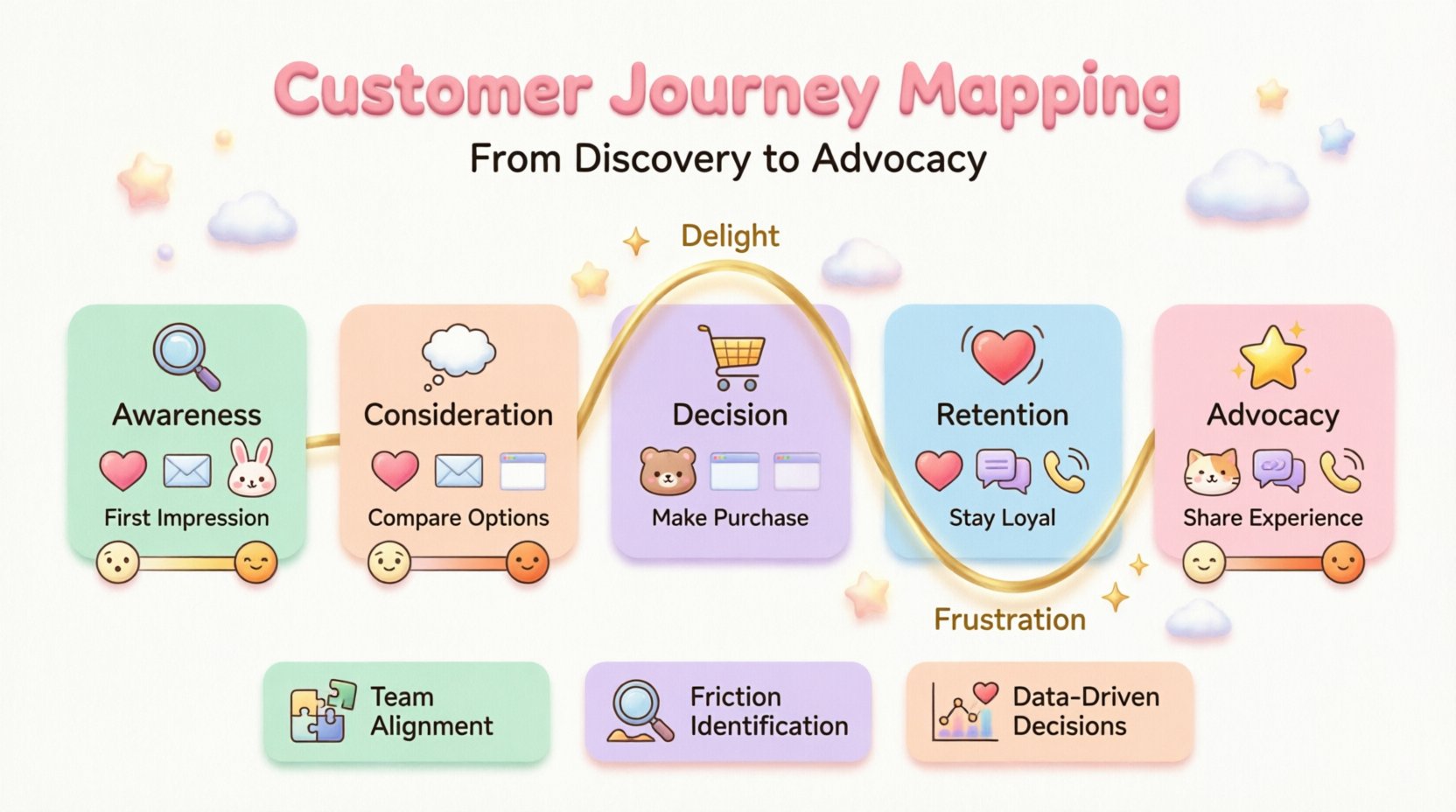
This is the most critical part of the map. At each action, note how the customer feels. Are they excited? Confused? Frustrated? Anxious? You can use an emotional curve to visualize this. Peaks represent high satisfaction, while valleys represent frustration.
- High Emotion: Moments of delight or high stress.
- Low Emotion: Routine interactions or waiting periods.
Step 5: Document Internal Processes
Behind every customer action, there is an internal action. When a customer clicks “buy,” an order confirmation is sent. When they call support, a ticket is created. Document these backend processes to see where delays or errors occur. Often, the customer’s frustration stems from an internal bottleneck they cannot see.
Visualizing the Customer Experience 🎨
Once you have the data, you need to visualize it. A well-designed map is easy to read and understand. It should be accessible to stakeholders across the organization.
Consider using a layout that separates the customer experience from the internal process. This allows you to compare what the user wants with what you are providing. Use color coding to highlight positive and negative experiences. Red flags should immediately draw attention to areas requiring urgent improvement.
Analyzing Friction and Opportunities 🔍
The map is useless if you do not analyze it. Look for the gaps. Where does the customer’s emotion dip? Where do they drop off? These are the friction points.
For each friction point, ask “why.” Is the navigation confusing? Is the checkout process too long? Is the support wait time excessive? Once you identify the root cause, you can brainstorm solutions.
Opportunities also exist in the high points. If a customer feels delight after a specific interaction, replicate that experience elsewhere. What made that moment special? Was it the speed of the response? The tone of the message? Replicating success is just as important as fixing failure.
Maintaining and Updating the Map 🔄
A journey map is not a one-time project. It is a living document. Customer behaviors change. New channels emerge. Products evolve. To keep the map relevant, you must update it regularly.
- Quarterly Reviews: Schedule time to review the map with key stakeholders.
- Feedback Loops: Integrate new customer feedback directly into the map updates.
- Version Control: Keep records of previous versions to track progress over time.
When you update the map, involve the team that is executing the changes. This ensures the map reflects reality and drives actual operational shifts.
Common Pitfalls to Avoid ⚠️
Even with the best intentions, teams can make mistakes during this process. Be aware of these common errors.
- Assuming you know the customer: Never rely on internal assumptions without data verification.
- Mapping the ideal scenario: Do not map how you wish the customer behaved. Map how they actually behave.
- Ignoring internal constraints: A map that highlights a solution you cannot implement will lead to frustration.
- Overcomplicating the design: If the map is too complex, people will not read it. Keep it simple.
- Creating it in isolation: Do not let one person create the map alone. Collaboration yields better accuracy.
Measuring Success After Implementation 📏
How do you know if your mapping efforts worked? You need to define metrics that align with your initial goals.
Track the following indicators:
- Net Promoter Score (NPS): Measures overall customer loyalty and satisfaction.
- Customer Effort Score (CES): Gauges how easy it is for customers to complete tasks.
- Churn Rate: Monitors the percentage of customers who stop using your service.
- Conversion Rate: Tracks the percentage of users who complete a desired action.
- Support Ticket Volume: A decrease in tickets often indicates improved self-service or clarity.
Regularly review these metrics against the baseline you established before the mapping project began.
Example Stages and Touchpoints 🗓️
To illustrate the flow, here is a breakdown of typical stages and their associated touchpoints. This table helps structure the information for easier comprehension.
| Stage | Primary Goal | Key Touchpoints | Emotional State |
|---|---|---|---|
| Awareness | Discovering the brand | Social ads, Search results, Word of mouth | Curiosity |
| Consideration | Evaluating options | Website, Product pages, Reviews | Skeptical |
| Decision | Making a purchase | Checkout process, Pricing page | Uncertain |
| Retention | Using the product | Onboarding emails, Support chat | Satisfied or Frustrated |
| Advocacy | Recommending the brand | Referral program, Social sharing | Loyal |
Final Thoughts on Execution 💡
Building a customer journey map is a discipline that requires patience and attention to detail. It is not about creating a pretty picture to hang on a wall. It is about using that picture to guide decision-making and resource allocation. When you execute this correctly, you create a culture of empathy within your organization.
Start small. Pick one persona and one specific journey. Get the data right. Involve the team. Analyze the friction. Implement changes. Measure the results. Then repeat the process for other journeys. Over time, this iterative approach will refine your customer experience strategy and drive sustainable growth.
Remember that the customer is the center of your business. Every decision should be weighed against how it impacts their journey. By keeping this focus, you ensure that your operations serve the people who matter most.