

In the modern business landscape, the difference between a loyal advocate and a churned customer often comes down to a single experience. Customer journey mapping is not merely a diagramming exercise; it is a strategic blueprint for understanding how your customers interact with your brand. This guide explores the methodologies, psychological underpinnings, and operational shifts required to build a robust customer experience (CX) strategy.
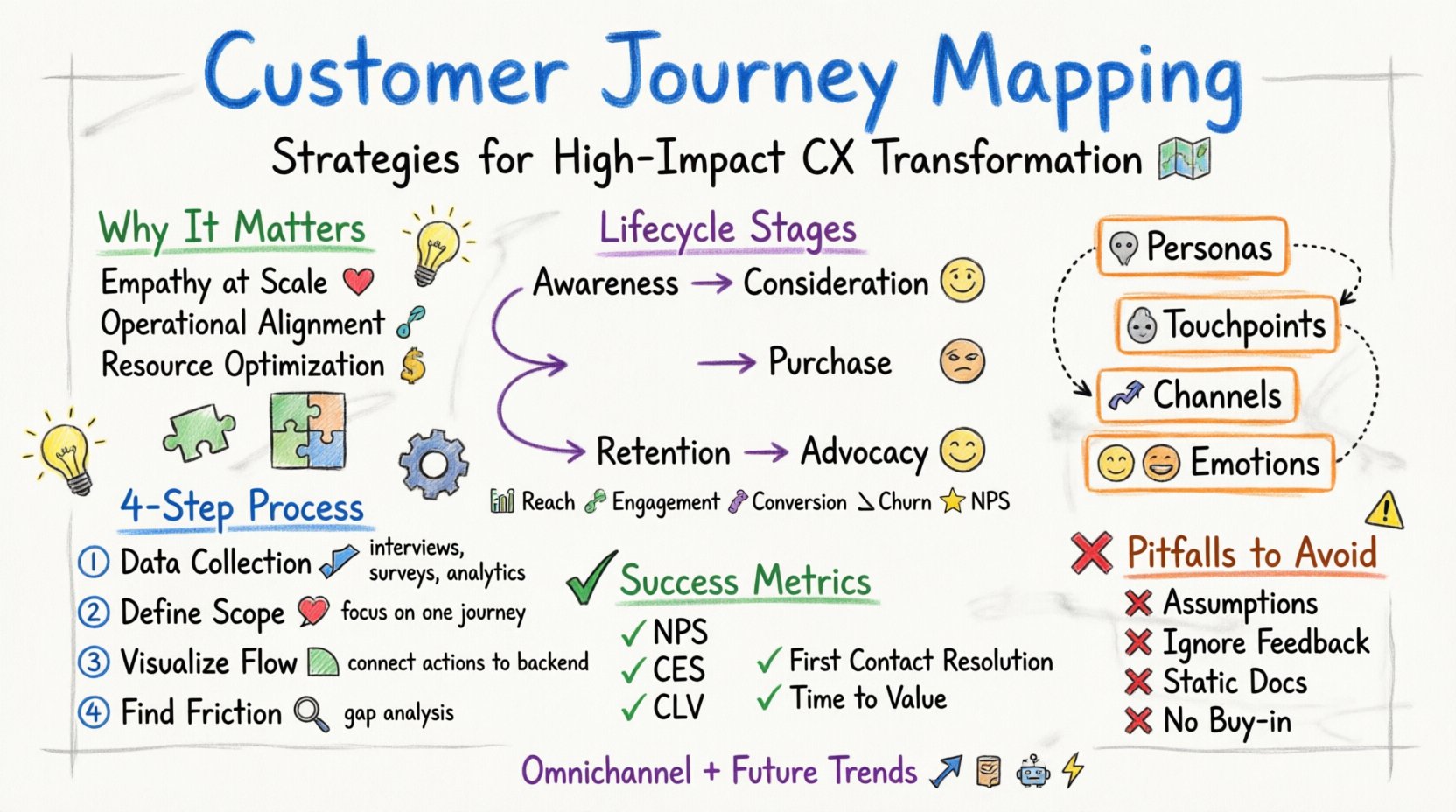
Why Customer Journey Mapping Matters 🤔
Organizations frequently operate in silos, where marketing, sales, and support teams view the customer through fragmented lenses. The marketing team sees a lead, sales sees a deal, and support sees a ticket. Journey mapping stitches these disconnected fragments into a cohesive narrative.
- Empathy at Scale: It forces the organization to see the product from the user’s perspective, highlighting emotional highs and lows.
- Operational Alignment: It reveals where internal processes fail to meet external expectations.
- Resource Optimization: It identifies high-value touchpoints where investment yields the highest return.
Without this visibility, companies risk optimizing for internal efficiency rather than customer satisfaction. A process that saves your company time but frustrates the client is a net loss.
The Anatomy of a Comprehensive Map 🏗️
A successful journey map goes beyond a linear timeline. It integrates data, emotion, and context. To construct a meaningful map, you must define several core components:
1. Personas and Segments 👤
A generic customer does not exist. You must define specific personas based on behavioral data, demographics, and psychographics. A map for a first-time buyer differs vastly from a map for a high-value enterprise client.
2. Touchpoints 📱
These are the moments of interaction. They can be digital (website, email, app) or physical (store, call center, packaging). Every interaction is an opportunity to reinforce brand promise or break trust.
3. Channels 🔄
Customers switch between channels constantly. They might research on a mobile device, compare on a desktop, and purchase in-store. The map must track this cross-channel flow to ensure consistency.
4. Emotions and Sentiment 😊😠
Quantitative data tells you what happened; qualitative data tells you how it felt. Plotting sentiment across the journey highlights friction points that might not show up in analytics.
Stages of the Customer Lifecycle 🔄
While industries vary, most journeys follow a recognizable arc. Understanding the goals and emotional states at each stage is critical for mapping.
| Stage | Customer Goal | Typical Emotion | Key Metric |
|---|---|---|---|
| Awareness | Discovering a solution | Curiosity | Reach, Impressions |
| Consideration | Evaluating options | Skepticism | Engagement Rate |
| Purchase | Completing transaction | Relief or Anxiety | Conversion Rate |
| Retention | Using the product | Satisfaction or Frustration | Churn Rate |
| Advocacy | Recommending to others | Delight | Net Promoter Score |
Executing the Mapping Process 🛠️
Creating the map is an iterative process that requires collaboration across departments. Do not attempt this in isolation.
Step 1: Data Collection 📊
Start with hard facts. Gather data from:
- Customer Interviews: Qualitative insights into motivations and pain points.
- Surveys: Quantitative data on satisfaction and frequency.
- Analytics: Behavioral data from web and app interactions.
- Support Logs: Common complaints and issues reported.
Step 2: Define the Scope 🎯
Do not try to map every single interaction at once. Select a specific journey, such as “Onboarding a New User” or “Returning a Product.” Focusing on a single critical path ensures depth over breadth.
Step 3: Visualize the Flow 🖼️
Use a collaborative workspace to draw the journey. Connect the dots between the customer action and the internal backend process required to fulfill it. This reveals hidden dependencies.
Step 4: Identify Friction Points 🔍
Look for gaps between expectation and reality. Where does the customer wait? Where is information missing? Where does the process require unnecessary effort? These are your opportunities for improvement.
Common Pitfalls to Avoid ⚠️
Even well-intentioned teams make mistakes when implementing journey mapping. Avoid these common traps to ensure your strategy remains effective.
- Relying on Assumptions: Never map what you think happens. Map what actually happens. Validate every step with real user data.
- Ignoring Negative Feedback: It is easy to focus on happy customers. The most valuable insights often come from dissatisfied users.
- Creating Static Documents: A map is a living document. If it sits in a folder, it is useless. It must be updated as products and markets change.
- Lack of Stakeholder Buy-in: If the team that manages the backend processes is not involved in the mapping, the insights will not be acted upon.
Measuring Success and ROI 📈
How do you know if your mapping efforts are translating into business value? You need to tie CX improvements to key performance indicators.
Primary Metrics
- Net Promoter Score (NPS): Measures loyalty and likelihood to recommend.
- Customer Effort Score (CES): Measures how easy it is for a customer to get things done.
- Customer Lifetime Value (CLV): Tracks the total revenue a customer generates over time.
Operational Metrics
- First Contact Resolution: Did the customer get their issue solved immediately?
- Time to Value: How long until the customer sees the benefit of your product?
- Drop-off Rates: Where are users abandoning the process?
The Role of Omnichannel Consistency 🌐
Customers expect a seamless experience whether they are on social media, your website, or in a physical store. Inconsistency creates cognitive dissonance.
If a customer reads a promotional email, the landing page must match the offer. If they call support, the agent must have access to the chat history. Context continuity is the backbone of modern CX.
Strategies for Consistency
- Centralized Data: Ensure all departments access a single source of truth regarding customer interactions.
- Unified Messaging: Maintain consistent tone and branding across all channels.
- Proactive Communication: Notify customers of issues before they reach out. If a service is down, let them know.
Organizational Readiness for CX Transformation 🏢
Mapping is the easy part. Changing the organization to align with the map is the hard part. This requires cultural shifts.
Leadership must prioritize customer needs over short-term gains. This often means investing in infrastructure that does not show immediate ROI but builds long-term trust.
- Empower Frontline Staff: Give customer-facing employees the authority to solve problems without excessive bureaucracy.
- Cross-Functional Teams: Create squads that include members from product, marketing, and support to own specific journey stages.
- Feedback Loops: Establish a system where customer feedback directly influences product roadmaps.
Future Trends in Journey Mapping 🚀
The landscape of CX is evolving rapidly. Technology is shifting from reactive to proactive and predictive.
Predictive Analytics
Advanced data modeling can now anticipate customer needs before they are articulated. If the data suggests a customer is at risk of churning, the system can trigger a retention offer automatically.
Hyper-Personalization
Moving beyond “Hi [Name]” to delivering content that matches the specific intent and context of the user. This requires deep integration of data streams.
Real-Time Interaction
The expectation for instant gratification is rising. Journeys that involve waiting are becoming less viable. Automation and AI are being used to reduce latency in response times.
Sustaining the Momentum 🏆
Once the map is drawn and improvements are made, the work is not finished. The market changes, competitors evolve, and customer expectations shift. To maintain high-impact CX transformation:
- Audit Regularly: Review the journey map quarterly. Does it still reflect reality?
- Train Continuously: Ensure new hires understand the customer journey from day one.
- Celebrate Wins: Recognize teams that improve specific journey metrics to reinforce positive behavior.
- Iterate Fast: Treat the journey map as a prototype. Test changes, measure results, and adjust.
Building a customer-centric organization is a marathon, not a sprint. It requires patience, data, and a relentless focus on the human behind the transaction. By rigorously applying these strategies, you create an environment where customers feel understood and valued.
The path forward is clear. It lies in the details of every interaction. When you align your operations with the customer’s reality, you do not just sell products; you build relationships that drive sustainable growth.