
Hotel Reservation Logic: AI Chatbot & VPasCode for DFD Modeling
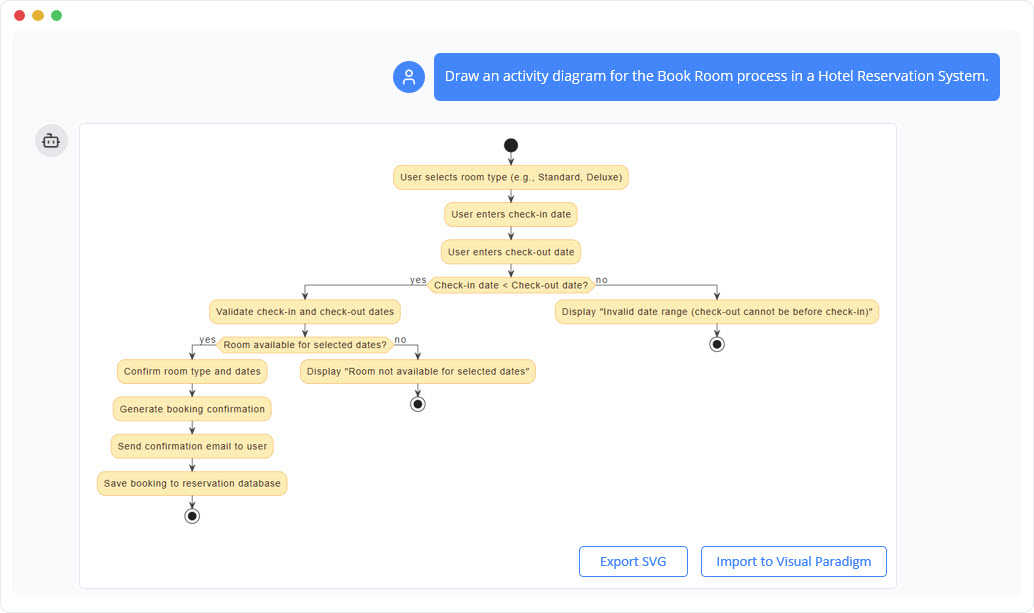
In modern software engineering, the gap between high-level conceptual thinking and precise technical implementation is often bridged by intelligent modeling tools. This tutorial explores how the Visual Paradigm AI Chatbot and VPasCode work in tandem to generate complex system architectures, using a real-world example: the Book Room process in a Hotel Reservation System.
From Natural Language to Logic Flow
The journey of creating a sophisticated activity diagram begins with a simple, conversational input. Instead of manually dragging shapes onto a canvas, the modern developer interacts with the AI Chatbot. The prompt provided in the context—“Draw an activity diagram for the Book Room process in a Hotel Reservation System”—triggers a sophisticated backend logic that understands domain-specific intent.
The resulting diagram, as seen in the interface, represents a robust state machine. It does not merely list steps; it models the decision-making logic required for a production-ready system. The diagram illustrates a clear flow from user initiation to database persistence, handling potential errors gracefully.
Deconstructing the Activity Flow
Let’s analyze the specific architectural components generated by the AI to understand how the system logic is structured.
- Initialization: The process begins with a Start Node (black circle), immediately guiding the user to the initial state of selecting a room type (e.g., Standard, Deluxe).
- Data Entry: The flow proceeds linearly through the collection of essential data: check-in date and check-out date. This linear progression ensures data consistency before validation occurs.
- Conditional Logic (Validation): The core intelligence of this diagram lies in the decision diamonds. The system first validates if the Check-in date < Check-out date. This is a critical business rule; a system allowing future check-outs before check-ins would be functionally broken.
- Error Handling: If the date validation fails (the “no” branch), the system immediately exits with an informative error message: “invalid date range”. This demonstrates the AI’s ability to model negative paths, ensuring the system is robust against user error.
- Availability Check: Assuming dates are valid, the system queries the database logic: “Room available for selected dates?”. This represents the intersection of the UI flow and the backend inventory management.
- Success Path: If the room is available, the diagram details the confirmation workflow: generating a booking ID, sending an email, and finally persisting the transaction to the reservation database.
The VPasCode Implementation
While the visual representation is intuitive, the underlying “Programmatic Precision” is powered by VPasCode. In the Visual Paradigm ecosystem, every visual element corresponds to a precise code block. To truly leverage the power of these tools, one must understand how to replicate or modify this logic using code.
Below is the logical representation of the diagram using a pseudo-code structure similar to what VPasCode interprets. This demonstrates how the AI translates the diagram into executable logic.
// Hotel Reservation System - Book Room Process Logic

start node "User selects room type (e.g., Standard, Deluxe)";
node "User enters check-in date";
node "User enters check-out date";

// Decision Node 1: Date Validation
decision "Check-in date < Check-out date?";
if (check_in_date < check_out_date) {
    goto "Validate check-in and check-out dates";
} else {
    error "Display 'invalid date range (check-out cannot be before check-in)'";
    end node;
}

// Decision Node 2: Room Availability
decision "Room available for selected dates?";
if (is_available) {
    node "Confirm room type and dates";
    node "Generate booking confirmation";
    node "Send confirmation email to user";
    node "Save booking to reservation database";
    end node;
} else {
    error "Display 'Room not available for selected dates'";
    end node;
}
Technical Analysis of the Decision Logic
The diagram above highlights a critical architectural pattern: Fail-Fast design. By placing the date validation check immediately after input, the system prevents unnecessary database queries for invalid date ranges. This optimizes performance and improves user experience by providing immediate feedback.
Furthermore, the diagram separates Business Logic (availability check) from System Logic (database saving). In a real-world implementation, the “Room available” node would trigger a transactional API call to the backend, while the “Save booking” node represents the final commit operation.
Conclusion
The integration of the Visual Paradigm AI Chatbot and VPasCode transforms the modeling process from a static drawing exercise into a dynamic engineering workflow. By starting with natural language and ending with precise code, developers can ensure that their system architecture is not only visually clear but technically sound. Whether you are designing a simple hotel booking flow or a complex enterprise system, understanding these tools is essential for modern software development.