
Mastering Enterprise Diagramming: A Guide to Custom AI Endpoints in VPasCode
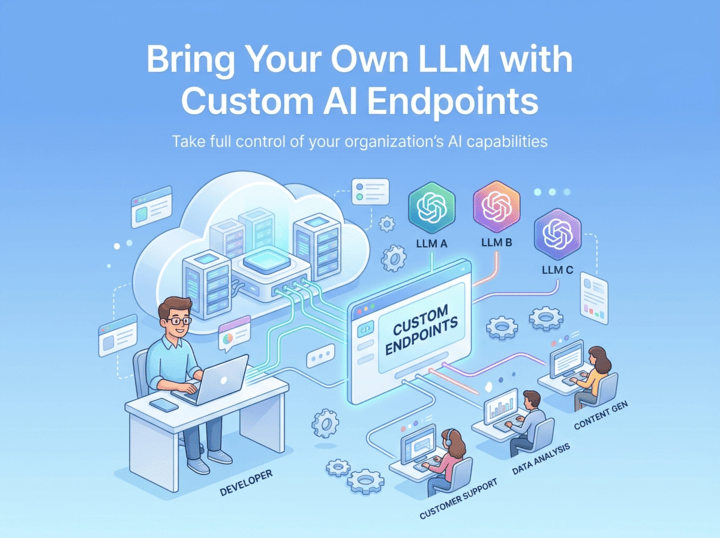
In the realm of modern software architecture, the speed at which we can visualize complex systems is often the bottleneck in our development lifecycle. Visual Paradigm VPasCode (VPasCode) addresses this by transforming the traditional diagramming workflow. While the tool offers a robust set of features for generating Mermaid code through natural language, the true power for enterprise-grade environments lies in its Custom AI Endpoint Support. This feature bridges the gap between convenience and security, allowing organizations to leverage Large Language Models (LLMs) without exposing sensitive architectural data to public cloud APIs.
Understanding the Architecture: The “Bring Your Own LLM” Concept
The core architectural shift in VPasCode is the move away from reliance on default, public AI providers. Instead, the tool is designed to function as a flexible client that can connect to any endpoint you configure. This is particularly critical for enterprise users who must adhere to strict data privacy regulations (such as GDPR or HIPAA) or internal security policies that prohibit sending proprietary code or diagrams to external third-party servers.
By integrating your own API credentials, you effectively create a secure tunnel between your local development environment and the AI processing power you choose. Whether your organization has deployed a private instance of OpenAI, Anthropic, Google, DeepSeek, Mistral, Qwen, or Groq, VPasCode allows you to plug these credentials directly into the tool. This ensures that the intellectual property used to generate diagrams remains within your organization’s control.
The Role of the Custom Endpoint
When you configure a custom endpoint, you are essentially defining the “brain” behind the diagram generation. The system architecture operates on a request-response model where:
- The Request: You input a natural language prompt (e.g., “Create a sequence diagram for a user logging in via OAuth2”).
- The Routing: VPasCode packages this prompt and sends it to your specified API endpoint using your provided credentials.
- The Processing: The AI model processes the request locally or within your secure cloud environment.
- The Response: The model returns syntactically correct Mermaid code, which VPasCode then renders into a visual diagram.
Technical Implementation and Workflow
The implementation of custom endpoints in VPasCode streamlines the workflow for developers and architects. Instead of manually writing syntax-heavy code or relying on potentially insecure public generation tools, the process is automated and localized.
- Authentication and Configuration: Users input their API keys for supported providers like OpenAI, Anthropic, or Google. This step is crucial for establishing the trust boundary.
- Model Selection: The system allows flexibility in choosing the underlying model (LLM A, B, or C as depicted in the architecture). This means you can switch between different AI capabilities based on the complexity of the diagram or cost constraints.
- Generation and Rendering: Once configured, the AI acts as a backend service. You focus on the logic of your diagram, and the tool handles the syntax generation, ensuring that the resulting Mermaid code is valid and ready for rendering.
This architecture supports global collaboration by allowing different teams to potentially use different AI models optimized for their specific tasks, such as data analysis or content generation, all while maintaining a unified interface.
Benefits of the Custom Endpoint Strategy
The decision to support custom AI endpoints offers several technical advantages:
- Data Privacy & Sovereignty: No sensitive data leaves your network. This is essential for financial institutions, healthcare providers, and government agencies.
- Cost Management: By using your own API credits, you have complete visibility and control over operational costs, avoiding hidden fees or unexpected overages from third-party tools.
- Flexibility: You are not locked into a single provider’s ecosystem. If a new model becomes available or your preferred provider changes, you can update the endpoint configuration without changing your workflow.
Conclusion
Visual Paradigm VPasCode stands out in the market not just for its ability to generate diagrams from text, but for its enterprise-ready architecture that prioritizes security and control. By enabling custom AI endpoints, it empowers teams to supercharge their workflow, turning natural language ideas into precise Mermaid diagrams instantly, all while keeping your data safe and your costs manageable.