


Customer journey mapping is not merely a diagramming exercise. It is a strategic tool used to understand the entire lifecycle of a relationship between a client and an organization. However, creating a map is only the first step. The real value lies in pinpointing the specific instances where decisions are made, emotions shift, and loyalty is either cemented or lost. These instances are known as critical moments.
Identifying these moments requires a deep dive into data, observation, and empathy. It involves looking beyond the surface-level interactions to find the friction points that cause drop-offs and the delight points that drive advocacy. This guide provides a structured approach to finding these pivotal touchpoints within your customer journey mapping efforts.
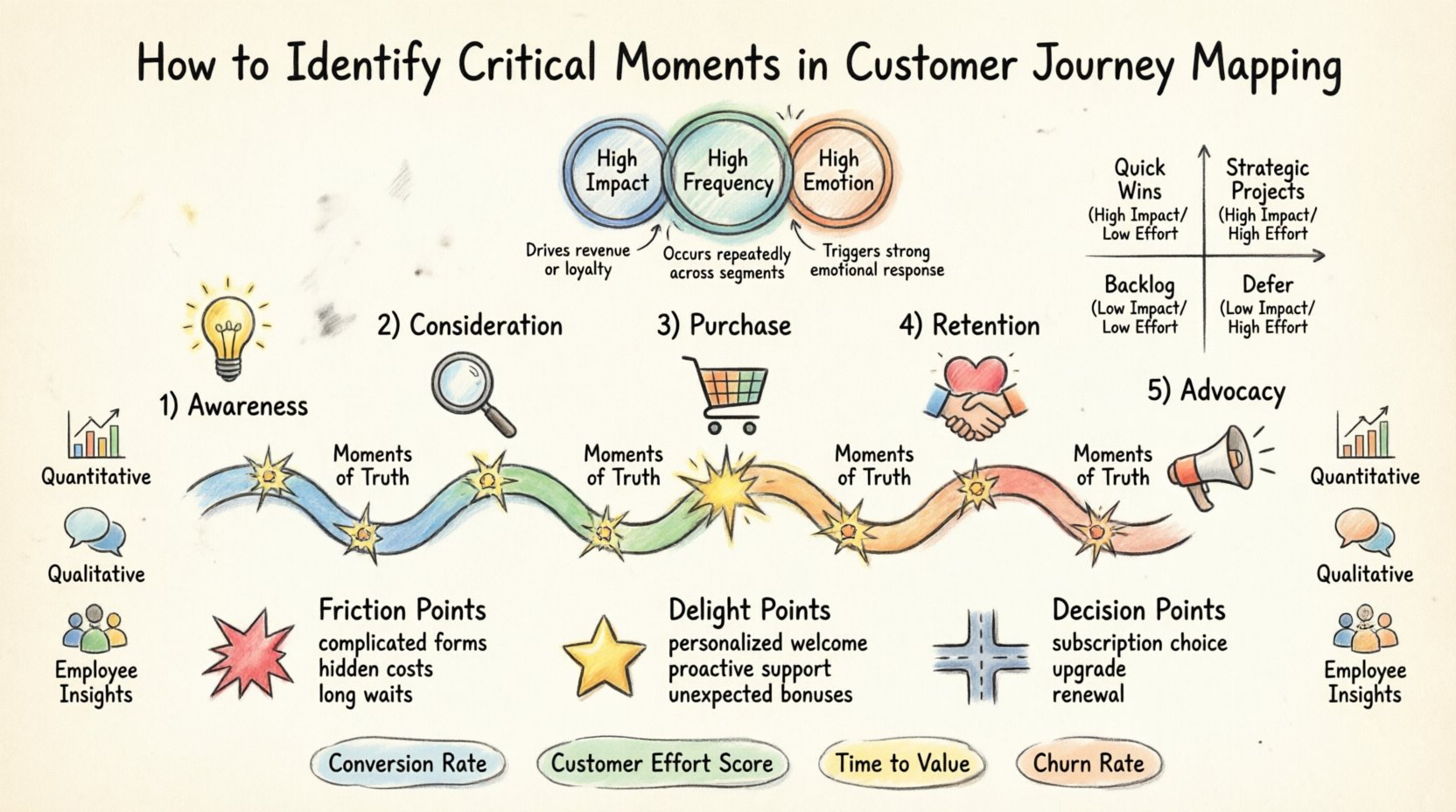
🔍 What Are Critical Moments in a Journey?
In the context of customer experience, a critical moment is any interaction that significantly influences the customer’s perception of the brand. These are often referred to as moments of truth. They are the inflection points where the trajectory of the relationship changes.
Not all interactions hold equal weight. A customer might interact with a brand dozens of times in a month, but only a handful of those interactions will determine whether they renew, recommend, or churn. Identifying these specific instances allows teams to allocate resources efficiently.
- High Impact: Interactions that directly affect satisfaction scores or revenue.
- High Frequency: Interactions that happen often and compound over time.
- High Emotion: Interactions that trigger strong feelings, whether positive or negative.
By categorizing interactions through these lenses, you can separate the noise from the signal. This ensures that improvement efforts are focused where they matter most.
📊 The Anatomy of a Journey: Where to Look
A complete journey map typically spans several stages. While the specific stages depend on your industry, the general flow remains consistent. Each stage contains potential critical moments that require attention.
1. Awareness Stage
At this stage, the customer realizes a need. The critical moment here is the first exposure to your brand. Does the messaging resonate? Is the ad relevant? If the first touchpoint is confusing or irrelevant, the journey often ends before it begins.
2. Consideration Stage
The customer is evaluating options. This is a research-heavy phase. Critical moments include reading reviews, comparing pricing, or visiting a demo page. Friction here, such as hidden costs or poor website navigation, is a major risk point.
3. Purchase Stage
This is the transaction. It is a high-stakes moment. The ease of checkout, the clarity of terms, and the security of payment processing are paramount. Any complication here can lead to cart abandonment.
4. Retention Stage
After the sale, the focus shifts to usage and support. Critical moments include onboarding, customer support interactions, and renewal notifications. A difficult onboarding process can negate the value of the purchase immediately.
5. Advocacy Stage
Happy customers become promoters. This stage involves referrals and public reviews. The critical moment is the request for feedback or the act of sharing the experience. If the customer feels valued, they advocate. If they feel ignored, they may deter others.
🛠️ Methods for Identifying Critical Moments
How do you find these moments? Relying on intuition is risky. You need a mix of qualitative and quantitative methods to triangulate the data. Below are proven approaches to uncover these pivotal points.
Quantitative Data Analysis
Numbers tell a story about behavior. By analyzing metrics, you can spot where the journey breaks down.
- Drop-off Rates: High exit rates at a specific page indicate friction.
- Time on Page: Excessive time might indicate confusion or difficulty.
- Support Ticket Volume: Spike in tickets for a specific feature highlights a pain point.
- Churn Rate: Analyze when customers leave. Is it after onboarding? After a price increase?
Qualitative Feedback
Numbers explain what happened; people explain why it happened. Gathering direct feedback provides context to the data.
- Surveys: Deploy Net Promoter Score (NPS) or Customer Satisfaction (CSAT) surveys at key intervals.
- Interviews: Conduct one-on-one sessions to understand the emotional journey.
- Usability Testing: Watch users attempt tasks to see where they struggle.
- Customer Support Logs: Review transcripts to find recurring themes in complaints.
Employee Insights
Your team interacts with customers daily. They often know the friction points better than any software. Frontline staff, sales representatives, and support agents have a unique vantage point.
- Frontline Interviews: Ask sales and support what questions they hear most often.
- Shadowing: Observe how customers use the product or service in real-time.
- Internal Workshops: Bring teams together to map out known pain points.
📋 Prioritization Framework
Once you have identified potential critical moments, you cannot fix everything at once. You need a framework to prioritize. The following matrix helps determine which moments deserve immediate attention based on impact and effort.
| Priority Level | Criteria | Action Required |
|---|---|---|
| High Impact / Low Effort | Moments that cause significant dissatisfaction but are easy to fix. | Quick Wins: Implement immediately. |
| High Impact / High Effort | Moments that are crucial but require significant resources. | Strategic Projects: Plan and allocate budget. |
| Low Impact / Low Effort | Minor annoyances that are easy to address. | Backlog: Handle when capacity allows. |
| Low Impact / High Effort | Complex changes that do not yield significant results. | Defer or Discard: Avoid investing resources here. |
This framework ensures that you are not spending time on low-value activities while neglecting high-impact areas. It aligns the journey mapping work with business goals.
🧩 Categorizing the Types of Moments
To effectively manage these moments, it helps to categorize them. Not all critical moments are negative. Some are opportunities to delight.
Friction Points
These are moments of struggle. They cause frustration, delay, or confusion. Common examples include:
- Complicated sign-up forms.
- Unclear pricing structures.
- Long wait times on customer support.
- Broken links or technical errors.
Fixing friction points is often the most direct way to improve retention. When you remove a barrier, you allow the customer to progress naturally.
Delight Points
These are moments of positive surprise. They exceed expectations and build emotional connection. Examples include:
- A personalized welcome message.
- Proactive support that solves a problem before the customer notices.
- Unexpected value-adds or bonuses.
- Simplified processes that save time.
While friction must be eliminated, delight must be cultivated. These moments drive word-of-mouth marketing and increase lifetime value.
Decision Points
These are moments where the customer chooses to move forward or stop. They are the crossroads of the journey. Examples include:
- Choosing a subscription plan.
- Deciding to upgrade a service.
- Choosing to renew a contract.
At decision points, clarity is king. Providing the right information at the right time ensures the customer makes a confident choice.
📈 Measuring Success and Optimization
Identifying the moments is only half the battle. You must measure the impact of your changes. Without measurement, you cannot know if your journey mapping efforts are yielding results.
Key Performance Indicators (KPIs)
Track metrics specific to the critical moments you are optimizing.
- Conversion Rate: Did the optimization increase sign-ups or purchases?
- Customer Effort Score (CES): Did the interaction become easier?
- Time to Value: Are customers realizing the benefit of your product faster?
- Churn Rate: Did retention improve after fixing onboarding friction?
Continuous Improvement
Customer journeys are not static. Markets change, competitors evolve, and customer expectations shift. A journey map that was accurate last year may be obsolete today. Establish a cadence for review.
- Quarterly Reviews: Check data and feedback trends.
- Trigger-Based Updates: Update the map after major product changes or rebranding.
- Real-Time Monitoring: Set up alerts for sudden drops in performance indicators.
⚠️ Common Pitfalls to Avoid
Even with the best intentions, organizations often make mistakes when identifying and managing critical moments. Being aware of these traps can save time and resources.
1. Relying on Internal Assumptions
Teams often think they know the customer experience because they work there. This is rarely accurate. Internal assumptions lead to maps that reflect the organization, not the customer. Always validate with external data.
2. Creating a Linear Map
Customer journeys are rarely straight lines. Customers may loop back, skip steps, or interact through multiple channels simultaneously. A linear map fails to capture this complexity. Ensure your mapping accounts for non-linear paths.
3. Focusing Only on Digital Touchpoints
Not all interactions happen online. Phone calls, physical locations, and printed materials are part of the journey. Ignoring offline channels creates blind spots in your critical moment identification.
4. Ignoring the Emotional Journey
A journey map is not just a timeline of actions. It is a timeline of feelings. A customer might complete a task successfully but feel anxious or unsupported. Always plot the emotional state alongside the actions.
5. One-Time Exercise
Treating journey mapping as a one-off project is a mistake. It requires ongoing maintenance and stakeholder alignment. If the map sits in a folder, it provides no value.
🚀 Strategic Implementation Steps
Once you have identified and prioritized your critical moments, you need a plan to act on them. Here is a practical workflow to execute your findings.
- Step 1: Validate Findings. Confirm that the identified moments are truly critical using data. Don’t guess.
- Step 2: Assign Ownership. Each critical moment should have an owner. Is it the product team? Support? Marketing? Clear accountability is essential.
- Step 3: Define Success Metrics. How will you know the fix worked? Set specific targets for the KPIs mentioned earlier.
- Step 4: Execute Changes. Implement the solutions. This might involve code changes, process updates, or training.
- Step 5: Monitor and Iterate. Watch the metrics. If the change didn’t work, analyze why and adjust. Repeat the cycle.
💡 Final Considerations for Long-Term Impact
The goal of identifying critical moments is not just to fix problems. It is to build a resilient, customer-centric culture. When teams understand where the friction lies, they become more empathetic to the user experience.
Over time, this focus shifts the organization’s mindset. Instead of asking, “What can we sell?” the question becomes, “What value can we deliver?” This shift is the foundation of sustainable growth.
Remember that every interaction is an opportunity. By systematically identifying and optimizing the critical moments in your customer journey mapping, you ensure that every touchpoint contributes to a positive outcome. This disciplined approach leads to higher retention, better brand reputation, and increased revenue without relying on hype or superficial tactics.
Start small. Pick one stage of the journey. Find the most painful moment. Fix it. Measure the result. Then move to the next. Consistency in this process will yield significant improvements over time.