Welcome to this comprehensive guide on strategic planning. Understanding the external environment is critical for any organization aiming for long-term success. This tutorial walks you through the PEST analysis framework, breaking down complex market forces into actionable insights. Whether you are a student, a startup founder, or a seasoned strategist, this guide provides the structure you need to navigate uncertainty.
What is PEST Analysis? 📊
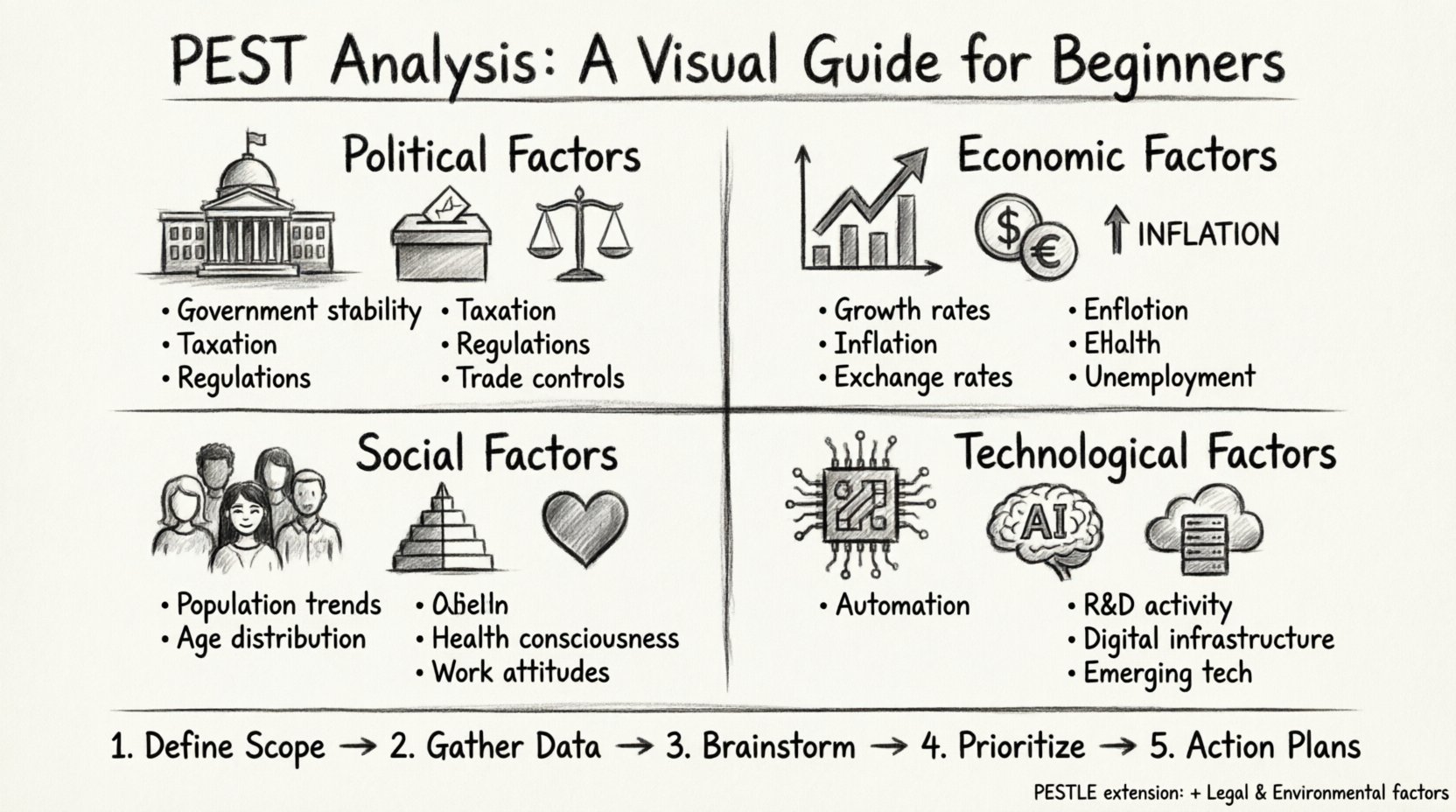
PEST analysis is a strategic tool used to identify and analyze the macro-environmental factors that impact an organization. It stands for Political, Economic, Social, and Technological. By examining these four areas, businesses can make informed decisions that align with current trends and future projections.
Unlike internal analysis tools that focus on resources and capabilities, PEST looks outward. It helps answer questions about the landscape in which the business operates. This external view prevents strategies from being built on assumptions that no longer hold true in the real world.
- Macro-environmental: Factors are external and beyond the control of the company.
- Strategic Planning: Used during the planning phase to set direction.
- Visual Framework: Often presented as a matrix or quadrant for clarity.
The Four Pillars of PEST Explained 🏛️
To conduct a thorough analysis, you must understand the nuances of each component. Below is a detailed breakdown of what each letter represents and why it matters.
1. Political Factors 🏛️
Political factors refer to how government intervention affects the economy or specific industries. This includes tax policy, labor laws, trade restrictions, and political stability.
- Government Stability: Is the current administration likely to change policies drastically?
- Taxation: How do corporate tax rates impact profit margins?
- Regulations: Are there new compliance requirements for your sector?
- Trade Controls: Do tariffs affect your supply chain costs?
- Environmental Policies: What are the rules regarding carbon emissions or waste?
For example, a change in trade agreements could suddenly increase the cost of imported raw materials. Understanding these shifts allows you to adapt your pricing or sourcing strategies before competitors react.
2. Economic Factors 📈
Economic factors influence the purchasing power of potential customers and the cost of capital. These indicators fluctuate frequently and directly impact demand.
- Economic Growth: Is the economy expanding or contracting?
- Inflation Rates: How does rising prices affect consumer spending?
- Exchange Rates: Is your currency strong or weak against others?
- Interest Rates: How expensive is it to borrow money for expansion?
- Unemployment Levels: What is the availability of skilled labor?
During a recession, consumers may prioritize essential goods over luxury items. An economic downturn requires a leaner operational model, while a boom might encourage aggressive investment.
3. Social Factors 👥
Social factors look at the cultural and demographic aspects of the market. These are often the slowest to change but have the most profound long-term impact on consumer behavior.
- Population Growth: Is the market expanding or shrinking?
- Age Distribution: Is the population aging or getting younger?
- Health Consciousness: Are people prioritizing wellness and fitness?
- Attitudes toward Work: Do employees prefer remote work or office settings?
- Cultural Barriers: Are there language or custom differences to consider?
Aging populations in certain regions create demand for healthcare services, while a younger demographic might drive tech adoption. Aligning your product with these social shifts is key to relevance.
4. Technological Factors 💻
Technological factors involve the innovation ecosystem. This includes research and development activity, automation, and the rate of technological change.
- Automation: Can machines replace manual labor to reduce costs?
- R&D Activity: How fast is innovation happening in your industry?
- Internet Infrastructure: Is connectivity reliable for your digital services?
- Data Security: What are the risks regarding cyber threats?
- Emerging Tech: Are AI or blockchain solutions viable for your niche?
Technology can disrupt entire markets overnight. Companies that ignore technological shifts risk obsolescence. Staying informed ensures you remain competitive.
PEST Analysis Framework Table 📋
Use this table to structure your research. It organizes the key questions you need to answer for each category.
| Category | Key Questions to Ask | Impact Level |
|---|---|---|
| Political | What laws affect our operations? How stable is the government? | High / Medium |
| Economic | What is the inflation rate? How does currency fluctuation affect costs? | High |
| Social | What are the lifestyle trends? How is the population changing? | Medium |
| Technological | What new tools are available? Is our tech becoming outdated? | High / Medium |
How to Conduct a PEST Session 🛠️
Executing a PEST analysis is a collaborative process. It requires input from various departments to ensure a holistic view. Follow these steps to conduct an effective session.
Step 1: Define the Scope 🎯
Before starting, clarify the objective. Are you launching a new product? Entering a new country? Or simply reviewing the annual strategy? A clear scope prevents the analysis from becoming too broad.
- Identify the specific market or region.
- Determine the time horizon (short-term vs. long-term).
- Set the budget and resources available for research.
Step 2: Gather Data 🔍
Reliable data is the foundation of a good analysis. Avoid speculation. Use credible sources to validate your findings.
- Consult government reports for economic and political data.
- Review industry journals for technological trends.
- Analyze demographic statistics for social insights.
- Interview stakeholders for internal perspectives.
Step 3: Brainstorm and Categorize 🧠
Bring the team together. List all potential factors and sort them into the four PEST categories. Be honest about what you do not know.
- Use a whiteboard or digital collaboration tool.
- Encourage open discussion without judgment.
- Group similar factors to avoid redundancy.
Step 4: Prioritize Findings 📉
Not all factors are equally important. Rank them based on their potential impact on the business and the likelihood of occurrence.
- Identify high-impact, high-probability risks.
- Highlight opportunities that offer significant growth.
- Discard factors with negligible impact to save time.
Step 5: Develop Action Plans 🚀
Analysis is useless without action. Translate your findings into strategic moves.
- Adjust pricing strategies based on economic shifts.
- Modify marketing messages to align with social trends.
- Invest in technology to mitigate competitive threats.
- Navigate political changes through compliance and lobbying.
Real-World Application Example 🌍
Consider a company planning to expand into a new region. Here is how they might apply the framework.
- Political: They discover new tariffs on imported electronics. They decide to source locally instead.
- Economic: They note high inflation in the target market. They adjust their pricing model to be more flexible.
- Social: They find a cultural preference for mobile payments. They integrate mobile wallets into their checkout process.
- Technological: They see a lack of reliable internet in rural areas. They launch an offline-first app version.
This example shows how PEST translates into concrete business decisions. It moves the team from theory to practice.
PEST vs. PESTLE 🔄
You may encounter the term PESTLE analysis. This is an extension of the PEST framework. It adds two more factors:
- Legal: Specific laws regarding employment, safety, and contracts.
- Environmental: Ecological and environmental aspects like climate change.
While PEST is sufficient for many general overviews, PESTLE is better for industries with heavy regulatory or environmental impacts, such as manufacturing or energy. You can choose the model that fits your needs.
Common Mistakes to Avoid ⚠️
Even experienced strategists make errors when using this framework. Watch out for these common pitfalls.
- Overgeneralizing: Do not assume trends apply universally. A factor in one country may not apply in another.
- Ignoring Data: Relying on intuition instead of verified statistics leads to bias.
- Static Analysis: The environment changes. A PEST analysis is not a one-time event. Review it regularly.
- Isolation: Do not use PEST in a vacuum. Combine it with internal analysis tools like SWOT for a complete picture.
- Too Many Factors: Listing every possible factor dilutes focus. Prioritize the ones that matter most.
Integrating with Other Strategies 🧩
PEST analysis works best when integrated into a broader strategic planning process. It feeds into other methodologies.
Linking to SWOT
External factors identified in PEST become the Opportunities and Threats in a SWOT analysis. Internal strengths and weaknesses remain separate. This combination creates a robust strategic view.
Linking to Market Research
Market research provides the data points for the PEST factors. Use surveys and focus groups to validate social and economic assumptions.
Linking to Risk Management
Political and economic factors often represent risk. Use PEST to build a risk register that tracks potential external disruptions.
Frequently Asked Questions ❓
Here are answers to common questions about this strategic tool.
How often should I update the analysis?
It depends on the volatility of your industry. In stable sectors, an annual review may suffice. In fast-moving tech sectors, a quarterly review is advisable.
Can I use this for non-profits?
Absolutely. Non-profits also face political, economic, social, and technological challenges. Funding shifts and donor behavior are key PEST factors for them.
Is this tool only for large corporations?
No. Small businesses benefit greatly from understanding their environment. It helps them allocate limited resources more effectively.
What if I don’t have access to data?
Start with public information. Government census data, news reports, and industry white papers are often free. Use proxy indicators if direct data is unavailable.
Final Thoughts on Strategic Planning 🌟
Strategic planning is not about predicting the future perfectly. It is about preparing for multiple possibilities. PEST analysis provides the lens to see those possibilities clearly. By understanding the forces at play, you reduce uncertainty and increase your chances of success.
Remember to keep the process iterative. The world changes, and your analysis must evolve with it. Use this guide as a starting point to build your own customized framework. Consistency in application is the key to long-term value.
Start your analysis today. Gather your team. Define your scope. And begin mapping the landscape that surrounds your organization.