


Enterprise Architecture is rarely a simple endeavor. As organizations grow, their systems, processes, and strategies become increasingly intertwined. Navigating this complexity without a clear map is a recipe for confusion. This is where ArchiMate Viewpoints become essential. They act as specialized lenses, allowing stakeholders to focus on specific aspects of the architecture without being overwhelmed by the whole.
This guide explores how to refine and optimize these viewpoints. We will look at the structural components, the strategic alignment, and the practical application of modeling techniques that serve complex environments. The goal is not just to create diagrams, but to facilitate decision-making through clarity.
Understanding the Core Function of Viewpoints 🔍
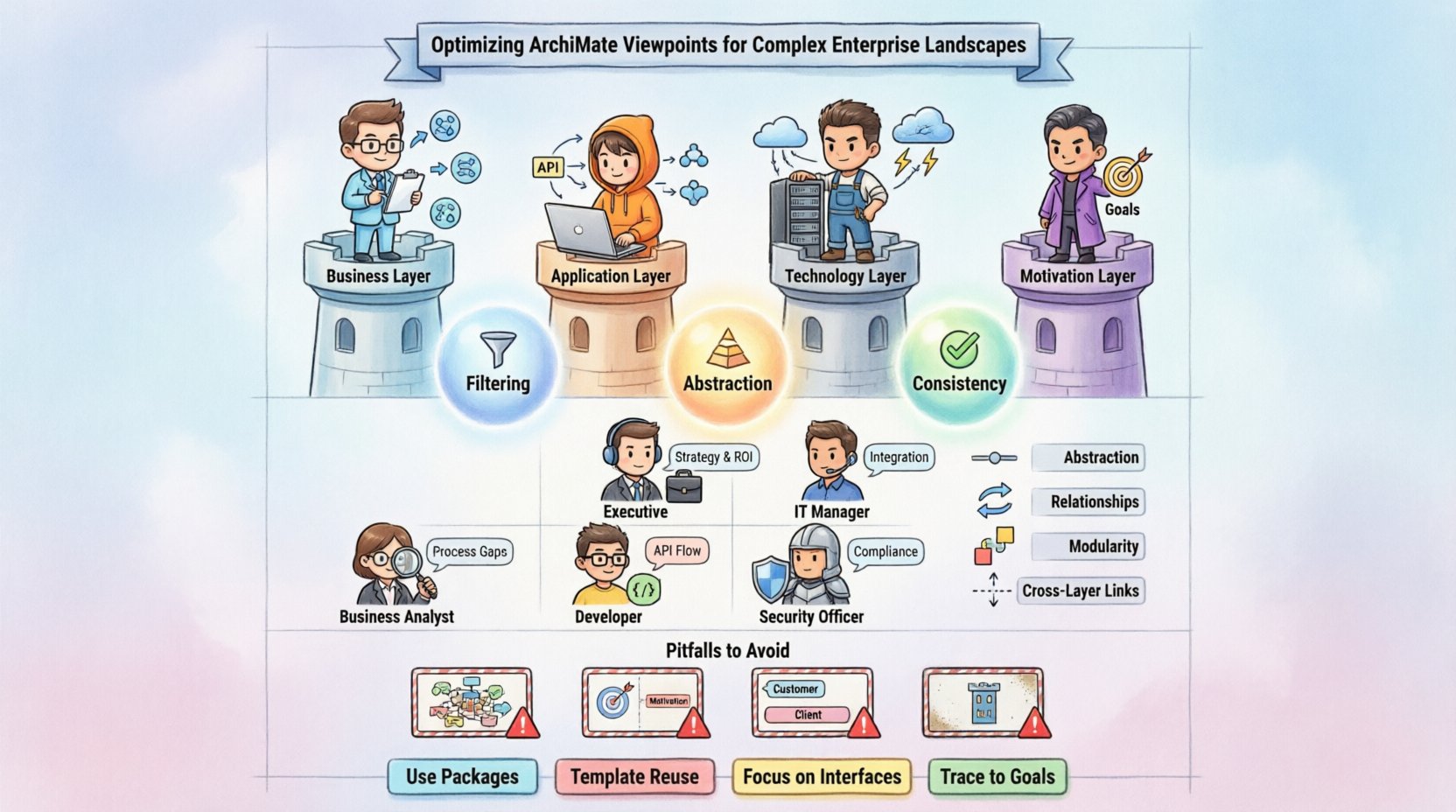
At its foundation, a viewpoint defines the perspective from which an architecture description is constructed. It answers the question: Who is looking at this, and what do they need to know? In a complex landscape, a single model cannot serve everyone. A developer needs to see API dependencies, while a CFO needs to see cost drivers across business services.
Optimizing viewpoints involves three critical actions:
- Filtering: Selecting only the relevant elements for a specific audience.
- Abstraction: Hiding low-level details that obscure high-level strategy.
- Consistency: Ensuring that the same concept is represented identically across different views.
When these actions are performed correctly, the architecture becomes a communication tool rather than a documentation burden. It bridges the gap between technical reality and business intent.
The Architecture Layers and Their Impact 📚
ArchiMate organizes concepts into layers. Each layer represents a different level of abstraction. When designing viewpoints, you must understand how these layers interact and which ones are necessary for your specific context.
1. Business Layer 👥
This layer deals with the organization’s goals, processes, and roles. It defines what the business does. Viewpoints here are often used by managers and strategists.
- Key Elements: Business Services, Business Processes, Business Roles.
- Focus: Value streams, organizational structure, and capability maps.
2. Application Layer 💻
This layer describes the software systems that support the business. It focuses on functionality and data storage.
- Key Elements: Application Components, Application Functions, Data Objects.
- Focus: System integration, deployment, and functional coverage.
3. Technology Layer 🔌
This layer describes the hardware and infrastructure that runs the applications. It is the physical or virtual foundation.
- Key Elements: Devices, Network, System Software.
- Focus: Infrastructure capacity, connectivity, and security boundaries.
4. Motivation Layer 🎯
This layer captures the drivers behind the architecture. It explains why changes are being made.
- Key Elements: Goals, Principles, Requirements.
- Focus: Alignment with corporate strategy and compliance.
Mapping Stakeholders to Viewpoints 🎯
One of the most common failures in enterprise modeling is creating a “one-size-fits-all” view. This leads to information overload. A successful optimization strategy requires mapping specific stakeholder groups to tailored viewpoints.
| Stakeholder Group | Primary Concern | Recommended Viewpoint Focus |
|---|---|---|
| Executive Leadership | Strategic alignment and ROI | Motivation & Business Layer (High Level) |
| IT Managers | System availability and integration | Application & Technology Layer |
| Developers | Data flow and API contracts | Application Layer (Detailed) |
| Security Officers | Risk exposure and compliance | Security Cross-Cutting Concerns |
| Business Analysts | Process efficiency and gaps | Business Layer (Process Flow) |
By adhering to this mapping, you ensure that every participant receives the information they need to do their job, without sifting through irrelevant data.
Design Principles for Effective Viewpoints 🛠️
Creating a viewpoint is more than just hiding elements. It requires a deliberate design process. The following principles ensure that your models remain useful as the landscape evolves.
1. Abstraction Levels
Not every element needs to be visible in every view. If a business process is supported by ten different applications, the business view should show the process and the service interface, not the specific server instances. This keeps the view clean.
2. Relationship Clarity
ArchiMate defines specific relationship types: Association, Dependency, Access, and Realization. Mixing these up creates confusion. A viewpoint should use relationships that make sense to the audience.
- For Strategists: Use Realization to link goals to services.
- For Engineers: Use Dependency to link components to infrastructure.
3. Cross-Layer Consistency
When a Business Service is supported by an Application Function, that link must be explicit. Optimizing viewpoints often means creating traceability lines that span layers without cluttering the diagram.
4. Modularization
Complex landscapes benefit from modular viewpoints. Instead of one massive diagram, create a set of linked diagrams. One diagram covers the core transaction, another covers the backend infrastructure. This allows users to drill down only when necessary.
Common Pitfalls in Viewpoint Design 🚫
Even experienced architects fall into traps that reduce the value of their models. Recognizing these pitfalls early is key to optimization.
Pitfall 1: The All-Encompassing Diagram
Trying to put everything on one screen is a mistake. As the organization grows, the model becomes unreadable. Stakeholders stop using it because they cannot find the specific information they need.
Pitfall 2: Ignoring the Motivation Layer
Many models focus solely on the structure (Business, Application, Technology). Without the Motivation layer, it is difficult to explain why a change is happening. This disconnect leads to resistance from business units.
Pitfall 3: Inconsistent Naming
If one view calls a service “Customer Onboarding” and another calls it “New Client Setup,” the model loses trust. Standardized naming conventions across all viewpoints are non-negotiable for complex landscapes.
Pitfall 4: Static Models
Architecture is dynamic. If a viewpoint is created once and never updated, it becomes a historical artifact rather than a planning tool. Regular review cycles must be built into the process.
Optimization Strategies for Complex Landscapes 🚀
When the enterprise landscape is vast, standard practices may not be enough. You need advanced strategies to maintain clarity.
1. Use of Packages and Groups
Organize models into logical packages. For example, group all Application Layer elements by domain (e.g., Finance, HR, Supply Chain). This allows you to toggle visibility for entire domains within a viewpoint.
2. Template Reuse
Define standard templates for common viewpoints. If you need a “Technology Infrastructure” view, use a pre-defined layout that ensures consistency. This reduces the cognitive load on the architect and the reader.
3. Focus on Interfaces
In complex systems, the interface is often more important than the internal logic. Optimize viewpoints to highlight the boundaries between systems. This helps identify integration points and potential bottlenecks.
4. Integration with Strategy
Ensure that every architectural element traces back to a business goal. If a technology component cannot be linked to a business capability, question its necessity. This keeps the model lean and relevant.
Maintaining Model Relevance Over Time 🔄
A viewpoint is only as good as its current accuracy. Maintenance is a continuous process.
- Version Control: Treat models like code. Keep history of changes to understand evolution.
- Change Impact Analysis: When a change is proposed, use the viewpoint to visualize the ripple effect before implementation.
- Feedback Loops: Regularly ask stakeholders if the view meets their needs. If a view is ignored, it needs to be redesigned.
The Role of Data in Viewpoint Optimization 📊
Data is often the glue that holds layers together. In complex landscapes, data objects are critical. A viewpoint should clearly show how data flows from one application to another.
Consider these aspects:
- Data Ownership: Which business unit owns the data?
- Data Sensitivity: Where does PII (Personally Identifiable Information) reside?
- Data Flow: How is data transformed as it moves through the system?
By explicitly modeling data in your viewpoints, you can identify redundancy and compliance risks more easily.
Handling Cross-Cutting Concerns 🛡️
Certain concerns do not fit neatly into a single layer. Security, Performance, and Compliance are cross-cutting.
Instead of cluttering every business diagram with security locks, create specific viewpoints for these concerns. For example, a “Security Architecture View” might show authentication points and data encryption layers across all domains. This keeps the business view clean while ensuring security is addressed.
Final Considerations for Implementation 📝
Optimizing ArchiMate viewpoints is a journey, not a destination. It requires discipline, consistency, and a deep understanding of the organization’s needs. As you refine your approach, remember that the model serves the people, not the other way around.
Key takeaways for your next project include:
- Define the audience before drawing the first line.
- Use abstraction to manage complexity.
- Maintain strict naming conventions.
- Regularly review and update models.
- Separate cross-cutting concerns into their own views.
By following these guidelines, you can transform a chaotic landscape into a structured, understandable environment. This clarity empowers better decisions, faster execution, and a more resilient enterprise architecture.