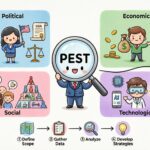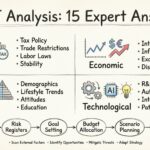
Strategic planning is often an exercise in looking inward. Leaders assess their team’s strengths, review financial health, and map out operational goals. However, a strategy built solely on internal capabilities is fragile. It ignores the tides of the external environment that can wash away even the most robust business models. To navigate this uncertainty, organizations rely on frameworks designed to scan the horizon. One of the most enduring and effective tools for this purpose is the PEST analysis.
This method provides a structured way to examine the macro-environmental factors that influence an organization. It is not merely a theoretical exercise; it is a critical component of risk management and opportunity identification. By systematically evaluating Political, Economic, Social, and Technological forces, you can identify strategic blind spots before they become threats. This guide serves as a comprehensive checklist to ensure your analysis is thorough, accurate, and actionable.
🔍 What Is a PEST Analysis?
PEST analysis is a strategic framework used to evaluate the key factors affecting an organization. It stands for Political, Economic, Social, and Technological. While some variations exist, such as PESTLE which adds Legal and Environmental factors, the core four provide a foundational view of the macro-environment. These are factors that are generally outside the control of the business but significantly impact its operations, profitability, and long-term viability.
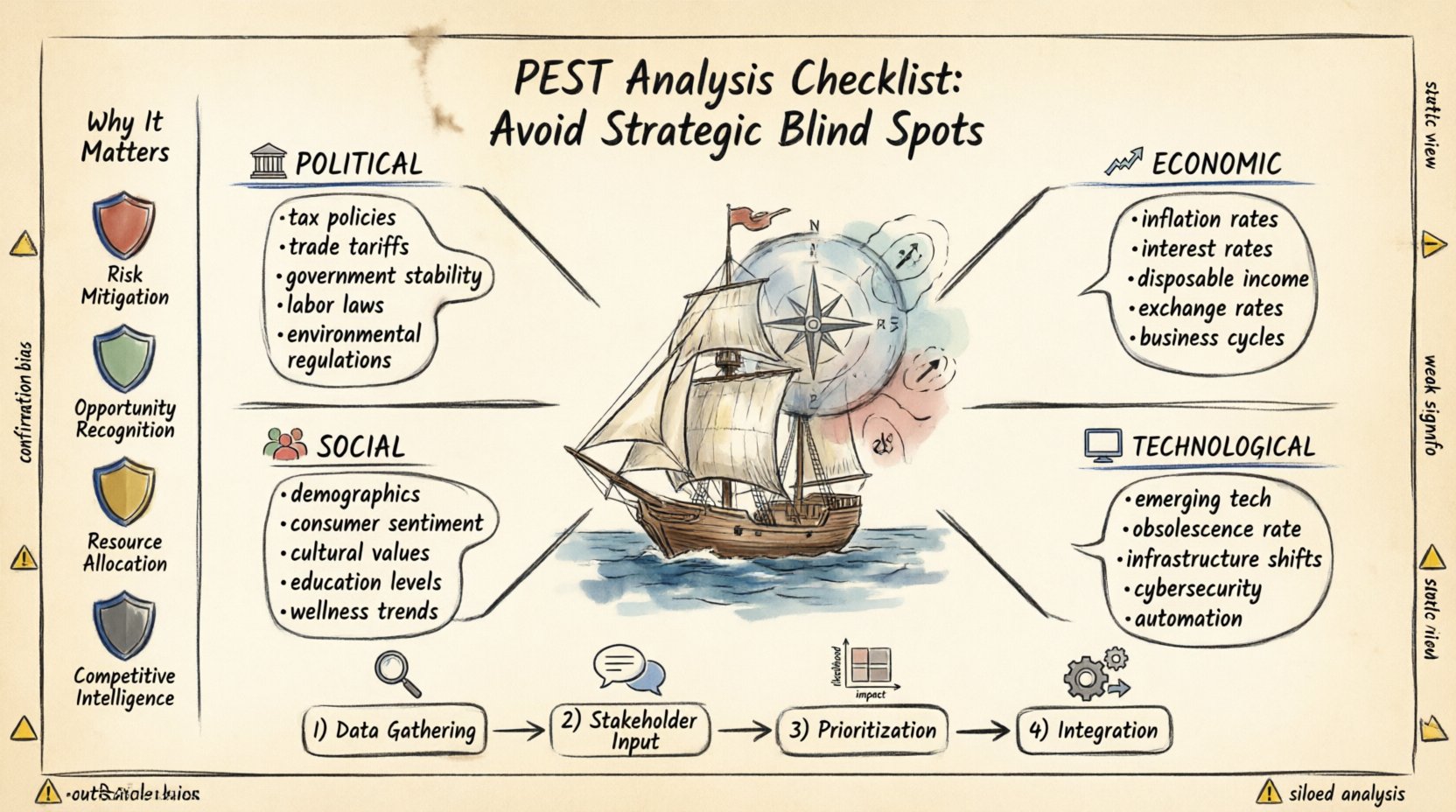
Think of your business as a vessel sailing on an ocean. You can control the engine, the crew, and the route. However, you cannot control the weather, the currents, or the depth of the water. The PEST analysis is your method of reading the weather forecast and mapping the currents. It shifts the focus from what you can do to where you can do it.
🛡️ Why It Matters for Strategic Planning
Ignoring external factors is a common cause of strategic failure. Companies often assume the market will remain static or that their current trajectory is the only path forward. When regulatory changes occur, or when consumer behavior shifts rapidly, organizations caught off guard struggle to adapt. This analysis helps in several critical areas:
- Risk Mitigation: Identifying potential regulatory hurdles or economic downturns allows for contingency planning.
- Opportunity Recognition: Spotting technological shifts early can position a company as a market leader rather than a follower.
- Resource Allocation: Understanding social trends ensures marketing budgets are spent where the audience actually is.
- Competitive Intelligence: It provides context for competitor moves that might otherwise seem inexplicable.
Without this external lens, strategies are built on assumptions. With it, strategies are built on evidence. The checklist below breaks down each category into specific, actionable items to ensure nothing is overlooked.
📝 The Core PEST Checklist Breakdown
To make this framework practical, we have broken down each of the four pillars into specific questions and data points. Use this table as a guide during your strategic sessions. Mark items as relevant or irrelevant to your specific industry, but ensure every item is considered before moving forward.
| Category | Key Questions & Factors | Strategic Implication |
|---|---|---|
| Political 🏛️ |
|
Impacts cost structure, market access, and operational compliance. |
| Economic 📈 |
|
Directly influences pricing power, demand elasticity, and investment capacity. |
| Social 🧑🤝🧑 |
|
Drives brand positioning, product features, and hiring needs. |
| Technological 💻 |
|
Determines operational efficiency, product longevity, and innovation pace. |
🏛️ Deep Dive: Political Factors
The Political category encompasses the extent to which a government intervenes in the economy. It is not just about the ruling party; it is about the stability of the system and the rules of engagement. Governments set the boundaries within which businesses operate.
Regulation and Compliance
Regulatory environments can change overnight. Consider the impact of new data privacy laws, safety standards, or industry-specific licensing requirements. A company operating in a highly regulated sector must dedicate significant resources to monitoring legislative updates. Failure to comply can result in fines, operational shutdowns, or reputational damage.
Taxation and Fiscal Policy
Tax structures dictate profitability. Corporate tax rates, import duties, and incentives for innovation directly affect the bottom line. A shift in fiscal policy can alter the competitive landscape. For instance, a government might introduce subsidies for green energy, instantly changing the cost dynamics for traditional energy providers.
Political Stability
Investment requires predictability. In regions with high political volatility, the risk premium increases. Supply chains may be disrupted by strikes, civil unrest, or sudden policy shifts. Organizations must assess whether the political climate supports long-term investment or if it necessitates a more agile, short-term operational model.
📈 Deep Dive: Economic Factors
Economic factors determine the purchasing power of potential customers and the cost of capital for the business. These are often the most visible indicators of business health, but they require nuanced interpretation.
Inflation and Interest Rates
High inflation erodes consumer spending power. When prices rise, consumers prioritize essentials over discretionary items. Simultaneously, high interest rates increase the cost of borrowing. This impacts expansion plans, inventory financing, and capital expenditures. A business model reliant on high leverage may become unsustainable during a rate hike cycle.
Exchange Rates
For organizations engaged in international trade, currency fluctuations are critical. A strengthening domestic currency can make exports more expensive and less competitive globally. Conversely, it makes imports cheaper. Hedging strategies and pricing models must account for these variances to protect margins.
Business Cycles
Economies move in cycles of expansion and contraction. Understanding where the economy sits in the cycle informs strategic timing. During a recession, cost efficiency becomes paramount. During an expansion, growth and market share acquisition take precedence. Timing your strategic initiatives to align with economic cycles can significantly improve success rates.
🧑🤝🧑 Deep Dive: Social Factors
Social factors are about the human element. They include population growth, age distribution, health consciousness, and cultural norms. These factors dictate what people want, how they live, and what they value.
Demographics
Population shifts are slow but powerful. An aging population creates demand for healthcare and retirement services while shrinking the workforce. A younger population may drive demand for education and technology. Understanding the demographic makeup of your target market ensures you are solving the right problems for the right people.
Cultural Trends
Societal values evolve. There is a growing emphasis on sustainability, ethical sourcing, and corporate social responsibility. Brands that ignore these shifts risk alienating consumers. Conversely, aligning with social values can build loyalty. For example, the shift towards remote work changed not just office real estate needs, but also how teams collaborate and communicate.
Education and Lifestyle
Education levels influence consumer sophistication. A more educated workforce requires more complex tools and products. Lifestyle changes, such as the demand for convenience or the rise of the gig economy, alter consumption patterns. Businesses must adapt their value propositions to fit these evolving lifestyles.
💻 Deep Dive: Technological Factors
Technological factors encompass the innovation and research and development (R&D) activities that impact an industry. This is often the fastest-moving category, rendering other factors obsolete in a short period.
Automation and AI
Automation is reshaping labor markets and production processes. Artificial intelligence offers new ways to analyze data and automate customer service. Organizations that fail to adopt relevant technologies risk being outpaced by competitors who utilize them for efficiency and insight.
Infrastructure and Connectivity
The availability of technology infrastructure, such as high-speed internet or cloud computing capabilities, determines where and how business can be conducted. In regions with poor connectivity, certain digital business models are not viable. Conversely, widespread 5G adoption opens new possibilities for IoT and real-time data processing.
Research and Development
The pace of innovation in your industry dictates your product lifecycle. If R&D is rapid, you must invest heavily in keeping current. If the technology is mature, you can focus on optimization and cost reduction. Ignoring the trajectory of technological development can lead to selling products that are already outdated upon launch.
🛠️ How to Execute the Analysis
Completing the checklist is only the first step. The value lies in the synthesis of the data. Here is a process for executing the analysis effectively.
1. Data Gathering
Collect information from diverse sources. Government reports, industry journals, news outlets, and academic research provide objective data. Avoid relying on a single source of truth. Triangulate information to ensure accuracy.
2. Stakeholder Input
Different departments see different signals. Sales teams hear customer complaints about pricing. Engineering teams hear about technical limitations. HR hears about labor market shifts. Bring these perspectives together to get a holistic view of the external environment.
3. Prioritization
You cannot act on every factor. Use a matrix to prioritize issues based on impact and likelihood. Focus your strategic resources on the high-impact, high-probability factors. Low-impact items can be monitored but do not require immediate strategic shifts.
4. Integration
Translate findings into action. If a political factor suggests a new tax, adjust the financial model. If a social factor suggests a demographic shift, adjust the marketing message. If a technological factor suggests a new tool, plan for adoption. The analysis must drive decisions.
🚧 Common Pitfalls in External Analysis
Even with a solid checklist, organizations often stumble during the execution phase. Being aware of these common traps helps ensure the integrity of your strategy.
- Confirmation Bias: Looking for data that supports pre-existing beliefs. If you believe the market is growing, you might ignore data suggesting saturation. Challenge your assumptions actively.
- Outdated Information: Using data from five years ago. The external environment changes rapidly. Ensure your data is current and relevant to the present moment.
- Ignoring Weak Signals: Focusing only on major news events. Often, the biggest shifts come from small, incremental changes that are not yet in the headlines. Pay attention to niche trends.
- Siloed Analysis: Conducting the analysis in isolation. It requires cross-functional collaboration. A technical team might miss a regulatory nuance that the legal team would catch.
- Static View: Treating the analysis as a one-time event. The environment is dynamic. The PEST analysis should be a recurring review, perhaps quarterly or annually, to track changes over time.
🔗 Integrating Findings with Other Tools
The PEST analysis is rarely used in isolation. It is most powerful when combined with other strategic frameworks. The most common pairing is with a SWOT analysis.
The PEST analysis informs the Opportunities and Threats sections of a SWOT analysis. By understanding the external environment, you can accurately identify where opportunities lie and what threats loom. The internal strengths and weaknesses are then matched against these external realities.
For example, if your PEST analysis reveals a technological shift toward mobile usage, and your internal analysis shows a strength in agile development, you have a clear strategic path forward. If your PEST analysis reveals a threat of new regulations and your internal analysis shows a weakness in compliance, you have a critical risk to address.
Another useful integration is with Scenario Planning. Based on the PEST factors, you can create different future scenarios. What happens if interest rates double? What happens if a new competitor enters with disruptive technology? Preparing for multiple scenarios ensures resilience.
🚀 Moving Forward
Strategic planning without an external perspective is navigation without a map. The PEST analysis checklist provides the coordinates. It forces leaders to look beyond their immediate operations and consider the broader forces at play.
By systematically addressing Political, Economic, Social, and Technological factors, you reduce the likelihood of surprise. You build a strategy that is resilient to change and adaptable to new conditions. The checklist is a tool, but the discipline of using it is what creates competitive advantage.
Start by reviewing your current strategic documents. Identify where the external environment has been assumed rather than analyzed. Then, convene your team and work through the checklist provided. Document the findings. Discuss the implications. Decide on the actions.
The market does not wait for your strategy to be perfect. It moves regardless of your plans. Aligning your strategy with the reality of the PEST factors ensures you are moving with the current, not against it. This alignment is the difference between reacting to change and anticipating it.