Standard strategic frameworks often assume a level of market stability that rarely exists in modern global commerce. While the PEST analysis model—Political, Economic, Social, and Technological—offers a foundational approach to understanding the macro-environment, applying it to complex market fractions requires a more nuanced methodology. Complex market fractions refer to highly segmented, volatile, or niche sectors where traditional indicators may not correlate linearly with outcomes.
This guide explores how to adapt the PEST framework for environments characterized by rapid change, regulatory fragmentation, and cross-border volatility. We will move beyond simple categorization into the mechanics of influence, interdependency, and strategic forecasting.
🔍 Why Standard PEST Falls Short in Complex Segments
Traditional PEST analysis often functions as a static snapshot. It lists factors present at a specific moment in time. However, complex market fractions operate on dynamic cycles. A factor that appears minor in a broad market analysis can become a critical disruption point within a specific niche.
Consider the following limitations of basic application:
- Lack of Granularity: Broad economic data often masks regional disparities. A national GDP growth rate might look positive while a specific industrial sector faces contraction.
- Static Nature: A one-time assessment does not account for the velocity of change in digital or regulatory environments.
- Isolation of Factors: Political decisions often trigger economic shifts, which in turn alter social behaviors. Basic models treat these as separate buckets.
- Missing Intersections: Complex fractions often exist at the intersection of multiple macro-trends. A standard list does not capture the synergy or friction between these trends.
To navigate these complexities, the framework must evolve from a checklist into a living matrix of risk and opportunity.
🏛️ Political Factors: Beyond Elections and Regulations
In a complex market fraction, political factors extend well beyond the election cycle or the passing of a new law. They involve the stability of institutions, the nature of governance, and the geopolitical landscape.
1. Regulatory Fragmentation
Many sectors face a patchwork of regulations rather than a unified legal framework. For instance, in data-heavy industries, compliance requirements can vary significantly between regions within the same country. This creates a compliance cost structure that differs from the standard market average.
- Assess local compliance overheads versus central mandates.
- Monitor lobbying activities that could shift the regulatory landscape.
- Evaluate the risk of protectionist policies targeting specific niches.
2. Geopolitical Stability
Trade routes, sanctions, and diplomatic relations directly impact supply chains and market access. In volatile regions, political risk is not a binary state but a spectrum of probability.
- Map supply chain dependencies against geopolitical tensions.
- Analyze the risk of asset expropriation or currency controls.
- Consider the impact of international treaties on market entry.
3. Public Policy Direction
Government spending priorities can create or destroy market fractions overnight. Subsidies for green energy or restrictions on certain technologies are clear examples.
- Track budget allocations for sectors adjacent to your market.
- Identify policy windows where intervention is likely.
- Analyze the long-term trajectory of state investment.
💰 Economic Factors: Liquidity, Inflation, and Parity
Economic indicators in complex fractions often diverge from national averages. Inflation rates, interest rates, and exchange rates affect different segments with varying intensity.
1. Purchasing Power Parity (PPP)
Standard income data may not reflect the real purchasing power within a niche. Luxury goods, essential services, and digital products react differently to inflation.
- Segment consumer income by discretionary versus essential spending.
- Analyze how inflation impacts input costs versus output pricing.
- Monitor debt levels within the specific consumer or business demographic.
2. Currency Volatility
For cross-border market fractions, currency fluctuation can erode margins faster than operational inefficiencies.
- Utilize hedging strategies where feasible.
- Model revenue scenarios under different exchange rate conditions.
- Identify regions with currency pegs that offer stability.
3. Capital Availability
Access to capital varies by sector. In some complex fractions, funding is driven by venture flows rather than traditional banking.
- Track investor sentiment trends in the specific niche.
- Analyze interest rate sensitivity for capital-intensive operations.
- Identify alternative funding sources like private equity or grants.
👥 Social Factors: Demographics, Values, and Behavior
Social factors are often the most volatile component of PEST analysis. Cultural shifts, demographic transitions, and lifestyle changes can render a market obsolete or create new demand overnight.
1. Demographic Shifts
Population aging, migration patterns, and urbanization rates affect market size and composition.
- Analyze age distribution within the specific target segment.
- Monitor migration flows that alter labor availability.
- Track household size changes affecting consumption patterns.
2. Cultural Values and Norms
Deep-seated beliefs influence adoption rates and brand perception. A product that succeeds in one culture may fail in another due to social stigma or preference.
- Conduct qualitative research to understand underlying values.
- Monitor social sentiment regarding industry-specific topics.
- Identify taboos or sensitivities that impact marketing.
3. Lifestyle Changes
The way people live, work, and spend leisure time dictates demand.
- Assess the impact of remote work on urban real estate or logistics.
- Track health consciousness trends affecting food or fitness sectors.
- Evaluate the shift towards digital consumption over physical.
🚀 Technological Factors: Disruption and Infrastructure
Technology is the fastest-moving variable in the PEST framework. In complex fractions, it is not just about the existence of new tech, but the rate of adoption and the infrastructure required to support it.
1. Disruption Velocity
Some sectors face rapid obsolescence. The gap between current technology and emerging alternatives narrows quickly.
- Monitor patent filings and R&D investment in the sector.
- Identify startups that threaten current business models.
- Assess the lifecycle stage of core technologies.
2. Infrastructure Readiness
New technologies require support infrastructure. A market fraction might have demand for a service, but lack the network to deliver it.
- Evaluate internet penetration and bandwidth speeds in target regions.
- Assess energy grid stability for tech-dependent operations.
- Check logistics infrastructure for physical product delivery.
3. Data Privacy and Security
As data becomes a primary asset, regulations and public concern regarding security become critical technological factors.
- Track evolving cybersecurity standards.
- Analyze consumer trust levels regarding data sharing.
- Review encryption and compliance requirements.
🧩 Integrating Factors: The Interdependency Matrix
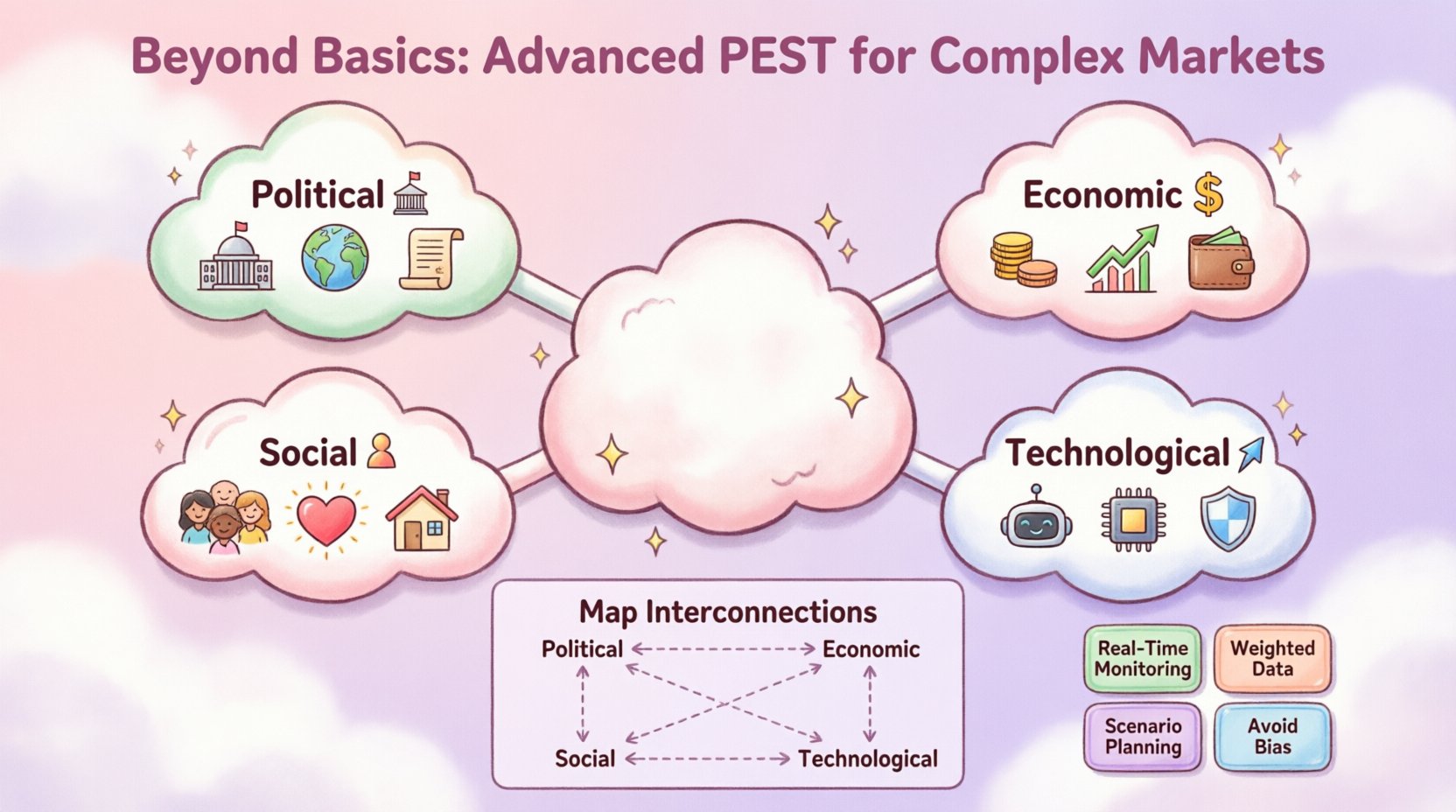
In complex market fractions, these four pillars do not operate in isolation. They interact, amplify, or dampen each other. A robust analysis requires mapping these interdependencies.
Comparison: Standard vs. Advanced PEST Application
| Aspect | Standard Application | Advanced Application for Complex Fractions |
|---|---|---|
| Scope | National or Broad Industry Level | Regional, Niche, and Cross-Border Specific |
| Data Frequency | Annual or Bi-Annual Review | Real-Time or Quarterly Monitoring |
| Factor Interaction | Treated as Independent Categories | Mapped as Interconnected Systems |
| Output | List of Risks and Opportunities | Scenario Planning and Stress Testing |
| Stakeholders | Executive Leadership | Operational Teams, Legal, and Strategy |
📊 Methodology: Gathering and Weighting Data
To execute an advanced PEST analysis, the data gathering process must be rigorous. Relying on headlines is insufficient for complex fractions.
1. Source Diversification
Do not rely on a single source of truth. Aggregate data from multiple channels to reduce bias.
- Government reports and census data.
- Industry association white papers.
- Academic research and case studies.
- News feeds and social listening tools.
- Internal sales and customer feedback data.
2. Weighting Mechanisms
Not all factors carry equal weight. A minor regulatory change might be critical for a highly regulated niche.
- Assign impact scores to each factor based on potential revenue effect.
- Assign probability scores based on historical trends and current signals.
- Calculate a risk exposure score by multiplying impact and probability.
- Prioritize factors with high scores for deeper investigation.
3. Frequency of Review
Static analysis is dangerous. The environment shifts continuously.
- Set up automated alerts for key regulatory or economic indicators.
- Schedule quarterly deep-dives into specific sectors.
- Conduct annual comprehensive reviews of the entire framework.
- Trigger ad-hoc reviews during major external shocks.
🛡️ Risk Mitigation and Strategic Action
The value of PEST analysis lies not in the identification of factors, but in the strategic action taken based on them. Once the analysis is complete, the focus shifts to risk mitigation.
1. Scenario Planning
Develop multiple future states based on different combinations of PEST factors.
- Create a “Best Case” scenario assuming favorable conditions.
- Create a “Worst Case” scenario assuming high volatility.
- Create a “Most Likely” scenario based on current trajectories.
- Prepare contingency plans for each scenario.
2. Diversification Strategies
Reduce exposure to specific risks by spreading operations.
- Diversify supply chains across different geopolitical regions.
- Expand product lines to hedge against economic downturns.
- Enter multiple market fractions to balance portfolio risk.
3. Agility and Flexibility
Organizational structure should allow for rapid response to changes identified in the analysis.
- Decentralize decision-making to allow faster local responses.
- Build modular processes that can be adjusted quickly.
- Maintain liquidity to seize opportunities or weather storms.
⚠️ Common Pitfalls to Avoid
Even with a robust framework, execution errors can undermine the analysis. Be vigilant against these common mistakes.
- Confirmation Bias: Seeking data that supports existing beliefs rather than challenging them.
- Recency Bias: Overemphasizing recent events while ignoring long-term trends.
- Groupthink: Allowing team consensus to override dissenting data points.
- Over-Simplification: Reducing complex socio-political issues to simple yes/no questions.
- Ignoring Black Swans: Failing to account for low-probability, high-impact events.
🔮 Future-Proofing the Analysis
As markets become increasingly interconnected, the PEST framework must adapt. Emerging trends like artificial intelligence, climate change, and digital currencies are reshaping the macro-environment.
To stay relevant:
- Integrate environmental factors (making it PESTEL).
- Include legal factors explicitly if regulatory complexity is high.
- Focus on predictive analytics rather than descriptive history.
- Engage external experts for niche sector insights.
The goal is not to predict the future with certainty, but to reduce uncertainty enough to make confident strategic decisions. By applying a deep, nuanced version of PEST analysis to complex market fractions, organizations can navigate volatility with precision.
📝 Summary of Key Takeaways
- Standard PEST models are often too broad for niche or volatile sectors.
- Political factors include regulatory fragmentation and geopolitical stability.
- Economic factors require deep dives into purchasing power and capital availability.
- Social factors hinge on values, demographics, and lifestyle shifts.
- Technological factors involve disruption velocity and infrastructure readiness.
- Interdependencies between factors must be mapped, not just listed.
- Data gathering must be diversified, weighted, and frequent.
- Strategic action involves scenario planning and diversification.
- Avoid biases and over-simplification during the process.
Implementing this advanced approach requires discipline and continuous effort. However, the insight gained provides a competitive advantage in environments where others rely on outdated models.